
I am collecting data about the #TrumpTrain hashtag to explore reasons and trends regarding support of Donald Trump in the upcoming 2016 presidential election. I expect to see either dramatic increase in usage as campaign success occurs or, simply the opposite.
When deciding on a hashtag I knew I wanted to focus my attention towards the 2016 presidential election. There has been a vast amount of media coverage, especially towards one individual: Donald Trump. Personally, I find myself with a lack of understanding regarding the presidential race as well as the candidates’ beliefs and views toward current important issues. Further, I have never found a passion for politics; however, the media coverage and public debate has caught my attention. It is my hope that an investigation of #TrumpTrain will open my eyes to this important event and allow me to understand it on a greater level. The presidential election is an important event to take a closer look at because it will affect the United States and the world as a whole in the years to come. This information will not only be beneficial to me, but anyone interested in finding more about the upcoming race and its confusing nature. After watching the recent Iowa Caucus, it became apparent to me that the race seems to be extremely close. Hopefully this examination of Twitter data will allow a greater understanding of the trends America is feeling. I chose a hashtag surrounding Donald Trump because of his unorthodox campaign techniques and his extreme media presence. Although he may not be conventional, he is extremely popular. I want to find out why.
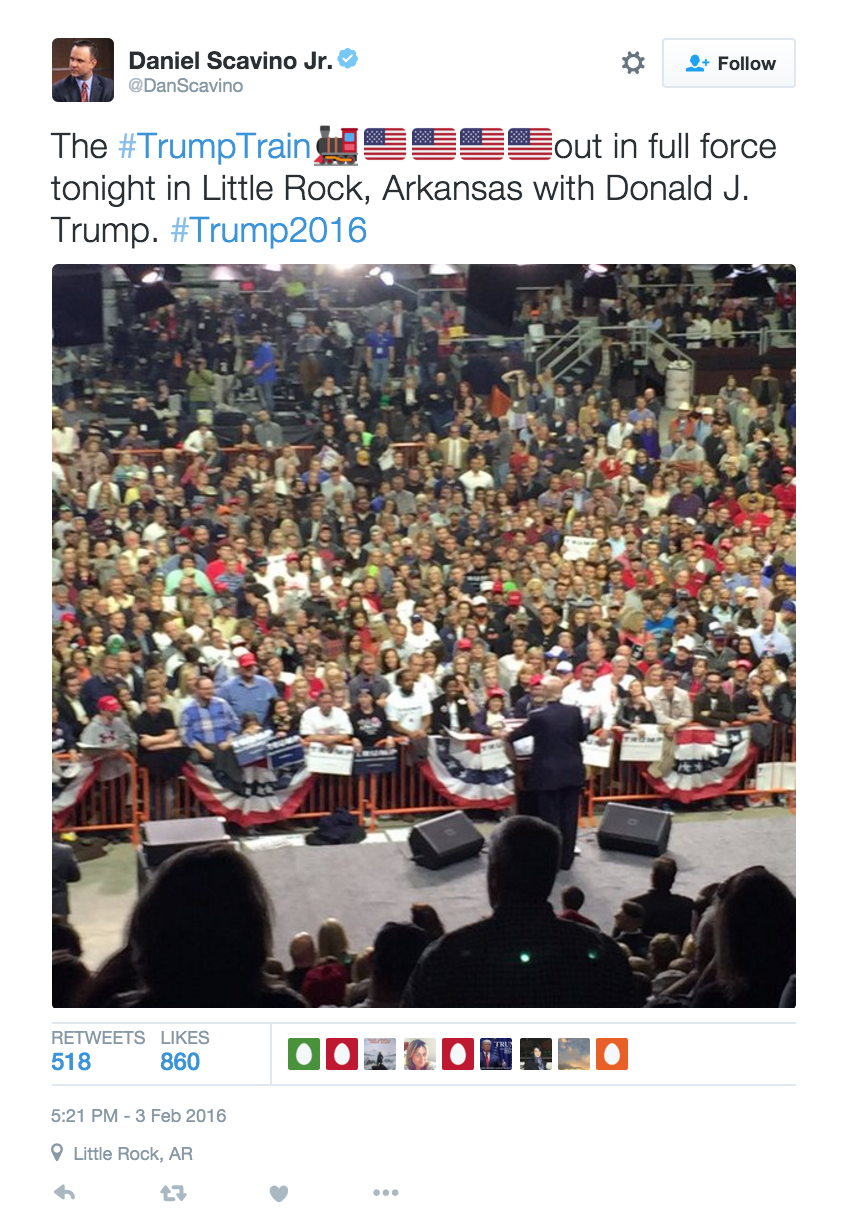
To begin, #TrumpTrain is used in support of Donald Trump and his presidential bid. It is a symbol of his “unstoppability” regarding momentum, polls, and popularity. On the evening of February 3rd, many of the tweets using this tag revolved around Donald Trump’s rally in Little Rock, Arkansas. The most common tweet was retweeted several hundred times. Daniel Scavino Jr. (@DanScavino), who doubles as Donald Trump’s senior advisor and media platform head, released a tweet seen in Figure 1. At the screenshot time (11:41 02.03.16) the tweet had 505 retweets and 836 favorites. The tweet and its current standing can be found here. It was obvious that this tweet was being used the most by a large amount of people. I was fortunate in that this tweet was both easy to spot due to its emojis (?????????) and that it was in fact the most popular tweet in recent hours. I personally wanted my first data retrieval to be during and/or after a big event because I knew that there would be many tweets as well as one that was most popular, sent out by Donald Trump or a staffer to be retweeted many times. Clearly this was the case. Another realization I arrived at while looking at this data is that this hashtag is made popular by a very small amount of important and well-known individuals. I find this to be a fascinating phenomenon that holds true in our everyday lives. We attempt to imitate famous people, and thus, in this specific case, #TrumpTrain becomes a globally trending tag.
Unfortunately, when googling “#TrumpTrain” there was little news coverage. However, the same search with the hashtag symbol stripped, yielded a vast amount of information. I found interest in picking one article from before the Iowa Caucuses and one from after. What I found was very interesting. The discussion of the “Trump Train” was extremely contextualized. In Politico, I found an article titled, “An Iowa win might make the Trump train unstoppable.” Due to the fact that the the term”Trump Train” was used in the title, the article revolves around the momentum of his campaign and the various ways in which it could be affected by the Iowa Caucus. As the authors state, “A win in Iowa . . . would send Trump into New Hampshire, where he’s held a large lead for months, with unmistakable momentum” (Politico). Following this statement, authors Eli Stokols and Mike Allen quoted candidate Ted Cruz and several GOP lobbyists as to their opinions on Iowa and its importance. Of course, all opinion was eventually related back to how Donald Trump and his campaign would be affected. In continuing this thought, I found the most interesting point surrounding one of Trump’s ideas, “[He] has been telling his crowds here that he thinks a win in the Feb. 1 caucuses would enable him to ‘run the table'” (Politico). I find this fascinating and am looking forward to follow #TrumpTrain to understand on a greater level how he will change his candidacy tactics. Of course, since this first article came out, Donald Trump did not win the Iowa Caucus, which leads us to the second aspect of this discussion. After the Caucus, the news sources quickly shifted their headings. Trump lost. One example of this can be taken from USA Today: “Iowa puts the brake on the Trump train.” As momentum is seemingly shifted away from the Trump campaign, news sources are clearly having fun with the term Trump Train and using it to their advantage. Author, David Redlawsk states, “A lot depends on whether the victory by Cruz changes the media focus, as we would expect historically” (USA Today). I find this fascinating in that this is most likely one of the first elections where there are so many different types of medias sources which impact such an election. Specifically for the data I am collecting, I am curious as to how in the next few weeks this will shift. Will the number of tweets diminish, or will Trump find away to flip the script and keep the #TrumpTrain moving full steam ahead? In looking at my hashtag topic I simply decided to search on Google News, “Donald Trump.” Nearly all of the information was the exact same as it was when searching “Trump Train.” The two articles I selected are titled, “Donald Trump Losing Steam After Iowa Loss” and “Polls Were Way Off on Donald Trump. Here’s What It Means.” Both of these clearly imply that following the Iowa Caucus Donald Trump’s supposed backing may have not actually existed, or now he is currently losing support. I really was not surprised at all at this connection due to the fact that nearly all of the media coverage in the last few months have been centered around not only the 2016 Presidential Election, but specifically the campaign Donald Trump has been running.
In the next part of this lab I went back to the first four months of the year 2006 to find out information on the topic of my hashtag: Donald Trump. I was amazed as I pressed enter to see the first fetched website. Seen in Figure 2.
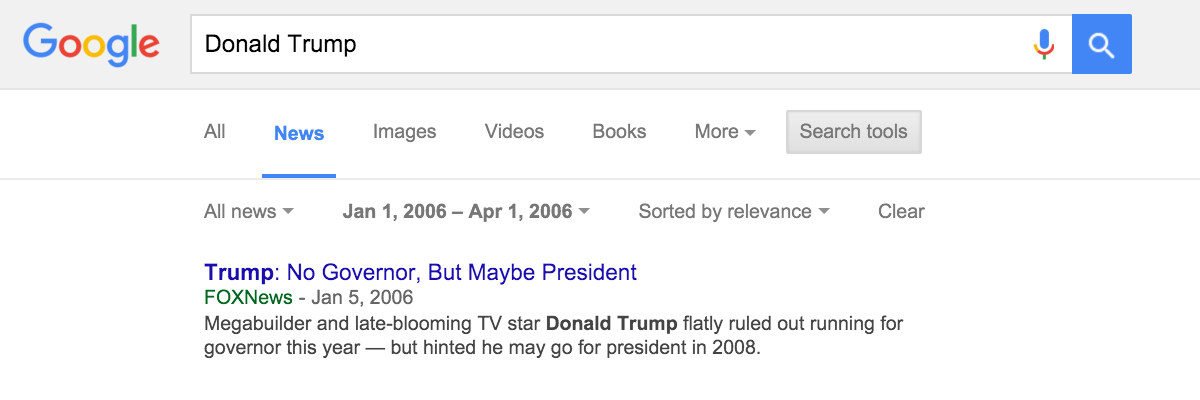
This FOXNews article is titled, “Trump: No Governor, But Maybe President” surprised be greatly. I had no idea that Trump had a political interest before this election. I simply though he was a savvy businessman. It makes me wonder if there is a population of current supporters who have been with his since this previous interest, or if it is mainly due to his recent campaign. Another aspect to this article was stated by a political figure who was close to Trump at the time: “‘Donald is definitely interested in running for president in 2008, possibly as an independent candidate'” (FOXNews). I find this fascinating because he is currently running such an extreme republican campaign. What has occurred in these few years which has changed his political stance? The rest of the articles were simply pertaining to Donald Trump and his news on business. The second article I chose to examine was titled, “Donald Trump Sues for Defamation: Is His Net Worth a Fact, or a Matter of Opinion?” It is a common understanding that Donald Trump is wealthy. I would argue that he is perhaps the most famous wealthy person is America and he is only famous for that fact. This article is written to discuss both this legal case as well as his wealth as a whole. I chose this article to bring forward one important question: is Donald Trump’s current political popularity mainly due to his money or is he actually a candidate of merit? I think that when examining #TrumpTrain, this is an important question to keep in an attempt to answer. It may help make sense of the data and in a larger realm, his campaign.
On page 315 of “Scraping the Social” Noortje Marres and Esther Weltevrede state, “Scraping is arguably enabling a distinctive approach to knowledge-making across social life, one that is pre-occupied with monitoring ‘what is happening, right now.'” By capturing this fresh online data we are most certainly given the ability to connect to the actual liveliness of an issue. With that being said, I think that there are many limitations to this practice. I find the most obvious to be that I am only focusing on one specific hashtag. Yes, I am able to examine an extreme amount of information regarding this aspect, but, it is just that: an aspect. I will have the ability to find out an abundance of information about this small area of a larger issue. It may guide us in the right direction; however, in the grand scheme of things we are only scratching the surface. The authors write, “the crucial question . . . is which entities are the most happening: which terms, sources, actors are the most active, which fluctuate most interestingly over a certain period” (Marres, et al. 2012). With that being said, gaining this information is undeniably important and useful and give us the tools needed to understand an issue. All in all, I currently feel as though we are simply capturing live data; however, in time I’m sure we will learn how to use and exploit this data in a positive manner and thus, connect to the actual liveliness of an issue in a far greater capacity.
SOURCES
Stokols, Eli and Allen, Mike. 2016. “An Iowa win might make the Trump train unstoppable.” Politico, January 29, http://www.politico.com/story/2016/01/donald-trump-iowa-momentum-218394.
Redlawsk, David. 2016. “Iowa puts the brake on the Trump train.” USA Today, February 2. http://www.usatoday.com/story/opinion/2016/02/02/trump-loses-iowa-winner-column/79698948/.
Drum, Kevin. 2016. “Donald Trump Losing Steam After Iowa Loss.” Mother Jones, February 4. http://www.motherjones.com/kevin-drum/2016/02/donald-trump-losing-steam-after-iowa-loss.
Cohn, Nate. 2016. “Polls Were Way Off on Donald Trump. Here’s What It Means.” New York Times, February 2. http://www.nytimes.com/2016/02/03/upshot/polls-were-way-off-on-donald-trump-heres-what-it-means.html?_r=0.
2006. “Trump: No Governor, But Maybe President.” FOXNews, January 3. http://www.foxnews.com/story/2006/01/03/trump-no-governor-but-maybe-presiden-53392630.html.
Hilden, Julie. 2006. “Donald Trump Sues for Defamation: Is His Net Worth a Fact, or a Matter of Opinion?” FindLaw, January 31. http://writ.news.findlaw.com/hilden/20060131.html
Marres, Noortje, and Esther Weltevrede. 2013. “Scraping the Social?” Journal of Cultural Economy 6 (3): 313–35.
I had never heard of the “Trump Train” before this course, but it is not surprising that the term refers to the perceived unstoppable nature of the Donald Trump campaign. It was interesting that you took note of “important and well-known individuals” supporting #TrumpTrain. I am curious, just as you are, to find out what kind of followers/supporters utilize this hashtag, and how it relates to the campaign overall. It might also be interesting to look through accumulated Twitter data to discover if #TrumpTrain garners negative feedback or mention. While there are many supporters of Trump taking to Twitter, groups with an adverse sentiment surely exist. Do these Tweeters ever use #TrumpTrain in a harmful fashion? The most intriguing aspect of your post was the Google search from 2006. Not that the results were totally shocking or unexpected, but it is interesting to consider Donald Trump and his celebrity status in the United States before running for political office. How does this affect his Presidential Campaign? I did not previously reflect on Trump’s political endeavors prior to the current presidential race. I find myself comparing the subject of my own posts, Bernie Sanders and his political background, to that of Donald Trump. Sanders has held government positions for the majority of his adult life, while the political life of Trump appears relatively new.
I like how you highlight your lack of knowledge regarding the 2016 candidate race, and how this catalyzes your interest in the phenomena as a whole. I can surely connect to this as a driving focus of my research, as I too have been blatantly disconnected from the most recent news regarding debates and candidate’s intentions. My focal point of research has surrounded the #99percent hashtag, which also applies to a phenomenon that has become a huge aspect of Bernie Sander’s campaign agenda. Your research on Trump’s past is also key in your analysis, as you were able to discover that he had political interest many years ago. We have not truly seen, in my opinion, a huge icon that lacks political experience like Trump, since Ronald Reagan entered office so I will surely continue to follow your research and will hopefully use it to shape my understanding of Bernie Sander’s goals and intentions.
You discuss the Iowa Caucus thoroughly in your response, and I am curious to see what your thoughts are after Trump did not win the Iowa Caucus, even though he did win the pre-election voting in New Hampshire. I would like to ask you how you think this affects the #TrumpTrain hashtag and Donald Trump’s campaign in general?
Since we have very similar hashtags, mine being #makeamericagreatagain and yours #trumptrain, I was not surprised to see the tweets using the hashtag or the google search results. We had the same FOXNews article from the search in 2006 which I also found very interesting. It was news to me that Trump had previously expressed interest in running for president. I did not think the way you did on that article, and it is entirely possible that Trump has had people following him and supporting him as a politician for nearly a decade now. TrumpTrain is a great phrase and is a perfect fit for Trump as he seems to just keep moving in the direction he wants regardless of what is in his path. I think that we will both have similar results in tweets and google searches throughout this project.