
When it comes to my data set I would expect to see most tweets to be coming from about 50 N and 100 W. This is approximately the location of the United States. I believe that this is the case because the Muslim Ban is directly affecting people in the United States and many people have different opinions about it. I also think that Trump’s decision to enforce this ban has fueled the fire when it comes to how U.S. citizens view him as a President. In addition to tweets coming out of the U.S. I also think tweets will be coming out of the countries that have been banned such as Syria and Iran from entering the United States. Many muslims have dreams of coming to the United States and now have to face the fact that this might not come true. I think the latitude and longitude of my small town outside New York City is 60 N and 90 W. I think I will see people tweeting about this issue there as it consists of liberals and conservatives who definitely have an opinion when it comes to what should be done about the Muslim ban.
My total number of tweets is 84,361. My total number of tweets with geolocations is 18 which means that .0213% of my tweets are mappable. I think my data might underrepresent a handful of groups of people as there are are so many tweets using #muslimban but so little are actually mappable. As Yau says “the best work is always rooted in data. To visualize data, you must understand what it is, what it represents in the real world, and in what context you should interpret it in.” I think this is an important concept to note as there is a reason why only 18 of my tweets are mappable. I expect most of my tweets to be coming from North America. I think most of them will be located there because this is where the Muslim Ban is taking place, therefore I expect many people to have opinions about it. When looking at what language my tweets were tweeted in the majority was english. I expected some to be written in arabic coming from the countries that were banned. This makes me question why muslims aren’t tweeting as much as I thought they would.
When it comes to the idea of big data, which is the massive quantities of information produced by and about people, things, and their interactions I feel like I have a fair amount of data. In relation to my team and even the whole class I have the most tweets. Therefore in this setting I have big data. However as Boyd and Crawford wrote “bigger data are not always better data.” I believe that there is truth in this statement as I have to sift and look through more opinions that could not actually have weigh in on the matter. I was not that surprised that I had the biggest data because this issue is very recent and people are constantly following how the matter is unfolding. In relation to Jack’s hashtag ISIS and Ian’s hashtag Syria they have both been in the news for months therefore I wasn’t surprised that the number of tweets I had surpassed them due to the new relevance of my hashtag.
I don’t notice a specific pattern when looking at my map. I think is due to the number of tweets I had that were actually mappable. One thing I found interesting however is that several were tweeted from Scotland. This to me seems like a random place for there to be a significant amount of people tweeting about the #muslimban. Narrowing down on America I noticed that from the 18 mappable tweets I had that the majority were tweeted from the east or west coast. This did not surprise me as I feel like people coming from New York and California have strong opinions about this ban. In mapping my data I used a time lapse so that the viewer would be able to visualize when and where the data was coming from. When it comes to telling a story I wish I had more points as I believe this data is withholding important information. I feel that if I did have more data I would be able to pin point who is most upset by this ban.
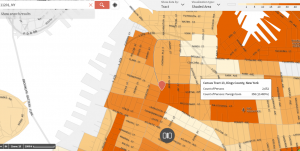
My first geolocation I chose was Brooklyn NY, 11201
Count of persons: Foreign Born Census 1970 track 13
13.499%
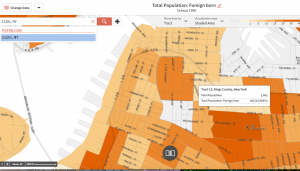
Count of persons: Foreign Born Census 1990 track 13
16.968%
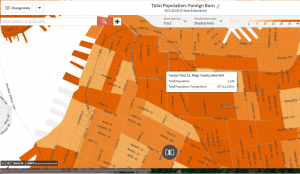
Count of persons: Foreign Born Census 2010 track 13
21.333%
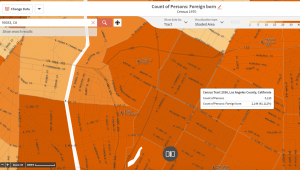
The second geolocation I chose was Los Angeles CA, 90033
Count of persons: Foreign born Census 1970 track 2036
41.112%
Count of persons: Foreign born Census 1990 track 2036
58.548%
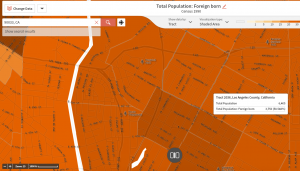
Count of persons: Foreign born Census 2010 track 2036
48.477%
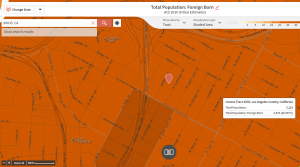
I found Social Explorer to be very interesting as there are so many demographics you can explore. When it came to choosing what topic I should center my map around I chose to look at the foreign born census taken from the years 1970, 1990 and 2010. I felt that this was an appropriate topic as my hashtag is centered around the idea of preventing foreigners from coming and living in the United States. In Brooklyn there has been an increase in the number of foreigners living there however, this number is not nearly as big as the number of foreigners living in Los Angeles. In 1990 more than half of the people living in L.A. were foreign born and unlike what I saw in Brooklyn this number decreased by 2010. I thought this was an interesting difference. One inference I have for this change is that these foreigners decided to move as the area changed or developed around them. I think these maps are important to show why there is controversy when it comes to the Muslim ban as it proves that not all people in the United States are native born. I think my twitter data when mapped was somewhat helpful as it supported ideas that I already had however, I wish I had more data to be mapped so that I could compare and get more insight to where and who cares about this ongoing issue.
When searching directly for Muslim Ban on JSTOR my results were slim. I wasn’t surprised by this as my topic has just became relevant. I then had to re adjust my search so that I could find articles relative to the Muslim Ban. I decided to look up Muslims in America. After searching this I was given a greater amount of results. The first article that caught my eye was called “Muslims in America” by Jessica Stern. An interesting point she made in her article which, I believe would be supported by people who are opposed to the ban is that the Muslim community has the most to lose from the spread of jihad among Muslim youth and the most to gain from helping law enforcement reduce it. Stern is pointing out that associating all Muslims with terrorists is not only wrong but dangerous to U.S. national security. I believe many people including Trump don’t feel this way and that is why our country has had such a divide in the past couple of weeks. Another article I found interesting is “Homeland insecurity: How Immigrant Muslims Naturalize America in Islam” by Mucahit Bilici. Bilici points out that many Muslims are very much aware of the state of conflict between Islam and the United States and because of this many have problems seeing themselves as American Muslims. This is a struggle as they want the prosperity and freedom that America is known for however, not its foreign policy or its liberal culture. This relates to the Muslim Ban implemented recently because although many feel this way the “American dream” in the end takes precedent and now it has been taken away from them. As defined by Graham “software-sorting actively shapes and structures social and geographical inequalities within and between places.” Graham suggests that way in which people use their devices and the network is reflecting the way in which society is developing and growing. This can be a negative in many ways as not everyone can be evenly represented. I believe this reflects my data as the areas where my tweets are located could suggest what type of ethnicity or political group live there. But as Graham points out these people are probably only receiving and being fed news that is relevant to their opinion and therefore they are not looking at the two sides of the argument.
Stern, Jessica. “Muslims in America.” The National Interest, no. 113 (2011): 38-46. http://www.jstor.org.ezproxy.trincoll.edu/stable/42896378.
BILICI, MUCAHIT. “Homeland Insecurity: How Immigrant Muslims Naturalize America in Islam.” Comparative Studies in Society and History 53, no. 3 (2011): 595-622. http://www.jstor.org.ezproxy.trincoll.edu/stable/41241826.
Boyd, Danah, and Kate Crawford. 2012. “Critical Questions for Big Data.” Information, Communication & Society 15 (2): 662–79.
Graham, Stephen D. N. 2005. “Software-Sorted Geographies.” In The People, Place and Space Reader, eds. Gieseking, Mangold, Katz, Low, Saegert, 133-138. New York: Routledge.
Nell,
Great work on this lab. You definitely were able to figure out some of the stuff with the mapping that I was not able to, so that alone makes your lab look very clean and well done. Beyond just that, I thought it was incredibly well written and informative. I found it interesting that similar to my lab, you did not have a ton of locations to work with relative to the sizable number of tweets you were able to collect. This definitely makes it difficult to draw any conclusions about how a subject is trending around the globe. I’m not entirely surprised to see that your JSTOR results were slim, as the subject of a Muslim ban in the specific context that you’re looking at it within is a new development. After looking at your Census maps, I believe that moving forward it would be useful if I were able to find statistics that better related to my hashtag. The “foreign born” census results you found were very pertinent, and I was unable to find something that could relate well to ISIS and terrorist attacks. Overall, I found you lab to be very impressive. Great work.