
I am hoping to see text analysis in support of Standing Rock, containing words like water, tribal, rights, life, and even action words like standing and solidarity. I imagine I will see a lot of these words as well as a lot of standingrock’s and valentines day references considering I am taking data from February 14th.
My corpus has 172,585 total words and 5,987 unique word forms. I was correct, vday was a hashtag that voylent noticed a lot!! There was also more jumbles of letters and numbers than I expected – particularly since they were identified the most out many other words. I spit my data into 12 hours periods i.e. 0-12 on February 14, 12-24 for February 14th and the same for February 15th. In my data set 12-24Feb15_standingrock, the most used distinctive words were “blockage” (139), “main” (138), “campus” (100), “ayvzwi” (99), “road” (138). “ayvzwi” is probably a user, but the other words paint a picture of what was transpiring on February 15th between noon and midnight – someone or something was blocking the main road. I will do some research to see if this was corroborated anywhere else on the web.
Stopwords are seeming to present a significant headache in my data. I am see amalgamations of û and letters with annoying accents that stopwords cannot seem to remove for me. Additionally, twitter handles like evan_greer. My seemingly most used word right now is “condensed,” and I am skeptical if this too is obscuring my data or revealing something I did not even remotely expect. I am going to work with it for now. Other big terms include history, nodapl, photo, access, and veterans. Oddly enough as I write this lab, I’m putting together why condensed and history were in my top words. The events occurring a half mile north of the Standing Rock’s reservation (a border outlined not by the Sioux, but by the United States government in the late 19th century), certainly present a photo of condensed history.
I am removing the stopwords:
standingrock
evan_greer
guh0xbjitx
û_
û
rt
ï_ù
t.co
https
amp
hif9yzwtff
_ùà
railchicken
mikehudema
_ùàū
vtbr5f2zb9
dsbwctcg
nokxl
ï__ù
ü
_ùàü
__ùà
b95o9jt
it’s
jordanchariton
ginggershankar
wat
amodernghost
I am exceedingly happy with the presentation of my data, and its prophetic overtones. Here is a screen shot and embed link of/to my data visualization:

Here is photo that was trending on Twitter on Valentines Day 2017
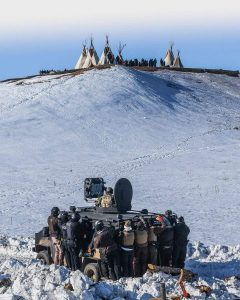
This photo was uploaded by @evan_greer (one of my stopwords); his caption: “US history condensed into a single photo from #Standingrock
I this my Cirrus and the photo above speak for themselves – I am very happy I picked valentines day’s data. I would absolutely agree with @evan_greer that this photo visualizes the history of American-Native relations. Another major word included was veterans, a clear nod to the large veteran support of the Standing Rock Sioux that began last November when hundreds of military veterans descended upon the camp to stand beside the water protectors.
I am picking history, nodapl, and veterans for my three words. While the power exhibited by the corelation between the trending photo and my cirrus is profound, it really makes nothing more than a nice soundbite in examining my data. For this reason, I am using nodapl – a universal opposition hashtag to the DAPL, and veterans for the reason outlined in the above paragraph. I also decided to use a fourth hashtag – cold – as it appeared a considerable amount, and it points to more real time updates from standing rock.
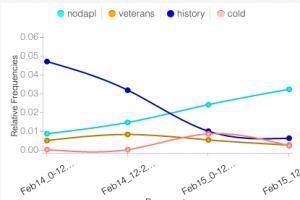
I am not surprised that history’s recurrence went down throughout the period of time I mapped as it referred to the trending picture, which by the nature of Twitter, would stop trending at some point relatively quickly. It is interesting to note, however, that history did not die off entirely, it returned to a rate of recurrence similar to veterans and cold. I think if I could map my data over several months, these terms would preserve the same relative recurrence. It is interesting as well to see that nodapl began trending during this period of time, although I am unsure why. Cold also spiked somewhat on February 15th, which makes sense as according to accuweather.com the lows in Cannonball, North Dakota, not far from the Sioux camp, were 16 and 14 degrees for 2/14 and 2/15. I can’t even imagine what it was with windchill. The link below is where I got the weather data.
http://www.accuweather.com/en/us/cannon-ball-nd/58528/february-weather/2134624
http://voyant-tools.org/?corpus=ce46945eff3e91f7a9a1b465669cdec8&stopList=keywords-c2b31b0c56d1a76f3f6594cd2273e118&panels=corpusterms,reader,trends,summary,contexts
I chose an article entitled “Standing Rock: A Change of Heart,” which I found in a google search of standing rock essays. I had to copy and paste the article into a word document to upload it, but it uploaded well. I liked the commentary in the article about how of native tribes have responded to disenfranchisement with violence, but during the Standing Rock movement, tribal leaders have been explicit in denouncing violence. Their decision to not condone violence brings my thoughts to the 1973 Wounded knee hostage crisis where Native’s took the site of the famous massacre and held it and several people hostage in defiance of the United State’s lack of recognition of the massacre and tribal rights. I think this non-violent approach to social justice is certainly a step in the right direction for tribal rights activists as the juxtaposition between them and the battle ready, fire hose, tear gas, and pepper spray wielding police evokes images of civil rights activists being beaten and brutalized by police.

The stopwords I used included:
standing
rock
it’s
like
I chose standing rock as words so I might see other more telling words from the article. Words like it’s and rock also appeared a lot but are not useful for data analysis. In the context of how this data might be decidedly American, I would point to the words water, warpath, and police. Water was a word seen a considerable amount of times in my first Cirrus with my #standingrock data. In the context of the Flint, MI water crisis, the Standing Rock movement, massive forest fires in the Great Smoky Mountains and elsewhere, and historic droughts in the last five years, I think the subject of water is one we as Americans have always taken for granted, but are now being confronted with in a way we did not expect. Warpath is an interesting word to me as it has largely fallen by the wayside in the wake of growing political correctness. My girlfriend goes to Florida State University – who’s mascot is the Seminoles (who ironically were driven from north Florida by Andrew Jackson and co.) – and has told me before that their student procession for football games used to be referred to as the warpath, but the term was banned by the school. Whether you agree with this or not, this is an American issue. Finally, the term of greatest recurrence was police. I don’t think I need to discuss why “police” and all that the po-po brings to mind is an American issue. In my dataset, I say terms like history, veterans, protectors, waterislife, police, and others. I think my data definitely represents distinctly American aspects in its discussion of law enforcement, water, and history. So much of our news revolves around paralleling the past with the present. Terms like “the changing same” have even become entire centers of study in academia and elsewhere. This is not the say that learning from the past is a decidedly American trait, but perhaps not learning from the past would be something Americans have fallen privy to.
Tufte theorizes that data is best collected from higher (perhaps academic) sources, using superior methods of collecting data. Yau, oppositely, discusses the need to collect data that is as complex as whatever the data seeks to map, and use it as an estimation of overall trends. I think there is merit to both claims, however for our purposes, I believe Yau’s approach to be more revealing. By mapping and analyzing #standingrock, I am looking American zeitgeist (mood of the people) regarding Standing Rock. This cannot be accomplished by selectively collecting data – particularly when events like Standing Rock will be analyzed for years after they transpire, but most likely not as in depth while they are transpiring. Yau’s approach would be able to capture both overall mood and more in depth commentary as can be seen examining massive amount of my tweets as well as individual ones like @evan_greer’s.
Works Cited:
“Standing Rock: A Change of Heart.” Charles Eisenstein. December 21, 2016. Accessed March 03, 2017. http://charleseisenstein.net/standing-rock-a-change-of-heart/.
Yau, Nathan. 2013 “Representing Data.” In Data Points, 91-134. Hoboken: Wiley.
Tufte, Edward R. 2011. “Visual &Statistical Thinking: Displays of Evidence for Making Decisions.” In Envisioning Information, 27-54. Cheshire, CT.: Graphics Press.
Sorry to hear it was so difficult to clean your data! Really weird that “condensed” was the most common word associated with #standingrock and I am curious as to why that is the case. Regarding the trend of the four words you chose, I also find it interesting why nodapl started trending throughout the week. I think it is really crucial for your data and its interpretation on how “cold” started becoming more used when it got cold in the area of North Dakota. What this suggests to me is that people must be talking about #standingrock in the area affected.
I think it is really cool that you focused on text analysis of your data solely collected on valentines day in order to examine what events throughout the day contributed to the commonality of certain words in your cirrus image and the frequency trends of those specific words over time. I think it would be interesting to see the context and relationship of the word “nodapl” to your hashtag throughout the day to help understand why it showed an increase in trending among twitter news. I do think it is interesting to see week from week how #keystoneXL correlates to the data you collect for #standingrock as it unveils a different perspective about the pipeline extension project that isn’t always frequent in my data.