
The Dakota Access Pipeline and the protests at Standing Rock have generated a great deal of conversation through the month of February. Early on, the Seattle City Council’s potential divestment from a bank funding the Dakota Access Pipeline had Twitter users tweeting a message to representatives; several weeks later, protesters made themselves heard when faced with a deadline to evacuate the camps. In addition to the commonly used words and phrases associated with #NoDAPL, I expect to find words relating to the themes of divestiture and resistance or civil disobedience.
For the text analysis, I chose the week leading up to the evacuation deadline: February 15th through 21st. In the tweets collected over this period, there were 893,723 total words, and 27,949 unique words used. Apart from the hashtag itself, the most popular words were, in order: “pipeline,” “standing,” “dakota,” and “rock.” All were used over 5000 times. Below that were “camp,” “water,” and “indigenous,” all with between roughly 3500 and 4500 uses. It’s interesting to note that the actual issues—environmental protection, indigenous rights, and the rights of the protestors—were hidden beneath a layer of identifiers. Several phrases were repeated, either tweeted by the same user or retweeted from another user; the most commonly used phrase, “resist ду,” was found 17 times in the dataset. “ду” translates as “control” in Russian, but combining the word with my hashtag yielded no results. (Perhaps #nodapl in this context is a misspelling of #novaplus, a Russian smartphone; the result “ду nodaplus” was suggested when googling the phrase.)
The following words or phrases were filtered from the word cloud, in addition to the standard exclusions. Most were Twitter handles whose posts were frequently retweeted.
- delo_taylor
- mikehudema
- joshfoxfilm
- ur_ninja
- ruthhhodkins
- americanindian8
- jordanchariton
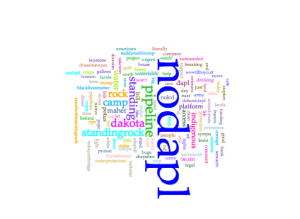
The results of my word cloud are not surprising. The most popular words refer to the movement itself; “pipeline,” “standingrock,” and “dakota” are all other identifiers, but don’t lend much insight as to the ideas of the users or the message they present.

Removing some of the identifiers paints a much different picture of the movement. In this version, the words “camp,” “water,” “indigenous,” “bill,” and “platform” rise to the top. Additionally, some other related hashtags, including “waterislife” and “nokxl” are also noticeable. It appears that the conversation about #NoDAPL encompasses multiple interests. The words used refer to politics, the environment, and social justice: “potus,” “blacklivesmatter,” “veterans,” “leaks,” and “police” are all used frequently. I am not particularly suprised by any of the terms I found, but it served as a reminder how diverse the discussion of #NoDAPL is.
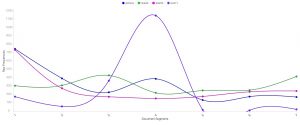
For the trend analysis, I chose four words that corresponded to the impending evacuation: “police,” “resist,” “stand,” and “won’t.” Use of the words “stand” and “police” both peaked on the 15th, the first day in my dataset, and subsequently tapered off. “Resist,” a more general term, saw relatively stable use through the same period. “Won’t” experienced the greatest fluctuations through week, peaking on the 18th, then dipping below the other words in the following days. On that day, the North Dakota House passed several bills increasing the severity of punishments for rioting and trespassing, which many believed to be directed at the protesters at Standing Rock. This would explain the sudden spike in usage of “won’t,” but does not shed any light on its subsequent drop.
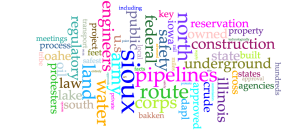
For comparison, I analyzed a composition of pages from daplpipelinefacts.com, a pro-pipeline website and the first Google search result for the terms “dakota access pipeline.” I filtered the words similarly, removing the words “dakota,” “access,” and “pipeline” to highlight unique words and phrases. I chose this as a counterpoint to #NoDAPL, which represents and is used by those opposing the construction of the pipeline. I wanted to explore both sides of the issue, and examine the similarities and differences in the rhetoric used.
In the Twitter word cloud, the American character of #NoDAPL is subtle: “potus” and “blacklivesmatter” are primarily American, but most of the other terms could apply in a global context as well. The DAPL Pipeline Facts word cloud is more clearly American. Place names—”iowa,” “illinois,” “bakken”—point to the United States, and words such as “army,” “regulatory,” “reservation,” and “protesters” often come up in other conversations about the United States. This dataset highlights issues that are not discussed on Twitter, mentioning the safety, legality, and feasibility of the project. While the conversation on Twitter focuses on rights and resistance, the “Pipeline Facts” website offers justifications.
In Yau’s and Wiley’s discussions of visualizing data, they seem to be arguing two sides of the same coin. Tufte writes about “superior methods,” referring to both the practices of data collection and visualization. Yau also details the importance of understanding and proper application of graphics, but handles the collection and analysis of data elsewhere. In creating my own visualizations, I found myself gravitating towards Tufte’s methods. Using the word cloud helped to see the Twitter data and better understand the conversations going on. Having some context from the other labs, I was able to improve my visualization using stopwords and adjusting the total size to reveal important topics that were not immediately obvious.
Works Cited
Tufte, Edward R. 2011. “Visual &Statistical Thinking: Displays of Evidence for Making Decisions.” In Envisioning Information, 27-54. Cheshire, CT.: Graphics Press.
Yau, Nathan. 2013 “Representing Data.” In Data Points, 91-134. Hoboken: Wiley.
You mentioned that you were not surprised by the common use of the following: “potus,” “blacklivesmatter,” “veterans,” “leaks,” and “police”. I am surprised to see that “veterans” and “blacklivesmatter” are commonly used with #NoDAPL. If #NoDAPL was used at all with #BlackLivesMatter (the Twitter hashtag that I am studying) it was not noticeable. Later in your post you also write, “On that day, the North Dakota House passed several bills increasing the severity of punishments for rioting and trespassing, which many believed to be directed at the protesters at Standing Rock.” I wonder why the other terms did not peak on Feb. 18. Perhaps users were re-tweeting the same tweet with “won’t” and not “stand”, “police”, or “resist”. This could account for why only “won’t” peaked on that single day.
I wonder if your world clouds would be more informative if either they images were larger or you had chosen to display fewer words.
The following suggestion is helpful in understanding why many of my STOP words had english-spanish hybrid spellings: “Perhaps #nodapl in this context is a misspelling of #novaplus, a Russian smartphone; the result “ду nodaplus” was suggested when googling the phrase.” I did not think to try and translate stop words that I had dismissed as random combinations of letters.
I first found insightful the fact that the “actual issues” were hidden beneath these general terms like “rock” and “standing”. I like how you identify which terms may be more important, but are hidden by other identifiers. I also found it interesting that you chose to present a lot more words than I did, for example, in your word clouds. It speaks to the vastness of your hashtag and the #nodapl discussion. I also thought it was interesting how you connected events during the week to spikes in term frequencies. Along with all of this, I think it would be interesting to consider the other side of the conversation, considering tweets with #nodapl seem to only be about one side of the issue. I think it would create a very interesting, diverse word cloud. From this analysis, I find a similarity with my research. Some identifying words you found that aren’t specifically related to the hashtag or issue, like “won’t”, were in my text analysis as well, and it is evident that these words can tell a story.