
https://musicislife61.carto.com/builder/7a2cf7f0-fe93-11e6-a807-0e233c30368f/embed
Since there was recently a court case in Pittsburgh that ruled in favor of allowing transgender individuals to use the bathroom of their choice, I hope to see a majority of the tweets I have collected to celebrate (or criticize) this approval. I also expect to see a lot of Trump and DeVos tweets as they are pressing to remove LGBT rights.
The results of the Voyant scan found 753,728 total words and 30,896 unique word forms. Among the most commonly used words are, of course, transgender, but also Trump, tranny, shemale, sissy, tgirl, but there is also support and protecttranskids. February 22 and 23 found one of the most distinct words, in comparison to the rest of the days, is the hashtag #protecttranskids.
With all of the stop words removed from my wordcloud, I am finding some significant results. The words included are either derogatory and critical of transgender individuals or they are broad, general terms that request support for transgender individuals. These words include shemale, tgirl, and ladyboy for the derogatory terms, and support, protecttranskids, and protections for support.
The stop words I removed included â, https, and https:â, among a few other words including â. I set the word count to 25 to show the best story for my hashtag, as it includes the primary terms associated with transgender rights.
Looking at my data, I was shocked to see how many derogatory terms for transgender individuals were included. Thinking about the recent court case in Pittsburgh, however, it can make sense that a lot of people are disgusted and angry about the decision made. A large amount of people still believe that everyone is born in the right body and that only two genders exist, and some of those individuals truly are revolted by the idea of transgender individuals having a right to use the bathroom of their choice. Words like tranny, shemale, and even #hotshemalesonly really shows how backwards some of the people in our society are. Since these words make up the majority of the cloud, I can now say that most of the #transgender tweets are more against transgender rights than supportive of them. I hoped to see more words supporting them, especially to see these words in larger size. But, as expected, one of the largest words is Trump.
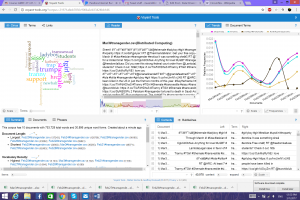
The image above includes both the wordcloud and the timeline of the four words I selected to focus on. I was unable to crop and zoom in on the individual parts. I was also unable to turn the timeline into the right chronological order, so the tenth day appears first.
The three terms I decided to focus on are protecttranskids, hotshemalesonly, shemale, and tranny. I am curious why there was a peak in the protecttranskids hashtag on February 22, as the rest of the days displayed a relatively low amount of these tweets. March 1 showed a significant peak in the shemale and tranny keywords, probably due to the court case being decided on just a couple days beforehand. The link to the Voyant wordcloud is here: http://voyant-tools.org/?corpus=21971a8eb7850c90fda2eb33424bb1d6&stopList=keywords-c4504c7bb1868ea3acbeff437139e3d3&panels=cirrus,reader,trends,summary,contexts
I decided to compare this data to the article in National Geographic about the transgender girl that was issued this past January. This was a revolutionary article that spurred a lot of both outrage and excitement, and was written in a way that explained the gender revolution very well. It is both a timely article and credible, as compared to articles from Huffington Post or The Odyssey. When in Voyant, I had to remove the words fa’afafine, like, make, just, said, don’t, among other regularly used words. Below is the wordcloud produced from this article:
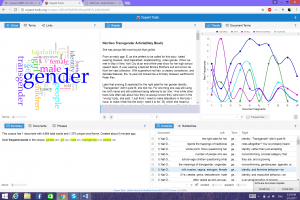
In comparison to the tweets, this wordcloud is much more decent and unbiased. The main words have to do with legitimate terms such as gender, transgender, nonbinary, and identity, whereas the majority of the twitter terms are very much against or supportive of transgender individuals. I am not sure whether I would say that this wordcloud helps me better understand my Twitter data, as I am already aware of all of these terms and how they are involved in the transgender rights movement. It does, however, show me just how critical Twitter users are of civil rights movements. Tweets are generally used to express opinion, as it seems, whereas articles in newspapers and magazines are used to state the facts and help explain situations in an unbiased manner.
From the readings for today’s class, I can say that Yau’s approach is more relevant for Twitter data. Tufte’s theory on visualization attempts to find the charts that best display the data without incorporating visual noise or putting the data in the wrong context – for example, displaying the data on a weekly rather than daily basis to show the overall fluctuation in illnesses in a particular area. Yau’s theory, however, explains that real life is complicated and gets influenced by much more than we can ever be aware of, so the method in which we display data can only be done to the best of our abilities to tell our story in the best way we can. When it comes to the data I found on #transgender, it is hard to say what the majority of the country thinks with regards to the transgender rights movement. Twitter users form a fraction of the American population, and the users that use the #transgender hashtag is an even smaller fraction of that population. Therefore, it is hard to find one ideal method to display this data. Instead, one should find a way to show the data and tell a story with it, to provide a new perspective on the situation. I agree with Tufte that researchers can easily skew the interpretation of the results based on how they decide to display the results, but with Twitter data, really any method of display will show skewed results of how the American population in general views the transgender rights movement.
Might be a backwards thing to say, but what a great time to be looking at this hashtag! So much news and talk has been around transgender(although not all good) and I found it perfect that you chose the dates during the Pittsburg court case. Although the setback in the transgender community sparked outrage, it still shows growth within the LGBT community. I think that it would be awesome if you could further your analysis by looking into geo locations in Pittsburg to see what the area is primarily tweeting about when it comes to #transgender. This would totally add to your conversation.
Looking at your word cloud in comparison to mine was very eye opening. By hashtagging the word transgender, it just means that it is a topic of conversation, it does not mean that you have to support it. I found it interesting that your word cloud was negative and mine was positive. This is probably because people who decide to add the additional hashtag of LGBT are most likely involved in the community and very supportive. I think that looking at your data set made me more curious about the opinions of people outside of the LGBT community, because for the most part, all of my data has been supportive of LGBT progressions, and critical of Trump.
I found it extremely interesting that most of the terms you found were derogatory. I was really shocked that the tweets that were being generated would be ones that would display hate towards the transgender community. I found it very insightful that you pointed to the Pittsburgh case and were able to draw from current events that would give explanation to these spiteful terms, as these are not ones that have been really prevalent in your other findings. Regardless of the Pittsburgh case I was still very surprised to see that these words were not just being tweeted but were dominating the discussion regarding the transgender community. While I would expect there to be some tweets of hate, I really did not expect this to be what is dominating the general discussion. Something that would be interesting to look into would be to see what the people living in Pittsburgh were tweeting in comparison to other areas. I wonder if it is those who are located in or around the area that are dominating these discriminatory tweets. I also would be interested in seeing the tweets generated before the case and looking into how the discussion was similar or different.
After reading your article and the amount of terms discriminating against the transgender population made me really want to look back into mine and see if I had any that directly attacked planned parenthood. Overall I found that everyone was standing for planned parenthood and against the attacks on it. While I know these are two completely different topics I still wonder why the twitter community seems more spiteful when discussing your hashtag.