
Today we are looking at #BlackLivesMatter tweets posted on February 22, 2017 to February 28, 2017. On February 26, 2012 17-year-old Trayvon Martin was shot. Many consider Trayvon Martin’s death to be the spark that ignited the Black Lives Matter movement. Therefore, I expect “trayvon”, “trayvonmartin”, or “remember” to be some of the most commonly used words on February 26, 2017. I am interested to see if the 89th Oscars Academy Awards, which was held on Sunday, February 26, 2017, affected the attention given on Twitter to the memory of Trayvon Martin. I expect that many tweets were posted on Sunday, February 26 and Monday, February 27 regarding the best picture award mess up. Originally during the award ceremony, it was announced that La La Land, a predominantly ‘white’ film, had won the Oscars award for best picture. It was soon discovered that the film Moonlight, a predominately ‘black’ movie, had actually won the Oscars award for best picture. So, perhaps “moonlight” will appear in the Twitter text study. Also, on February 28, 2017 President Trump addressed Congress. Since many #BlackLivesMatter tweets have addressed anger towards President Trump before, I also expect that tweets regarding President Trump will be prominent in the text analysis. I also expect there to be tweets about black history month, since February is black history month in the U.S.
Tweets posted on February 22 through February 28 were uploaded to voyant to be analyzed. The analyzed tweets contain 566,806 total words and 31,047 unique word forms. I was surprised to find that “protecttranskids” was found in 1,119 tweets on February, 23. On Wednesday, February 22, 2017 President Trump “rescinded protections for transgender students that had allowed them to use bathrooms corresponding with their gender identity.” (Jeremy) It seems that people who tweet using #BlackLivesMatter or about Black Lives Matter movements topics my also support and tweet about transgender and other gender and sexuality related issues.
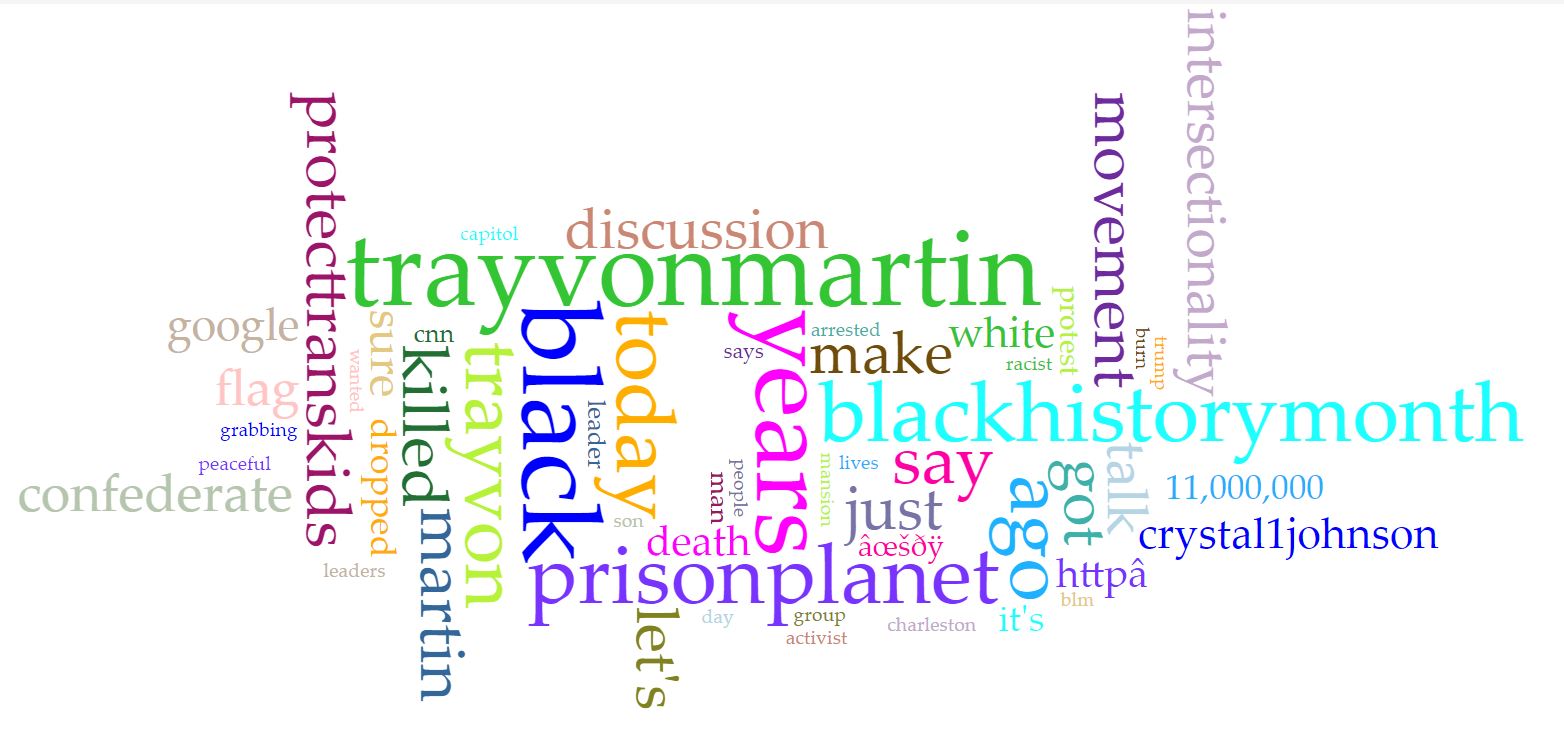
After blocking “RT”, “https”, “co”, “amp”, and “#BlackLivesMatter” from the text analysis I found that “blacklivesmatter” appears to large in the word map to see any of the other most commonly used words. So, “blacklivesmatter” was blocked from the text analysis as well. The words that stood out most, because they were largest in size, included: trayvonmartin, black, blackhistorymonth, years, today, and protecttranskids. I was not surprised to see that trayvonmartin, black, and blackhistorymonth were some of the most commonly used words. These words either include the same or similar words as #BlackLivesMatter, or are viewed as critical to the ignition of the Black Lives Matter movement. As I already mentioned, I did not expect for “protecttranskids” to be one of the most commonly used words. Additionally, I expect “today” or “years” to appear so frequently in #BlackLivesMatter tweets. Some of the more unhelpful, yet most commonly used, words include “á” and “â”. These variations of “a” appear in tweets that state, “HOW WHITES CAN SUPPORT #BlackLivesMatter:” and are then followed by a string of unrecognizable characters. The character “â” also appears randomly next to “€” in urls and Twitter handles.
I removed the following 23 unhelful words: á, â, ẚ, adamantxyves, ðÿ, é, ê, ȇ, é̩, éªá, éªé, êœ, êœá, êÿ, fw34ecâ , httpá, krzviw , ò, œá, q9xkcx34â, sá, tc.o, xvezznmefi, and prisonplanet. Voyant gives the option of including 25, 45, 75… words in the word cloud. I chose to include the 45 most frequently used words, because it includes “11,000,000”, the 31st most commonly used word. From reading the tweets that include “11,000,000” I was able to determine that these tweets reference the $11.5M that Google pledged to fight racial bias in policing and sentencing. (Guynn) I choose the 45 word count which revealed the prevalence of this recent event, over the 25 word cont which may have appeared easier to read. The five most commonly used words are: black, trayvonmartin, years, blackhistorymonth, and today. I predicted that “blackhistorymonth” would appear as one of the top five words, because February is Black History Month in the U.S. Moreover, as mentioned before, “black” and “travonmartin” are intuitively common. From scrolling through the collected tweets, it appears that “years” is used to describe the age of people, duration of an event, and number of years ago that an event occurred. I was unable to identify a pattern in the way that tweets use the word “today”.
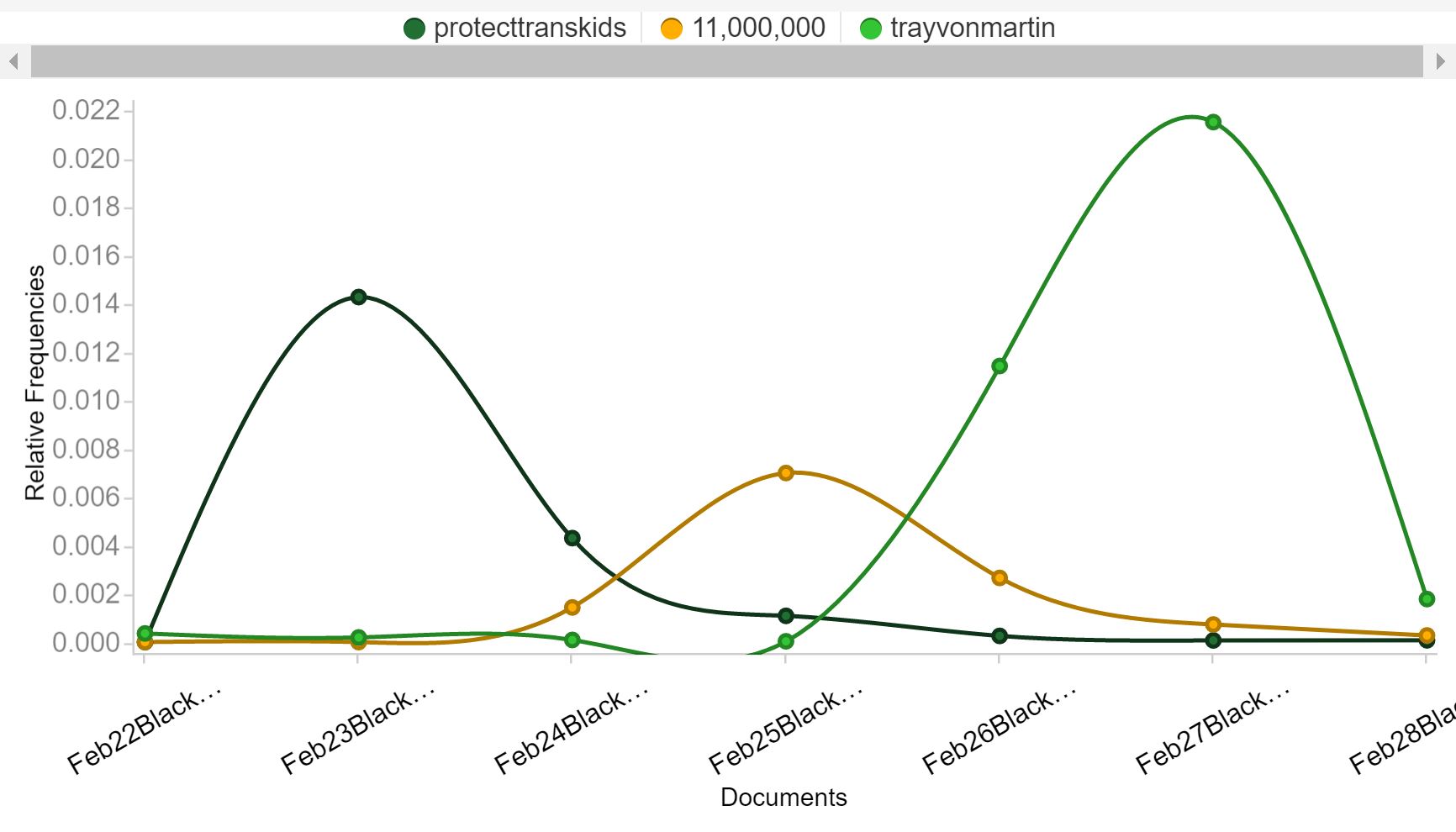
Voyant counts and identifies the top five most commonly used unique words for each day. On February 23, 2017 “protecttranskids” was used 1,119 times. I am surprised to see that “protecttranskids” does not appear as one of the top five unique terms on Feb. 24. Did #BlackLivesUseres stop caring about protecting transgender kids after 24 hours? It also appears that “11,000,000”, which was used 638 times on February 25, was not used noticeably on February 26. This was probably due to February 26 being the anniversary of the death of Trayvon Martin. On February 26, “rememberingtrayvon” was the most commonly used unique word. Looking below in Figure 2, we see these trends predicted. Note that I was unable to find and select “rememberingtrayvon”, so Figure 2 includes “trayvonmartin” instead. We still see the same trend, and there is a spike in use on February 26.
I chose to run a text analysis on the article The Matter of Black Lives, by Jelani Cobb. Cobb’s article, published in The New Yorker, summarizes the history of the Black Lives Matter Movement, recent events (up to October 2016) and where he predicted the movement to go. Since October, 2016 we have elected and nominated a new president whose opinions and position has greatly impacted the work of the Black Lives Matter movement. I chose this article to see if a text analysis can infer whether Cobb’s prediction regarding the BLM movement was accurate.
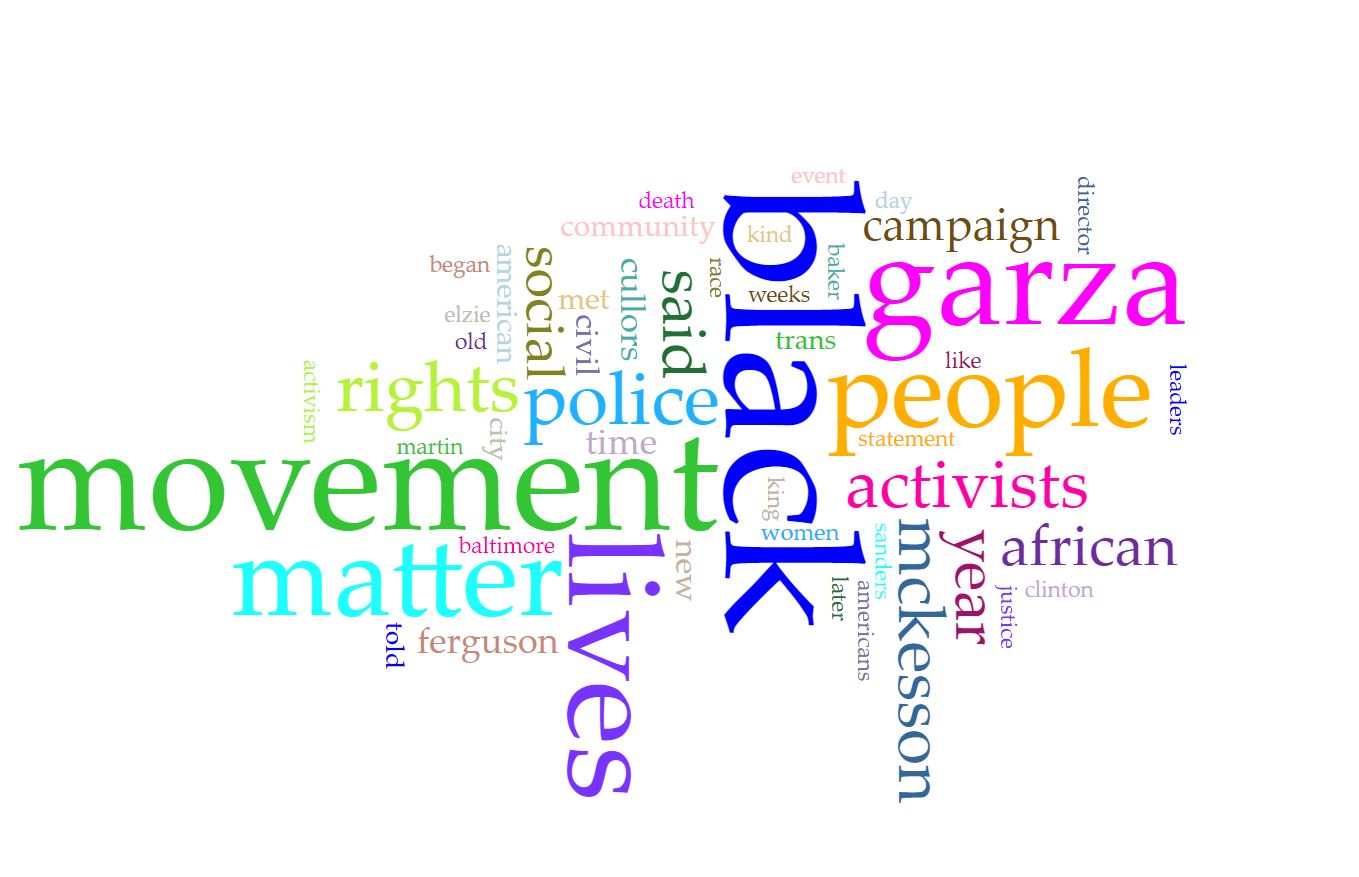
As shown in Figure 3, many of the trending and most commonly used words on Twitter are missing from the article. These words include: trayvonmartin, blackhistorymonth, today, and protecttranskids. I was most surprised to see that other names, such as garza, mckesson, and clinton all appeared in the word cloud, but Tayvon Martin’s name did not. Perhaps this is a reflection of the Cobb’s attempt to highlight other important contributes to the BLM movement. The extensive use of Trayvon Matrin’s name may also reflect the general public’s lack of knowledge of other modern contributes to the BLM movement. This, however, is a dangerous speculation to make, since under no circumstance (that I can think of) should we disqualify the the memory of Trayvon Martin. Other words, such as “black” and “year(s)” appear frequently in both text analyses. This is not surprising, since I would expect an article to reference different events about black people, thus requiring the common use of “black” and “year(s)”.
Voyant:
http://voyant-tools.org/?corpus=38587d29a855a13afe32323537c69c6f&stopList=keywords-b080a2334ad2ea1faab039b42ea51ac6&panels=corpusterms,reader,trends,summary,contexts
Cobb, Jelani. “Where Is Black Lives Matter Headed?” The New Yorker. October 28, 2016. http://www.newyorker.com/magazine/2016/03/14/where-is-black-lives-matter-headed.
Guynn, Jessica. “Google pledges $11.5M to fight racial bias in policing, sentencing.” USA Today. February 23, 2017. http://www.usatoday.com/story/tech/news/2017/02/23/google-115-million-racial-justice-grants/98283364/.
Jeremy W. Peters, Eric Lichtblau and Jo Becker. “Fight Erupts in Trump Administration Over Transgender Students’ Rights.” The New York Times. February 22, 2017. https://www.nytimes.com/2017/02/22/us/politics/devos-sessions-transgender-students-rights.html.
I was particularly impressed with your time series analysis. In such a broad topic, I was surprised to see such marked shifts in the usage of particular words or phrases. Having Black History Month and the “anniversary” of #BlackLivesMatter included in your data set clearly affected the quality of your data. Do you think you would see similarly defined spikes in word usage at other times?
I see in your post how important the specific events are to both your word cloud and your analysis. I would do well to dig a little further into the events taking place in North Dakota over the month of February.
From the start, I found it valuable that you are thinking about what is going on during the times you collected tweets. It is good to connect your hashtag with specific events to see what sparks discussion. I too was wondering what affect the Oscars would have on my data, so I find it insightful that you took that into account. I also liked how you thought about the frequency of words and what days they were used. I found it insightful that you questioned #protecttranskids being used a lot one day, and not at all 24 hours later. The only thing I would suggest is to further investigate this hashtag and its relationship to yours because from the surface it looks like the two have little to do with each other. Looking at this lab, I can really tell how current events affect what people are talking about. Even though my hashtag is so complex, I realized the importance of connecting what is going on in the world and how it affects the usage of #woke.