The purpose of this website is not to tell parents about each individual school in Hartford and its suburbs, but rather it is to show what kinds of options Hartford families have for schools for their children.
Where can I start?
This chart explains the types of schools starting with interdistrict and district. The district path is not as extensive, although there is still a considerable amount of information a parent should know about staying within district schools. If you select interdisctrict schools, you will learn more about Open Choice, Magnet Schools and Charter Schools. Clicking on each heading will also take you to a website that can provide more information about that particular type of school. In addition, we have hyperlinked other useful information such as brochures, applications and current research. This tool should serve as a guide for parents and anyone interested in school choice in the Hartford region.
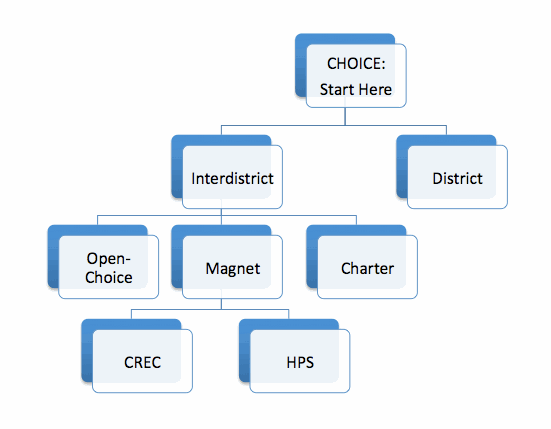
With this flow chart it is much easier to understand which options are available with the different interests that parents have for placing their students in a school in Hartford and the surrounding suburbs. To go one step further, if you click on the links below, there is an in-depth definition of what each option is.
DISTRICT
How much choice is too much?
A clear solution to Hartford’s battle with equal education has been to implement more options for parents. However, with too much choice it becomes increasingly difficult to figure out the best pathway for your student. The following picture depicts district and interdistict schools at the elementary level near Trinity College. In this search, 35 schools were listed – and this is only elementary.
”]

With all of this choice, we hope to help Connecticut parents make sense of the options they have. If parents are more aware of their options, they can make more informed decisions for their child. Parents must consider a number of factors when choosing a school: location, demographics, test scores, size, etc.
How did we end up with all this choice?
The history of school choice in Hartford goes back decades from now and includes many different types of school reform and programs with the goal of continuing to decrease the separation of race from school to school in both cities and suburbs. The most basic of all school choice options began in the 1950’s where students had the ability to choose which type of school they wished to attend, for example: a technical school where students could choose a specialty and be trained specifically for it, or a “regional agriculture science and technology education center.” [2. Mark McQuillan, “Public School Choice in Connecticut” (Connecticut Department of Education, 2011 2010), http://www.sde.ct.gov/sde/lib/sde/pdf/equity/choice/choicebooklet1011.pdf.]
In 1966 school choice expanded to suburban and city students. Project Concern allowed urban students to attend suburban schools, giving them a different type of education and opportunity, as well as integrating the racially separated schools, which is a similar goal of the school choice programs in Hartford today. The number and types of schools continued to increase under Project Concern with the opening of Hartford’s first regional magnet school in 1991 and the opening of the first charter school in 1997.
The Project Concern program was the basis of school choice in Hartford until 1998-1999 with the introduction to today’s current Open Choice Program. The Open Choice Program was even more effective in equalizing the racial demographics of schools because it not only allowed urban students to attend suburban schools, but also suburban students to attend urban schools. [3. Mark McQuillan, “Public School Choice in Connecticut” (Connecticut Department of Education, 2011 2010), http://www.sde.ct.gov/sde/lib/sde/pdf/equity/choice/choicebooklet1011.pdf.]
People seemed to be content with the new Open Choice Program in Hartford until the subject hit the headlines with the case of Milo Sheff versus William A. O’Neill in 1996. The case brought attention to the fact that “public school students in the City of Hartford attended schools that were racially, ethnically, and economically isolated in violation of the Connecticut Constitution…”[4. Wesley Horton and Richard Blumenthal, “Sheff vs. O’Neill: Stipulation and Proposed Order” (Connecticut Supreme Court, April 4, 2008).] With this news brought to the attention of the Supreme Court, stipulations were made to decrease racial separation within schools completely by 2013. These goals have been redefined after the state did not meet them in 2007, and so in 2008, a new “phase” of stipulations were set. Some of the new demands include: “the State shall examine the demand for seats in reduced-isolation settings by Hartford-resident minority students based on the number of Hartford-resident minority applicants…” [5. Wesley Horton and Richard Blumenthal, “Sheff vs. O’Neill: Stipulation and Proposed Order” (Connecticut Supreme Court, April 4, 2008).] This means that depending on the number of minority students who apply to the Open Choice program, schools must be aware that the number of minority students they accept into the lottery and into the schools reflects the overall number. Another example of a goal of the new Sheff vs. O’Neill stipulations include:
“If in November of the final year of Phase II [2013-2014], the state is unable to demonstrate its attainment, through reasonable efforts, of the goal of meeting 80% of demand, the parties shall convene to revisit the Comprehensive Management Plan and to determine what steps are necessary to meet the demand standard by the following year.” [6. Wesley Horton and Richard Blumenthal, “Sheff vs. O’Neill: Stipulation and Proposed Order” (Connecticut Supreme Court, April 4, 2008).]
The various different levels of choice for Hartford District students that are presented on this website in great detail are one of the ways in which the district is appeasing the Sheff case ruling.
Demographics of the Hartford region
The population in Hartford according to the 2010 Census results is 124,775 people. Out of the total population, 29.8% are white, 38.7% are black, 43.4% are Hispanic or Latino/a, and other races include Asian, American Indian, Native Hawaiian and more.[7. “Hartford (city) QuickFacts from the US Census Bureau,” U.S.Census Bureau, 2010, http://quickfacts.census.gov/qfd/states/09/0937000.html.]
Within the Open Choice Program in Hartford, all of the Hartford city schools are included, as well as 28 other districts. The map below highlights in blue all of the participating areas.
“]

The “Maps Created with UCONN Magic” page of Jack Dougherty’s On The Line webpage have maps that are beneficial in understanding more about the demographics of Hartford and its surrounding suburbs. The map below shows the racial makeup of these areas in 2010:
“]

The map shows that the majority of areas with a very low population of white individuals are near the city of Hartford in the middle of the map. As you move towards the outer regions, which are mostly suburbs, the populations become more densely white populated.To better understand some of the other demographics of these districts in Hartford including racial makeup of schools, test scores, the distance of the school from where you live, the SmartChoices website[10. “SmartChoices: A Digital Guide to Public School Choice in the Greater Hartford Region,” SmartChoices, n.d., http://smartchoices.trincoll.edu/about.html.] helps put all of these categories in one place. It is unique due to the fact that parents can enter their own address as well as what type of school their child wants to attend, and instantly find the schools near their home.
The map of participating districts as well as the racial makeup map can better show the demographics of people choosing schools is these areas. The next map will show that in the areas with a very low population of white people, there is a very high concentration of families using the SmartChoices website to research different schools in other areas.
How do demographics affect school choice?
A study by Jack Dougherty and others called “How Does Information Influence Parental Choice? The SmartChoices Project in Hartford, Connecticut”, provides a map indicating where the majority of the SmartChoice patrons were from. This map is below:
”]

This grid below shows that the majority of parents searching for alternate schools for their children are from the city of Hartford area rather than suburban areas surrounding Hartford. This suggests that there is an emphasis on city students going to suburban schools, but not the other way around.
”]

What’s going on in the media?
NPR “Parents Don’t Always Pick Best Schools”[12. Jeff Cohen, “Parents Don’t Always Pick Best Schools,” MP3, Morning Edition (Hartford, CT: National Public Radio, March 23, 2011), http://www.npr.org/2011/03/23/134766860/in-hartford-parents-dont-always-pick-best-schools.]
In this NPR program on school choice in Hartford, it is very clear that parents in the area are overwhelmed with the amount of choice that Hartford Public Schools offer them. Jeff Cohen also discusses that parents don’t always make decisions based on school achievement within the state. He delves a bit deeper into which aspects in choosing schools are the most important.
Watch the Hartford Public Schools “Choose” Campaign commercial![13. Hartford Public School “Choose” Campaign, n.d., http://www.youtube.com/watch?v=pi_mWizYV8c&feature=related.]
This is one of the more recent “Choose” Campaign commercials that are played on local television stations in Hartford to promote choice as well as the desegregation of Hartford Public Schools.
ABOUT THE AUTHORS:
Courtney Chaloff is a senior at Trinity College majoring in Educational Studies with a concentration in learning styles and special education. She is a Jewish Studies minor and is the Chair of the Student Athlete Advisory Committee as a senior member of the Trinity Varsity Women’s Volleyball team.
Ashley Ardinger is a senior Educational Studies major at Trinity College with a concentration in English Language Learner policy and special education. She has a minor in Music and is the musical director of Trinity’s oldest acapella group, The Trinity Pipes.
FOOTNOTES: