
A New England Village is… Below, I describe ten key things that make up a village.

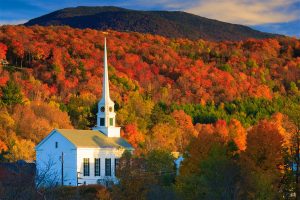
A New England Village is a core geographical imagination and a term used a lot where I live in Massachusetts and Maine. Just because a town is located in New England, many people think it automatically qualifies it as a “New England Village.” However, that is simply not always the case, and to help clarify that confusion, I have comprised a list of the top ten key concepts that make a New England town a New England Village.
1) House of Worship:

From the arrival of the first English settlers in the mid-1600s, the cornerstone of any authentic New England Village is a House of Worship. The majority of the original English settlers were from the East Anglia region of England, so most of the “First Parish” churches in New England are Congregational, which is what the religion of the Puritans eventually became.

Religious life acted as the hub for activity and dictated all facets of life, such as education, worship, and behavior. Churches basically acted as the seat of local government to the early settlers, and many of the earliest churches housed records of births, deaths, marriages, and punishments. Although not as influential now, the churches still stand in true New England Villages, and are often a center of social, if not religious, activity. Many authentic New England churches still have architectural remnants such as the old horse stalls where the colonial settlers would house their horses and carriages during services, which typically lasted most of Sunday in the 17th and 18th centuries.
Academic source: http://www.congregationallibrary.org/nehh/main
2) Town Meeting:
Another one of the key components of a New England Village is the existence of Town Meeting to debate and manage the important business of the town. Town Meetings are an important part of town government in New England, and many towns in New England still operate through this manner. It is a place for everyone to come and speak their minds, and debate in a parliamentary fashion. It is the original form of representational government in colonial America. Each person has a vote in town affairs which still exists today. Originally, only men had the right to debate and vote, but Town Meeting has evolved over the centuries to include all citizens over the age of 18. Town Meeting is a symbol of traditional American freedoms, in which basic levels of democracy are displayed.
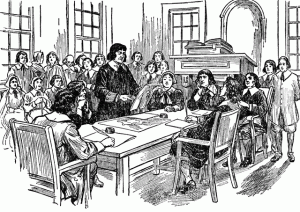
The original intent of these town meetings was to disperse the settlement land out amongst the families in the village. Land had to be distributed through the families and their offspring, as there were typically no pre-existing property boundaries with the original land grants. Another important part of the original Town Meeting was to establish who would be the town minister. The minister was basically the head of the town, acting as the main official in the newly formed government.
Academic source: http://americanarchivist.org/doi/pdf/10.17723/aarc.25.2.a41x928626p71t16?code=same-site
3) Commons:
One of the best ways to unify a community is to have shared spaces to work, mingle and converse. That is why a New England Village must have shared Common land for townspeople to freely access. It is similar in intent to college campuses and how they have commons or quads for all students to access. The original intent of a town common was to graze livestock and gather for militia training, but over time it has evolved to include many different uses. Many current activities on a town Common include gatherings and events like graduations and concerts.
Typically, a Common is what makes up the heart of a New England Village, so they typically were and are found in the center of the town. Historically, often meetinghouses and churches were located on the Common, in large part because those were the most heavily visited buildings. Additionally, usually main roads would converge there, helping to maximize the use of the town Common. Particularly in the era of horse travel, it was important to locate most resources close to each other for the greatest efficiency of time and effort. A Common, then and now, is a cultural hub for the town, where community can come together, and can observe traditions together. It demonstrates the values of community and is a staple of any quintessential New England Village. Perhaps the most famous Common of all is Boston Common, and all of the satellite elements surrounding a Common can be easily seen there, such as the State House, a historical church (Park Street Church), and a crazy convergence of busy roads.
Academic source: http://www.mass.gov/eea/docs/dcr/stewardship/histland/terra-firma6.pdf
4) Conservation Land:
Similar in concept to the town Common, another essential part of a New England Village is having conservation land for the public use. This is land that won’t be developed, but rather is kept for its natural beauty and the enjoyment of its townspeople. One of the original uses of conservation land was for hunting, but now that is usually prohibited, with the land being used primarily for recreational activities such as hiking, running, biking and trail-riding with horses.
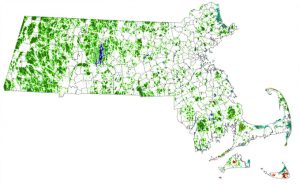
Conservation land in New England typically came about from donations by large landowners of unused farmland or of areas of geographical natural beauty, such as ponds, hills, and rivers.
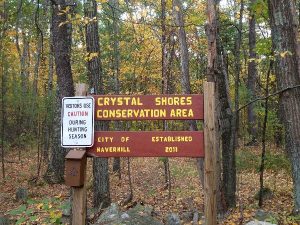
New England as a region seems rather unique in its preservation of conservation land and the importance of balancing development with responsible land stewardship. One need only look at the suburban sprawl in places like Houston or St. Louis to appreciate this observation. Farmland and pastures in these areas (and others like them) were turned over to rapid development without ecological consideration or protection. Even though New England supports one of the densest human populations in the U.S., it is also one of the most heavily forested regions.
Academic source: https://www.sciencedirect.com/science/article/pii/S0006320714001244?showall%3Dtrue%26via%3Dihub
5) Cape Cod and Colonial Homes:
The classic architecture of homes that is seen in a drive through quaint New England towns and villages is either the Cape Cod or Colonial style. There are original examples of this architecture still in existence today in this towns, but more commonly seen are modern, fancier versions that copy the basic features of these styles: central chimney, steep roof, windows and dormers, and either clapboard or shingle siding.
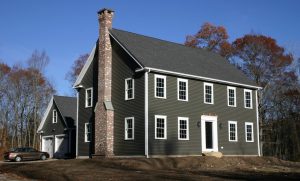

As mentioned earlier, the original English settlers of New England were primarily families of East Anglian stock. They were solidly middle-class and practical, and built homes that reflected this mindset. Their homes were built to withstand the long, often snowy, bitter New England winters. They used building materials that were readily available, which was wood, and employed techniques and styles that were familiar from their homeland. In keeping with their focus on simplicity and plainness, there was little adornment on their homes.
Academic source: https://christinefranck.wordpress.com/2011/05/13/english-colonial-domestic-architecture-of-new-england/
Virginia Savage McAlester. A Field Guide to American Houses. Alfred A. Knopf, New York. 2015.
6) Agrarian Roots:
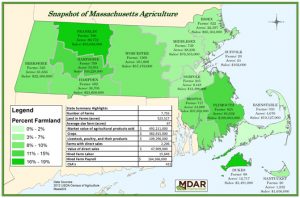
Most New England Villages began as farming communities, with very little industry. The seemingly unlimited land that was available in the New World attracted settlers that cleared the land for agriculture and grazing. For over 200 years, the land in New England was deforested, eventually resulting in more than 70% destruction of regional forest cover.
Reminders of the agrarian past can be seen in the remnants of stone walls on conservation land forest. These walls were built, using easily found granite rocks, to mark the property lines between farms. Interestingly, unlike many other regions of the U.S., most of the New England forest is owned either privately or by nonprofits. This is likely a combined consequence of these agrarian roots and the shrinking of agriculture in the region.
Academic source: http://harvardforest.fas.harvard.edu/sites/harvardforest.fas.harvard.edu/files/publications/pdfs/Foster_NE_Forest_Landscape_2008.pdf
7) Transcendentalism and Romanticism:

Ralph Waldo Emerson and Henry David Thoreau were among the literary giants who were proponents of these philosophies. Both philosophies believe in the power of the individual and personal freedom and in the divinity within nature and humanity, not surprisingly cornerstones of the New England Village, which was the heritage of both of these men.
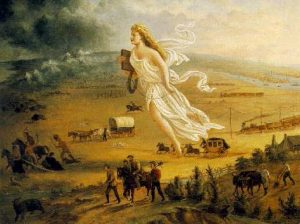
The combination of their educational and religious upbringing and the agrarian and forested natural beauty of the New England landscape were instrumental in shaping their beliefs in these philosophies. The key components of the New England Village created an environment that nurtured this idealistic philosophy and social movement, which interestingly had progressive views on feminism and community, particularly for its time.
Academic source: Wood, J.S. (1991), “Build, Therefore, Your Own World”; The New England Village as Settlement Ideal. Annals of the Association of American Geographers, 81: 32-50.
8) Manufacturing and Industrial Shift:

The shift from an agrarian to a manufacturing and industrial economy forever altered the idyllic image of the New England Village. As the population shifted to the cities for job opportunities, many New England towns lost population and farms were either neglected or abandoned altogether. The centerpieces of the agrarian New England Village, the church and obligation to community, were severely challenged and stressed.
Instead of largely self-contained farming communities, some New England towns and villages morphed into manufacturing and industrial hubs, often based on their proximity to falling water and newly-built road and railroads. The urbanization of these towns and their surrounding towns marked the end of the New England Village in its original form in many of them.
Academic source: http://harvardforest.fas.harvard.edu/sites/harvardforest.fas.harvard.edu/files/publications/pdfs/Foster_NE_Forest_Landscape_2008.pdf
9) Transportation:
New England Villages also experienced transformation as modes of efficient transportation changed from water-based schooners and steamboats to land-based railroads and then cars. As mentioned previously, the prosperous coastal New England towns and villages were challenged in terms of population and opportunity by the growing industrial centers made easily accessible by rail and then car.

Post-World War II, New England saw the explosion of prosperity that the rest of the country experienced, often resulting in somewhat reckless development. The mass availability of the automobile and development of the interstate system had a further deteriorating effect on the New England Village mystique.
Academic source: http://americanexperience.si.edu/wp-content/uploads/2016/02/The-Transportation-Revolution_.pdf
10) Suburbanization:
After World War II, many New England Villages were further transformed from self-contained towns into suburban extensions of their closest metropolitan area. Examples of this are the MetroWest, North Shore, and South Shore suburbs of Boston, and the Westchester County and southern Connecticut suburbs of New York City.
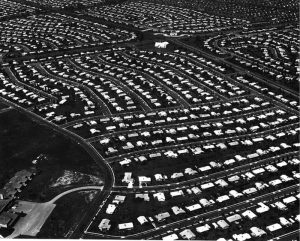
Town interests have changed from being primarily town-focused to regionally-focused in many of these New England towns and villages. The generational commitment to the community is often lacking, with the resulting diminishing interest in the participatory dimensions that define community, such as Town Meeting attendance, church attendance, and so forth. Hopefully, the New England Village does not become a core geographical imagination that is a distant memory only.
Academic source: http://www.nytimes.com/1991/01/20/magazine/secession-of-the-successful.html?pagewanted=all
https://www.theatlantic.com/business/archive/2016/08/decline-suburbs/496445/
I like the use of the videos it allows for the reader to see/hear other opinions around the topic. I also think you did a good job talking about the many different aspects of the “new england town”. It is also a clear movement through time.