
Individually, each graph says something different about the data. The map shows a majority of the tweets concentrated in the U.S and the data corresponds to show the majority of the tweets in English. The map combined with the pie chart of language show that the majority of the Tweets are in fact in English and located geographically in America.The people are responding through Twitter to President Donald Trump’s initial statements deemed anti-women’s rights. Looking at the number of tweets per day, it is interesting to see that when something big happens in world news, the number of tweets go up. For example, the number of tweets on 2/9/17 significantly increased over the other days of the week because an article was released asking people to get the word out about Senator McConnel being silenced. On this day, tons of people used the #whyImarch hashtag to raise awareness.The word cloud shows various phrases that correspond to the hashtag, while the SNA shows specific connections between the words and users. All together, we can draw certain conclusions about the hashtag as a whole. Since #whyImarch is a reform against U.S. politics, the map and pie chart of language show that the issue is mainly an American one. During the time period I chose to collect data during, the map specifically shows all but one of the tweets concentrated around the country, with only one individual tweet in Spain. I looked into and found that there was a women’s march in St. Petersberg, which explains that singular dot on the particular day.
The Social Network Analysis shows the conversation between different users, who is connected, and who is not. #WhyIMarch is the largest node, in which all of the other nodes are connected to. It was not surprising to see that #realdonaldtrump and #womensmarch are closely connected to #whyImarch, as this topic is about the women’s march and is standing up against President Donald Trump’s ideals. From this SNA graph, I was able to see that the Canadian Women’s march had many users tweeting about it, however those users had little to no connection with the American users. Then looking at the word cloud, I can see that all of the hashtags and users that accompany why I march, with women’s march being the largest word.
I believe that Social Network Analysis and the World Cloud tell the strongest story combined. The SNA shows only words, and although it is aesthetically pleasing to the eye it does not reveal that cdnwomenmarch has actually very little to do with the American women’s march.Separately, the word cloud I created shows women’s march as the largest word, then maga, resist, women, trump, whyiresist, and cdnwomensmarch all in different sizes and colors. When analyzing the social network analysis, similar words pop up, such as realdonaldtrump, womensmarch, cdnwomensmarch, etc. However, it is interesting to see which are actually connected to each other! For example, cdnwomensmarch is disconnected from the majority of the nodes, since people in Canada are probably not tweeting about the same specific issues as people in America, and vice versa. It is also interesting to note that they are not connected.
Slide 1: Title Slide: #WhyIMarch
Slide 2: Background: What is the women’s march? Why were women marching?
Slide 3: Data Visualization (1) : Word Cloud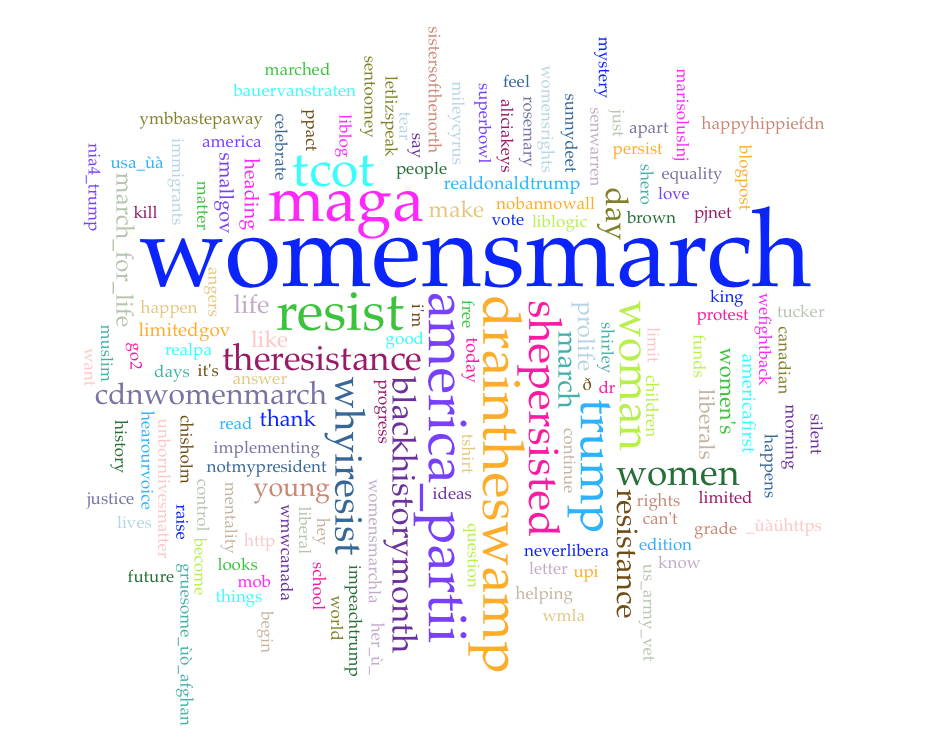
Slide 4: Data Visualization (2) : SNA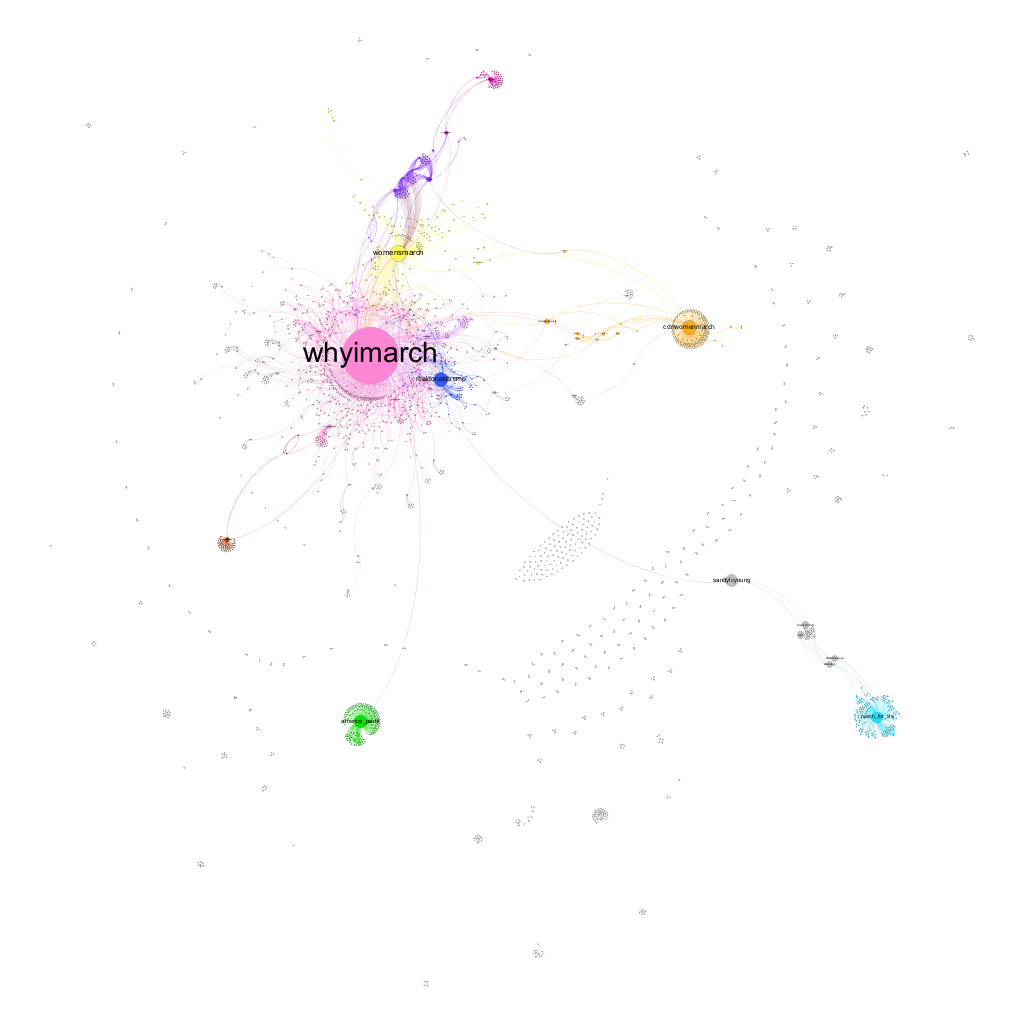
Slide 5: Readings: Nathan Yau, Boyd & Crawford
Slide 6: Summary: Individually, these slides tell separate stories. But together they paint a larger picture of the users and other hashtags that are connected, and those that aren’t.
Slide 7: Work Cited
The final march is here. Our topics are pretty similar in the sense that they both mainly affect people in the United States, but Caroline’s topic is more of a global issue. I’m excited to see the different or similar stories that your word cloud and social network analysis tell and look forward to your presentation. 🙂
I like the line of reasoning a lot and you tie these together nicely. How are you planning on using Yau and boyd & Crawford? I can see multiple connections but am keen to hear you bring that out.
Also, I just asked Julia & it is something it would be exciting to hear you touch on as well: why do you think debates around feminism and queerness took the form they did? That relates to Katherine’s SNA as well–are a lot of folks tweeting? Or maybe are they using other issues?
Katherine,
I look forward to seeing you present your data on Monday! I think your argument is strong!