
Skimming my tweet’s content, I expect to see a lot of words involving protecting and supporting trans people. Also, I except to see people tweeting about Moonlight the night of the Oscars, due to the fact that it has LGBT roles. I expect to see tweets at Donald Trump or about him as well, due to the fact that he does not support trans people.
I have collected 430,352 total words and 35,855 unique word forms from this data set. Some phrases that stand out to me are transgender, as I predicted, as well as trans. One common phrase was Dino_71phg, which I looked up on twitter and it was an account, not even verified that just tweeted updates about popular LGBT shows, like RuPaul’s Drag race. In addition I saw a lot of supportive words, such as congratulations, equality, rights, loveislove etc. A few phrases that stood out to me were The Resistance, anti, and resist, I found this interesting because it solidified the fact the the LGBT community is fighting for their rights, I feel that I get caught up in the positivity of the phrases and hashtags, and forget that these people are fighting for basic rights. There were a few random characters in different languages and small words like “just” but I didn’t find any phrases to be out of place. I decided to add to the word- stop list: time, Dino_71pgh, just, said, it’s, like, se, gt, and jordanUHL and a few various characters in different languages. These words do not help me see trends.
I chose a word bubble with 185 words. This word bubble shows the LGBT community as a whole, on the outside of the word bubble, there are positive words such as love, community, parents, justice. The closer the words to the center illustrate the LGBT communities main fights and struggles, words like transgender, protecttranskids, equality, the resistance, and Trump. I think that these words illustrate what LGBT people are fighting for and also who they are fighting against. I think that these key words reveal the current issues and struggles of transgender people, but it also shows the endless support they have from the members of their community. 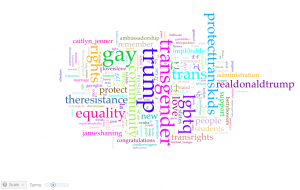
I am choosing the phrases and words, protectranskids, transgender, Trump, theresistance, community, and impl0rable. I think that these words will tell a very interesting story. I want to see when certain things spiked, especially the resistance. I also want to learn more about impl0rable, what does this mean and in what context is it used? I also want to see if people are tweeting about Trump and protecttranskids at the same time, or different times.
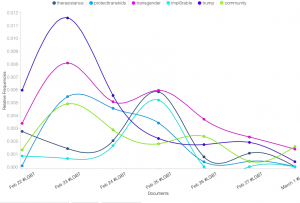
It makes perfect sense that both Trump, transgender, and protecttranskids spiked the day Donald Trump decided to reverse the transgender bathroom directive. On Feb 22, those were the most popular tweets. Then on February 25th, it shows the backlash of Trump’s decision and how the LGBT community dealt with it. On this day, theresitance and impl0rable both spiked. Imp0rable has to do with anti-trump people, and their distaste for Trump’s decision against transgender bathrooms. During this day, transgender was also a popular word to be found in tweets. I thought it was interesting that when theresitance went up in popularity, community went down. The next day, both the resistance and impl0rable dropped, as did all the other words. All of the words lost popularity by the end of the week. I thought that it was cool that the first half of the week was the anger response to Trump’s decision, and the following day was the aftermath and the resistance to his decision.
http://voyant-tools.org/?corpus=837f23f11c0d255ef5e98b4f3a1b94ff&stopList=keywords-dacc94109d6b70c8677cc7fadccb54a1&panels=corpusterms,reader,trends,documents,contexts
I chose an article from a Transgender health journal called, “Psychosocial Disparities Among Racial/Ethnic MinorityTransgender Young Adults” I think that this article ties in nicely with what is currently going on in the LGBT community, especially with transgendered people. An article illustrating the difficulties trans people face will correlate perfectly with the data I have been collecting.
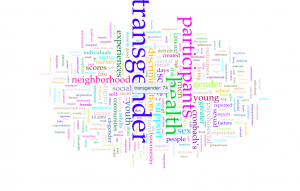
This data set has a lot of similarities with my twitter data set. Transgender is a very necessary topic of discussion so it makes sense that it is being displayed clearly in both my word bubbles. Transgender health is discussed in this article, where transgender’s well being is discussed in my twitter set. Another large word in both my twitter sets is the idea of community and neighborhoods. This article does not touch on the politics of my twitter data set, so as a result does not perfectly mirror my collected twitter data. I think that this article and word cloud allow me to better understand my data set, as this article illustrates the necessary increase in attention transgender people need, without getting wrapped up in the politics of it.
Tuftes believes that data visualizations should produce accurate findings of data sets, while Yau realizes that data is an “abstraction of real life,” and accepts data visualizations as attempts to make sense of large data sets and pull conclusions to it. I believe that Yau’s approach to data visualization is better. Throughout this lab, both graphics of my twitter data set revealed valuable information, but two totally different presentations and explorations of my data. The word cloud revealed the most important words within my data set, which further allowed me to investigate the key aspects of my hashtag LGBT. I used the key words to research what was going on in the world in the news. The other graph, that showed the frequencies of when each key word was tweeted, allowed me to stitch together a story of my data. I was able to compare the news to the word frequencies to see if the spikes in certain words correlated with the news, it was cool. I think that this agrees with Yau’s way of looking at data visualization, as my findings were an attempt of analyzing data while simultaneously looking at it in context of the news and other findings. Obviously, all of the tweets I collected do not tell the same story, but by gathering a lot of data and comparing it to the news and looking at it in context, I was able to tell a story with my data.
My first reaction when looking at your word cloud is that it displays significantly different results from #transgender. Whereas the majority of the words in the #transgender tweets were derogatory, critical and negative, most of the #LGBT words were supportive and respectful of the LGBT community. I found it interesting that in your word cloud is the word transgender, as well as protecttranskids, which I found as a common word in my cloud as well. In my cloud, however, LGBT did not stand out much. The only explanation I can find for this discrepancy is that LGBT is more of an overarching term that tends to receive a little less backlash than transgender individuals specifically. As transgender rights are the current heated topic, those who use that hashtag are more likely to be very defensive for their position.
Your article choice was a good one, it is nice to see that there is not much of a difference in word usage between the tweet words and, as I would imagine, a much less biased article.
What initially strikes me as insightful in your post is the fact that you looked at an article that, although pertaining to your overall topic, was not one that did not touch on the politics of your twitter data. This is extremely interesting because today politics has so much to do with both of our topics as well as most others in our class. I really like how you were able to see your data in a way that was not altered by any sort of politics. I also find it fascinating that although your article did not touch upon the politics of your hashtag topic, it still showed similar data trends. Your reasoning is also very thoughtful when you state that “this article and word cloud allow me to better understand my data set, as this article illustrates the necessary increase in attention transgender people need, without getting wrapped up in the politics of it”.
I think it would be really interesting to go back and find an article that does have a type of political bias and compare and contrast the words that pop up with both your twitter data and the data from the other article. I think it would be really interesting to see which article has more similar data to that scraped from twitter.
The fact that your article was unbiased in terms of politics also interests me due to the fact that my article was purely political. While you found an article that discussed the transgender community and transgender health without displaying any political stance, my article displayed what was happening politically in regards to planned parenthood and how the house of reps wanted to stop federal funding. With this mind, it is interesting to compare our overall findings on the differences between our twitter data and our article data. Where you found many similarities between the two, I found that there were many differences. This made me want to go back and find another article pertaining to planned parenthood that is more of an informative piece- lacking political or media bias.