
Considering my research and the content of the tweets I have collected related to #keystoneXL, I am hoping to see words generally related to the resistance movement for construction of the pipeline. Words I expect to see are “dapl” or “transcanada” or “standing rock” which all are directly affected by this hashtag and seems to come up frequently throughout the tweets I have collected.
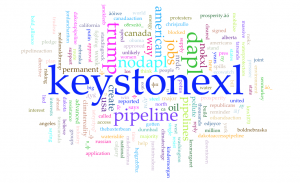
The 10 documents I had organized for my Twitter data found a total of 251,935 words and 27,578 unique words. Some of the most frequent words that were found was “keystonexl,” “daps,” “pipeline,” and “nodapl.” Some of the interesting data points found from the summary box was that in document February 21-23rd one of the usual words selected was “water protectors” and in the document for February 9-11th the term “price of oil” I found unique. I also found the phrase “baxter bean” and “apcentralregion” to both be really common, which I later found are both Twitter handles, “apcentralregion” being a a news organization in Texas and midwest region of the US and “baxter bean” referencing an individual who frequently expresses their interest in political and environmental issues. The words that stand out first within the text analysis image were “american,” “pipelines,” “jobs,” and “Trump” all which really encompass the general beliefs and tweets I have found in association with the hashtag. Furthermore, these specific words really focus on the american-pro side of this issue rather than the real debate that I feel like is occurring between the people who are being affected by the issue. Some unusual phrases or words that I found to be used were like “ilz4mme” or “kgrumke” which I assume are Twitter handles that are repeated when people retweet the same tweet frequently. Other phrases that didn’t make much sense in the context were like “puts,” “it’s,” “haven’t,” “hey,” and “oh.”
Words I included in my stop list:
- ilz4mme
- just
- kgrumke
- hasn’t
- that’s
- you’ve
- today
- tens
- mid
- puts
- lots
- it’s
- haven’t
- oh
- is6ryztyq7
- фп
I included a total of 155 words in order to really visualize entirely what the data I have collected thus far is saying. With only a bit over 10,000 tweets for #keystoneXL, I am hoping to extrapolate as much as I can from such a condense set of data.
The cirrus cloud shows the debate of the Keystone XL project as a whole. The words like Trump, American, pipelines, no DAPL, DAPL, oil, create and jobs are all centered within the image from being the most popularly tweeted and happen to really channel the pro-side of this issue that has been argued persistently throughout this debate. However, the smaller words in the background, like blocked, nebraska, lied, pollute, bulldozing, resistance and protestors all really speak to the doubts and concerns many people have about this issue, and symbolize their voices being minimally heard and taken into account as the project continues to charge forward. I was surprised to see words like canada, alberta, prosperity, truth out and applauded. It’s really interesting and cool to see how these words clash with one another while still clumped together like they represent a cohesive population or topic, when in fact it represents the reality that this project starkly separates the population. The text analysis below is consistent with what I have been finding in terms of the different arguments that have been revealed throughout my Twitter data and smaller side-arguments for the issue will hopefully come up in later analysis in order to see how it frames the debate for the Keystone XL project and creates the picture below.
The three big words that I wanted to explore further were National Resources Defense Council (NRDC), no DAPL, and jobs. All three of these terms were very popular throughout my collected Twitter data, but also again really encompass the argument against the Keystone XL project and show how protestors of the XL project rally behind these main points to further propel the resistance of its construction. Furthermore, I thought it would be really interesting to see where these main protesting points for the XL project fluctuate throughout time in relation to one another.
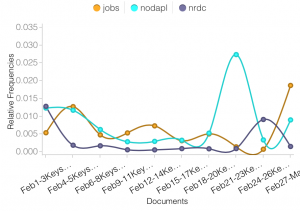
It is interesting to see that the words NRDC and no DAPL run pretty similar together for the middle two weeks of February, but at the beginning of February no DAPL and jobs were more similar. Then towards the last week of February no DAPL grew in frequency higher than any of the other words had reached, and once it calms down, the NRDC spikes up with jobs taking off as well. It doesn’t surprise me that there is such low frequencies of NRDC and no DAPL throughout the middle of February since there was little acceleration in the project occurring during that time and less was being tweeted in general. I think it’s interesting that jobs however remained some popularity throughout that middle part of February however and wonder what was propelling that word to be used more than the others. I also find it interesting why the no DAPL peaked between February 18th and the 24th, indicating a political advancement must have taken place to move forward with the Dakota access for the pipeline.
http://voyant-tools.org/?corpus=544ab8df4fe74917b10c44a0d1c8489e&stopList=keywords-576b894e1bfa8b47c5594ad5331d7c21&panels=cirrus,reader,trends,documents,contexts
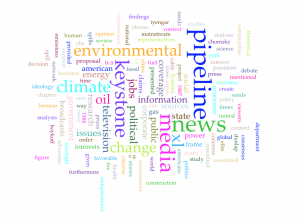
I chose an article published in the New York Times called Game Over” for the Climate: The Keystone XL Pipeline on TV News written by Elisabeth Wilder. While this document is actually 90 pages long, it does a great job going beyond the general outline of what the project is and delves into the environmental influences the project has on all of America, not only those directly impacted with its construction. Given that most of America is on board with the XL project, Wilder analyzes what the media is reporting and their methods that recruit such large support for this pipeline extension. Wilder even makes the point that the media heavily relies on the government and businesses as their sources, thus broadening and channeling news related to Keystone XL to be reported in a more political and economic lens. This helps to explain why I have been collecting a large amount of tweets that are more political and force the data to make it appear that the topic is less environmentally presented.
http://voyant-tools.org/?corpus=68c5b72ad84ed28df9e1b5bb0226aec4&panels=cirrus,reader,trends,summary,contexts
There are a lot of similarities with the data set derived from this article and with the data set I have collected from Twitter. However, Wilder’s data set touches more on the side of the media influence and the environmental perspective that circulate around this project whereas my Twitter data set touches more on the political perspective of the XL project. I think this data set offers a really interesting side of the topic derived from my data as much of the environmental or media perspectives of the XL project are hidden in the shadows of the political advancements and debates related to the project throughout a social media platform. I think its important to keep in mind that my Twitter data is not the Keystone XL debate in of itself, that there are many other sides to this issue that are overlooked or veiled by using the methods and analyzing the audience we are founding our research on.
While Tufte believes that methods of data collection and analysis can accurately and precisely draw conclusions on the real life issue or topic entirely, Yau believes that data collection and analysis is generally an “abstraction of real life” and can help draw conclusions on an issue, but it doesn’t necessarily connect to the reality of a topic in a full sense. I happen to agree with Yau considering my data on #KeystoneXL largely touches on the political perspective on the project and overshadows many other sides of this issue that rarely come up within my Twitter data. A lot of the text analysis for #keystoneXL data references words like bill, create, jobs, reported, pipeline action, sen Markey, etc that all refer to the political side-conversations about the Keystone XL project. This is also shown by the low dip in frequency of the words jobs, no DAPL, and NRDC throughout the month of February, only spiking in popularity when advancement had been made to propel the project further. Therefore, the main political focus on this issue is hiding a lot of the other focuses that shift and frame the overall debate of the Keystone XL project.
Good to see how you found how the smaller words in the background suggest the doubts and concerns many people have about #keystoneXL. Similar to Graham’s data, you also found “nodapl” to have a significant spike at the same time. I am sure if you and Graham got together and collaborated, you both could find some interesting conclusions about the similarities in your data, especially why “nodapl” spiked at the same time. You draw a great connection to Elisabeth Wilder’s article to understand the broadening and channeling news related to Keystone XL to have been reported in a political and economic lens.
It’s too bad to see terms like create and jobs near the top of your list but I am very fascinated by the vast array of terms you encountered! I would have never known what a bean baxter is were it not for your research! I also think I can tell you why #nodapl spiked between Feb 18 – Feb 24: Feb 22nd was the deadline for the water protectors obstructing the completion of of the DAPL to break camp and leave their occupied land. It is really cool to see data that relates to my topic at work in your tweets as well. I wonder if there is more contextual research you could do about your data, or if there will be a definitive moment in the coming months that will yield a contextual milestone in your data. Additionally, I hope you’ll further explore the disparity between media coverage of these pipelines and political sentiment – I think there could be some very cool overlap with my own data and perhaps a commentary on differences between Yau’s abstraction of life and what the media might present as the abstraction of life.