
Part I
I chose February 22nd, 23rd, and 24th as the deadline to vacate the Standing Rock camp was February 22nd and I wanted to see how #standingrock would change in the subsequent days following the removal of the water protectors. After cleaning my data, I have 3147 rows.
Part II
There are 77 nodes and 254 edges for the Les Mis data. If I were to analyze this data, I probably would have chosen an Undirected approach as that would reveal more about character relationships, however, a direct approach would include asides from the characters that are spoken to the audience while an undirected may ignore this data. For the purposes of my data, I would want to use a directed approach in order to measure people who did not tweet at another person, but still used #standingrock – we know this is true because some columns were empty in my cleaned data.
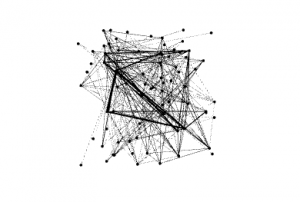
Valjean’s ID is 11.0 and the ID of the edge between he and Fantine is 47.Valjean is talking to four different characters, and Fantine is talking to 9. Their IDs are in linear order, ranging 1 onward, which could be ordered thusly based on when they are introduced into the play – however, I would imagine the characters are grouped by chapter and the placed in order.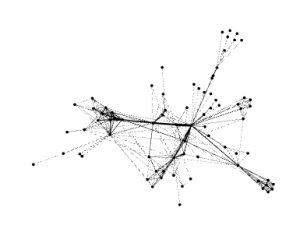
When changing the repulsion strength, I think you allow gephi to process the data within a larger plane, and thus the data can spread out as the parameters of the program have been enlarged. The network diameter is 5, while the average path length is 2.641.
Unfortunately, my betweenness centrality would not cooperate when finishing my mapping of Les Mis – this might be a product of my tired laptop, but anyway I’ll try to answer some of the questions regardless – with respect to betweenness centrality, the function seems quite simple: making the data with the most undirected connections more visible by enlarging this data and shrinking data with less connections. For the purposes of this lab, it makes sense to make the extremes for nodes size 200 and 10 as that will much more visibly display the data.
Part III
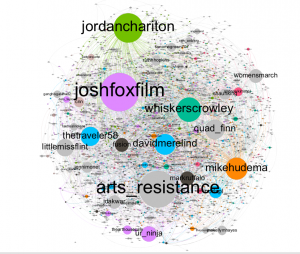
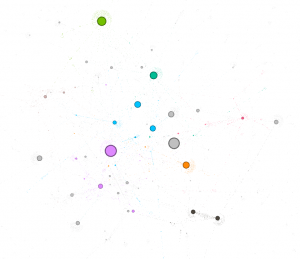
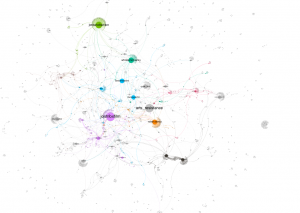
The network diameter of my data was 18, while the average path length was 6.394. I imagine this means I had a lot of data, as these were 3 times the size of the Les Mis data – and that is a really long novel. Either way, I think this definitely points to large and diverse data. I had 2785 nodes and 2773 edges. While I didn’t have long to analyze my data, I was pleased to see the diverse range of data in my graph. I definitely expected a lot of data for this day – considering the real world implications for those who remained at the sacred stone camp past 2PM on February 22nd. I very much wish I had had more time to delve into my data, but I was able to find the tweet from josh fox film, the nodes with the most connections by betweenness centrality.

This was Josh Fox’s post. And I would disagree with his claim of a lesson learned by “the world” in “true peace.” I return again to Graham’s discussion of action vs. perceived effect in digital discourse. Despite the thousands of tweets in support of the water protectors, I wonder how many users actually visited Standing Rock or gave money to the Sioux’s legal or actionable resources. I wonder how many users believed that their “prayers” meant anything more than a collection of data points I have struggled to map. Perhaps that is an incredible tragedy about seeing the digital support for worthwhile cause – we can see how many people support a cause, while also seeing how many people won’t do more. At least the freedom fighters are finding each other though – #womensmarch was actually one of my most connected terms – and there were not any terms in defense of the DAPL that found a lot of connection on the twitterverse. Maybe that tells us something. For the sake of the Sioux, I hope so.
You’re data is the polar opposite of mine and #energy. All of your tweets are connected and that is really cool to look at and see. It’s great that you’re data is really connected and the dates you picked are perfect. I like how your data was all connected and the tweet from John Fox is fantastic detail that you included in your lab. Seeing the tweet that created so many nodes was a great. My lab was completely opposite there were no conversations in my data and I found that fascinating, but the singular event that is your data creates a fantastic conversation that was really great to look at.
It is super cool how much data you have been able to collect on your hashtag and to understand the many different conversations going on about it and their connections. I thought it was also really interesting to see how such a spike in conversation over the tweet by @joshfoxfilm was created in your data. Being able to narrow a huge part of your data to one source, and it also being able to speak so much about the overall topic of #standingrock, is really awesome. In relation to my data on #keystoneXL, I think its great you capture a totally different side to the extension project that my data has touched very little on. I think it would be interesting to see how close the two align in some instances and see if they correlate on a timeline of events and how frequent the hashtags get throughout time.
Woah! Your tweets are all connected, compared to mine. You really do have large and diverse data. Your diameter and average path length were actually very similar to mine, despite the Gephi looking so different. Josh Fox’s tweet was really powerful and it makes sense why so many people connected to it/shared it. I doubt many users actually visited Standing Rock or gave money to the Sioux’s legal or actionable resources, but it is nice to know they are sharing it!