20
Oct

Early African Newspaper

   Posted by: rring   in Uncategorized

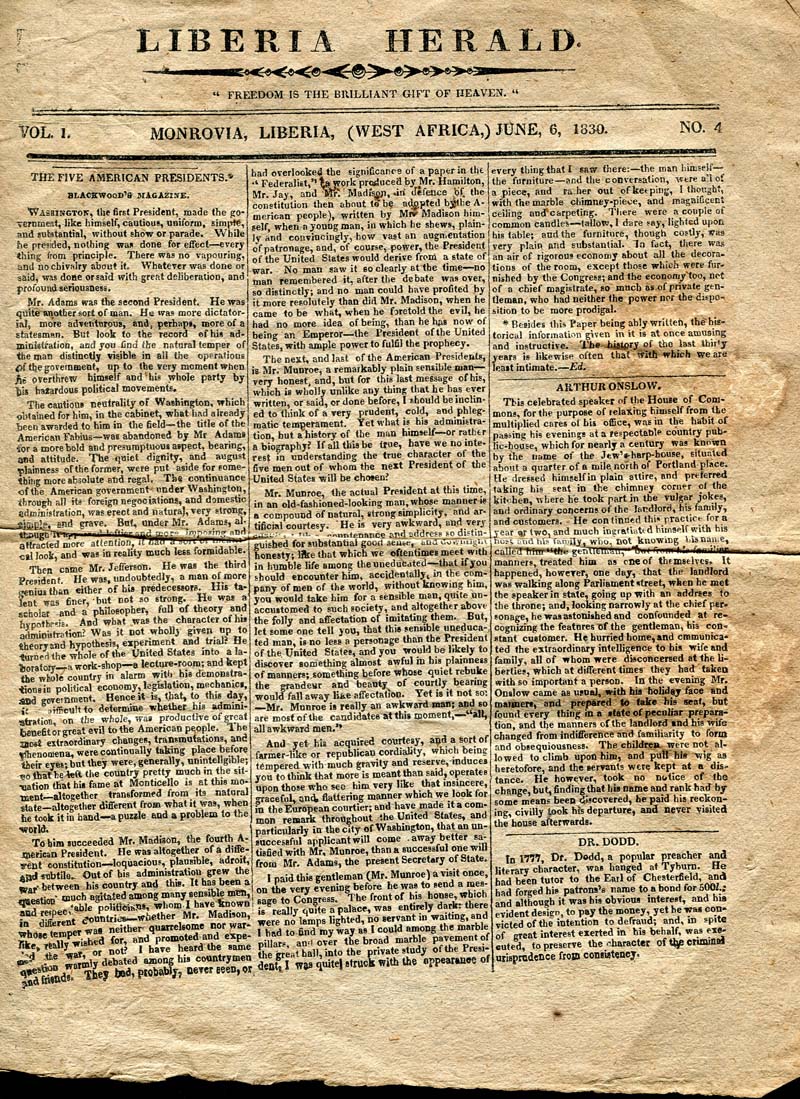
The Watkinson has two issues (vol. 1 numbers 3 & 4) of the first newspaper published in the colony of Liberia. From 1830 to 1834, its editor was John Brown Russwurm, a Jamaican-born mulatto who was educated in Canada, graduated from Bowdoin College in Maine, and then settled in New York where, in 1827, he and Samuel Cornish co-founded Freedom’s Journal, the first black newspaper in the United States. The Liberia Herald became the fifth oldest newspaper in Africa after the French-language periodicals published in Egypt during the Napoleonic occupation of 1797, the Cape Town Gazette of South Africa, 1800, The Royal Gazette and Sierra Leone Advertiser, 1801, and The Royal Gold Coast Gazette, 1822.

The library record is here: http://library.trincoll.edu/voyager/shortcut.cfm?BIBID=276493

Tags:

18
Oct

This week at Trinity 100 years ago…

   Posted by: rring   in Uncategorized

Friday, October 21, 1910

“Freshman Rules Posted”

“Freshman!  Conduct yourselves always in a respectful and obedient manner towards your superiors.  Evidence of this respect must be shown by saluting al professors, graduates, and men of higher classes.  All throwing of water or calling out of windows, shouting on the campus or throwing snow-balls is strictly forbidden.  The placing of notices upon the bulletin-board is also prohibited.  Unless accompanied by a man of class, you are forbidden under any circumstances to appear at Heub’s, or in a box at any theatre.  The freshman cap must always be worn except on the Sabbath or when going down town.  The cap must not be disguised or defaced or altered.  In attending all college meetings, sings, and games, promptness is compulsory.  Obtrude not yourselves unbidden into the discussion of your superiors, nor offer advice unsolicited.  Neither make yourselves conspicuous by the display of loud haberdashery or clothing.  Never smoke pipe or cigar or wear school insignia of any sort in public.  Also the wearing of khaki and corduroy and the carrying of canes will not be tolerated.  Sitting upon the college fence is forbidden.  You are further required to step off the board walk at the approach of a superior, and in passing up and down Vernon Street to use the south side exclusively.”

Best advertisement:
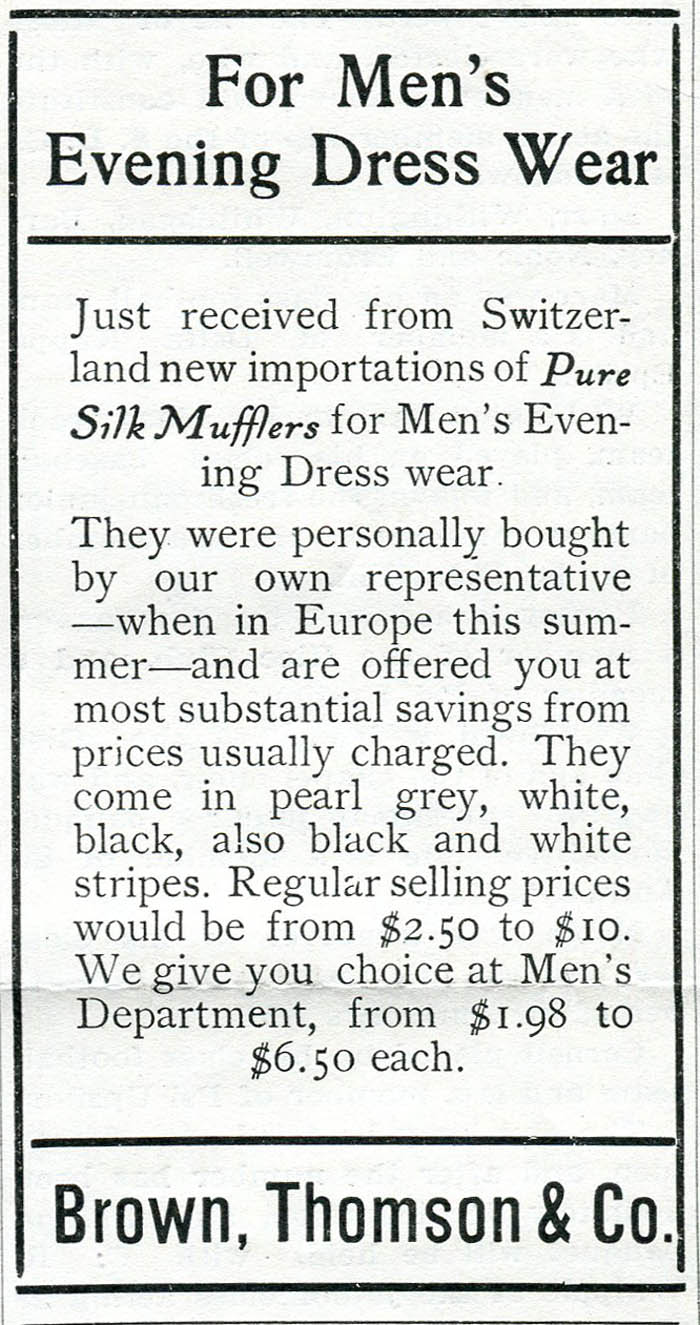
FOR MEN’S EVENING DRESS WEAR.  Just received from Switzerland new importations of pure silk mufflers….

Tags:

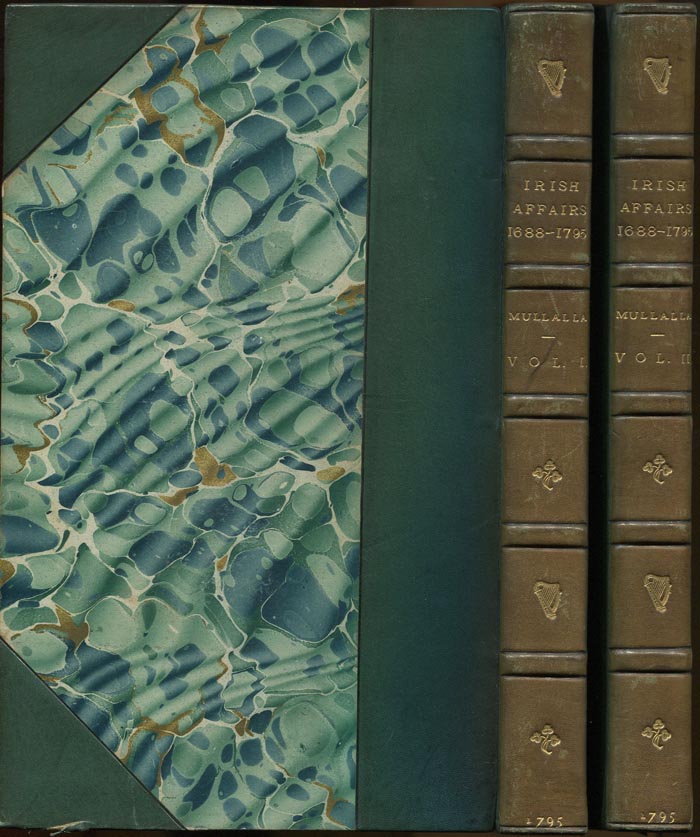
James Mullalla,  A View of Irish Affairs since the Revolution of 1688 (Dublin, 1795).

The first edition of this treatise on Irish politics, to which Washington subscribed (for fifty copies) in the year he ratified the Jay Treaty, the accord which began a decade of peace with Britain.  Mullalla, ‘patriot’ historian, Trinity (Ireland) scholar and Freemason, analyzes the ‘calamities of the nation invariably flowing from public misrule, barbarous manners, private interest, and the rage of parties’.  He cites archives and authors studied at Oxford and Cambridge, and discusses the effects of political actions undertaken at the Vatican, at Westminster and on Irish soil.  Mullalla achieved notoriety in 1792 when he produced “the most politically provocative [pamphlet] of all.”  His Compilation on the Slave Trade, respectfully addressed to the Irish People, with its “blunt assertion of the African’s right to revolt against his master was a highly unusual feature in the anti-slavery discourse” (Rodgers).  A View of Irish Affairs sees Mullalla revisit the theme of Irish manumission, as he discusses the “narrow and illiberal policy of Great-Britain.”  Despite this, he is on the whole optimistic about the future relationship between the nations.  SEE Nini Rodgers, “Ireland and the Black Atlantic in the Eighteenth Century,” Irish Historical Studies, 32:126 (2000), pp. 174-192.


Tags:

11
Oct

Admiral of the Ocean Sea

   Posted by: rring   in Uncategorized

Today is Columbus Day, and we librarians are busily working as the students are off visiting family, watching the game (whichever game is on in your part of the country), or sleeping off last night’s party.

Plumbing the depths of the Watkinson today, I drew up quite a nice nugget–Noviter historiarum omnium repercussiones, printed in Venice in 1506.  This is a chronicle that contains one of the earliest printed accounts of Columbus and his voyages.  The great Americana bibliographer Henry Harrisse gives us the following description in 1866:

“Many of the historians of the fifteenth century were mere chroniclers, who kept a historical register of events in the order of time, beginning a mundi incunabulis[i.e., the cradle or beginning of the world], and ending with the year when the manuscript was intrusted to the printer.  Every two or three years, additions were made and new new editions published under the name of the author who had given celebrity to the work, even after he was dead and buried within the walls of the monastery, which had often been his only sphere of action and personal influence.  The present chronicle is one of that character.”

The author was Jacopo Filippo Foresti da Bergamo (1434-1520), who “was of a noble family, and abandoned the world to become a monk of the Augustine order.”   The first edition of this work was printed in Venice in 1483, and it was reprinted with additions as late as 1581.  The first edition to mention Columbus was printed in Venice in 1503.  Aside from this 1506 edition, the Watkinson has an edition printed in 1492, which (of course) makes no mention of the world-changing event that happened that year (it only covers events up to 1490).

Tags:

11
Oct

This week at Trinity 100 years ago

   Posted by: rring   in Uncategorized

In the October 14, 1910 issue of the Tripod, the following books were among those reported as “additions to the library”:

An Account of Some of the Descendants of John Russell, the Emigrant, by the late Gurdon Wadsworth Russell (Trinity Class of 1835).  The book is still here:  http://library.trincoll.edu/voyager/shortcut.cfm?BIBID=564598

Shakespeare and His Critics, by Charles F. Johnson (gift of the author, and it was reviewed in the Tripod in 1909).  The book is still here:  http://library.trincoll.edu/voyager/shortcut.cfm?BIBID=401511

Music in the Church, by Peter Christian Lutkin.  The book is still here:  http://library.trincoll.edu/voyager/shortcut.cfm?BIBID=491463

Proceedings of the Second National Peace Congress, Chicago, 1909, ed. by Charles E. Beals.  The book is still here:  http://library.trincoll.edu/voyager/shortcut.cfm?BIBID=521362

 Best advertisement:  Promoting the various aspects of the college, including the library:  “The LIBRARY contains about 60,000 volumes, 30 per cent of which have been purchased within the last twelve years.  It is open daily for consultation and study.

Tags:

6
Oct

This just in (new acquisition)

   Posted by: rring   in Uncategorized

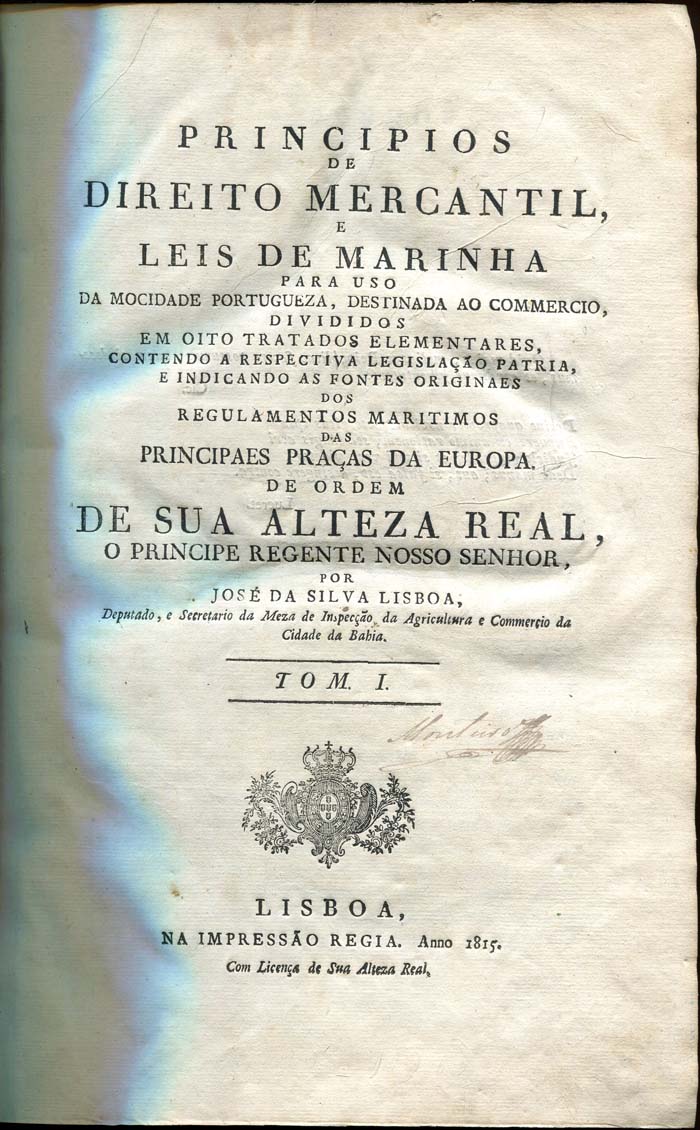
Lisboa, José da Silva.  Principios de Direito Mercantil, e Leis de Marinha para uso da mocidade portugueza, destinada, ao commercio.  (Lisbon: Impressão Regia, 1801-1819). 

This work first appeared in 1798 (here expanded), proved highly influential, and was a pioneer of its kind published in Portuguese.  It covers such matters as insurance, commercial risk, averages, foreign exchange, contracts, the conduct of the ships’ company, and mercantile law.  The author was a native of Bahia and a distinguished political economist, who later became Visconde de Cairú.  He attributed many of the ills of Brazilian society to the reliance on negro slaves and later in 1818 ascribed the progress in São Paulo to the preponderance of the white race there (Maxwell, Conflicts and Conspiracies: Brazil and Portugal 1750-1808, 1973, pp. 227-8).  “In Portugal the harshest critic of the colonial system was José da Silva Lisboa . . . who guided the economic policy of Dom João VI in Brazil . . . Upholding liberal principles, he spread the ideas of Adam Smith in numerous works” (Emilia Viotti da Costa, “The Political Emancipation of Brazil,” IN From Colony to Nation: Esays on the Independence of Brazil, ed. by Russell Wood, 1975).

Tags:

4
Oct

This week at Trinity 100 Years ago…

   Posted by: rring   in Uncategorized

October 7, 1910

“Trinity 21, Worcester 0. ‘Tech’ Men Go Down Before Superior Team Work—Trinity Plays Well in First Game”

Mention is made of Hudson, “a big, 200-pound freshman who played full-back,” who “came to Trinity from Shattuck School, in Fairbault, Minnesota, where he played for two years on a championship preparatory school team.”  He “suffered a severe wrench of the left ankle” while dodging two other players, which was “the first accident he has ever sustained from football.”  Tough luck, injured in the first game of the season!

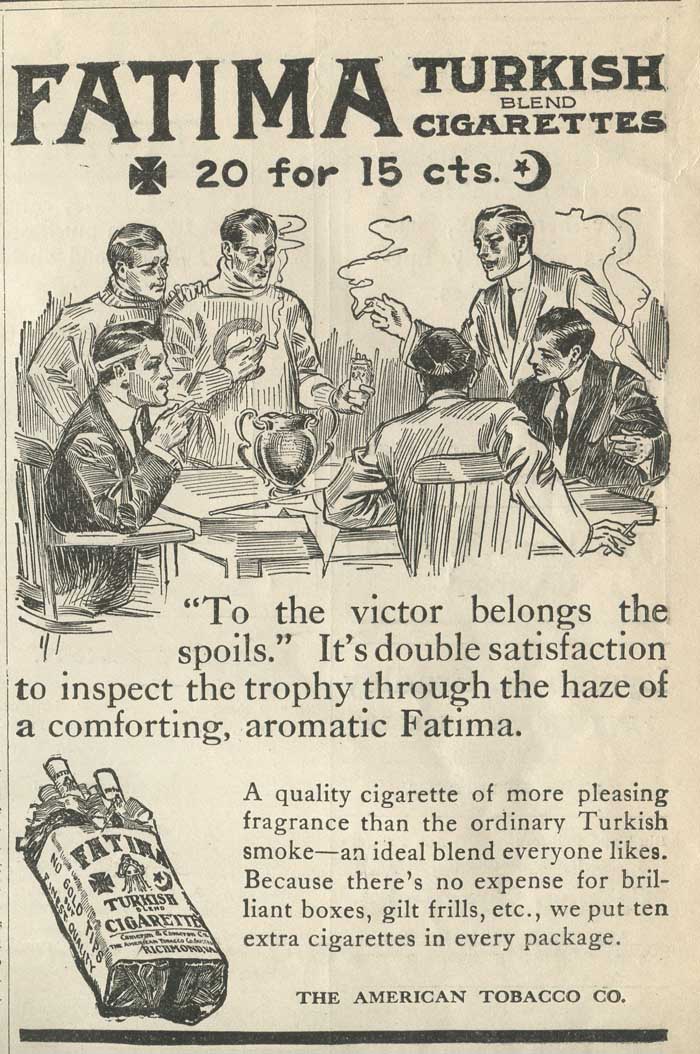
Best Advertisement:  Fatima cigarettes—guys smoking around a trophy.  How many packs did they smoke the day before the game?

Tags:

30
Sep

For those suckers born in the last few minutes

   Posted by: rring   in Uncategorized

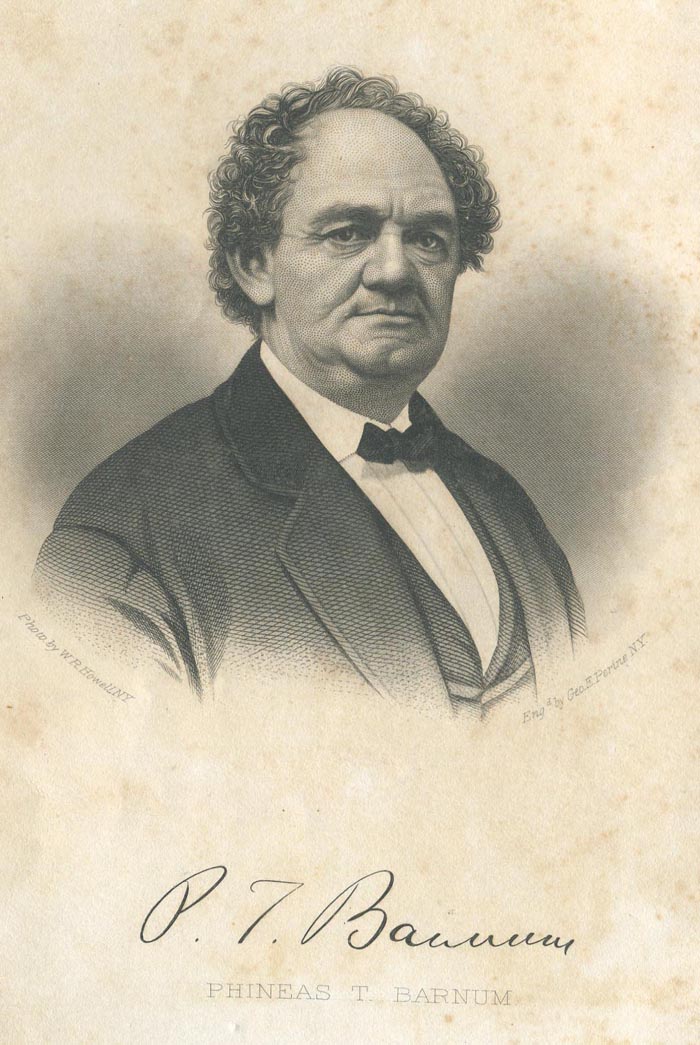
The fact that 2010 is the 200thanniversary of P. T. Barnum’s birth just crossed my desktop, so I thought a glance into the stacks to see what we have would be interesting.  Barnum was born in Bethel, CT on July 5, 1810 to Philo F. Barnum, a merchant farmer who apparently descended from one of the eight original proprietors who established Danbury in 1685.  His mother was Irena Taylor, daughter of Revolutionary War veteran Phineas Taylor.  After a few false starts as a clerk and a newspaper owner, Barnum essentially moved to New York in 1835 and started shucking & jiving, beginning with purchasing the services of Joice Heth, purportedly the 161-year-old ex-nurse of George Washington, for $1,000, and making $750 a week by charging admission to hear her spin tales of our first president for a year until she died.  Schemes like the American Museum and his various traveling shows (including The Greatest Show on Earth) generated tremendous crowds and fans, and had an enormous impact on American popular culture.

The Watkinson has a nice handful of sources, including the second edition of Barnum’s autobiography, entitled Struggles and Triumphs: Or, Forty Years’ Recollections (1869)–from which the portrait of Barnum shown here was scanned.


“Without printer’s ink,” Barnum once said at a banquet in his honor, “I should have been no bigger than Tom Thumb.”  We have a copy of his Humbugs of the World (1866),which includes some of his theories about the effective use of publicity.  Barnum defined a “humbug” as “putting on glittering appearances–outside show–novel expedients, by which to suddenly arrest public attention and attract the public eye and ear.”  I include here a page from the table of contents.


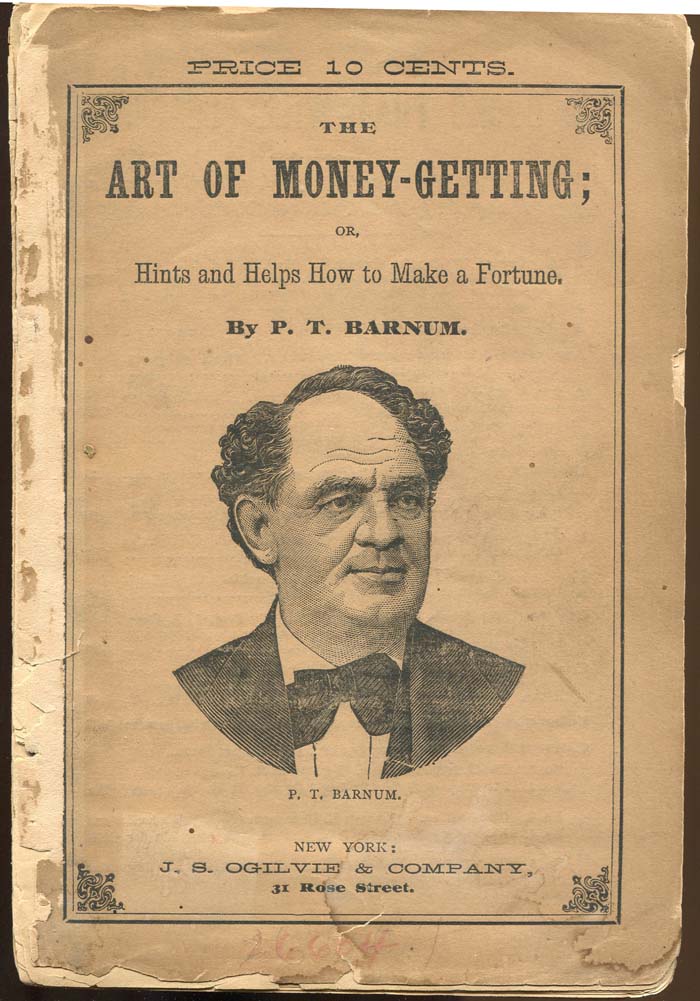
“The Art of Money-Getting, or Success in Life” was first delivered as a lecture to an audience of over 2,000 in London on December 29, 1858, and in the London Times review of it the next day, its organization was likened to Cicero’s De Officiis.  On our shelves we have an edition of this printed in 1882.


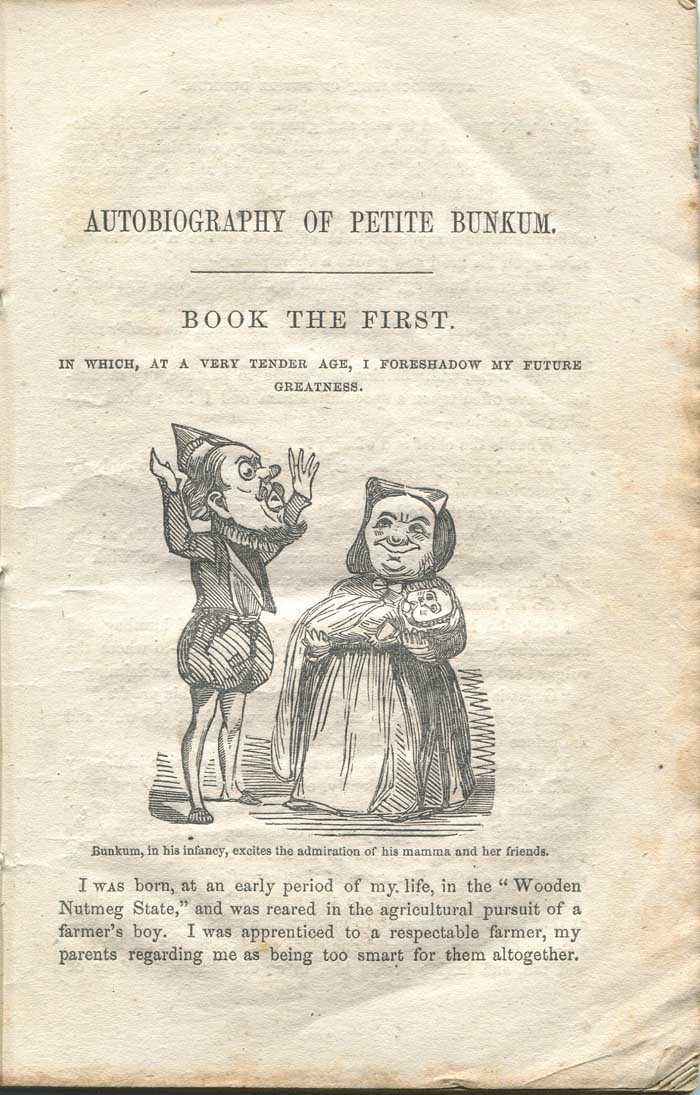
The final nugget is, according to biographer A. H. Saxon, “an anonymous burlesque” by one of Barnum’s journalist friends, entitled The Autobiography of Petit Bunkum, the Showman, published in 1855–the beginning of which is shown here.

Tags:

29
Sep

New Acquisition: Two Travelogues

   Posted by: rring   in Uncategorized

Announcing the acquisition of a couple of nuggets, recently plucked from the trade:

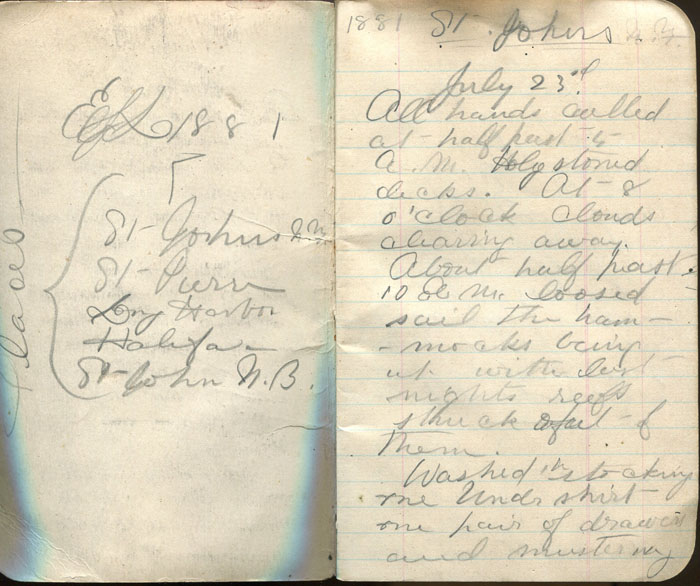
Two manuscript journals by different authors, one recording a seaman’s nautical journey launched in 1881 from Saint John, New Brunswick, with stops at Saint Pierre, Long Harbor, and Halifax; and one a Brooklyn man’s 1885 trip to Florida by way of Alabama, Mississippi, Louisiana, and Georgia, mostly via train.

The sea journal describes the sailor’s never-ending efforts to keep the decks clean with sand and holystone and to keep himself clean as well; when no such labor is required, he reads “newspapers and history” or studies navigation and geometry, with a trip ashore noted for “target practice.”  There is one account of a fierce and damaging storm, and another of the attempted rescue of a steamer wrecked near Halifax; a Newfoundland 5-cent stamp with an image of a seal is pasted into the book.  At one point a lieutenant reads “the Articles of War”; it is possible, then, that this journal was kept on a Royal Navy vessel.

The Florida journal describes a visit to 1884 World’s Fair in New Orleans (the World Cotton Centennial Exposition) and includes a list of “Bird skins collected in Halifax River Region – 1885” as well as a lengthy itemization of travel expenses and another of birds seen or heard “during a walk 3 miles north of Jacksonville on afternoon of Feb. 7/85”

Tags:

27
Sep

This week @ Trinity, 100 years ago…

   Posted by: rring   in Uncategorized

September 27, 1910

“Freshman Win Both Rushes”

The freshman were victorious in both of yesterday’s rushes, winning the bulletin-board rush and the rope rush in rather easy style.  The sophomores were simply outnumbered, and are to be congratulated on their spirit in putting up a hard fight in the face of almost certain defeat.”  [The rope rush was new that year, and was described thus]: “At a signal from the referee’s whistle the two bands of shouting contestants rushed furiously at each other with an energy that became somewhat abated before the conflict was declared a victory for 1914.  Each man was armed with a four-foot length of rope and as he encountered a man from the opposing class he strove to tie him in such a manner that there would be no chance of his farther entering the battle . . . in previous years “Bloody Monday” rushes have been more or less farcical, but in no way could this be so termed . . . the college body, who witnessed the conflict as interested spectators from the sidelines, decided that there was no doubt as to the practicability of this new rush, and it will be a welcome substitute for the “push rushes” of former years, which maimed several men and were otherwise brutal.”

Best Advertisement:

The College Tailor (44 Vernon Street) offers “clothes pressed and cleaned for only $1.00 a month.”

Tags: