
I think it would be interesting to follow these tweets through the week of February 6-13th.According to an article from the guardian, the next Women’s March scheduled for March 6 and announced on Feb 6. https://www.theguardian.com/commentisfree/2017/feb/06/women-strike-trump-resistance-power
It seems as though many people are less active during the middle of the week. The least amount of activity was during both Tuesday and Wednesday. When looking at weekday versus weekend it seems as though people are tweeting more during the weekend.
When looking at my data on voyage it displays that my corpus has 7 documents with 84,582 total words and 4,127 unique word forms. It was extremely interesting to look into the distinctive words and how they differed throughout each day of the week. On Some of the words that were popping up that pertained to my hashtag were ones such as “planned” “parenthood” “health” “access” “women” “protecting”. When taking out terms such as https, t.co, RT and my hashtag the cloud of words became more condensed and more interesting. The most frequent words that were used in the corpus were planned (1770); parenthood (1768); ppact (1660); care (1124); speakerryan (597). The first word that came up was planned and the second was parenthood. Although my hashtag does not use these terms and simplifies it to “PP”, it is clear that this should be what is first and most commonly associated with my hashtag. It was interesting to look at the hashtag #ppact as one trending that also pertains to planned parenthood. The next terms that proceeded I was interested in seeing that speakerryan came up and after looking on google I found that this was a reference to speaker Paul Ryan from the House of Reps. When looking this up I found a CNN article regarding the topic- http://www.cnn.com/2017/01/05/politics/paul-ryan-planned-parenthood-obamacare/ . This article discusses how Paul Ryan announced that Republicans are moving to strip all of the federal funding for planned parenthood in order to begin their process to dismantle Obamacare. It is occurrences such as this that I thought would effect my hashtag and would be interesting to see the discussion generated during. Some words that are high on the terms list are filler words such as i’m and say as well as â. There are some words that I was not positive as to why they are on there and am unsure if they are words that are obscuring or if they have more of a significance that I am missing such as 0000, arizonans, and tue. I was specifically interested in understanding why “arizonans” was included- as I tried to look up if there was any reason behind this but nothing popped up immediately.
The words that I decided to add to my stop words were: i’m, say, 0000, â, amp, ðÿ, pin, asvrjq6g0j, ainnvq1jg9, t.câ, iâ, npwf, jhiavvgâ, 6r6y8aobqf, n6iymytyar, istaâ, 700, 492, n6iymytyar, 6061, 608, nevadans, 202, 804, 8210, 720, istandâ, r0ou7jl2hn, and d7v4â. After taking these words out I feel as though it really cleared up my overall diagram, allowing me to accurately look at the way in which people are talking about my topic without many outliers. After the first round of taking these words out I was still seeing a few extra words so I also took out 775, 608, and 0136. I feel as though in order to visualize the best story pertaining to the discussion around my topic around 85 words should be represented. Although this does not seem like many it allows for one to really look at and understand these words, as I feel as though many of them have a deeper story such as the example of speakerryan. Also, my hashtag seems to generate a lot of excess words and otherwise there would be a lot more stop words to add in. When looking at 85 words there are many simple words that display the support from the overall community such as rights, need, health, urgent, sign, women, etc. Through this visualization it is also clear that many people are not only tweeting in support of planned parenthood, but tweeting towards those and that opposing and trying to distinguish planned parenthood. There are words that target trump, speakerryan, etc. I also found it interesting that there were different people and groups of people being targeted in these tweets such as emmastone, nevadans, arizonans, jefflake, elizabethbanks, texas, etc.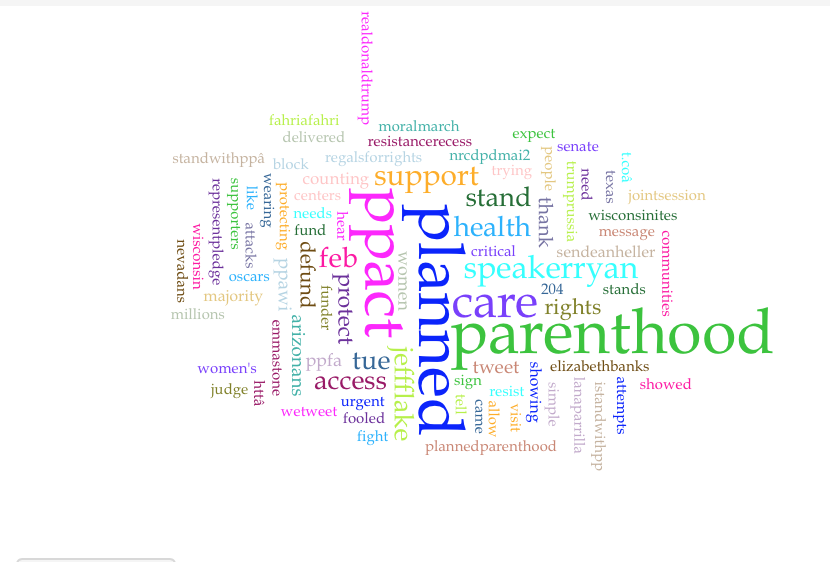
The words that I choose to look into were “speakerryan”, “defund”, and “trumprussia”. I decided to do speakerryan in order to see when people began tweeting about his ideas to take away federal funding for planned parenthood as well as how this has changed overtime. I also decided to look at defund in order to see how it correlates with speakerryan as to when people were most tweeting about it. The third word that I chose was “trumprussia” due to the intense discussion this topic would generate. While I also understand this is a topic that would cause a lot of discussion, I am also really interested in understanding its relation to my hashtag. This is why I decided to look at when this was being tweeted over time and see if I could draw any conclusion on its relevance as a key word within my topic.
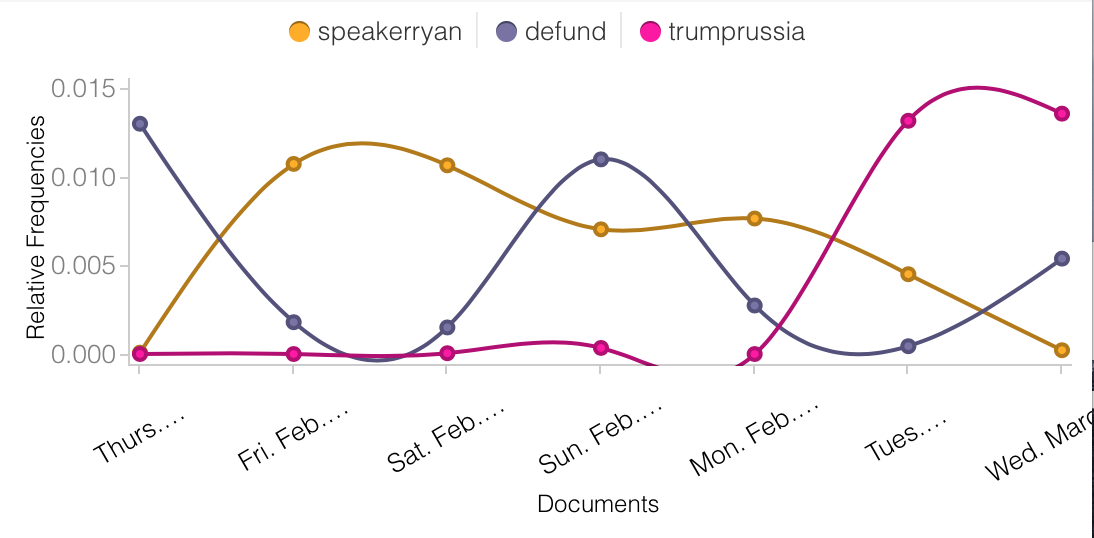
When looking at this data it was interesting to see that speakkerryan was pretty persistent throughout, but started to decline later in the 7 day period. I thought that defund would have spiked at the same time as speakkerryan, but was surprised to see that it did not. I also was not surprised that there were not many tweets being generated about trumprussia throughout the period then all of a sudden there was a large spike on Tuesday. The fact that there was not much talk about this keyword then it had a large presence explains why it was overall a trending term. After scanning the three words tweet contents I decided to look into the contents of “defund.” Most of these tweets contained the statement “tell the Senate: Block all attempts to defund #PlannedParenthood.” Other ones noted that Congress wanted to defund planed parenthood and would go on with hashtags and slogans to stand with it. This is the type of discussion I initially thought would be generated through my topic.
http://voyant-tools.org/?corpus=ebc9e6b8d6d163eed757fc21c23de818
The article that I chose to put into voyant was posted by time stating that “Republicans Take Upper Hand in Fight to Defund Planned Parenthood”. I decided to choose this article due to the fact that my entire topic was established due to the political decisions to diminish planned parenthood. Throughout my data scrapping it became clear that my tweets revolved around taking a stance around most recent acts to take away federal funding from planned parenthood. This article discusses how Republicans plan to take action to defund planned parenthood, thus I thought it would be very relevant and of interest to see an analysis of this post. â, oewe, 553, trumpâ, 07, 1.3, 1.6, 2018â, 300, canâ, care.â, groupâ.
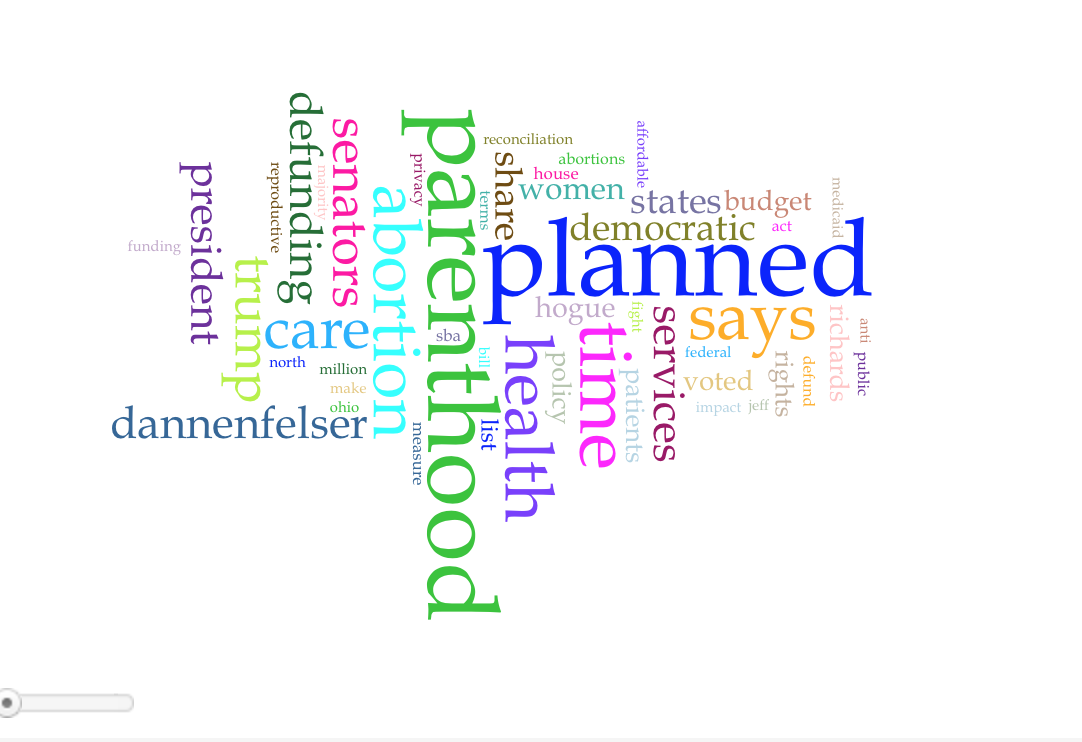
Overall I felt as though these stop words were coming up in the article less frequently than in my tweets. When looking at my own tweets generated and comparing it to these they are very similar in the major terms. Where it differs is when looking into the excess terms. I feel as though the tweets display more of the opinions regarding my topic, whereas the article simply reports what is going on. Because the tweets show the way in which this news is having an impact on the general population, I feel as though they are more interesting to look at when understanding my topic and my hashtag overall. This being said, it is also possible that these tweets are slightly biased in the fact that most if not all of the time, those who are actively tweeting about this are clearly upset with what is occurring in the news.
http://time.com/4626516/planned-parenthood-defund-republicans/
Examining Tufte’s statement that “Superior methods are more likely to produce truthful, credible, and precise findings” (1997, 27) as well as Yau’s statement that “Data is an abstraction of real life, and real life can be complicated, but if you gather enough context, you can at least put forth a solid effort to make sense of it” (2013, 41), it becomes clear through my own personal readings as well as analysis that Yau’s approach is more sensible considering the fact that we are gathering data from twitter. Like I addressed in my last post when looking at both the words generated from twitter as well as a reliable news article, it becomes clear that there are many ways in which these words and this data can be biased based upon the context and platform it is on. Even when looking at news articles, each company has a clear stance and because of this creates some sort of bias. Because of this it becomes essential to really examine context and understand data as more of a story. I personally have worked a lot in advertising and in this we focus on combining both data driven insights and the creative story to attract the consumer. When looking at it like this it becomes essential to see the ways in which data can be used to create and establish meaning based on its context.
First off, you did a good job with finding the reasoning behind all of the words associated with your hashtag. The article explaining what Paul Ryan was talking about really helps explain the word cloud results. My hashtag did not have much of terms that needed further explanation but for future labs, this is a great decision to make.
As in Olivia’s word cloud, I am glad to see that basically all of the associated words are positive and supportive of Planned Parenthood. I expected to see some more negative words, particularly from people who support Trump’s potential decision to defund PP, but it is reassuring to see that Twitter users generally are supportive of the organization. Your results are drastically different from mine, where the majority of the associated words criticize transgender individuals. With the article you chose, the word commonalities are pretty similar, though the article, as expected, is less biased and has more neutral words. As we have discussed in class, tweets tend to have more polarized views of topics whereas magazine articles are more neutral, so these results make sense.
The most thoughtful thing about your post was the days you decided to further analyze your data set. Choosing the days when the women’s march was being planned was a very interesting way to see the tweets of the march in it’s most heated moments. I also found it interesting that out of all of your words, there was only about 4,000 unique words. That means that everyone is tweeting and saying the same things. Whereas my hashtag #LGBT covers such a wide variety of topics.
One thing that I think would be interesting to consider is what the tweets would look like on an hour by hour break down of the day of the women’s march. Seeing when specific words peaked or valleyed throughout the day would be very exciting to see. I wonder if your twitter data was all pro planned parenthood, because I was interested to see the similarities in your word clouds with the republican article. From your post, I learned more about opinions vs. straight facts. I think that this relates to my post as well, as my article is an informative one regarding transgender heath, when my twitter data was opinion based tweets on transgender and other lgbt members.