
In my analysis, I expect to see topics like Donald Trump, Black Lives Matter, and gender equality to pop up.
I chose to show 55 terms in my cirrus. The summary of my analysis shows that the most frequently used word after “woke” was “rt” during the week of Feb 1-7. I find it interesting that the tweets that my hashtag produces apparently have an affect on people who see it to send the message further. It explain the vastness and diversity of my data. After cleaning some of the terms, I still found a few terms obscuring my lens. the most frequently used one is a “dy” symbol that is completely invaluable to my data. The are also some words that were included in tweets to make complete sentences, like “don’t” and “the” that are also not useful. There are a good amount of social terms that I find more valuable.
Words that I added to the stop words list is as follows: bowl, â, dÿ, don’t, martysauresrex, officiallyice, philophy, sssalbum, and vuhsace. I chose to show 35 terms in my word cloud.
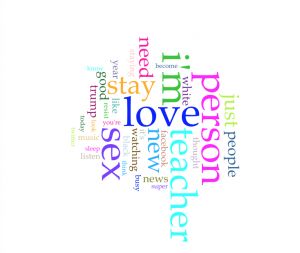
I found that my word cloud reveals something interesting about my data. Some of the words that I expected to see used the most frequently are represented on the word cloud, but as smaller words. I found it interesting that the top five most frequently used terms were “love”, “I’m”, “person”, “sex” and “teacher”, and it actually says something about my hashtag. It seems like terms that involve human interaction and human values are used almost always with #woke. Then, through the terms with smaller text size, you find the specific issues people are talking about, like “trump”, and racial issues. I was extremely surprised by this, but I do like the message it portrays, which says a lot about my hashtag.
Three terms that spoke to me were “Trump”, “Black”, and “people”. I chose Trump because his election and inauguration have been headlines of discussions for months now. The term “black” stood out to me primarily because I have noticed an extremely large amount of tweets about racial issues with my hashtag. I also want to see how much was being talked about Black History Month, which is February. Thirdly, I chose “people” because my hashtag is a term about human interactions and also the opinions of people. Social issues are about people.
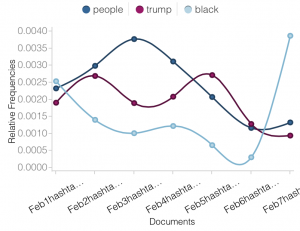
I am not surprised by these trends. I expected each of them to be consistently used throughout the week. Nothing especially exciting happened around Trump, which explains that consistency. Both “people” and “black” were used with greater frequency at the beginning of the week than at the end, until “black” spiked on February 7th, which i didn’t expect. After some research, I found that on this day in 1926, Carter G. Woodson started the first Black History Week, which evolved into Black History Month which covers the entire month of February. http://voyant-tools.org/?corpus=f319ac15d6226eae51ed18bb00bd2ad5&stopList=keywords-4aa6e913be3fdf50a221f052a7f8a81a&panels=cirrus,reader,trends,summary,contexts
The article I chose is titled “Racial Structures and The Structure of Mass Belief Systems”. I chose this article because it outlines data analysis and reveals political attitudes and issue preferences. It explains reasons for ideological constraint, which speaks a lot towards twitter and the reasons why people do/don’t express themselves.
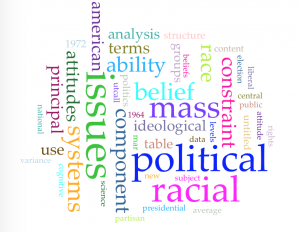
In some ways, this dataset does help me understand my Twitter data in a better way. Because of the nature of my hashtag being so broad, covering a number of different issues, focussing on data about one specific issue increases the depth of my data. I can relate some of the words in this new word cloud to the more general terms in my Twitter word cloud.
In regards to the data I have acquired and researched from #woke, I think Yau’s approach is the best. From the first time I acquired data, I realized that a good amount of tweets had nothing to do with any social issues, and people were using the hashtag in a less-political manner. Yau’s approach makes more sense because I needed to gather a lot more data, because looking at a small sample of it wouldn’t create credible, precise information. Also, because the use of it is quite random across a wide range of social issues, there really isn’t one superior method to help understand trends in the information. Yau’s approach states that real life is complicated, like my data. I feel like I have made enough sense of my hashtag through continuous data research of the thousands of tweets my hashtag produced. Given today’s lab, the fact that I was able to improve on my knowledge of my hashtag through reading another article about a specific issue enhances Yau’s idea. The more we dig into our datasets the closer we get to making sense of our information.
Looking at your word cloud, I share your surprise with regards to the primary topics represented. I was expecting social issues to come to the fore, rather than appearing on a lower tier. It seems to me that #woke is more focused on personal relationships, given the frequency with which “love” and “sex” are used—do you think that perhaps #woke is related to a different, non-political movement? If not, what made those words rise to the top and caused the more political issues to fall?
Comparing to my own research, it’s interesting to see some common words and ideas between the two hashtags—”trump” and “resist” appear in both our word clouds, and issues of race are represented by both. I would like to dig deeper into my own data and see if #woke appears.
I was surprised that your most commonly used words: “love”, “I’m”, “person”, “sex” and “teacher” did not include political terms such as “Donald Trump” or “BLM”. I could hardly see “Trump” and “black”. It seems that #woke may be geared toward gender and sexuality issues more than race and political ones. Even so,
Why did you expect “topics like Donald Trump, Black Lives Matter, and gender equality” to appear in your text analysis? Is it because of the week that you chose to study or recent event reported in the news?
There is a visible delay in “black” and “trump” words. In other words, first the use of “black” decreases Feb. 1-3 and then the use of “trump” decreases Feb. 2-4. After, the use of “black” increases Feb. 3-4 and then the use of “trump” increases Feb. 4-5. This is surprising, because I would have thought that tweets using “trump” would instigate tweets using “black”, not the other way around. When we do a text analysis again, I will look for the same trend in the #BlackLivesMatter data.