
Given my maps and analysis of my tweets, I expect the topics of my tweets to cover terrorism and violence in the Middle East, as well as some politicized terms. This is what the majority of my tweets are about, as in most languages and cultures “ISIS” has this connotation. Once in a while, however, I will see a tweet that mentions ISIS in a totally different way, entirely unrelated to my hashtag topic, but I don’t think that will come into play much.
My document contains 91,530 total words and 7,989 unique word forms. One interesting data points from the summary box are that my three of my most highly occurring distinctive words on February 22nd were “leaving” “burn” “rings”. A second interesting data point is that although February 23rd had the shortest document length, it also had the highest density of tweets.Overall, the biggest thing obscuring my word cloud were letters with accents over them. These do not get picked up by the program’s initial stop list, so I believe that is why they’re so prevalent. In addition to that, words in foreign languages obscure my word cloud, however I do not think these are inherently not useful. They are not helping my understanding of the world cloud, but that may only be because I cannot understand them.
Stopwords: RT rt https t.co amp #ISIS #isis isis, t.cȃ à á ã å ø ù ú ü ȃ
Number of words included in word cloud: 145
Overall, I am very satisfied with my word cloud. Setting the slider to 145 terms seems to include a lot of relevant subjects, while not being so much that it starts to include off-topic words. I would say that this is what surprised me most about my visualization; simply how well it worked. I expected to see terms regarding terrorism, violence in the Middle East, and politicized terms and I got exactly that. The word cloud suggests many topics that are obvious, but is also full with terms that are logically connected to ISIS. I do not believe that this will make me think differently about my analysis to date, as this was much of what I expected. My five most frequent terms are: Mosul, Women, Iraq, Syria, and Liberated. The term that most surprised me here was Women, because although the topic of women and women’s rights in the Middle East is common, I did not expect it to have such a strong correlation with the topic of ISIS.
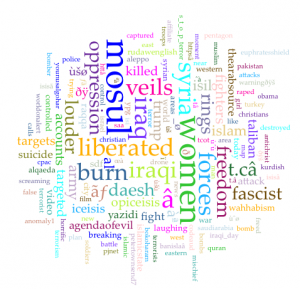
I am selecting the 5 terms Mosul, Burn, Iraq, Veils, Liberated, I choose these because I could see how some of them may correlate with each other.
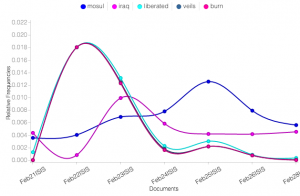
I was very surprised to see the results that I did. Although I chose these terms because I anticipated some correlation between them, I did not expect how closely they would correlate, or the terms that would be correlated with each other. I was expecting some sort of violence correlating Mosul and Iraq because of the term Burn, and a correlation between women and liberated. There is a nearly perfect correlation between Burn, Veils, and Liberated that is heavily concentrated on February 22nd. There was clearly some sort of politicized event that occurred on the 22nd involving the burning of veils. In addition to this, I expected to see some sort of correlation between Iraq and Syria, however they both trended the most on entirely different days.
http://voyant-tools.org/?corpus=c02e702a5b42057ee8b025d8a3d663fa&stopList=keywords-c6b2c39773ba8fdb9a38539e3e2307a3&panels=cirrus,reader,trends,summary,contexts
Stop words: ISIS, isis’s, al, qaeda, abdelaziz,
The document I chose to run a text analysis on is called ISIS: Inside the Army of Terror Michael Weiss. I selected this because it seems to capture the entire subject of ISIS as a whole, as opposed to an article or policy statement which would likely be concentrated on one event or action of ISIS.The word cloud directly reflects the American aspects of my data set, as this is a book written with an American audience in mind. This book and the text analysis that come from it does not help me better understand all of my Twitter data, however it does help me understand the portion of my Twitter data with tweets relating to ISIS and their war efforts, especially those that get American media attention.
While carefully reading for today’s class, I was struck more by the work of Tufte than I was of Yau. Tufte’s logical and concise approach resonated with me as a person, and I appreciated the black and white nature of the way he saw things. I related to Tufte’s way of thinking, and I found myself agreeing with him, despite the fact that I have minimal experience in data visualizations. This lack of experience is the precise reason why, as I was completing the lab, I found myself agreeing more with Yau. After playing with the multitude of options on Voyant, it appeared to me that data could be very abstract, and things will appear to logically connect one way when, in reality, they meant something entirely different. This was exactly the case with my experience in working with the visualization of the trending of words across the different days of my data sets. I thought that logically, Syria, Burn, and Iraq would be closely related, and Veil and Liberation would be loosely associated, and I was entirely wrong. Veil, Burn, and Liberation were perfectly grouped, while Syria and Iraq trended on completely opposite days. This experience made me appreciate Yau’s approach because it made me consider that not all data is exactly as it appears. There are correlations and trends that can look like they’d be one thing and end up being entirely another. Although I respect both scholars on their work and value each of their approaches for their differences, today’s work made me believe in the context of our work with Twitter, Yau’s approach is superior.
Whats happenin. Your predictions were pretty accurate (as I can see based on your Word Clouds), and just Nell you and I share some similar words. The words you chose really revealed an amazing correlation, specifically Mosul and Liberated, this is very interesting! Great find! You ended with a great text visualization. Yau’s approach, as you have said, is greatly exemplified here–data is not always at it seems!! Have a wonderful break, great lab–enjoyed reading it!
ALso, I think it is important to note that the article you chose to read gives a great look at how the American media give attention to ISIS. Interesting read. Thanks for sharing.
Jack,
I thought it was really interesting that your three most highly occurring distinctive words were “leaving” “burn” and “rings” as these words are very broad and can lead to many different interpretations. I had a similar problem as some of my words contained letters with accents over them, which took away from telling my story through my word cloud. I thought you did a really good job on your word cloud as it is clear and has a wide variety of words. I concur with you that it is interesting that one of your most frequently used words was women. It was also interesting to see how nicely your words correlated on the map. I think it would be interesting to look up what occurred on February 22nd to see why Burn, Veils and Liberated were so heavily used on that day. I thought it was insightful that you used a document that was written for an American audience and I am interested to know what words appeared in your word cloud. In relation to my hashtag I am surprised that muslimban wasn’t prevalent in your word cloud because ISIS is a major reason why Americans think Muslims should be banned from entering the country.