
This week we looked at the language in which #BlackLivesMatter tweets are posted in, and the number of tweets posted daily from Feb. 14, 2017 to Mar. 1, 2017. When we mapped geocoded tweets, we found that most of the mappable tweets were from the US. Therefore, I expected to find that most of the tweets are written in English or Spanish. Moreover, when we performed a network analysis we found that on Feb. 26, 2017 all of the main network clusters were tweeting about the same topic: the death of Trayvon Martin. Therefore, since Trayvon is from the US and his death was a important catalyst in the BLM movement, I expect that most of the tweets are in English or Spanish, and that there was a spike in the number of tweets Feb. 25-27, 2017.
Microsoft Excel was used to analyze the tweets. The analysis determined that 68232, or 94%, of tweets were written in English. The second and third most used languages were French and Russian, and Spanish is only the forth most commonly used language. (See summary tables below.)
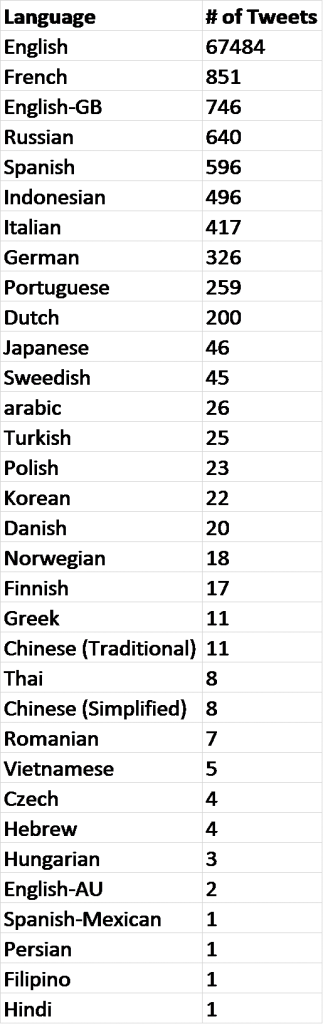
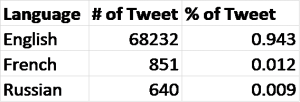
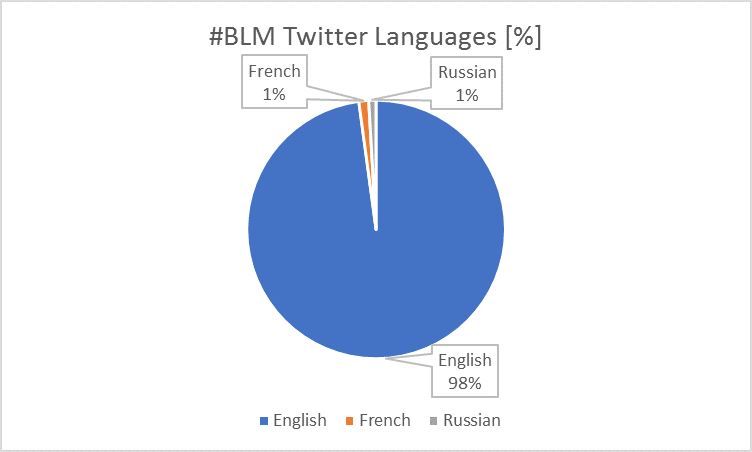
We should not assume that English is the most commonly used language, simply because our analysis has determined it to be. Microsoft Excel did not perform a language analysis on the Twitter text to detect the language used, Twitter did. As we have learned in class, from articles like Shaka McGlotten’s “Black Data” and Tarleton Gillespie’s “Can an Algorithm Be Wrong”, algorithms are coded by people who encode bias into the algorithm. So, it is probable that the Twitter text algorithms were coded to best detect English, the “predominant” language. Therefore, while our knowledge of #BlackLivesMatter tweets may confirm that English is the most commonly used language, it may not be as commonly used, 94%, as the Excel analysis determined.
Next we plotted the total count of daily tweets from Feb. 14, 2017 to Mar. 1, 2017. We see a spike in tweets on Feb. 18, 24, and 28. There was a lull on Feb. 22 and Mar. 1. Since Twitter data scraping began mid afternoon on Feb. 14 and stopped early morning Mar. 1, we will ignore the daily count for these days.
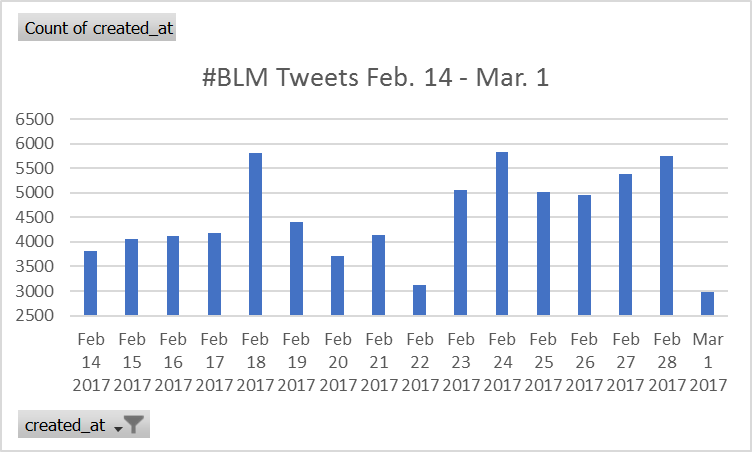
From our text analysis lab, we know that on Feb. 23 #BlackLivesMatter was being used together with #protecttranskids. This followed president Trump’s decision on Feb. 22 to “rescinded protections for transgender students that had allowed them to use bathrooms corresponding with their gender identity.” (Jeremy) The text analysis revealed that many people who tweet about the Black Lives Matter movement also tweet about transgender rights. So perhaps these people stopped tweeting about the Black Lives Matter movement on Feb. 22 to instead focus the topic of their tweets on transgender rights.
A quick google search revealed that there was a Black Lives Matter Teen Conference at the Schomburg Center for Research in Black Culture in New York on Feb. 18. This conference is a likely contender for causing the spike in #BlackLivesMatter tweets on Feb. 18. Additionally, Feb. 28 is the last day of Black History Month in the U.S. The text analysis, which revealed the connection between support for the Black Lives Matter movement and transgender rights, also revealed that many of the tweets using #BlackLivesMatter were about Black History Month. Feb. 28, 2017 was also the first day of Mardi Gras in New Orleans. I spent my spring break in New Orleans, just after Mardi Gras, working with Habitat for Humanity and an organization that recycles Mardi Gras beads. It was evident from the conversations that we had with leaders from the community that Mardi Gras is a time to celebrate the history and culture of black people in New Orleans. Thus it may have been that #BLM supporters rallied on Twitter to celebrate the last day of Black History Month and the first day or Mardi Gras.
To better understand the frequency of #BlackLivesMatter Tweets, the average, median, mode, sum, max, min, and range of daily tweets was calculated. These values were then compared to the statistics for other students’ hashtags. Below is a table that shows how #BlackLivesMatter statistics ranked in comparison to the other social justice hashtags. A high rank score (i.e. 10) corresponds to a high statistic.
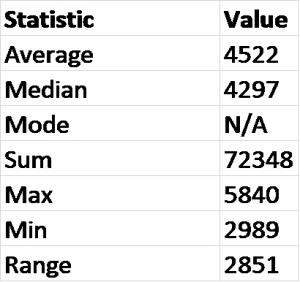
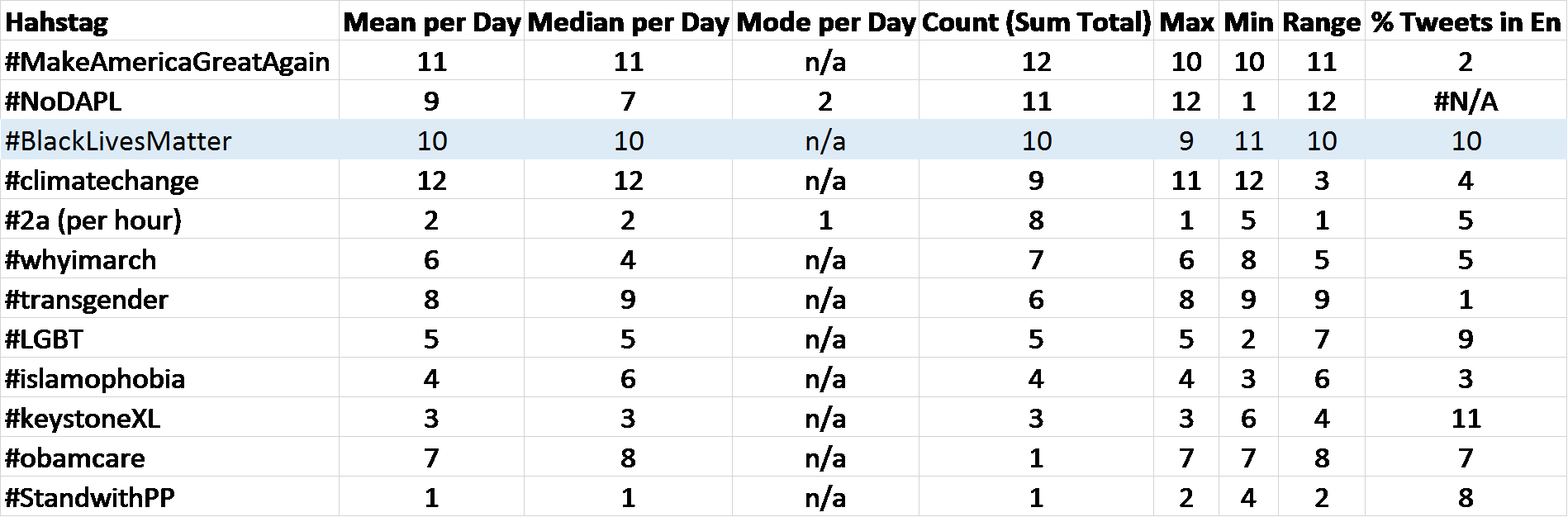
There appear to be no correlations between Count, Range, and % Tweets in English. Only the range of #BlackLivesMatter tweets stands out: range = 2851. Seven of the twelve hashtags have a range that is less than 1000. It is difficult to identify the cause for such a high range. The Twitter data that we scraped for this lab was less than 0.01% of all Twitter data. There is no way of knowing if the sample is significant and random. Moreover, we do not know if Twitter allows data to be scraped based on a hashtags trending status. As we learned from Gillespie, Twitter uses its own unique algorithms to determine trending status. A hashtag does not trend simply because it is used most frequently. To be considered trending, a hashtag must be used by different groups/clusters and must have a spike in total count. Of course, we do not know exactly how Twitter determines trends, but we do know that its trending algorithms make stating conclusions about our analysis difficult. Overall, the large range in daily count may indicate either of the following: people who are devoted users of #BlackLivesMatter are also supporters and Twitter users of other social justice hashtags, or #BlackLivesMatter is so commonly used that it is not always considered a trending hashtag by Twitter.
Works Cited:
McGlotten, Shaka. 2016. “Black Data.” In No Tea, No Shade: New Queer of Color Critique, ed. E.P. Johnson, 262-286. Durham: Duke University Press.
Gillespie, Tarleton. 2012. “Can an Algorithm Be Wrong?” Limn (2)
Jeremy W. Peters, Eric Lichtblau and Jo Becker. “Fight Erupts in Trump Administration Over Transgender Students’ Rights.” The New York Times. February 22, 2017. https://www.nytimes.com/2017/02/22/us/politics/devos-sessions-transgender-students-rights.html.
https://www.eventbrite.com/e/black-lives-matter-teen-conference-tickets-31069955072#
Interestingly, both of our data sets had a significant number of tweets per day and a high value for the range. I wonder if the range for your data (and other large datasets, including mine) is greater simply because the total volume is greater. I would like to see the full datasets from the rest of the class to see if there is any correlation. In my own data, I also saw a distinct drop centered around a significant event. In both cases, I wonder if there was an actual drop in the number of tweets, or if the Twitter algorithms showed an artificially lower number of tweets.
I found your insight on encoding bias, and how Twitter’s algorithm is most likely to work best detecting the English language. It is something I didn’t take into account, and probably explains why I got a lot of tweets with weird symbols that Microsoft office or Twitter couldn’t detect. It raises a lot of questions about what Twitter allows us to see, and I had a similar experience with my analysis. I think your point about how Twitter’s algorithm might not state #blacklivesmatter and #woke as trading because they are very commonly used, and have been for a long time. Does this mean “trending” only applies to new conversations?