
Featured post

Registration Instructions for Fall 2014

sample-barcode-300px

Dear Trinity Students:

If you are interested in taking my Sports, Race & Nationalism seminar in the Fall of 2014 you have to do the following steps listed below. You must follow this steps or you will not get a registration permission PIN number.

  1. Decide whether you want to enroll in the History or International Studies section; that is, under Hist. 383 or INTS 383. Students majoring in History should register in Hist. 383 and INTS majors in INTS 383. Other students have the choice of either one.
  2. Please be aware that the enrollment cap for the *combined* sections is 15, so either 7 or 8 in each one, depending on which one fills up first.
  3. Enrollment priority for Hist. 383 will be given to History majors and for INTS 383 to INTS majors.
  4. If you are interested in taking the course, you must send me an email message indicating: (a) why you want to take this course and (b) in which section you want to enroll. –– Please send the email to *both* of my email addresses: (a) Luis.Figueroa (at) trincoll.edu *and* (b) Luis.Figueroa.Martinez (at) gmail. Please notice the dots between my names in each email address. Sending them to both will guarantee that I see you email because I get each day sometimes dozens of emails in my Trinity email account.
  5. I will evaluate all the students who write me no later than Friday morning, April 18, and will then send the registration PIN numbers to the selected students so you can register in TCOnline on Friday or Monday.
  6. If the combined sections of the course are full by Monday, students not chosen for either section will be added to a waiting list. Then, once the add\drop period starts in late April or May, I will send emails adding students to the list as spaces become available. This will apply for the entire add\drop period, which ends early on the second week of class in September.

 If you have any questions, please send me an email to *both* my Trinity and my Gmail addresses, as specified above in step #4.
Featured post

Introduction

The purpose of this website is to serve as a teaching and learning vehicle for students and the instructor in courses on sports taught at Trinity College (Hartford, Connecticut) by Prof. Luis Figueroa–Martínez.

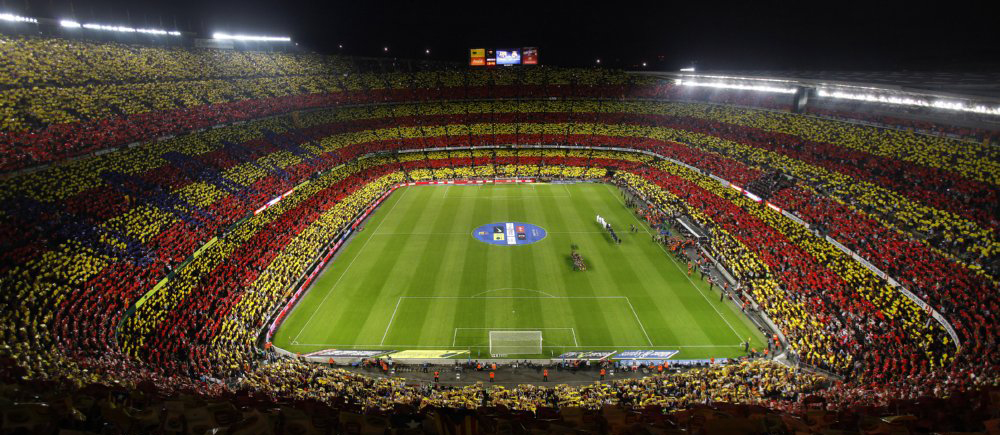
The crowd at a Spanish "La Liga" football game during the pre-game ceremony. Source: nye.com (public domain)

The crowd at a Spanish “La Liga” football game during the pre-game ceremony. Source: nye.com (public domain)

Originally intended to serve this purpose for a Fall 2013 seminar titled “Sports, Race and Nationalism,” for a variety of reasons it is not until now (January 2014) that I have been able to incorporate it into another course, this time on “Soccer, Race and Nationalism,” that I’m teaching during Trinity’s first J-Term, a three-year curricular experiment at the college.

We invite everyone to explore the topics examined in the course and the ideas expressed by its students. Continue reading

Gabriel Maletta Final Paper

European Integration and Racial Controversy at Euro 2012

Soccer is often described as the “beautiful game,” captivating people around the world with its simplicity and ability to bring people together. This can be seen from the lowliest back alley pick up game to the worldwide tournaments that attract millions. In many instances however, major soccer events are sought after for reasons beyond an appreciation of the sport.  Hosting a major tournament has become a way for countries to show their best side to the world and to secure political and economic benefits that last after the final game is done.  But soccer has a dark side as well, a history of racial and ethnic intolerance and violence that can show a nation at its worst.  In 2012, Poland and the Ukraine defied expectations and demonstrated that a concerted effort by all participants keeps racism in the shadows. Continue reading

Jordan Adams Final Paper

1/18/2014

Room for Four: The Establishment of the MLS


When it comes to the sporting world America has already chosen its big three, while some may consider the NHL to be the fourth sport to really become ingrained in mainstream American sports, it has yet to gain the same level of recognition that the MLB, NBA, and NFL have maintained throughout recent years. While soccer may be one of the world’s most popular sports, it has yet to gain the same level of popularity and devotion here in the United States. From its inception the MLS has been fighting an uphill battle to squeeze soccer into the hierarchy of American sports. The creation of the MLS looked to challenge the notion that soccer could not garner the same level of respect as other mainstream sports, and while there are still obstacles to overcome the MLS has made great strides towards solidifying soccer within the American sporting world. Continue reading

TIFO 8: BBC Documentary was ‘necessary’

This TIFO is the BBC’s response to accusations of sensationalism in its documentary ‘Stadiums of Hate.’ The BBC declared that the documentary was beneficial for soccer in Eastern Europe, as it was enough of a gut check to spur leagues in Poland and Ukraine to take action.

TIFO 7: The ‘Polish Effect’

This TIFO is a page from the Polish Ministry of Sport and Tourism. It seeks to redub ‘the Barcelona effect’ the ‘Polish Effect’ as the EURO 2012 games had an overwhelming effect upon Polish tourism and the countries economy. In additon to the monetary and infrastructural benefits the article proclaims that Poles have ‘gained confidence’ after the success of the games, in spite of the overwhelming odds.

Victory in 1991 (Seth Browner TIFO 1/17/14)

American victory in 1991

As this TIFO is the last, I want to post something cheerful. The United States experienced a galvanizing triumph in transnational soccer in 1991. However, the individuals that thrust the U.S. forward were women. Obtaining an international athletic title in a sport that is not historically valued in the United States, the American team set precedents for the popularization of soccer in this country. The team also paved the way for the elevation of the women’s game in ways previously unheard of. May the 1991 team’s male compatriots feel the a similar glorious victory this summer in Brazil.

http://www.youtube.com/watch?v=CJClOqKTrIQ

Last PCQ

Stages of the Global:

It’s interesting that Rowe doesn’t really make any arguments about the game of Football and only talks about how racism is in soccer.  He brings this about talking about how sport and media are tied together and that now, “sport and media were once largely confined within a national framework, but their infra- structure and imagery are increasingly subjected to the pressures of globalization.”  (pg. 356)  He then describes the case of Zidane and the historical context of his nationality in the controversial case of the Final.  I find this quote fascinating, “thus, when over three years after the World Cup the Scottish writer A.A. Gill visited Algeria, he found Zidane’s violent act popularly celebrated as ‘authentically Algerian’ after his many years as a ‘brown Frenchman’ subjugated by a former colonial master:”  (pg. 364)  The Algerians celebrated what happened because he broke all rules against their colonial power and forced them to fail towards their accomplishments, which seems like they are exaggerating the importance of the event a little.

Continue reading

PCQ 7 Gabriel Maletta

Rowe’s article ‘Stages of the global’ shows both the positive and negative effects that media has upon football. On one side the media is capable of broadcasting football to the world. Just as our classroom shows, people from across the world cheer for teams thousands of miles away. Cable television and the internet have allowed fans unprecedented access to their teams and even spread the fan bases. Media forms take a large portion of the credit in making soccer the world beloved sport that it is today. Continue reading

Acculturation and Racialization (Seth Browner PCQ 1/16/14)

Racialization and the Last Temptation of Zinedine Zidane

I enjoyed this article because I felt it touched on several points that are salient to the study of global football. For example, the author in great detail elaborated on the influence that the media plays in the spread of global soccer more than ever before in the game’s history. It also delves into the 20th century advent of investigative journalism.

The media has incredible power over how audiences come into contact with sports. More than simply reporting, I believe the explosion of the mobile device era is equally as potent in information’s spread. I really give specific credit to the iPhone and iPad. The ease of using them, the accessibility of international news, and the almost uninterrupted internet connection makes them especially worthy of note. The iPhone popularized the smartphone craze. They are so widespread in the rich world. Even in the semi-peripheral tier of countries, Apple’s technology is influencing culture there.

Most significantly is the impact that globalized media wields over culture. Culture is being re-shaped and broken down. New trends and fads are materializing. I would say that soccer’s prominence in the United States is part of that materialization.

Continue reading

PCQ 1/16/14 Zinedine Zidane and Migrant Youth Footballers

David Rowe’s article on the media and the incident involving Zinedine Zidane’s head-butting of an Italian soccer player during the world cup examines the media’s treatment of suspected racism by the Italian player Materazzi in provoking the head-butt by possibly calling a terrorist and threatening sexual violence on Zidane’s family.  The article describes the extensive focus by the media on the actual words used by Materazzi in determining if he did in fact express racism prior to being head-butted.  This focus on the words rather then the context of who the players were, one a French born son of Algerian immigrants and the other an Italian whose country had colonies in northern Africa.  The article describes how even if explicitly racial epithets were not used the threats of sexual violence against Zidane’s family could be a reflection of colonialist ideas of emasculating colonial male subjects by sexually controlling the women.  Thus the conclusion of the investigation that said Materazzi did not express racism but only derogatory language to Zindane is not entirely accurate because of the lack of attention paid to broader context of the utterances.

Continue reading