
I chose to make a subset of 3000 points of data from the time between February 13-15. Because of the size of my data sets, I wanted to use a time frame that I haven’t analyzed yet this semester. If I run the first type of data extraction, I expect to see
There are 544 new rows in my dataset.
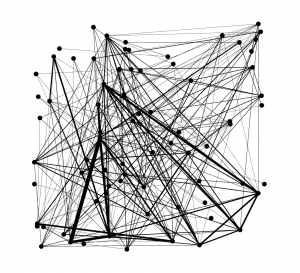
The number of Nodes is 77, and the number of Edges is 254. Valjean has ID Number 11 and Fanzine has ID Number 23. If Valjean is the source, he is connected to Myriel, Mlle. Baptistine, Mme. Magliore, and Labarre. If Fanzine is the source, she is talking to 9 other characters, all of which are ordered by ID number.
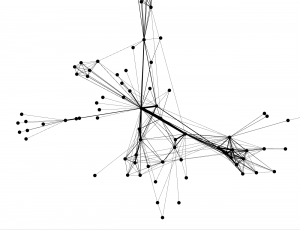
When I increased the repulsion strength to 10000, it seemed to have spread out my nodes so I can easily pick them apart. I feel like repulsion strength increases the distance between non-linked nodes to more easily decipher them, almost making groups of the characters who have relationships. The Average Path Length is 2.6411483253588517 and the Diameter is 5.
When I applied Betweenness Centrality again, with a min. size of 10 and a max. size of 200. I think this made the characters who have the most relationships stand out, with the biggest nodes being the people with the most relationships.
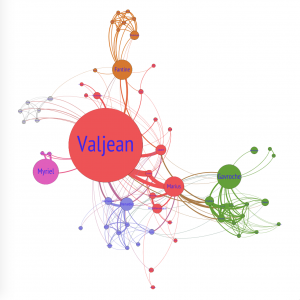
I chose to run a repulsion strength of 10,000. I feel that it’ll best represent my data because of the differences in tweets I received. This is better show who is actually talking to each other or about the same topic and who is not linked with anyone. My Average Path Length was 2.157, my Modularity was 0.767, and had 825 Connected Components. In terms of modularity, I think the value 0.767 says there is a decent amount of separating and grouping that guff was able to do. 825 Connected components in a sample of 3,000 data points does seem a little low to me, but I think it makes sense with my hashtag because it’s used a lot of the time by itself and in regards to no one else.
I feel like these recent labs have affirmed my thoughts and ideas from early on in the semester. I think I had a good understanding from the start of what kind of hashtag #woke was, and saw trends play out in the labs. I think a very critical component to #woke is the way people use it. Other social hashtags like ones in my group, #blacklivesmatter and #nodapl, are specifically about a single topic. I found it very interesting to see that #woke could be used for a wide range of social issues, and it different types of tweets as well. Even though some tweets that I received had nothing to do with social issues, they still provided a lot of information on the way people express themselves. To me, it seems like #woke is a gateway for the average person to get his/her voice out.
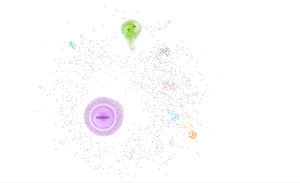
The first thing that stands out in my graph is the massive group around @adoredelano. One of his tweets received an incredible number of retweets, it read, “What is “#woke” about mocking mental health? Go home with all of that shit. Britney is your mother.” I really don’t understand what this tweet means, but it got an incredible amount of retweets, and stood out as the largest base of the #woke conversation. I did expect relationships like this to occur in my data; one probably semi-popular twitter account posting something that might be controversial to a lot of his/her followers. Controversial tweets, especially one with #woke, get the most response from followers and get the conversation started. There are 3 or 4 groups of conversations that were going on in my sample of 3,000 tweets on February 15th, and there are a lot of singletons. It makes sense that a lot of people use #woke to express an individual opinion that doesn’t reach out to other tweeters. Then, once retweets start to happen and more people are exposed to a certain tweet, groups are formed.
I was surprised to see how many unconnected components you had in your chart, but it makes sense, given the different interpretations of #woke. I also noticed that we both had a cluster with two “central” nodes surrounded by shared connections. This is something I should look into further with my own data—whether the two nodes are mentioning each other often, or simply have a strong contingent of shared followers.
The tweet you found from @adoredelano was interesting as well. Do you think the sentiment of that tweet represents the majority of people who use #woke, or is it disproportionately represented here?
Wow! Your network analysis appears extremely binary. I wonder if the green and purple clusters share the same opinions, tweet on the same topics, or even retweet each other’s tweets. I would like to know if one cluster uses #woke to raise support for social injustice awareness, and the other cluster uses #woke to mock the concept of one being “woke”.
I looked up the the tweet that you mentioned was most retweeted by the primary purple cluster: “What is “#woke” about mocking mental health? Go home with all of that shit. Britney is your mother”. I found that this tweet is a reaction to a comment that Katy Perry made at the Grammys when she was asked how she was doing. Perry responded, “Fantastic, I haven’t shaved my head yet.” This comment was assumed to be a reference to Brittney Spears. — I am not surprised that this was tweeted, but why does it appear as the most common tweet for #woke?