Privatization and Securitization Threatens the Future of the Public Square by Gabe Fedor

It’s one of those first truly warm days of Spring in the year 2038, where even when you stand in the shade the air still has a warmth to it that wraps around you. Like all self-respecting urbanites in New York City on the first nice day of the year, we decide to go for a walk to a public square. We choose a new square that had just been built on the site of a recently demolished newspaper office building, because who reads those anymore? When we arrive to the square, we are immediately struck by the eight-foot concrete and plaster wall that surrounds it on all sides. We have to access the square through one of four gated entrances. A sign hanging on the entrance reads: “Square Hours: 7AM – 6PM. Strictly Prohibited: Sleeping, Drug Use, Skateboarding, Loitering, Tents or Informal Structures, Protesting, Shouting.” The sign strikes us as oddly detailed and the hours seem strangely restrictive, but we enter anyways because we want to enjoy the warm weather. Once inside the walled square, we see a few people with ties and pantsuits, scattered around on benches eating their lunches or looking at their phones. We were hoping to layout on the grass in the sun to read or maybe doze, but we don’t see any grass or a long bench that isn’t intersected by those armrests that are meant to deter the homeless from sleeping on them. There are a few trees and flowerbeds, but the square is mostly comprised of large stone pavers, metal benches, concrete walls, and a huge, contemporary art sculpture in the middle. We grab a bench close to one of the large trees in the square and begin to read. I look up occasionally to people watch or peer at the sculpture, but once the lunch hour is over, the square almost completely empties out, and the sculpture was more intimidating than interesting to look at. After peering around for a while, two security guards positioned at either end of the square catch my periphery vision, then I begin to notice how each of the lampposts throughout the park are also fitted with micro security cameras. Their presence actually makes me feel less secure – why is all this security necessary? Am I in a bad part of town? We begin to feel uneasy with all the eyes on us. The square stops being enjoyable because we can’t relax since there’s no one there to relax with and we are constantly being monitored. We decide to head to another neighborhood in search of a better, more lively and green public square.

The foundation of the urban public square is being shaken to its core. Two elements are causing this upset and must constantly be grappled with and contested in the public square of the future: privatization and security. At the heart of this transformation of the public square of the future is the sweeping, international urban trend of neoliberal policy, which has a dramatic effect on public squares, namely that when corporate and private interests craft our public spaces, they are inherently not public, but are privately owned representations of what planners and corporations believe the public should want (Kingwell 215 and Hou). In his discussion of public space, Kurt Iveson investigates how people’s accessibility to public areas shifts depending who constructs it: “The ceremonial model of public space makes an important contribution by considering the issue of state provision of public space, and its impact on how people occupy public spaces. It is argued that the state should be more open to claims for access to public space than private owners, whose concerns are more market driven” (Iveson 187-188). When an enterprise decides to build a public square across from their office tower, their concern is boosting their own image, not the provision of a useful, pleasant public square accessible to all. Indeed, the issue of security in public square morphs with privatization, as public space that is privately owned is increasingly “made bleak by intrusive surveillance technology” and private security guards (Kingwell 212). In New York City, this has given rise to privately owned public space (POPS) that tend to conform to the de-localized, security obsessed, and sleek style of corporate office culture while making the space uncomfortable or downright uninviting for those outside of the dominant corporate culture: “private plazas are more sleek than sylvan. ‘There’s not a blade of grass.’ Over the years, private parks and plazas — some with dramatic waterfalls — have won mixed reviews” (Foderaro). These mixed reviews are due to the public squares being designed for corporate aesthetics rather than the livability of the people, where fancy granite pavers and towering fountains take precedence over a simple bench or grassy lawn. It will be argued that the key to preventing the privatized and security-camera monitored public square of the future is insurgent urbanism, through which the agency of individuals and communities transform urban spaces to fit local needs (Hou).

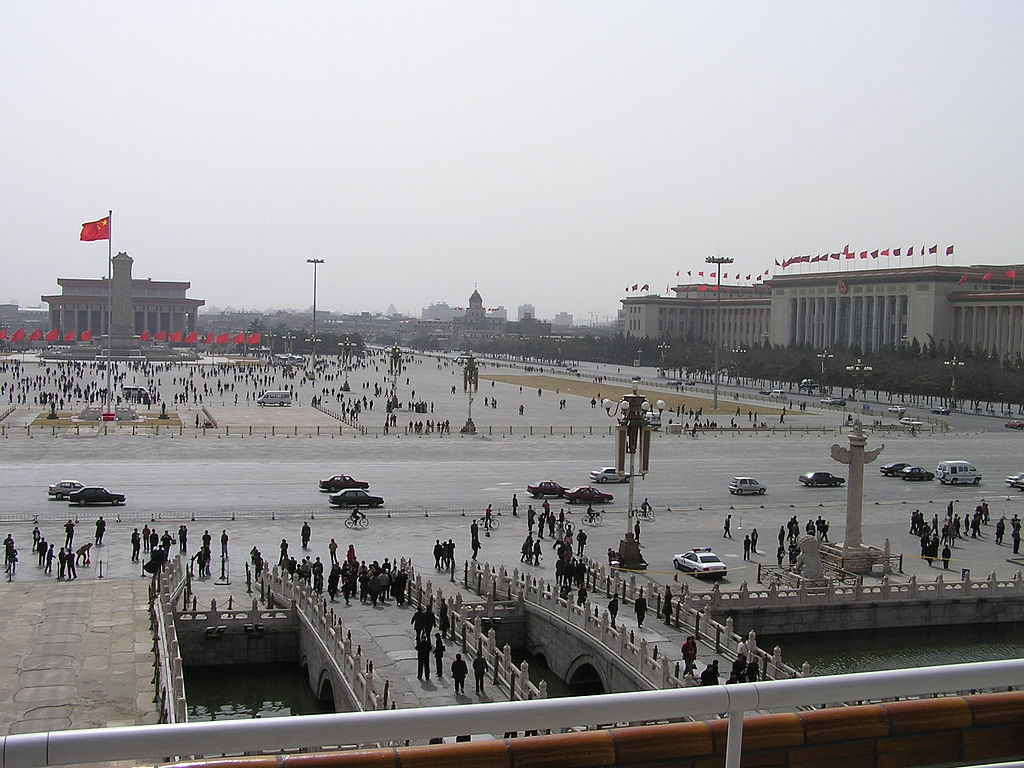
In the neoliberal age, it is now more important than ever to ask the short but complex question: what is public? Primarily, public brings to mind the difference between the space inside a home compared with the populated and public space outside of the home. Another popular use of public is to refer to the state, as a separate and distinct entity from the private market. In his chapter titled “Putting the Public Back into Public Space,” Iveson contends that these varied meanings of public contribute to a collective hesitation towards defining the nature of public spaces in societies throughout the world. To create a more concrete representation of public space, Iveson defines four models of it: ceremonial, community, liberal, and multi-public. The ceremonial model defines authentic public space as, “the triumph of the public over the market, usually through state ownership and large-scale civic design” (Iveson 187). The Zocalo in Mexico City, Tiananmen Square in Beijing, and Moscow’s Red Square are all examples of ceremonial public space because they signify the power of the state through their size, architecture, and the celebration of the nation, state, or city’s historically significant events. Further, because they are built entirely by the nation, state, or city, they communicate the victory of public good and civility over private market desires (Iveson 187). The inverse of celebrations in ceremonial public space is protests, which are staged with equal frequency. Instead of celebrating the public nature of the state, protests are staged when people become excluded from the public or the government ceases to represent the public’s interest. Zuccotti Park and Times Square in New York City are both antonyms of ceremonial public space, and thus under this model, would not be considered truly public space at all. This is because Zuccotti Park is privately owned by Brookfield Properties and Times Square is imbibed with private corporate messaging that all but makes one forget they are standing on city property (Katz and Townsend).

The community model of public space is concentrated on the theory of ‘new urbanism,” which argues that well-designed public urban features have the ability to bring the diverse urban population together and foster community (Iveson 188). In the community model, for a public space like a city square to actually be public, it need not be owned by the state like in the ceremonial model, but only has to serve the needs of the local community and act as a cohesive anchor, bringing residents together through spontaneous interactions. In tandem with the community model, the liberal model of public space is also concerned with how the space is used in urbanite’s lives rather than who owns the space for it to be public. In the liberal model, it’s a matter of accessibility that makes a given space public or not. For a city square to truly be public under the liberal model, it must be open and accessible to all regardless of status and social difference (Iveson 189). Under the liberal model of public space, Zuccotti Park would be considered public because it is open for use by anyone, 24-hours-a-day, not just employees from the neighboring skyscrapers (Levitin). However, there are aspects of Zuccotti that could come into conflict with this model centered around accessibility, namely that it is located in the extremely wealthy financial district, severing accessibility for people living in boroughs further out, and no sleeping is allowed, denying access for the homeless (Levitin and Katz). As the Occupy Wall Street protestors demonstrated in 2011, the square is not accessible for protestors who decide to campout after Mayor Michael Bloomberg ordered the square to be cleared for “deteriorating health and safety concerns” (Katz). This lack of accessibility for certain groups in Zuccotti raises concerns over the future of public squares, especially with the increasing use of neoliberal policy to lessen the financial burden on cities that subsequently gives rise to more privately owned public space across the urban fabric (Bressi 42).

The last model of public space that Iveson discusses is multi-public, which criticizes the lumping of all people into one public and instead brings attention to ‘counter-publics’ that have unique interests that are marginalized and not represented by the dominant public (Iveson 189). The multi-public model demonstrates the need for alternative spaces where the minority interests of the counter-publics can be expressed in the city’s physical environment. The model shows that in order for a public space to actually be public, it must celebrate difference rather than ignore it or attempt to conform the different publics into a lumped majority by using the space. Inequalities exist in public space primarily because there is a lack of acceptance and recognition of different cultures, so to combat this, the multi-public model calls for each of the marginalized and counter-publics to be formally represented in the space (Iveson 190). Homelessness presents the most vivid example of cultural difference, where the interests of the homeless are rarely included in public space, but are usually actively deterred from participating in the public sphere. Zuccotti Park is definitely not public under this model due to its location and exclusion of certain groups through Zuccotti’s rules preventing people from sleeping within the square.

From the four models of public space presented by Iveson, it’s possible to combine the models in order to better grasp how neoliberal policy that encourages privatization and securitization is threatening the different iterations of public space and squares. A truly public space has to place the needs of the public above private interests, must help to foster community through its design, has to be accessible by every social class, and must represent and celebrate in its design the differences of both publics, the dominant and the marginalized (Iveson 187-190). Privatization encouraged by neoliberal policy along with gentrification threatens many of these factors that make a space actually public. As the population, and thus the need for public squares increased throughout New York City, the city found it economically infeasible to support all of that infrastructure, so they began providing private developers with incentives to build public space (Bressi 43). The incentive that has led to the development of 503 privately owned public spaces throughout the city was allowing developers to surpass the skyscraper zoning laws if they agreed to provide a certain amount of public space for every floor of the skyscraper that went above the height limit (Bressi 43). This gave New Yorkers their much need public space, but it was privately owned, which as Mark Kingwell points out in his chapter titled “The Prison of Public Space,” can have serious consequences.

Like what happened in New York City with the need for more public space, when a public amenity becomes threatened by overuse or requires expansion, “The typical response to this threat are regulation and privatization. Neither is without cost. Privatization of some goods – air, for example, – is economically untenable as well as offensive to the common need (although privately supplied water, sold in bottles for profit, is now widely accepted: a red flag) (Kingwell 213). The example of bottled water applies remarkably well for public squares: where they were once solely constructed by the state as visible signs of public government putting the civic good over private interest, public squares are now primarily built by private developers in New York City (Rosenberg). This mirrors how water was solely a public amenity, but has since been bottled by private companies (many of which lie about filtration) and sold for profit. Kingwell argues that just as water is a basic human right and is available through the public water supply, public space allows citizens the right “to gather and discuss, to interact with and debate one’s fellow citizens” (Kingwell 213). More than simply being a public square, it actually encourages the great urban intermixing of classes and races that gives rise to discussions and arguments, the very cornerstone of democracy. Kingwell thus proves that since public space allows citizens to exercise democratic rights like the right to assemble and freedom of speech, its privatization risks limiting that right to those who are able to access the privately owned public square. Shockingly, after an audit of all of New York City’s privately owned public spaces in 2017, it was discovered that 180 of them did not comply with the city’s rules. Private corporations negated everything from benches to water fountains; with some private enterprises going as far as putting signs above public spaces that wrongly informed people that they were “for members only” or were “private property” (Rosenberg). New York City’s privately owned public spaces are not meeting Iveson’s models for being truly public and they have the potential to strip people of democratic rights as Kingwell has discovered. The answer to solving these issues caused by the privatization and securitization of public squares is the creation of insurgent public space.

Insurgent public space is created through insurgent urbanism, which is when citizens and communities create space outside of regulatory and government legal stipulations. People reclaim, occupy, or appropriate certain spaces in cities to create the change they want to see, express opinions on space, garner support for change, or just to engage in community activities (Hou). At the most basic level, a block party is an example of insurgent public space. A road usually used for car traffic must be blocked, either illegally or legally, in order for the space to be transformed for a party setting. At it’s highest caliber, insurgent urbanism is the Occupy movement in Zuccotti Park and the Arab Spring in Tahrir Square, where the usual square regulations are ignored and the space is reconfigured and redesigned to meet the needs of protestors and revolutionaries. Insurgent urbanism can help to alleviate the effects of those 180 mismanaged privately owned public spaces throughout New York City – if the corporation responsible for the square does not provide benches, then insurgent urbanism says to build a bench and put it there regardless if it is permitted or not. If the privately owned public square must have an outdoor water fountain but does not provide one, insurgent urbanists should start a protest outside the owner’s office tower until the water is supplied. The point behind insurgent public space is that when the needs of the people who use the space are not being met, they should have the right to transform it until it meets the local community’s needs or to protest until change is initiated: “Lived experience should be more important than the physical form in defining the city” (Hou). One such instance of insurgent urbanism that attempted to construct the city according to lived experience instead of through the vision of private developers occurred in Tomkins Square Park on New York City’s Lower East Side, in 1988. Riots were organized for an entire night to fight a 1AM curfew that had been imposed on the community’s park in order to deter use by drug dealers and the homeless. The curfew was seen as an attempt to clean up the square in order to make the neighborhood more appealing to private developers and the new residents that were moving into the Lower East Side, rapidly gentrifying the formerly working class area (Smith 314). “‘Whose fucking park? It’s our fucking park’ became the recurrent slogan” (Smith 315). Residents sought to protect the park and their neighborhood as a whole from private interests through insurgent urbanism. The riots against the curfew and evictions of homeless people from Tompkins Square Park lasted through the night, creating a temporary insurgent public space within the larger park. When the privatization of public space gives rise to spaces that aren’t providing for the needs of local residents, or aren’t accessible or representative of every member of the public, it will be through public demonstrations and insurgent urbanism like the Occupy movement in Zuccotti Park and the riot in Tompkins Square Park that makes the space truly public once again.

If the widespread neoliberalization of American cities continues, there may no longer be public squares in the U.S. by the year 2038. Instead, the privately owned public squares that are currently saturating New York City’s public spaces will be all that’s left. POPS do not meet the models of truly public space outlined by Iveson because they are not always accessible to all classes, do not put the public good above private interest, and do not help to build community. Further, due to the urban public square’s ability to foster democratic rights as basic as gathering in groups and discussing issues, when they become privatized, those rights become threatened by private interests. As Kingwell proves, this is a slippery slope that can lead to not only a select few being able to access the public squares, but a select few being able to actively participate in the democratic process. In order to avoid this bleak future of security camera-ridden squares designed to match corporate aesthetics, the people must reclaim spaces through insurgent urbanism. When the community is able to shape the space as opposed to private developers dictating how it should look and be used, the community is not only united through its creation, but is gradually able to bridge class divides and cultural differences through daily interactions within the truly public square.


Bibliography

Bressi , Todd W. “The New York City Privately Owned Public Space Project New York,             New York.” Places Journal, pp. 42–54.


Foderaro, Lisa W. “Zuccotti Park Is Privately Owned, but Open to the Public.” The New York Times, The New York Times, 13 Oct. 2011.


Hou, Jeffrey. “Beyond Zuccotti Park: Making the Public.” Places Journal, 1 Sept. 2012.


Iveson, Kurt. “Putting the Public Back into Public Space.” The People, Place, and Space   Reader, edited by Jen Jack Gieseking et al., Routledge, 2014, pp. 187–191.


Katz, Andrew. “Occupy Wall Street: How Protesters Made the Zuccotti Park Eviction    Inevitable.” The Guardian, Guardian News and Media, 25 Nov. 2011.


Kingwell, Mark. “The Prison of ‘Public Space.’” The People, Place, and Space Reader,     edited by Jen Jack Gieseking et al., Routledge, 2014, pp. 212-216.


Levitin, Michael. “The Triumph of Occupy Wall Street.” The Atlantic, Atlantic Media      Company, 10 June 2015.


Rosenberg, Eli. “A ‘Members Only’ Public Space in Manhattan? Join the Club.” The New             York Times, The New York Times, 19 Apr. 2017.


Smith, Neil. “Class Struggle on Avenue B: The Lower East Side as Wild Wild West” The   People, Place, and Space Reader, edited by Jen Jack Gieseking et al., Routledge,             2014, pp. 314-320


Townsend, Anthony. “ Digitally Mediated Urban Space: New Lessons for            Design.” Praxis, Harvard Graduate School of Design, 2004.


Gabe’s Timeline

I chose Zuccotti Park as the place for my timeline because it was the site of the Occupy Wall Street movement. However, I presented the park in a way that didn’t confine the space as only the site of this event – upon further research, I discovered the public square was significant for many reasons. First and foremost, the park is emblematic of the sweeping trend of neoliberal policy in modern cities across the globe. Zuccotti Park is a POPS, meaning it is a public space that sits on privately owned land. POPS are prevalent throughout New York and allow the city to provide adequate open and public space to residents without having to deal with the costs of maintenance. This is also a positive tradeoff because private companies are then held responsible for their public footprint and how urbanites perceive the companies influence on the city. Problems begin to arise, however, when questions of who has a right to the space arise. Since the park is public and must be open 24 hours a day, protestors believe they have a right to the space but officials view them as restricting the freedom of others to use the square. It’s a very difficult urban dilemma with no clear solutions, which is why I began my timeline in Antiquity.

By beginning the timeline in ancient Greece, I hope to demonstrate that public squares and the question of who has the right to use them have existed for as long as humans have settled together. The term public square has always been deceiving, because history shows that a segment of the population was consistently excluded and oppressed from the space. In 500 BCE, it was women, slaves, and foreigners who couldn’t access public squares. In 2011, it was anarchists and those that were fed up with the financial establishment that were eventually barred from accessing public space. Further, by beginning in Antiquity and traveling to other parts of the world, its possible to show how public squares have a number of universal uses, as well as public squares that serve very particular functions for a specific city – Boston Common was a pasture for grazing, like many other public spaces at the time, but was simultaneously the site of antislavery protests as well as civil rights demonstrations.

Lastly, at the root of my timeline is my own love of urban public squares. In any city I visit, I am immediately drawn to the wide-open and bustling spaces of public squares. I’ve spent entire days simply sitting on benches, people watching and eves dropping. It’s where the best of city-life is on display at any hour of the day and where a visitor can gain the most profound sense of place. Cities are usually distinguished most by their skylines, but it’s what happens in between those looming skyscrapers, in the urban public squares, that give a city its true character.

Bibliography
Blitz, Matt. “The Oldest City in the United States Turns 450.” Smithsonian, Smithsonian Institution, 3 Sept. 2015. [1]
Carmona, Matthew, et al. Public Space: The Management Dimension. Routledge, 2008. [2]
“Experiencing the Hybrid City: The Role of Digital Technology in Public Urban Places.” The SAGE Handbook of New Urban Studies, by John A. Hannigan et al., SAGE, 2017, pp. 535–549. [3]
Foderaro, Lisa W. “Zuccotti Park Is Privately Owned, but Open to the Public.” The New York Times, The New York Times, 13 Oct. 2011. [4]
Folpe , Emily Kies. “A History of Washington Square Park.” Washington Square Park Conservancy, 2002. [5]
Gordon, Eden. “The Top 10 Secrets of NYC’s Zuccotti Park.” Untapped Cities, 6 Dec. 2017. [6]
Hou, Jeffrey. “Beyond Zuccotti Park: Making the Public.” Places Journal, 1 Sept. 2012. [7]
Jarus, Owen. “Tenochtitlán: History of Aztec Capital.” Live Science, 15 June 2017. [8]
Katz, Andrew. “Occupy Wall Street: How Protesters Made the Zuccotti Park Eviction Inevitable.” The Guardian, Guardian News and Media, 25 Nov. 2011. [9]
Kreiter, Suzanne. “History of Boston Common.” BostonGlobe.com, Boston Globe, 30 Sept. 2007. [10]
Langer, Adina. “Places That Matter: Zuccotti Park.” Place Matters – A Joint Project of City Lore and the Municipal Art Society, Oct. 2011. [11]
Levitin, Michael. “The Triumph of Occupy Wall Street.” The Atlantic, Atlantic Media Company, 10 June 2015. [12]
Light, Richard. “The Agora from Athens to Atlanta: Public Space as Marketplace, Park and Center of Urban Life.” Planetizen – Urban Planning News, Jobs, and Education, 15 Apr. 2010. [13]
Mark , Joshua J. “Acropolis.” Ancient History Encyclopedia, 2 Sept. 2009. [14]
“The Production of Space.” The People, Place, and Space Reader, by Jen Jack Gieseking et al., Routledge, 2014, pp. 289–293.  [15]
“Putting the Public Back into Public Space.” The People, Place, and Space Reader, by Jen Jack Gieseking and Kurt Iveson, Routledge, 2014, pp. 187–191. [16]
Reynolds, Francis. “After Zuccotti Park: Seven Privately Owned Public Spaces to Occupy Next.” The Nation, 14 Oct. 2011.  [17]
Ruddick, Susan. “Constructing Differences in Public Spaces: Race, Class and Gender as Interlocking Systems.” The People, Place, and Space Reader, by Jen Jack Gieseking and William Mangold, Routledge, 2014, pp. 7–11. [18]
Schwartz, Mattathias. “Pre-Occupied The Origins and Future of Occupy Wall Street.” The New Yorker, The New Yorker, 28 Nov. 2011. [19]
Weiss, Lois. “John Zuccotti, Tireless Champion of Downtown, Dies at 78.” New York Post, New York Post, 23 Nov. 2015. [20]
Wheeler, Heather. “Aztec Trade: Regional Markets and Long Distance Trading.” History on the Net, Regnery Publishing, 10 June 2005. [21]
Willis, Amy. “Occupy Wall Street Eviction: as It Happened 15 November.” The Telegraph, Telegraph Media Group, 17 Nov. 2011. [22]


The Two Faces of Urban Public Squares

Related image
A popular concert and festival in the Zócalo (Plaza de la Constitución), Mexico City, Mexico. The urban public square as a medium for artistic expression. Photo curtesy of MonitorLatino.com
Tiananmen Square, Beijing, China. This square was the site of a deadly confrontation in 1989 between the Chinese military and university students seeking freedom of speech. It is also the largest public square in the world. Photo curtesy of Touropia.


Image result for arab spring square
A mass of protestors in Tahrir Square, Cairo, Egypt. Tahrir Square was the site of the 2011 Egyptian Revolution. Photo curtesy of Touropia.

Since the skeleton of the modern city began to ossify thousands of years ago, the public square has always been at its heart, pulsating the urban lifeblood of commerce, politics, religion, art, and culture throughout the city’s veiny streets. The physicality of the public square as an urban space is quite simple with only two essential ingredients – a breakup in a city’s density to allow for open space and people – but what occurs when those two elements are combined is a complex diversity of interactions, developments, chance-encounters, and confrontations. From Madrid’s Plaza Mayor and New York’s Times Square, to Rome’s Saint Peter’s Square and Mexico City’s Zocalo, the urban public square is an extraordinarily prominent, varied, contested, and beautiful part of the modern urban fabric. The square is where the joyous serendipity of everyday urban life can best be experienced, but also where revolutions begin when that urban life becomes threatened or oppressed.

Picture
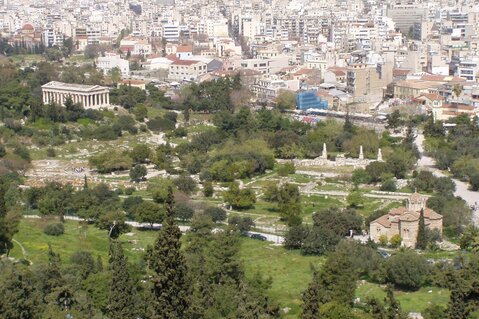
Aerial view of the ancient Athenian Agora. Photo curtesy of The Athens Key.

1. Various forms of public squares have existed since people first began to congregate in dwellings, but it was the Greek Empire’s creation of the agora that made the public square an infamous and essential part of everyday urban life. When Greek civilization entered its classical period around 600 B.C., almost every city of ancient Greece had an agora (Glancey). The agora, which translates to ‘meeting place,’ was located at the center of the city, making it easy to access for peasants and aristocrats alike, cementing the idea of a truly public space, open to all classes of people (Whipps). The agora consisted of a large central square surrounded by public buildings with space for market stalls where merchants sold their wares.

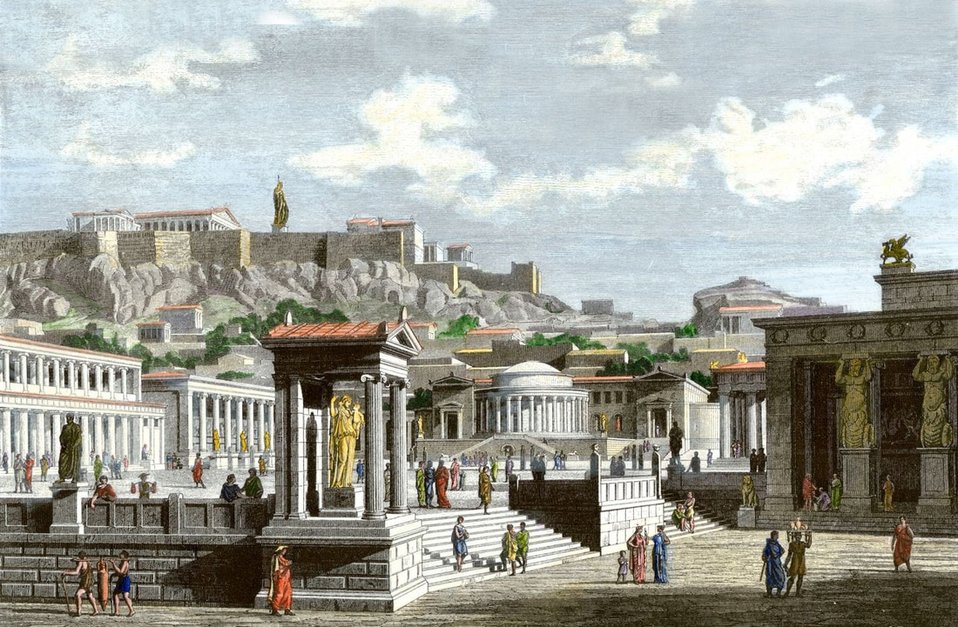
An imaginary depiction of the Agora of ancient Athens at the time of Pericles.
An artist’s rendering of the ancient agora in Athens. Photo curtesy of The Athens Key.

2. The hub of ancient Greek civilization was the Athenian agora, which was the largest public square of the time that stretched for more than 30 acres. Athens’ agora included numerous markets, three teaching porches or ‘stoas,’ two theaters, a gymnasium, five temples, a courthouse, and a prison (Light). This mixed-use agora was more extensive than the public square of today – resembling a modern civic center – but it attracted an equally diverse crowd as today with traders, scientists, politicians, slaves, state officials, and philosophers regularly brushing shoulders and conversing in the agora. Indeed, it was this high level of interaction between different classes of people that the agora facilitated, where “the sacred and the profane met on a daily basis,” which contributed to the creation of democracy in the Athenian agora (Light and Whipps). The concept of the Greek agora was transferred to the Roman empire under the new name of ‘forum,’ but continued the same traditions and structure as the agora.

Image result for renaissance city square
Piazza della Signoria in Florence, Italy. A good representation of a typical Renaissance city square. This space is now most commonly used by tourists seeking an authentic piazza experience. Photo curtesy of Wikipedia.

3. The grandiose scale of the first public squares, the Greek agoras and Roman forums, was gradually reduced to its current size and function as the products and services provided in public squares grew into entirely new industries requiring separate space (Light). As the Catholic Church gained power during the Middle Ages, space for worship was removed from the public square and placed inside of a church, separating the city square and the temple forever. During the Renaissance, simple peasant trades grew into full-blown, respected professions: architects, sculptors, and painters could no longer preform their work or advertise their products effectively within city squares, so they set up shop in buildings around the square and throughout the city (Light). Industrialization further shrunk the square’s marketplace due to mass merchandising, but also limited the social contributions of the public square. As more urbanites began grueling industrialized work, time became constrained between factory shifts, which allowed for less time spent lingering and conversing in the public city square. The advent of supermarkets, home refrigeration, and eventually freeways and office towers, further stripped the public square of its auxiliary uses, now only occasionally becoming a market place on weekends for small farmers and artisans (Light).


A bustling Times Square in New York City. An example of a modern, pre-designed square. Photo curtesy of Giffy

4. The modern form of the public square is completely redefined from its original agora structure, but the social and cultural effects radiating out from these open spaces in the middle of dense cities are equally important to society as the Greek agora was to the formation of democracy. As temples, marketplaces, and courthouses expanded out into the city from the public square, it allowed squares the increased freedom to be programmed in whatever way urbanites needed it to be – a need that can change on a daily basis. Today, public squares are divided between two categories: “one that is older, organic, chaotic, and populated; and one that is recent, planned, orderly, and deserted” (Marron Et Al). The first of these two variants grew organically to accommodate the needs and culture of ordinary urbanites as they arose throughout history, and usually results in a shared space with bustling activity. The second type of public square is built according to a pre-designed master plan to embody the values of the city in an attempt to reap the social benefits from the chance encounters of public space.

The above video from The Urban Land Institute awards six cities for their outstanding public squares and parks in 2015. Video curtesy of the Urban Land Institute

5. The issue with the second variety of public square stems from its artificiality that leaves no corner unplanned, largely defeating the public square’s greatest asset: it’s customizable, programmable quality, which allows citizens themselves to shape and appropriate the space through constant daily use. In the book City Squares, writer George Packer criticizes the newer generation of public square for its tendency to “leave nothing to chance. It tells people that they are subservient to the state and, in a sense, irrelevant to it” (Marron Et Al). When urbanites occupy a square designed for the sole purpose of glorifying a city or nation’s achievements, they feel a sense of powerlessness and lack of belonging, for they sense the space is monumental and not intended for their lived urban experiences. Moscow’s Red Square and Beijing’s Tiananmen Square are both examples of this “ceremonial model of public space,” in which civic planners create large-scale squares in dedication to the nation or city’s accomplishments (Iveson 187). Most public squares however, blend these two styles of public space together, so that urbanites shape the character of the square along with civic planners that incorporate national pride and triumph. The Three Cultures Square (Plaza de las Tres Culturas) in Mexico City has a rich history and represents a hybrid modern/ancient public square.

Related image
Three Cultures Square in Mexico City, Mexico. The three cultures are represented by the Aztec ruins, the Spanish church, and the Modernist Mexican high-rises. Photo curtesy of Esoteric Survey.

6. Three Cultures Square is located in the Cuauhtémoc borough of Mexico City and was first built in the mid-1960s. The space was originally planned to be a Corbusierian-style housing block and was included in the master plans for a modernist, one million square meter, high-rise housing project called Tlatelolco (Gallo 58). The sparse, high-rise apartments soared up, surrounding Three Cultures Square on all sides, but the Mexican developer responsible for Tlatelolco, Mario Pani, dared not touch the square due to what lay just underneath the surface: the ancient remains of an Aztec pyramid that had been razed by Spaniards in the sixteenth century. The stones from the pyramid were repurposed to build a Catholic church directly opposite the  partially destroyed pyramid. In a strange repetition of history, Pani sought to finish the job the Spanish started by clearing the remains of the pyramid and the colonial church to make way for a modernist, block-housing project of unbelievable scale. Luckily, archaeologists and Mexican authorities prohibited Pani from building on the ancient site. As a compromise, Pani incorporated the ruins into his design of the Tlatelolco housing project by making it into a public square (Gallo 59). Three Cultures Square is a unique blend of the two styles of public square – it is at once ancient and has been used as a congregating space for centuries, but has subsequently been highly planned and modernized, partially negating that history and the natural development of public squares. After Pani finished its design and construction, the square was named by Mexican officials to reflect the site’s contested history between the three cultures that each laid claim to the square at one period in history.

Related image
An alternative view of Three Cultures Square in Mexico City, Mexico. The three cultures that also represent the three races are prominently displayed. Photo curtesy of Mexico Lore.

7. Three Cultures Square is named after the three cultures that are visible from within it: Native Aztec, Colonial Spain, and Mexican. City officials created and promoted the name of Three Cultures Square due to the post-Revolutionary ideology that “modern Mexico was a new mestizo culture born out of the encounter of two previous civilizations: the Aztecs and the Spaniards” (Gallo 59). Thus, the ancient pyramid is a reminder of Aztec architecture, the church as an example of Spanish construction, and Pani’s modernist housing project serves to show how modern Mexico builds and lives today. A plaque located within the site reveals that Three Cultures Square is not only named in honor of the three different architectural styles and cultures, but also after the three separate races: “On August 13, 1521, after being heroically defended by Cuauhtémoc, Tlatelolco fell to Hernán Cortés. It was neither victory nor defeat, but the painful birth of the mixed-blood country that is Mexico today” (Gallo 60). Three Cultures Square is then also Three Races Square, allowing Pani’s modernist high rises to represent the mixed-blood inhabitants of modern Mexico. Pani honored this idea of intermixing by centering the housing project around the square and designing the tallest building in the Tlatelolco development to be a modernist interpretation of a pyramid (Gallo 60).

Related image
An aerial view of Pani’s Tlatelolco modernist housing project with the Three Cultures Square in the center. Photo curtesy of Pinterest.

8. The developer of Three Cultures Square and Tlatelolco, Mario Pani, the son of a diplomat, was born in 1911. He studied at École des Beaux Arts in Paris during the 1930s, which is when he discovered the philosophy and work of Le Corbusier. He cultivated a love for urban planning during his time in Paris, and upon his return to Mexico, began lobbying the Mexican government for large-scale urban transformation. In the late 1940s, he was commissioned to build the first Corbusierian housing project in Mexico City (Gallo 56). City officials had originally planned to build smaller houses or duplexes, but Pani convinced them that modern urbanism was the best route; so one thousand apartments were built within 12 large complexes. The Tlatelolco development was Pani’s third project and his largest and most monumental yet, setting out to build enough apartment blocks for one hundred thousand residents in fifteen thousand apartments (Gallo 56). Pani commented on his vision and reason for Tlatelolco: “We still need to regenerate over half of Mexico City, which is full of awful neighborhoods. The one advantage is that most of these neighborhoods are so awful that they are just waiting to be regenerated, to be torn down and rebuilt properly” (Gallo 55). Clearly a descendent of Corbusier’s style of urbanism, Pani had no regard for the history of place or patience for the accompanying urban chaos. Messy urban history would form within Pani’s master-planned Tlatelolco housing project nonetheless.

Image result for three cultures square massacre
A memorial to the massacre victims at Three Cultures Square. Photo curtesy of Wikipedia.

9. Only two years after construction was finished on the last building in the Tlatelolco housing project, a student protest in Three Cultures Square ended in the massacre of hundreds of students at the hands of Mexican police. In 1968, student movements and protests were breaking out across the world, and Mexico City was no exception. Thousands of National University students gathered in Three Cultures Square on October 2nd, just a week before the opening ceremonies of the 1968 Summer Olympics, to protest government repression and violence against students. As the rally was ending, soldiers arrived to arrest the student resistance leaders, but were greeted by gunshots from the surrounding high-rise apartments. The soldiers then opened fire on the crowd, turning the peaceful protest into a shooting that lasted two hours and took and estimated 200-400 student lives (NPR). It has since been revealed that a branch of the military, the Presidential Guard, had posted snipers in Pani’s high-rises surrounding the square with orders to shoot at the incoming soldiers to make them believe they were under fire from the students, resulting in the soldiers killing hundreds of people. The massacre at Three Cultures Square demonstrates the potential power held within the open spaces of public squares, and the consequential violence that can erupt when that power clashes. The massacre also reveals a government so desperate to present a civilized, peaceful image of Mexico City to the world during the 1968 Olympics, that they were willing to murder their own citizens to create it.

Related image
Gammeltorv Square in Copenhagen, Denmark. Copenhagen is known around the world for their vibrant and leisurely urban spaces. The city is sometimes referred to by residents as ‘our urban living room.’ Photo curtesy of NPR.

10. The creation of Three Cultures Square and subsequent protests and violence demonstrate the contrasting functions of public squares across the world: they are the spaces where urban life most visibly thrives, but also the first space people mobilize to when that urban life is prevented from thriving. An urbanite can read about civic unrest in Syria or watch a North Korean military parade that each make use of public squares for their respective ideologies, while sitting in a beautiful and serene public square, filled with people sipping hot mugs on outdoor café tables and children playing in fountains. The public square is simultaneously the arena of political confrontation and a destination for the foreign tourist; it is the platform through which the local merchant can sell her wares to busy urbanites passing through, while also being the site of immense bloodshed and loss in the name of a movement or revolution. It is this incredible dichotomy in how public squares are utilized that makes them the most vital organ in any city, where anyone from any walk of life can come together to organize, speak out, observe, or just be. Public squares are the ultimate physical manifestations of the sense of freedom urbanites experience in cities all over the world, so it is no surprise the public square gave birth to democracy.

Related image
Protesters participate in an anti-corruption rally in Palace Square, St. Petersburg, Russia. Photo Curtesy of NPR.


Bibliography

Anzilotti , Eillie. “What Public Squares Mean for Cities.” CityLab, 9 May 2016.

Gieseking, Jen Jack., et al. The People, Place, and Space Reader. Routledge, Taylor & Francis Group, 2014.

Glancey, Jonathan. “The Violent History of Public Squares.” BBC, 3 Dec. 2014.

Light, Richard. “The Agora from Athens to Atlanta: Public Space as Marketplace, Park and Center of Urban Life.” Planetizen – Urban Planning News, Jobs, and Education, 15 Apr. 2015.

Marron, Catie. City Squares: Eighteen Writers on the Spirit and Significance of Squares around the World. HarperCollins, 2016.

“Mexico’s 1968 Massacre: What Really Happened?” NPR, NPR, 1 Dec. 2008, www.npr.org/templates/story/story.php?storyId=97546687.

“Putting the Public Back into Public Space.” The People, Place, and Space Reader, by Kurt Iveson, Routledge, Taylor & Francis Group, 2014, pp. 187–191.

“Tlatelolco: Mexico City’s Urban Dystopia.” Noir Urbanisms: Dystopic Images of the Modern City, by Rubén Gallo, Princeton University Press, 2010, pp. 53–73.

Whipps, Heather. “How the Greek Agora Changed the World.” LiveScience, Purch, 16 Mar. 2008.