Are The Suburbs In Decline?

The suburbs: this highly romanticized location was once the Holy Grail for nuclear families in America; however, this is not true in today’s world. In the past decade, the suburbs have gone into decline, due to numerous reasons, with the first being that millennials have absolutely no desire to live there. Additionally, there is a perception that nothing happens in the suburbs and has been regarded as a conventional, dreary land with no opportunity in store for them. Thus, many of today’s young, working class desire and flock to urban areas to live in. Poverty is another contributor to this shift, as it has now overwhelmed the suburbs, due to the influx of wealth coming into cities from these once prosperous communities. This flood of wealth has resulted in cities becoming an increasingly affluent place to live, forcing out those who can no longer afford to live there, which has attributed, at least in part, to the abandonment of now low-quality, inner-ring suburbs. As these areas become more occupied with minority residents, police presences within these areas also rises, leading to an upsurge in crime rates as the police are more likely to arrest residents based of racial biases and prejudices. The suburbs were viewed as a positive development for Americans when they were first constructed because they provided many young families with a home of their own – a luxury they could not have afforded before. Nevertheless, this opportunity also came with its fair share of problems, which ultimately led to its demise. In order to fix this decline of the suburbs, I suggest housing developers and investors begin producing affordable housing options in all neighborhoods.

The American Dream is an idea that has been a constant part of American culture and identity since the United States was first established. One thing about the American Dream that has not been consistent, however, is what it represents. For instance, the American dream during the 1940s through the 1950s is vastly different from today’s American Dream. Traditionally when you hear “the American Dream” the first images that often pop into the mind of many Americans living today is an idyllic view of a picturesque house surrounded by a white-picket fence with a happy nuclear family playing on the front lawn.  In the 40s and 50s, this was precisely what American Dream was: homeownership. It became fundamental for Americans to have a place they could call their own, which additionally symbolized upward mobility. The American Dream in today’s society has been characterized as having the “’Freedom of choice in how to live’…having a good family life…and retiring comfortably.”[1] This means that in order to acquire the American Dream, it no longer requires owning a quaint house in the suburbs.

Due to extreme economic turmoil from the Great Depression in America from 1929 to 1941, many Americans were forced to evolve from the materialistic lives that they were accustomed to throughout the Roaring Twenties. The Great Depression had a monumental influence on the American Dream post-World War II, due to the limited amount of housing that was available across the country and yet Americans wanted a place all to their own more than ever. Post-World War II, Americans used their new economic freedom to their advantage by buying a home. “One of the first necessities sought after by Americans was housing. By late 1945 and early 1946 the housing crisis was acute. Veterans and other Americans demobilized from wartime production desired housing but were met with a lack of supply.”[2] William Levitt recognized this problem early on and decided to capitalize on the crisis by offering returning World War II veterans and their families affordable housing on Long Island, in a community he would name Levittown.

Thanks to the G.I. Bill, veterans (specifically white-middle class) had access to mortgages, while the Federal Highway Act of 1956 allowed for new highways to be built, making commuting to and from the city easier.[3] These laws being passed made it even more reasonable for white, middle-class veterans to live in the suburbs, giving them the opportunity to have their own piece of the American Dream. While aspiring to obtain your own space is unquestionably a strong reason for wanting a home, it is not the only one. Owning a home also signifies a symbol of self; “many people brought houses to bolster their image of self-both as an individual and as a person in a certain status position in society.”[4] Americans use both the interior and exterior spaces of their homes as expressive extensions of one’s self and has also been used to convey messages about how people view and feel about themselves to the outside world, as well as those who they would permit into their homes. Interior decoration and well-preserved exteriors are notable indications to the status of Americans – theses spaces are both conscious and unconscious expressions of social identity or the identity chosen to be displayed to society.

The suburbs have constantly exhibited a sense of mass conformity over the course of their existence; houses tend to be uniform in appearance and so were the people who lived there. Everyone desired to have the reputation of being a well put together, happy, and stable nuclear family accompanied by good morals or, otherwise known as, the perfect family. This, in turn, produces “the classic image of American Suburbia as a homogeneous place of conventionality”[5] The suburbs unequivocally exemplified an era of domesticity, as women were confined solely to the home, fulfilling the conventional housewife role. Women were regularly forced into these roles, as the domestic sphere was where women belonged, according to men, resulting in them restricting women from the work force and, in turn, the public sphere. Women were now exclusively confined to the home; dissatisfied with their lives on the inside, but were forced to continually put on a façade of contentment throughout their lives. With few opportunities available to them in the suburbs, women felt isolated from outside activities and viewed the home as “a potential source of repression.”[6] Being so isolated, they became dependent on the resources of their families and a majority felt that they “lacked stimulation” and felt their personalities suffered as a result. Before the suburbs, many of these women lived in the cities. Once they moved the suburbs, a third of them reported that they missed “their old patterns of socializing”[7] and felt lonely. Suburban women had an overall, less positive view of the suburbs than their male companions, as the men viewed it as a place ideal for raising children and relaxing after spending the day in the hustling city. Women generally agreed that they too thought of the suburbs as being a respectable place to raise children. However, women also viewed it as an oppressive place that had no opportunities available to them and no stimulation, leading to feelings of stagnation and depression among suburban women. Now, as well as then, the majority of women have no desire to live in such a place of oppression, as they value the ability to have and pursue their own personal goals and pleasures outside of the private sphere. Modern women view the suburbs as a place of stagnation for personal growth that has not offered an equal amount of opportunities and experiences like urban areas have offered. Nor do they view the suburbs as being the only good place to raise children, as many view the city as being a place where their children can encounter vast amounts of diversity with accompanied opportunities and experiences that can not be replicated in the suburban life.

The home as an entity was just not important to the nuclear family because it served as a private and tranquil switch from the bustling city life for the husband and was perceived as the perfect location to raise children, but also because it represented one’s status. Houses in Levittown were mass-produced, making them all looking exactly the same. The original house of Levittown called the “Cape Code style” and allowed for families to renovate and add additions to their houses, as they had no garage or basement, and an unfinished second floor. Residents began to reshape their houses with renovations to demonstrate their wealth, as well as their personalities. These continuing renovations done by homeowners throughout the beginning stages of the suburbs led to a transformation of the suburbs, as they transitioned from a housing development for low-income workers to a middle-class community. Residents had reshaped their environment and raised it to a “new socioeconomic level”[8], and elevated their community’s standards for innovation and growth to a new level, prompting for residents to refurbish and upgrade their houses even more. Renovations boosted individuals’ social status and also their home’s value and the surrounding ones as well, resulting in it becoming an area limited to only certain types and classes of people. In fact, William Levitt built Levittown to keep minority groups, specifically African Americans, out of Levittown and excluded them from buying homes in Levittown even after the Supreme Court ruled it unconstitutional.[9] The suburbs were extremely segregated and had no desire to acquire more diversity within their communities, as some thought of it a threat to their security and safety because they often correlated people of color with crime, continuing the appalling stereotype about minority groups. Still today, only 1% of Levittown’s population consists of African Americans, even though it is surrounded by an urban region with a large population of African Americans[10]. By marking the suburban communities as a space made for innovation and improvement for houses and by having residents revamp their houses, it increased costs and value of the houses went up drastically. The average price of a house in Levittown in the 1950s was around $7,000 and in 2008 the average cost of a house in Levittown sold for no less than $350,000[11]. The original Cape Cod houses of Levittown have been radically transformed into houses that are no longer accessible or affordable to lower and middle-class citizens and minorities.

In the past decade, there has been a surge to live in the city rather than the suburbs; “’these days the market is driven much more by people who are either choosing to live in the city or in the near-in suburbs’”.[12] This flocking to the cities has been mainly consistent of white Millennials who are more interested in the growing work opportunities and amenities that the cities offer; such as diversity, great public spaces, and endless activities and attractions scattered throughout the city. The attractiveness of the city doesn’t only appeal to millennials, but also many white, wealthy elites as well, for the same reasons. This gentrification of urban centers over the past decade has been the one of the main reasons in explaining why there have been significant increases in rent for apartments. In 2016, the average rent in Manhattan ranged from $2,500 monthly to $30,000 monthly[13] developers are continuing to construct these lavish and expensive apartments even though there is a high demand for affordable apartments. These ever-rising prices of apartments have also made the city a place that only the wealthy or upper-middle class can afford. Therefore, these economic trends have been pushing out those who cannot afford living in city to homelessness or inner-ring suburbs.

Minority groups often have no other option than to relocate to inner-ring suburbs because these communities are not as attractive, or clean, or sought-after, or as high quality as outer-ring suburbs. Inner-ring suburbs are the older suburbs usually constructed in the 50s and 60s, are located near the central city, and no longer entice new inhabitants or developers because of its bleak out-of-date model and location.[14] Contrasted with the outer-ring suburbs, which are characteristically inhabited by white wealthy families looking to distance themselves from the core of the dirty and harsh city environment to a place with healthy, safe, clean living conditions, while also being perceived as morally sound and exclusive. This constrains the options of living spaces for lower-income and minority families because they cannot afford to nor are they “allowed” to live in the outer-ring suburbs due to rising housing costs, which pushes them to the only space available, the inner-ring suburbs. The suburbanization of minorities began to disrupt previously all-white suburbs, resulting in African Americans being condemned to the suburbs while also being sequentially detached from white suburbs. Pushing African Americans into inner-ring suburbs created an environment where below average income levels, higher-levels of poverty, and higher crime rates festered compared to predominantly white suburbs. In 2000, the median household income of inner-ring suburbs was twenty-five percent below the median income of other suburban neighborhoods.[15] The inner-ring suburbs have been characterized as being “the new metropolitan calamities of the United States, areas of ethnic, racial and income segregation where the suburban dream has largely vanished.”[16] Being in poverty, entities such as having food, water, and shelter are prioritized over items like cars and high-quality living conditions; meaning that for many of these of low-income or poverty-stricken families to have a shelter, they frequently must opt for low-quality housing, with sub-par conditions as these are the only communities where they can afford to buy a home. Houses new and especially old can require extensive maintenance work as they deteriorate over time, thus requiring renovations. However, the cost of renovation has soared; for instance, the average cost for replacing a roof is now $6,838; kitchen renovations can range from $4,500 to $49,000[17]; new siding runs on average $14,000; and replacing one window can cost up $100 not including installment fees. The cost of repairing basic amenities of one’s home comes at a hefty price and many residents in inner-ring suburbs cannot afford to replace them, unlike upper-middle class individuals who have the funds to pay for such maintenance. Police have had a long a history of targeting neighborhoods such as these, whose inhabitants mainly consist of poor, people of color by arresting them for minor crimes in an effort to reduce more serious crimes. This over-aggressive policing tactic is known as “broken window policing” because police thought broken windows represented disorder and, if left unattended, assumed that the residents did not care enough to replace it and would eventually lead to more chaos and crime in the neighborhood. This tactic leads to the crime rates in these neighborhoods to soar. In past decades, it has been acknowledged that crime rates in the suburbs are rising. Between 2003 and 2008, Atlanta’s violent crime rate in the suburbs increased by twenty-three percent.[18] This rise of crime in the suburbs is not solely caused by the actual crime being committed by residents, but also by over-policing by law enforcement – giving a rise in dangerous and toxic cycles of policing of minorities.

The suburbs once presented itself as a sublime, unadulterated, and optimal location for the nuclear family to raise children in that allowed for numerous working-class Americans to attain the American Dream of owning a house. As time has passed, many things have changed, including the American Dream, as it no longer exclusively represents the vision of owning a house. Another dynamic that has change along with the American Dream is the suburb. While the suburbs were initially seen superficially as good, yet there were and continue to be many problems that accompany it, which ultimately led to the decline of the suburb we see today. Many Millennials have no interest in living in the suburbs and seek to vanish from them as quickly as possible. Many view them as an oppressive place that repressed women for decades and enforced gender-stereotypes for decades to come. While also being desolate and expensive, the suburbs present no opportunities for Millennials to grow as individuals or professionally, giving rise to a surge of white millennials and wealthy elites flocking to cities. This increase of groups such as these displace poor minority groups as rents continue to rise, due to the influx of wealth from the once affluent suburban communities. Since these groups often cannot come up with the funds to continue their city lives, they must find housing elsewhere. These disenfranchised groups are now excluded from the rich, white, wealthy outer-ring suburbs because it too requires vast amounts of money to live in the better neighborhoods of suburban communities, but because it requires a car, something poor minority groups often cannot afford. Therefore, they are pushed into the inner-ring suburbs, full of cheap, low quality housing and living conditions. Police target these minority neighborhoods, as they assume that disorder will ensue due to unruly exterior conditions of the homes that these residences cannot afford to fix. Thus, this leads to a rise in crime rates as police are increasingly over-policing these areas, making it an undesirable place to live and making livelihoods fall further into decline. In order to restore the suburbs to stability, and prevent this from happening to other suburbs, I suggest major action be done on affordable housing projects throughout America. By creating more average quality houses and apartments that are affordable for minorities, lower-class and poverty-stricken individuals can have access to every neighborhood. This not only aids in individuals obtaining their own homes, but potentially help lower crime and poverty rates around America and assist in declining communities to get back on their feet again.

Footnotes

[1] Smith

[2] Lesh, 3

[3] Weingroff, 10

[4] Cooper, 169

[5] Short et al. 644

[6] Imrie, 156

[7] Saegert, S105

[8] Kelly, 28

[9] Kushner, xiv

[10] Rothstein, 27

[11] Hanlon, 4

[12] Frizell

[13] Kaysen, RE1

[14] Hanlon, 7

[15] Hanlon, 95

[16] Hanlon, 109

[17] Home Advisor

[18] McWhirter and Fields

Sources

Cooper, Clare. “The House as Symbol of the Self.” In The People, Place, and Space Reader, First., 1–446. New York, NY: Routledge, 2014.

Hanlon, Bernadette. 2010. “Once the American Dream.” In Once the American Dream: Inner-Ring Suburbs of the Metropolitan United States, 1–11. Temple University Press. http://www.jstor.org/stable/j.ctt14btdf6.6.

Home Advisor. “How Much Does It Cost To Remodel Multiple Rooms?” ..Com. Home Advisor, n.d. https://www.homeadvisor.com/cost/additions-and-remodels/remodel-multiple-rooms/#plumbing.

Frizell, Sam. “The New American Dream Is Living in a City, Not Owning a House in the Suburbs.” ,Com. TIME Magazine, April 25, 2014. time.com/72281/american-housing/.

Imrie, Rob. “Disability, Embodiment and the Meaning of the Home.” In The People, Place, and Space Reader, first:1–446. New York, NY: Routledge, 2014.

Kaysen, Ronda. “2017: Year of the Renter.” New York Times. January 6, 2017, sec. 360 View.

Kelly, Barbara M.. 1993. “Little Boxes, Big Ideas.” Design Quarterly 158: 26–31. https://doi.org/10.2307/4091292.

Kushner, David. 2009. Levittown: Two Families, One Tycoon, and the Fight for Civil Rights in America’s Legendary Suburb. New York, NY: Walker & Company. https://books.google.com/books?hl=en&lr=&id=2KqsKUk36ZkC&oi=fnd&pg=PR9&dq=evittown:+Two+Families,+One+Tycoon,+and+the+Fight+for+Civil+Rights+in+America%E2%80%99s+Legendary+Suburb.+&ots=4BwPcSVSHO&sig=ZjjJp7DZ–faMHRzS4BdFDt1bpU#v=onepage&q=levittown&f=false.

McWhirter, Cameron, and Gary Fields. “Crime Migrates to Suburbs.” The Wall Street Journal, December 30, 2012. https://www.wsj.com/articles/SB10001424127887323300404578206873179427496.

Rothstein, Richard. 2015. “The Racial Achievement Gap, Segregated Schools, and Segregated Neighborhoods: A Constitutional Insult.” Economic Policy Institute, Race and Soical Problems, 7 (1): 21–30. https://doi.org/10.1007/s12552-014-9134-1.

Short, John Rennie, Bernadette Hanlon, and Thomas J. Vicino. “The Decline of Inner Suburbs: The New Suburban Gothic in the United States.” Geography Compass 1, no. 3 (2007): 641–56. https://doi.org/10.1111/j.1749-8198.2007.00020.x.

Smith, Samantha. “Most Think the ‘American Dream’ Is within Reach for Them.” ..Ord. Pew Research Center, October 31, 2017. http://www.pewresearch.org/fact-tank/2017/10/31/most-think-the-american-dream-is-within-reach-for-them/.



Levittown timeline

Sources

[1] Richard Harris, and Peter J. Larkham, eds. 1999. Changing Suburbs: Foundation, Form and Function. Planning, History and Environment Series. New York, NY: Routledge 6

[2] Bruce Lesh. n.d. “Post-War Suburbanization: Homogenization or the American Dream?” Baltimore County Public Schools. http://www.umbc.edu/che/tahlessons/pdf/Post-War_Suburbanization_Homogenization(PrinterFriendly).pdf. 3

[3] Margaret Lundrigan Ferrer, and Tova Navarra. 1997. Levittown: The First 50 Years. United States of America: Arcadia Publishing. https://books.google.com/books?hl=en&lr=&id=yh0nM4sIH14C&oi=fnd&pg=PA6&dq=%22island+trees%22+%22levittown%22&ots=DF0u7jdKVV&sig=H19RY647YASUM5OBpTHwlpPuIK4#v=onepage&q=%22island%20trees%22%20%22levittown%22&f=false. 7

[4] Margaret Lundrigan Ferrer, and Tova Navarra. 1997. Levittown: The First 50 Years. United States of America: Arcadia Publishing. https://books.google.com/books?hl=en&lr=&id=yh0nM4sIH14C&oi=fnd&pg=PA6&dq=%22island+trees%22+%22levittown%22&ots=DF0u7jdKVV&sig=H19RY647YASUM5OBpTHwlpPuIK4#v=onepage&q=%22island%20trees%22%20%22levittown%22&f=false 8

[5] Peter Bacon Hales. n.d. “Levittown: Documents of an Ideal American Suburb.” University of Illinois at Chicago. http://websupport1.citytech.cuny.edu/faculty/pcatapano/US2/US%20Documents/Levittown%20Documents%20of%20an%20Ideal%20American%20Suburb.pdf. 3

[6] Kenneth T. Jackson. 1985. Crabgrass Frontier: The Suburbanization of the United States. New York, NY: Oxford University Press. http://www.csun.edu/~rdavids/350fall08/350readings/Jackson_Federal_Subsidy_and_Suburban_Dream.pdf. 204

[7] Weingroff, R F. 1996. “FEDERAL-AID HIGHWAY ACT OF 1956: CREATING THE INTERSTATE SYSTEM.” Federal Highway Administration 60 (1). https://trid.trb.org/view/469739.

[8] Alfred S. Levitt. 1951. “A Community Builder Looks At Community Planning.” Journal of the American Institute of Planners 17 (2): 80–88. https://doi.org/10.1080/01944365108979318. 98

[9] Richard Longstreth. 2010. “The Levitts, Mass-Produced Houses, and Community Planning in the Midtwentieth Century.” In Second Suburbs, edited by Dianne Harris, 123–74. University of Pittsburgh Press. http://www.jstor.org/stable/j.ctt83jhq9.11. 123

[10] Chad M. Kimmel. n.d. “Community in History: Levittown and the Decline of a Postwar American Dream.” Shippensburg University of Pennsylvania. http://www.asanet.org/sites/default/files/savvy/footnotes/nov03/fn8.html.

[11] Dianne Suzette Harris. 2010. Second Suburb: Levittown, Pennsylvania. University of Pittsburgh Press. https://books.google.com/books?hl=en&lr=&id=Rbfy5gikEpwC&oi=fnd&pg=PP1&dq=%22levittown%22+history&ots=OXLLNeEdZb&sig=Awn24rDlCWtwdwWu_fosNLw–k8#v=onepage&q=%22levittown%22%20history&f=false. 7

[12] Richard Garber, and Nicole Robertson. 2006. “The Pleated Cape From the Mass-Standardization of Levittown to Mass Customization Today.” ACADIA, 426–39. 428

[13] Alfred S. Levitt. 1951. “A Community Builder Looks At Community Planning.” Journal of the American Institute of Planners 17 (2): 80–88. https://doi.org/10.1080/01944365108979318. 80

[14] “Levittown.” 2016. .edu. Digital History. 2016. http://www.digitalhistory.uh.edu/disp_textbook.cfm?smtid=2&psid=3427.

[15] Peter Bacon Hales. n.d. “Levittown: Documents of an Ideal American Suburb.” University of Illinois at Chicago. http://websupport1.citytech.cuny.edu/faculty/pcatapano/US2/US%20Documents/Levittown%20Documents%20of%20an%20Ideal%20American%20Suburb.pdf. 5

[16] Levittown Public Library. n.d. “Levittown History.” .org. Levittown Public Library. https://www.levittownpl.org/research-history.

[17] Kathryn T. Flannery. 2007. “Levittown Breeds Anarchists! Film at 11.” In Placing the Academy, edited by Jennifer Sinor and Rona Kaufman, 109–24. University Press of Colorado, Utah State University Press. http://www.jstor.org/stable/j.ctt4cgq72.10. 120

[18] Barbara M. Kelly. 1993. “Little Boxes, Big Ideas.” Design Quarterly 158: 26–31. https://doi.org/10.2307/4091292. 28-29

[19] Barbara M. Kelly. 1993. “Little Boxes, Big Ideas.” Design Quarterly 158: 26–31. https://doi.org/10.2307/4091292. 28

[20] James Leach, and Lee Wilson, eds. 2014. Subversion, Conversion, Development: Cross-Cultural Knowledge Exchange and the Politics of Design. Massachusetts Institute of Technology. https://books.google.com/books?hl=en&lr=&id=E42AAwAAQBAJ&oi=fnd&pg=PA1&dq=design+of+%22levittown%22&ots=fiSItE4bGw&sig=UJJP7OU73hAsdZqvZ9fy2BfYEhU#v=onepage&q=remolding&f=false. 11

[21] David Kushner. 2009. Levittown: Two Families, One Tycoon, and the Fight for Civil Rights in America’s Legendary Suburb. New York, NY: Walker & Company. https://books.google.com/books?hl=en&lr=&id=2KqsKUk36ZkC&oi=fnd&pg=PR9&dq=evittown:+Two+Families,+One+Tycoon,+and+the+Fight+for+Civil+Rights+in+America%E2%80%99s+Legendary+Suburb.+&ots=4BwPcSVSHO&sig=ZjjJp7DZ–faMHRzS4BdFDt1bpU#v=onepage&q=levittown&f=false. Xvi

[22] Barbara M. Kelly. n.d. “The Houses of Levittown in the Context of Postwar American Culture.” West Babylon, New York. https://www.nps.gov/nr/publications/bulletins/suburbs/Kelly.pdf. 5

[23] MARTIN DINES. 2015. “Metaburbia: The Evolving Suburb in Contemporary Fiction.” In Making Suburbia, edited by John Archer, Katherine Solomonson, and Paul J. P. Sandul, 81–90. University of Minnesota Press. http://www.jstor.org/stable/10.5749/j.ctt17t77s8.9. 84

[24] New York Times. 1994. “How William Levitt Helped to Fulfill the American Dream.” New York Times, February 6, 1994.

[25] Richard Rothstein. 2015. “The Racial Achievement Gap, Segregated Schools, and Segregated Neighborhoods: A Constitutional Insult.” Economic Policy Institute, Race and Soical Problems, 7 (1): 21–30. https://doi.org/10.1007/s12552-014-9134-1. 27

[26] James Wolfinger. 2012. “‘The American Dream—For All Americans’ Race, Politics, and the Campaign to Desegregate Levittown.” Journal of Urban History 38 (3): 430–51. https://doi.org/10.1177/0096144212445452.

[27] Bernadette Hanlon. 2010. “Once the American Dream.” In Once the American Dream: Inner-Ring Suburbs of the Metropolitan United States, 1–11. Temple University Press. http://www.jstor.org/stable/j.ctt14btdf6.6. 4

[28] Susan Saegert. 1980. “Masculine Cities and Feminine Suburbs: Polarized Ideas, Contradictory Realities.” Signs, The University of Chicago Press, 5 (3): S96–S111. S102

[29] Charles E. Redfield. 1951. “The Impact of Levittown on Local Government.” Journal of the American Institute of Planners 17 (3): 130–41. https://doi.org/10.1080/01944365108979326. 136

[30] “Billy Joel Biography.” n.d. .com. Biography. https://www.biography.com/people/billy-joel-9354859.

[31] “Little Boxes.” n.d. .com. Genius. https://genius.com/Malvina-reynolds-little-boxes-lyrics.

Reasoning

            Levittown is often credited as America’s first suburbs, a picturesque town symbolizing the American Dream at the time. Before World War II, housing and buying a house was very expensive and mainly only rich, upper-middle class white families could afford to own nice a home all to themselves. This led to many middle, working, and lower class families to be stuck in crowded houses or apartments in urban centers like New York City. After World War II, however, the economy began to thrive and Americans sequentially took advantage of the new economic freedoms, like being able to afford a home of their own. The reason why I choose to present Levittown the way I did was to show how William Levitt capitalized on an untouched market, the US housing disaster, and how he was a beneficiary to the timely arrival of the GI Bill, which helped veterans (specifically white ones) get mortgages – making it easier for them to pay for houses. The Federal Highway Act was another piece of legislation put in place around the time of Levitt, allowing thousands of Americans to more easily commute from their suburban neighborhoods into and out of the urban centers where they were employed. All of these dynamics helped change the face of American suburbs and also how Americans perceived the their livelihood, their community, family life, family ideals, gender roles, gender norms, racism, classism, individualism and the American Dream. Amongst all this radical change, however, Levittown acted as a stabling force for many white Americans looking for the social bubble suburbs ultimately provided. In the wake of the Second World War, the American Dream became the ability to buy and own a house, made possible by the new and innovative federal legislation. Levitt understood how to capitalize on the circumstances at hand and seized the opportunity to produce affordable housing, showing his innovate thinking in a time where so many would end up following his model.

I really wanted to display the layouts of the houses and how they were constructed because of the apparent gender roles we can synthesize from them. Leaving the attic or second floor unfinished, having no garage, or basement gives men the opportunity to display their manhood in subtle ways they may have even been unaware to. Men are often perceived as the logical candidate to be able to handle manual work or renovation projects, yet this is a tool that could really be used for men to show off their masculinity. On the other hand, these masculine gender roles also carve out a woman’s role was also perceived, as the men take the part of doing all the “dirty” work of home renovation and women get the “clean” work in this renovation process. For example, women are expected to be the ones to provide guidance with interior decor, not men. Levitt made and planned the Levittown houses with these gender constructs in mind, accepting that the interior of houses would likely be renovation to one’s own liking, not the outside. Levitt wanted the outside of his suburban neighborhoods to all be the same. Levitt did not want any individualization to distinguish homes from one another, which became a personal brand for Levitt to produce these massive neighborhoods, filled with cookie-cutter homes. Residents who would renovate their homes provided distinction throughout the community as a symbol of class or monetary wealth. This too also makes competitions for which person has the best house, creating divides within certain classes. The construction of Levittown also brought up a various amount of other problems, such as racism. Levitt built Levittown as a new community, meant to exclude African Americans or any other force that would put his artificial utopia at risk. Personally, I felt it was important to highlight the overt racism Levitt certainly carried and his building of Levittown, and the obvious marginalization of African Americans, is proof of it. By highlighting that I wanted to enlighten those who were not aware about this reality of early-American suburbs so as to portray a more complete reflection on the realities of the time. Levittown was a community of shelter and oppressive tendencies, and when they did not approve of someone or something, they were place in a constrained, social box, removed from their suburban dream.


The Suburbs Aren’t What They Seem

Here are the top ten things you didn’t know about the suburbs…

1. The term suburbs has been used since the 19th century

“The City vs. the Suburbs: We’ll Help You Decide!”by Hero Images/Getty Images. Source: realtor.com. Undated.

When you hear the word “suburb” an image automatically pops-up in your head, but what actually constitutes a space as being defined as a suburb?  The term suburb derives from the Latin words sub, which means beneath/below, and urbe. While urbe doesn’t necessarily mean town, it could be translated as a “pre-urban nucleus.”[1] Suburbs have traditionally been designated as, “urban areas lying beyond the physical limits of the city, usually outside the city walls, where the unpleasant, polluting and dangerous trades were concentrated, along with the under-classes and outcasts who could not afford the privilege and safety of living within the city itself.” [2] In the 19th century, the English middle class wanted to live in areas that were removed from the cities “environmental nuisances”. In 1845 Friedrich Engels was one the firsts to highlight the occurrence of suburbanization and residential segregation.

2- The suburbs have been around since medieval times

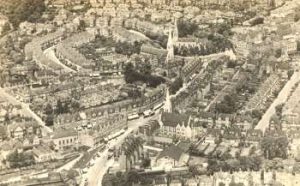
Aerial View of Streatham, c. 1930 Source: Ideal Homes: A History Of South-East London Suburbs

Suburbs have been around for a very long time, dating back to post-Roman or mediaeval times. There are many indications that mediaeval suburbs were based on detailed plans catered to the layout of whichever town they were building in. There are also many references to the suburbs in English literature, one of them being Shakespeare, as he mentions the “rabble of the suburbs”[3] in his Henry VIII of 1613. These references often refer to the disgraceful conditions in suburban London and have often been portrayed as “hell”. However, the suburbs were becoming more desirable in London by the 19th century and, in fact, it was during this time when a massive growth of suburbs began in London. There was a huge desire to live in a place that had easy access to the city but weren’t inside it. Post-World War II, in America there was a massive movement of people, mainly whites, moving from cities to rural areas.

“MERCEDES BENZ MOVE GIF BY MERCEDES-BENZ AUSTRALIA” Source: GIPHY. Undated.

World War II and the Great Depression had changed economic perspectives of many Americans – the economic turmoil that Americans experienced from 1929 to 1941 had induced them to ration material items they had taken for granted during the roaring 20’s. In the post-Word War II era, Americans sought to take advantage of their economic freedom by buying homes. “One of the first necessities sought after by Americans was housing. By late 1945 and early 1946 the housing crisis was acute. Veterans and other Americans demobilized from wartime production desired housing but were met with a lack of supply.” [4] The implementation of the Federal Housing Authority made it easier for America’s veterans to get mortgages, while the newly established G.I. Bill would help those same veterans go to college in addition to providing monetary support as they pursued an advanced degree.[5] This new legislation made it easier for veterans and their families to get houses in the suburbs, where housing was cheaper and my conducive for America’s rising middle class. The Federal Highway Act passed in 1956, allowed for transportation to be more effective, and made it easier for people to get in and out of the city. As a result, the inner-city neighborhoods of New York quickly deteriorated as many middle-class families who lived there ultimately left for seemingly better opportunities outside of the city. Racial tensions were likely an additional factor, which motivated many white Americans to leave the cities. The Great Migration had seen many African Americans resettle in the North’s metropolitan areas, causing a considerable societal shift in combination with the concurrent white migration to the suburbs.

3.  Levittown is the first and prime example of an American suburb

Levittown is an excellent model of the American post-war suburb. Levittown was established by William Levitt, who had taken advantage of the housing crisis that followed the post-Word War II years, as he offered affordable housing to white Veterans and their families that were in the Long Island and New York City areas.[6] These neighborhoods were made easy to commute from because of the Federal Highway Act. This was a perfect opportunity for the middle class to also move out of the city’s overcrowded apartment buildings. Levitt built Levittown as a new-model American community, which sequentially attracted many Americans to make the transition. Those who lived in Levittown were convinced that their community was one of the most important aspects of their lives.[7] Eventually, the houses in Levittown began to change, as the owners were rising in wealth and status. The community’s standard of living pushed for a more innovative culture in Levittown and caused residents to redecorate and improve their homes.

4- Living in a gated community makes you more fearful 

Gated communities and condominium developments are often concerned with providing a safe and secure community separate from the rest of the world, resulting in the residents becoming more fearful of others who aren’t “people like us” [8] (co-op residents).  At the same time, residents of these censored communities tended to go to their homeowners’ association board or could hire management to resolve conflicts, rather than handling it themselves to diminish conflict and contact between each other. Residents have not just been fearful of the actual action of a crime, such as kidnapping and burglary, they are more so worried about who they think will commit these crimes.


“SCARED CLASSIC FILM GIF BY SHUDDER” by GIPHY. Undated.

Meaning that since they are so isolated from the outside world and are insulated by an institution of like minded people, any interaction with someone who is not like them is seen as a threat and are discouraged. For example, even “strangers by virtue of their race or unconventionality are singled out as “suspicious” if merely walking down the street”. [9] Their exaggerated fear of crime really just means that they are afraid of “predatory behavior by strangers.”Upper and middle-class suburbs are structured to provide separation and privacy, both socially and physically. Residents desire to live with “people like us” (white, middle/upper class families) because it creates a sense of safety since the people buying it can afford to live there, implying that they will not steal from them and because the people who can afford to live there are mostly white. Residents of these gated communities closely monitor their spaces to identify outsiders, the people not like them.

5- Scholars still don’t agree on the exact definition of the suburbs

Since the term suburbs was first defined in 1845 by Friedrich Engels, the definition of the suburbs has expanded exponentially. However, scholars still don’t agree about what exactly defines a suburb because of how abstract the definition would have to be to encapsulate all the dynamics of such a setting. When scholars talk about the suburbs, they often tend to approach the conversation in more broad terms. Suburbs have become so difficult to find a concise definition for because it often seems “formless, with suburbs characterized along more than one dimension for most people.”[10]

Many scholars have different views of what constitutes a suburb, “people who write about suburbs actually define them explicitly as a whole—including many classic, influential, and

“X FACTOR ITALIA GIF” Source: GIPHY. Undated.

otherwise important works on suburbs. Some focus on specific types of suburbs defining them quite clearly but not dealing with suburbs more generally.” [11] Some scholars have defined suburbs by using examples such as, “by applying the term suburban to particular places or characteristics from which a definition can be deduced by the reader.” [12] However, other scholars “focus on areas that are clearly suburban by many definitions—for example new developments of detached housing on the urban fringe. However, they do not pay much attention to articulating whether other kinds of developments are also suburban.” [13] The term suburbs are ever changing and are interpreted in different ways by different people, this is what makes the suburbs a term that is confusing and difficult to clearly define.

6-  Latinos are fighting for their right to live in the suburbs 

White people are not the only ones who desired to shift from the city to the suburbs. Latino residents (both immigrant and non-immigrant) are increasingly moving into the suburbs. This shift of Latinos to the suburbs has increased both pro and anti-immigrant activism in suburbs and has caused a challenge that requires a reassessment of how immigrant activism is approached and theorized. However, Latinos have always been moving to the suburbs because of the relocation of industries to the suburbs and the development of private land, prompting immigrating Latinos in places like California to move to the suburbs rather than cities.

“Right to the City” is a phrase that was devised in 1968 and was used as a “rallying cry in the struggle for maximizing political access, claiming public space, and expanding spaces of citizenship”[14] and was concerned with the problems that arise within cities and urban society. “In Los Angeles, where the

“Right to the City” Source: Indigo New Media. Undated.

suburb and city are intimately tied to one another, adopting a Right to the City framework necessarily requires adopting an investment in a regionally oriented vision. While the suburb is a site of contestation, organizing in the suburbs presents a unique set of challenges.”[15] White homeowners have traditionally been the ones that have had the rights in the suburbs, which has led to the suburbs becoming a place where whites and Latinos are fighting for who exactly has the “rights” to live in the suburbs. Even as the Latino community continually grows in suburbs, “The Right to the Suburb allows a way to approach these diverse struggles, while accounting for the unique openings for action allowed in the suburb as a historical, political, and ideological construct. At the same time, claims by immigrants in suburbs offer an exciting way to broaden the application of the Right to the City.”[16]


7- It’s the “End of the Suburbs” as we know it..

In the book End of the Suburbs by Leigh Gallagher, Gallager isn’t actually talking about the suburbs ending, it talks about how the “bad” suburbs are ending and how the good ones are not ending.[17] It also touches on how Millennials are helping in the decline of the suburbs. “Bad” suburbs are ending because of the high costs of transportation, long commutes and a total lack of diversity within the suburbs. Most Americans live in communities built within the last fifty years, which have often been larger developments that are more spread out, meaning that one has to travel even farther to get to a desired location. Today, the suburbs are located so far away from the cities that they are not really “suburbs” anymore. Poverty has now overwhelmed the suburbs rather than the cities, while wealth has now rushed back to the cities. In cities, multi-family housing in apartments and condo’s are very popular, making it easier for families to now live in cities, something that was once a big problem.

“SATURDAY NIGHT LIVE GIF” Source: GIPHY. Undated.

Millennials have played a big role in the decline of the suburbs as 77% of Millennials prefer to live in an urban area. When they leave their parents’ home, they often “don’t want anything to do with the kind of suburbs they grew up in.”[18] Millennials also do not seem to care as much about driving and cars as previous generations, which was proven in 2010 when only 47% of 17 year-olds claimed to have a driver’s license. This means that those without a license are more dependent on public transportation, making it impossible for them to live in a suburban area.

8- A suburban town has the highest deportation in the country

“DIFFERENT RULES” Pool Photo by Michael Schwartz . Source: The New York Times. Undated.

In 2005, the Mayor (Allan Mansoor) of the suburban town of Costa Mesa, California, proposed a partnership with Federal Immigration and Customs Enforcement (ICE). This prompted local law enforcement to have the ability to identify, process, and detain immigrants. In the first year alone, over 3,000 immigrants were “identified for deportation” by ICE, who claimed to only target those immigrants who had “‘aggravated felonies and criminal street gang activity.’” [19] As a result of this, Costa Mesa became the programs national leader in  deportations and also became the model for other suburbs that too were anxious to restrict the ever growing population of Latinos in their suburbs. ICE officers also worked full-time at the Costa Mesa city jail, allowing the city access to federal resources, in turn, allowing arrests to soar because Costa Mesa’s local law enforcement was able to access the resources to deport unauthorized residents, legal permanent residents, and visa-holding immigrants at an extraordinary rate.

9-  The suburbs were a big in movies post-World War II

“JAMES STEWART CHRISTMAS GIF” Source: GIPHY. Undated.

Film can often reflect the reality of a time and the current events contemporaries face. In the 1990’s most Americans were living in or hoped to live in the suburbs, so naturally the suburbs were a big part of American movies and a movie making. The suburbs that are portrayed in movies are interchangeable because they don’t have any distinct features that separate one from another, so they have also conformed to our previous notions of what the image of the suburbs is. In movies like It’s a Wonderful Life (1946) and Miracle on 34th Street (1947), these the films exemplify the earliest examples post World War II movies that dealt with the suburbs and presented these communal suburbs as an escape. Movies made during this post-war era were “intended to appeal to suburbanites, most were sympathetic, gently satirizing everyday problems, as if to imply that only these minor blemishes marred the scene.” [20] In the film, Bachelor in Paradise (1961), Adam J. Nile, a bachelor living in a suburban town is told “You’ll find this truly is paradise. Schools, churches, country club, playground, pool, shopping center…As we say, a family can live a full and happy life and never leave.”[21] The suburbs were what a lot of Americans thought as being the most practical path to a good and respectable life.

10- Women were dissatisfied with home life, while Men loved every minute of suburban life

“ITS A WONDERFUL LIFE GIF” Source: GIPHY. Undated.

Women were very dissatisfied with their lives in the suburbs on the inside, however, on the outside they put on this facade that they were very content and happy with their lives. Women who lived in the suburbs were dependent on the resources of her family because they were fairly isolated from activities that were outside of the home. “Yet it generally appears that often their overall enjoyment of the home is most related to adult activities and the satisfactory definition of a life-style in the home setting.” [21] The majority of women who lived in the suburbs felt that they “lacked stimulation” as they were confined to their homes while some even argued that they had become more boring as a result of this. Women in the suburbs saw few options available to them within the suburbs and the possibility of getting a job, especially in the city, was out of the question because of the commute would impede on their family obligations. Of the women who had lived in the city and had moved to suburbs, a third of those women reported that they missed their old patterns of socializing and felt lonely.

“1950s Family Life” Source: Fifties Web. Undated.

It was actually men who said they enjoyed leaving the chaotic city scene for the suburban living life. Men who lived in the suburbs and were fathers “frequently talked of the values of the suburban experience for their children. They especially emphasized outdoor play and a more natural environment.”[22] Suburban men were the most satisfied with where they were living because the suburbs offered an escape from the chaotic cities where they worked, allowing them peace and room for recreation. Their movement to suburbs did not allow for them lose any opportunities compared to when they lived in city since they were still able to be a part of these public settings. Whereas for women, they did not have these opportunities, and as a result, they were not as thrilled about the idea of living in the suburbs because they were forced into the confined home and had to the duties of a housewife day-in and day-out, being cut-off from the outside world.

FOOTNOTES

[1] Richard Harris, and Peter J. Larkham, eds. 1999. Changing Suburbs: Foundation, Form and Function. Planning, History and Environment Series. New York, NY: Routledge. 6

[2] Ruth Mcmanus and Philip Ethington. 2007. “Suburbs in Transition: New Approaches to Suburban History.”Urban History, Cambridge University Press, 34 (2): 317–37. https://doi.org/10.1017/S096392680700466X. 320 

[3] Richard Harris, and Peter J. Larkham, eds. 1999. Changing Suburbs: Foundation, Form and Function. Planning, History and Environment Series. New York, NY: Routledge 6

[4] Bruce Lesh. n.d. “Post-War Suburbanization: Homogenization or the American Dream?” Baltimore County Public Schools. http://www.umbc.edu/che/tahlessons/pdf/Post-War_Suburbanization_Homogenization(PrinterFriendly).pdf. 3

[5] Kenneth T. Jackson. 1985. Crabgrass Frontier: The Suburbanization of the United States. New York, NY: Oxford University Press. http://www.csun.edu/~rdavids/350fall08/350readings/Jackson_Federal_Subsidy_and_Suburban_Dream.pdf.

[6] Peter Bacon Hales. 2014. “Levittown: Documents of an Ideal American Suburb.” Journal of American History 101 (1): 1-7. 3

[7] Herbert J. Gans. 1967. The Levittowners: Ways of Life and Politics in a New Suburban Community. Columbia University. http://courses.washington.edu/gmforum/Readings/Gans.pdf. 67

[8] Setha Low, Gregory Donovan, and Jen Gieseking. 2011. “SHOESTRING DEMOCRACY: GATED CONDOMINIUMS AND MARKET-RATE COOPERATIVES IN NEW YORK.” Journal of Urban Affairs 34 (3): 279–296. https://doi.org/0.1111/j.1467-9906.2011.00576.x. 289

[9] Setha Low, Gregory Donovan, and Jen Gieseking. 2011. “SHOESTRING DEMOCRACY: GATED CONDOMINIUMS AND MARKET-RATE COOPERATIVES IN NEW YORK.” Journal of Urban Affairs 34 (3): 279–296. https://doi.org/0.1111/j.1467-9906.2011.00576.x. 288

[10] Ann Forsyth. 2013. “Defining Suburbs.” Journal of Planning Literature 27 (3): 1–23. https://doi.org/10.1177/0885412212448101. 3

[11] Ann Forsyth. 2013. “Defining Suburbs.” Journal of Planning Literature 27 (3): 1–23. https://doi.org/10.1177/0885412212448101. 3

[12] Ann Forsyth. 2013. “Defining Suburbs.” Journal of Planning Literature 27 (3): 1–23. https://doi.org/10.1177/0885412212448101. 3

[13] Ann Forsyth. 2013. “Defining Suburbs.” Journal of Planning Literature 27 (3): 1–23. https://doi.org/10.1177/0885412212448101. 3

[14] Genevieve Carpio, Clara Irazabal, and Laura Pulido. 2011. “RIGHT TO THE SUBURB? RETHINKING LEFEBVRE AND IMMIGRANT ACTIVISM.” Journal of Urban Affairs 33 (2): 185–208. https://doi.org/10.1111/j.1467-9906.2010.00535.x. 186

[15] Genevieve Carpio, Clara Irazabal, and Laura Pulido. 2011. “RIGHT TO THE SUBURB? RETHINKING LEFEBVRE AND IMMIGRANT ACTIVISM.” Journal of Urban Affairs 33 (2): 185–208. https://doi.org/10.1111/j.1467-9906.2010.00535.x. 188

[16] Genevieve Carpio, Clara Irazabal, and Laura Pulido. 2011. “RIGHT TO THE SUBURB? RETHINKING LEFEBVRE AND IMMIGRANT ACTIVISM.” Journal of Urban Affairs 33 (2): 185–208. https://doi.org/10.1111/j.1467-9906.2010.00535.x. 189

[17] Roy J. Schneiderman. 2014. “REVIEW: The End of the Suburbs: Where the American Dream Is Moving.” REAL ESTATE ISSUES, 2014. 63

[18] Leigh Gallagher. 2013. The End of the Suburbs Where the American Dream Is Moving. New York, NY: Penguin Group. https://books.google.com/books?id=Y20IDAAAQBAJ&printsec=frontcover&dq=The+End+of+the+Suburbs+Where+the+American+Dream+Is+Moving+By+Leigh+Gallagher&hl=en&sa=X&ved=0ahUKEwjkyLGphNTZAhWuY98KHUB-CMYQ6AEIKTAA#v=onepage&q&f=false. 19

[19]Genevieve Carpio, Clara Irazabal, and Laura Pulido. 2011. “RIGHT TO THE SUBURB? RETHINKING LEFEBVRE AND IMMIGRANT ACTIVISM.” Journal of Urban Affairs 33 (2): 185–208. https://doi.org/10.1111/j.1467-9906.2010.00535.x. 190
[20] Douglas Muzzio, and Thomas Halper. 2002. “PLEASANTVILLE? The Suburb and Its Representation in American Movies.” Urban Affairs Review, Sage Publications, 37 (4): 543–74. 560

[21] Douglas Muzzio, and Thomas Halper. 2002. “PLEASANTVILLE? The Suburb and Its Representation in American Movies.” Urban Affairs Review, Sage Publications, 37 (4): 543–74. 561

[22] Susan Saegert. 1980. “Masculine Cities and Feminine Suburbs: Polarized Ideas, Contradictory Realities.” Signs, The University of Chicago Press, 5 (3): S96–S111. S103

[23] Susan Saegert. 1980. “Masculine Cities and Feminine Suburbs: Polarized Ideas, Contradictory Realities.” Signs, The University of Chicago Press, 5 (3): S96–S111. S105

[22] Susan Saegert. 1980. “Masculine Cities and Feminine Suburbs: Polarized Ideas, Contradictory Realities.” Signs, The University of Chicago Press, 5 (3): S96–S111. S103

[23] Susan Saegert. 1980. “Masculine Cities and Feminine Suburbs: Polarized Ideas, Contradictory Realities.” Signs, The University of Chicago Press, 5 (3): S96–S111. S105