Minorities Have Trouble Fitting In at Trinity College and What Can Be Done to Help

Posted on

On Trinity College’s campus there are many problems regarding minority students fitting into the social scene and social groups. At Trinity there is a group called PRIDE and its goal is to make minority students transition from high school to college be smoother. The PRIDE group brings many minority students together at the beginning of the school year in order to make them feel more comfortable as well as give them the feeling that they fit into a group. Although PRIDE is a very good program at Trinity there are many things that it, as well as other parties can do in order to make everyone feel more comfortable. In order to do this Trinity must take ideas that have worked from other schools and implement them as their own.

The problem with race at Trinity College as well as many other places in the world is that many people do not recognize that there is a problem and will not speak up when they see an act of racism occur [1. Trinity College, “Protesting Hate at Trinity College, April 2011,” College Archives – Documents (April 1, 2011): 4]. On top of that people need to understand the factual advantages and disadvantages of their race in today’s society. White’s inherently have more privilege and opportunity than minorities and minority groups often struggle to fit in to American culture . This is a problem in today’s society and this transfers down many college communities including Trinity’s. The frat life and many social scenes on campus don’t seem to include the minority population of Trinity very much and this is a problem. There needs to be a racially equal social scene on campus so that everyone feels comfortable integrating and joining different friend groups. The frats as well as other events and organizations have to take conscious steps to make people of all races and backgrounds feel equally comfortable to join and take part in.

The solution to the problems regarding race at Trinity lies within different organizations on campus. PRIDE is a huge part of making minority students feel more welcome on campus but PRIDE needs some adjustments in order to be even more helpful. PRIDE needs to be a support system for minority students but at the same time not restrict them to staying attached to PRIDE because that will in turn cause the reverse effect than what is desired. Although PRIDE does welcome white students they should make it more known so that white students don’t feel uncomfortable joining. On top of all this there should be more classes on the subject of race in school so that whites do understand what the minority students are going through and realize that for the white students it is easier to fit in than for students of color [1. Helen Fox, When race breaks out: conversations about race and racism in college classrooms (Peter Lang, 2009)]. There needs to be more effort on the schools part to get white students involved with racial diversity on campus because no matter how much PRIDE tries to make minority students feel comfortable they will never be completely at ease until they feel like they fit in with the majority of the students on campus.

A well-recognized idea to make more students feel more comfortable on Trinity’s campus was proposed by President Jones. His idea is to discontinue all of the frat houses on campus and turn them into what he called ‘theme houses’ [1. Jones, James F. Jr., “To Reweave the Helices: Trinity’s DNA by Our Two-Hundredth Birthday” (2011). College Archives – Documents. Paper 5. p.33 http://digitalrepository.trincoll.edu/trinarchives/5]. He says this because he believes that the alcohol-fuelled parties are not always inviting to all students on campus and that theme houses have the potential to be. President Jones makes some very good points as well as ones that are not necessarily the best for the Trinity community. Fraternities are big venues on campus and to take those away would greatly anger many people. However, Mr. Jones is correct in saying that they are not always welcoming to the majority of students and that must be fixed. Something similar to what was done at Union college should be done to a less extreme extent in order to make more students feel comfortable on campus. What Union College did in 2004 was take exclusive rights of the frat houses away from the fraternities and make it so that “A fraternity chapter will still be able to occupy a wing of a dormitory, but its members might have to live alongside those of the outdoors club, a sorority, a foreign-language society, or a mix of students.” [1. Andrew Brownstein, “New York’s Union College Abolishes Its Greek Residential System,” The Chronicle of Higher Education, March 5, 2001, sec. Archives, http://chronicle.com/article/New-Yorks-Union-College/107306/.]. Trinity should take pieces of what Union College did and reformat it to fit Trinity.
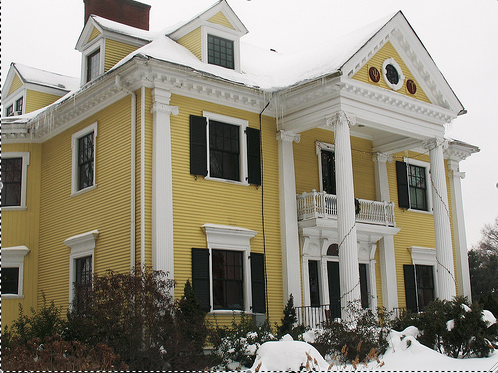
Psi Upsilon Fraternity at Trinity College

What physically needs to be done at Trinity is the Fraternities need to be more involved with all the different types of students on campus. What also needs to be done is for more classes or lectures that are marketed towards white students as well as minority students so that everyone on campus can have an idea of what other types of students are going through here at Trinity. The classes and/or lectures do not have to be required because this may cause resentment towards them but must be greatly encouraged and heavily marketed so that many people attend them. The fraternities, on the other hand, should be required to do many events with different cultural houses so that it will make many more people feel like they are welcome at a vast variety of social scenes on campus. On top of that it may not be a bad idea for fraternities to have to do an amount of community service so that they can interact with the community and better themselves and the people around them.

There are many problems with the social scene on campus regarding minorities. If actions are taken and people get involved with trying to fix this problem and make all students feel more comfortable on campus Trinity has the potential of becoming an even better place. The first step is that people need to be more educated on how the many different types of students feel about their social life at Trinity and the second step is to have larger social institutions and organizations team up to try to better the lives of all students and make everyone feel more comfortable. Once this is done Trinity could become a precedent on how to create a truly welcoming community for colleges all over the country.

Sophmore Integration Programs: The Key to Unity on Campus

Posted on

Currently, Trinity College is facing a serious issue regarding race and social class cliques on campus.  Most students tend to stick to groups of friends they feel the most comfortable with, which is commonly fellow students of the same race or social class.  This causes segregation amongst students and defeats the overall goal of a diverse campus.  When students are predominantly interacting with those similar to themselves, they are not learning about new cultures, places, or experiences.  In a survey that interviewed a random group of sophomores at Trinity College, 5/15 students mentioned that either race or social class has played a direct role in the way they interact with friends on campus.  While this number may not appear extremely high, it should be as close to zero as possible.  In order to have an open environment on campus, no students should have to feel as if race or social class will determine their social life.

This picture, taken from a movie, depcits the idea of what a stereotypical racial clique can look like. http://listverse.com/2009/01/14/top-15-movies-about-high-school/

At a Liberal Arts college it is essential for students to be exposed to unfamiliar aspects of life and open to change.  Specifically, Trinity’s mission is to “foster critical thinking, free the mind of parochialism and prejudice, and prepare students to lead examined lives that are personally satisfying, civically responsible, and socially useful.” Currently at Trinity, because of the cliques, students are not fulfilling their college experience. It is nearly impossible for students to accomplish this mission statement when they are rarely exposed to diversity within their respective social groups.  Students must be encouraged to be pushed outside of their comfort zone instead of frequently making decisions that make them feel most comfortable.  Further, the varying perspectives of diversity on campus make it difficult to combat the issue.  Many white students feel as though being at Trinity has exposed them to more diversity then they have ever seen, while students of color feel as though they are the obvious minorities on campus.  Marshall, a white sophomore at Trinity, states that his home state “is a state where it is over 95% white and before coming to trinity I can honestly say that besides for traveling I had never actually lived in a setting with not only different ethnicities, but also different religions.” [1. Marshall, 22.] From this quote it is clear that Marshall was exposed to more diversity then ever before when he came to Trinity. Marshall is not the only student of his type on campus and it is essential that students like this come to Trinity with an open mind instead of arriving on campus expecting to solely interact with students similar to themselves.  Although there are many different ways one could attempt to combat this obstacle, it is critical that students are exposed to diversity and forced to interact with new students as soon as they arrive on campus, before they have been given a chance to form any cliques.

Trinity College’s Campus Climate Report, released in 2007, brought up many pressing issues on campus that remain prevalent on campus today.  This report set goals that Trinity should focus on achieving and recommendations in order to reach these aspirations.  Overall, the goals were well thought through and were crucial for racial and social class diversity development on campus.  Specifically, goal number two, which states “We need greater economic, racial and ethnic diversity in our student body, faculty and staff,” [2. Cheryl Greenberg, Philip Khoury, “Final Report of the Charter Committee on Campus Climate,” (diss. Trinity College, 2007), 11.] and goal number four, which states “We need a residential and social life for students, faculty, and staff that fosters a stronger sense of community and mutual responsibility, as well as one that encourages an open-minded embrace of diverse opinions and styles,” [3. Cheryl Greenberg, Philip Khoury, “Final Report of the Charter Committee on Campus Climate,” (diss. Trinity College, 2007), 16.] are important goals to strive for in order to eliminate cliques on campus.  These goals discuss featuring more diversity on campus and the importance of individual roles on campus.  Although the recommendations provided are strong and have potential to help improve the problems, they barely address the issue of changing the orientation program.  We do agree with the goals and recommendations brought up in the Campus Climate Report, but we feel as though the most important recommendation, to change our orientation program, was not addressed enough in the report.  Recommendation “F” under goal four states that the College must, “Provide adequate funding to extend orientation programming into the academic year.  Consider a sophomore orientation, geared toward community building and fostering connection with the Hartford Area.” Despite the fact that this recommendation does address the orientation programs, the recommendation itself is located close to the bottom of the list, indicating that it is not an issue of top priority. Therefore, we believe it is not considered as critical to life at Trinity as it should be.

With determination to resolve the issue of cliques on campus founded on the basis of common characteristics such as race and social class, we propose to refurbish Trinity’s First Year orientation schedule, and to implement an effective, innovative “further integration” program for students entering their sophomore year.  After the students have become acclimated to their environment at Trinity College over the previous academic year, their “new” label has worn off and they tend to remain comfortably settled into their established social group.  As previously discussed, these cliques generally consist of members who share the same race and/or social class, and this is detrimental to the quality of the of their liberal arts education.  In order to experience what Trinity has to offer to its full potential, students would immensely benefit from a revised first year orientation program accompanied by a second year integration program designed to expand the borders of their social comfort zones.

Upon arrival at Trinity College, students usually experience a sense of timidity, yet prominent eagerness to socialize with their new peers.  Coming to Trinity as an International student, one of us (Lucy) was forced to go through International Orientation, an early orientation program geared towards students of origin outside the US.  While it was helpful to arrive on campus early, the orientation required incoming freshmen to get to know fellow international students.  Because not many other students were on campus during these few days, this was the only group of students available for socialization.  These students, more then anyone, tend to gravitate towards other students who are culturally similar or geographically close to themselves because international students are already so far away from their home, families, and other aspects of familiarity.  This causes cliques to be formed prior to the arrival of other students on campus.  Although an early orientation program for international students proves to be helpful in many regards, combining it with the regular first year orientation schedule may eliminate the initial issue of cliques on campus prior to the start of classes.

International Student Program held at Trinity College. http://www.trincoll.edu/Admissions/international/Pages/default.aspx

Additionally, having recently experienced the nerve-wracking transition to college, we can accurately attest the necessity for an effective welcome program.  It would be helpful to incorporate a greater quantity of sophomore students into the running of the First Year Orientation activities.  Had there been more students running this schedule, it would have been further organized and well put together.  Also, having extra sophomores available on campus during the first few days of orientation, the incoming freshman class would benefit from the additional people they can turn to with questions and concerns.  Participation in the facilitation of the First Year Orientation schedule should be voluntary, but students should be offered an incentive such as higher quality housing for their junior year in order to encourage their willingness to help.  Clearly, the Residential Assistants worked very hard to incorporate everyone into icebreaker exercises, but running a first year orientation is a daunting task that requires the participation of more students who can provide a fresh outlook regarding the experience of freshman year at Trinity College.

The most critical aspect of our proposal is the sophomore year integration program.  We believe it should be referred to as an integration program as opposed to an orientation program because the word “orientation” denotes a sense of unfamiliarity with the campus.  Clearly, the incoming sophomores do not need to be directed through the practices of a new, unfamiliar educational institution.  However, they do need to be further integrated into the campus community, constantly challenging their preconceived notions and broadening their horizons while leaving their comfort zones.  The very purpose of a Liberal Arts education is to constantly question, explore, and discover new aspects of life.  In exploring the way other colleges address the issue of encouraging students to maintain an open mind throughout their education and into their adult lives, we found through a Chronicle of Higher Education article that the University of Pennsylvania showed their incoming freshman skits designed to dramatize the conflict between black and white students that plagued the campus during the previous semester.  We believe that Trinity’s sophomore students, as part of their mandatory integration program, would benefit from skits similar to the ones performed for the University of Pennsylvania freshmen.  Additionally, these skits depicted “the side of college life you don’t get on the guided campus tour: date rape, safe sex, and, especially, the friction associated with growing racial and ethnic diversity.” [4. Christopher Shea, “Orientation at Penn,” The Chronicle of Higher Education, September 15, 1993, sec. Archives, http://chronicle.com/article/Orientation-at-Penn/92558/.] We believe that after completing one year of college, these issues will motivate the students to become vocal about their opinions, and inspire them to think about race and other issues in a new way.

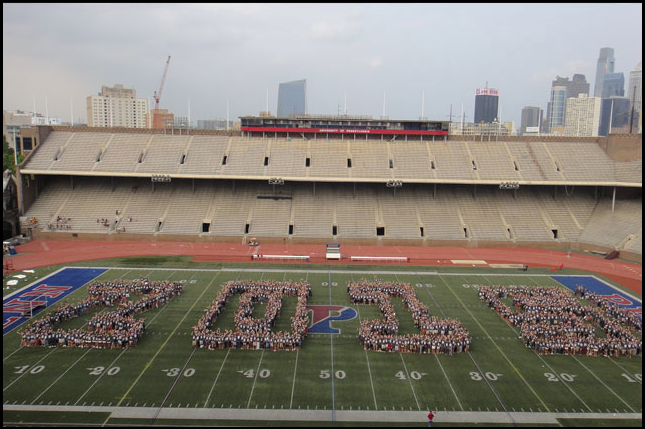
The University of Pennsylvania class of 2015 at one of their first year orientation programs. https://secure.www.upenn.edu/nso/nso-gallery-2011.html

In addition to the viewing of the skits, we propose that the students should be separated into randomly selected groups in which they participate in enjoyable activities such as problem solving exercises or even relay races.  The main goal of this new program is to facilitate the interaction and socialization of students who would not normally establish friendships.  These activities should be run by upperclassmen, also offered an incentive for participation.  We argue that this program should be mandatory for all incoming sophomores because the concept of voluntary participation implies that willingness for open-mindedness is also an option here at Trinity College.  When paired with the increasingly organized First Year Orientation, we argue that a sophomore year integration program will enhance not only the unity amongst the sophomore class, but also the experience of a Liberal Arts education.

After examining campus reports at Trinity, talking to Trinity sophomores and exploring orientation programs both at Trinity and at other campuses, it is clear that Trinity must refurbish their orientation program in to order to achieve their goal of a diverse and open-minded student body.  This resolution is the key to resolving race and social class cliques on campus, which are not allowing students to fulfill their liberal arts experience.  By expanding the orientation program into sophomore year, students get the opportunity to interact with fellow classmates they may not know and further understand the importance of a clique-free environment.    It is essential that this recommendation be implemented as soon as possible as the issue of cliques on campus is a fundamental problem to the overall goal of a diverse student body.

About the Authors: Lucy Robinson, from Toronto, Canada, and Christy Boyle from  Longmeadow, MA, are both students at Trinity College in the class of 2015 within the first year seminar “Color and Money.”

A Well-Rounded Admissions Process

Posted on

The admissions process is complicated and extraneous to all students. The difficult decision of choosing where to spend the next four invaluable years of school is based solely on the way people can display themselves. Criterion such as grades, standardized test scores and community service all have an impact on the decision process when looking at applications. However, many colleges and universities place a heavy amount of the decision on the conditions that many cannot control. Factors like financial status, alumni connection and racial background play a vital role in who is accepted and who is denied. As we have seen in readings and simulations in class, it is often those with advantages in these areas that are accepted over the real qualified students. Trinity College should revise its application process to enhance the consistency of applicants by evaluating students on their future potential rather than assessing them on their past. Privileged individuals do have an advantage in the admissions process. This system should be set in place to both minimize the influence that these privileges have in the final decision and evaluate the students based on their success given certain advantages. Although it may seem impossible to make a perfect system to determine who is accepted and who isn’t, there should be revisions to the current process to provide more consistency. The qualifications of an applicant should be evaluated in terms of the factors that can be controlled by students; factors that compare the success of students up until college based upon both their educational and socioeconomic background.

Similar to most colleges and universities, Trinity College searches through thousands of applications to find the most qualified and well-rounded students. To make the difficult task of determining which students should be chosen from the thousands that apply, Trinity depends on many sources of information to “try to balance the following factors when evaluating candidates for admission” (Trinity College). Trinity College states that it takes into consideration factors such as 1.) Your transcript 2.) Course selection 3.) The quality of your course loads and prefers to see that you have challenged yourself with the strongest program that you can handle 4.) Standardized test scores 5.) One (1) college or guidance counselor recommendation, as well as two (2) teacher recommendations 6.) Grades and 7.) Extracurricular activities etc (Trinity College). Despite the information given, it is unpractical for a college to look at just these factors alone, for there are other attributes that should be acknowledged. Yet, it is important to pay attention to the influence certain factors play in determining who gets admitted and what additional attributes should be viewed to make such a decision.

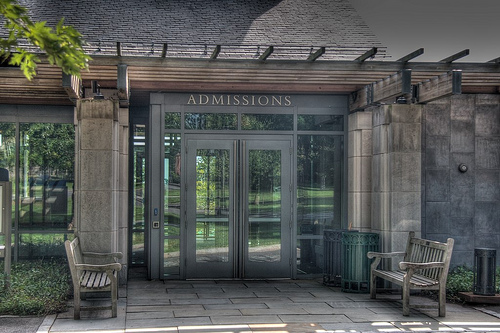
The Trinity College Admissions Office

In discussions over the current admissions process, one controversial issue has been the validity in the admissions structure. On the one hand, some argue that the current application process provides the best indication of a student’s full potential in college. Others maintain that the current process is flawed. The general argument made by Bryan Nance in his work For a Fairer Admissions Process, Read Between the Lines, is that the current admissions process is unsound because of the indicators it uses to determine the best applicants. More specifically he argues that the system is flawed because of the heavy amount of weight placed upon the quantitative information received by schools. He states, “Although these are extremely important [grades and standardized test scores], the historic numbers-trump-all model has become increasingly outdated in its ability to assess an applicant’s true potential, especially among low-income, first-generation, and minority students”(Nance). Here, Nance suggests that the current system is inaccurate because of its inability to properly determine the future success of students. Furthermore, he mentions that, colleges and universities that use this system find more difficulties in evaluating the future potential of students that fall in the racial or economical minority. Today’s system is structured to favor the wealthier white majority that applies to higher education schools such as Trinity. Numerical evaluators will generally be higher within communities with more superior school systems and resources. Systematic changes must be made to discontinue the unequal “playing field” for applicants coming from advantageous backgrounds.

Instead of referring to standardized tests scores and high school GPA’s, the college admissions team should look at more effective indicators of a student’s potential. Teacher recommendations and the decisions for students to choose harder level courses in high school should be looked at more closely. The choice to challenge oneself portrays the work ethic needed to succeed both in college and afterwards. Connections between Trinity and all high schools should be strengthened to help build relationships between the admissions staff and the teachers of those schools. The recommendations are one of the few times in an application where students get use the opinions of other adults to describe the real identity of an applicant. These are just a few of the indicators that should be looked at more closely, over the heavily weighted numerical indicators.

The CommonApp System, used by most colleges and universities to accept applications

Some may say that the college admissions decision is based on all contributing factors to an application. Although this may be true to a certain extent, the most important factors in an application are based on aspects that the applicant cannot control. Factors such as social status, race, legacy and early decision advantages play a huge determining role in the final decision. Applying early decision or early action to a college is a huge advantage for the student coming from a higher economic background. However, this advantage is not practical for all applicants given their financial status. In the article, The Troubling Rise in Early Admissions, Richard Kahlenberg discusses why and for whom the early decision process helps and in some cases hurts students in the admission process. Kahlenberg states, “Early decision programs are particularly unfair to low-income applicants because the binding commitment to attend a particular college eliminates the ability to bargain between colleges for the most advantageous financial aid packages” (Kahlenberg). In this statement he explains how the admissions process is unfair to students of lower socioeconomic status, while wealthier students have it easier because of early decision possibility.

At Trinity itself, the admissions staff takes into consideration these attributes when deciding who to admit and who to deny. These problems are not only here at Trinity but are occurring nationwide. At Texas A&M, the admissions staff was experiencing some of the same problems. Yet, they have made improvements by choosing to abolish the admission of legacies that have fewer qualifications in comparison to non-legacy students (Schmidt). Furthermore, factors that have to do with connections and background should be weighed less. A student’s admittance should be based on their own performance in and out of school.

The admissions process at Trinity College needs to recognize the success of students in relation to the background they come from, rather than in comparison to all the applicants in the admissions pool. Many would agree there exists a major gap between the types of educations amongst various communities. Wealthier and more affluent communities tend to yield students with greater résumés while impoverished neighborhood struggle to send a higher percentage of students to school after high school. In Derek Bok’s article Closing the Nagging Gap in Minority Achievement, he acknowledges that the problem is, “closing the gap in academic achievement and standardized test scores separating black students from their white and Asian-American counterparts. The gap is nationwide, it is substantial, and it has not diminished in the last 15 years. The task is all the more difficult because most experts attribute the gap to racial differences in child-rearing, preschool preparation, and opportunities for a quality public-school education” (Bok). Here, there is a recognized disparity between students who are raised in drastically different environments that often goes unaccounted for in the admissions process. Students are undoubtedly tested to overcome greater disadvantages when not given the proper resources to succeed like their wealthier counterparts. To level the playing field, students at Trinity College need to be evaluated based on the success of where they come from rather than in comparison to the group as a whole.

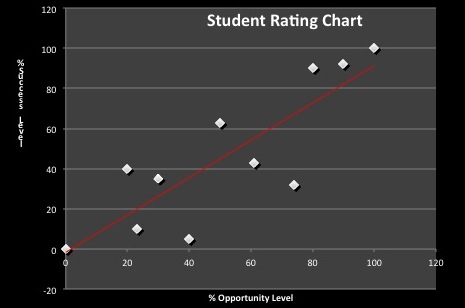
The success of students should be judged in comparison to the background in which they come from. The graph above is a model intending to display the new way the admissions staff at Trinity should view its applicants. The linear line (shown in red) is the space on the graph that predicts the average success that a student should have, given a certain opportunity level. The opportunity level is displayed using numbers from zero to one hundred (one hundred symbolizing a background with more opportunities). A higher opportunity level is computed by looking at the resources and guidance that students had throughout middle school and high school. Students that fall below the line are students that did not succeed to the potential the college would expect given the background from where they came from. On the contrary, students that lie above the line are indicators of applicants that surpassed the expected level of success prior to coming to Trinity College. It is important to emphasize the difference of a student surpassing expectations given a lower opportunity level in comparison to a student coming from a wealthier background. Trinity College should look at factors such as these to gain more understanding on the personality and character of each individual.

Our solutions to these problems are meant to fix the current inconsistencies in the admissions process at Trinity. With these solutions, come possible dilemmas such as funding and disagreement in the new evaluation system. However, the goal of these revisions is to create a new way to properly evaluate students in an equal way; to judge students on their capabilities of becoming successful in the future both at college and afterwards. Like any changes in a process, this process may take awhile to ever fully be effective. Yet, with time there can be a new and more efficient way to evaluate the leaders of tomorrow.

About the authors: James DiBlasi and Casey Tanner are two first-year students in the Color and Money Seminar. Both students come from the greater Boston area; James (Winchester, Ma) and Casey (Wellesley, Ma).

Bibliography
Admissions Staff. “FAQ.” Trinity College. Trinity College, 2011. Web. 2011.

Anne West, Hazel Pennell, and Philip Noden, “School Admissions: Increasing Equity, Accountability and Transparency,” British Journal of Educational Studies 46, no. 2 (June 1, 1998): 188-200.

Bartlett ,Tom, “Race Is a Factor in Admissions at a Third of Colleges, Survey Finds,” The Chronicle of Higher Education, October 10, 2003, Volume 50, Issue 7 edition, sec. Students.
Bok, Derek, “Closing the Nagging Gap in Minority Achievement,” The Chronicle of Higher Education, October 24, 2003, Volume 50, Issue 9 edition, sec. The Chronicle Review.

“Fall Timeline for High School Seniors: November « College Blog by Kris Hintz.” College Blog by Kris Hintz. Web. 05 Dec. 2011.

Fischer, Karin, “Unknown Factor Hampers Minority Students’ Performance in College, Study Finds,” The Chronicle of Higher Education, June 6, 2003, Volume 49, Issue 39 edition, sec. Students.

Kahlenberg, Richard. “The Troubling Rise in Early Admissions,” The Chronicle of Higher Education, Innovations, October 29, 2010, http://chronicle.com/blogs/innovations/the-troubling-rise-in-early-admissions/27737.

Nance, Bryan G. “For a Fairer Admissions Process, Read Between the Lines,” The Chronicle of Higher Education, September 19, 2010, sec. Diversity in Academe, http://chronicle.com/article/For-a-Fairer-Admissions/124444/

Sawallich, Christopher. Trinity College Chapel Hartford, CT AdmissionsBuilding, October 14 2011, http://www.flickr.com/photos/csawallich/6244617023/.<.

Schmidt, Peter, “New Pressure Put on Colleges to End Legacies in Admissions,” The Chronicle of Higher Education, January 30, 2004, Volume 50, Issue 21 edition, sec. Archives : Government & Politics.

“The Welcome Weekend” Woes

Posted on

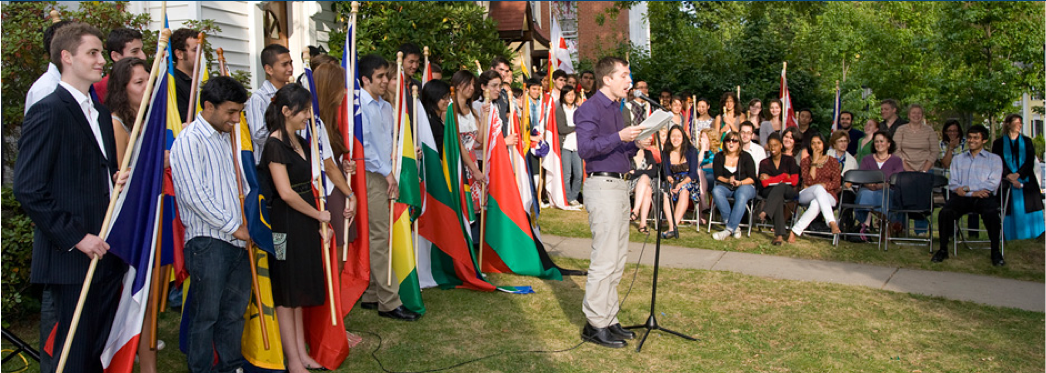
Trinity’s campus suffers from many problems regarding race and social class, one of which is the fact that the minority students feel isolated from the every day activities on campus. The P.R.I.D.E. program at Trinity “is a program organized by the Office of Multicultural Affairs aimed at supporting students from diverse backgrounds and encouraging interaction among all first year students at Trinity College” P.R.I.D.E. offers a “three day pre-orientation program, called “The Welcome Weekend”, that helps international students and students of color become acquainted with Trinity’s physical and social atmosphere.” “The Welcome Weekend”[1] helps create a social atmosphere amongst the first year students that from the beginning of school separates the students of color from the White students.

“The Welcome Weekend” sponsored by P.R.I.D.E. is sought to do good for the incoming students at Trinity College, but in fact has caused a separation among racial minority and white students. P.R.I.D.E. is not the problem driving racial separation on campus, but rather the lack integration amongst students that is caused by “The Welcome Weekend.” The pre-orientation program helps facilitate racial division on campus. P.R.I.D.E. students have already made friends within the first three days of their pre-orientation program, similarly to how football players make friends with kids on the football team before the rest of the freshman class arrives. This gives these students a sense of community and comfort that they do not wish to break as the majority of students enter campus. The difference between “Welcome Weekend” and the football team’s preseason is that there are both racial minorities and racial majority players on the football team compared to “Welcome Weekend” that highly recommends racial minorities to participate.  Arriving to campus early, unfortunately, creates a divide amongst students that already have made friends and students that have not had the chance to make friends yet.

Imagine that you are an incoming freshman student at Trinity. In this scenario, you are part of the _________ group on campus. This particular group asks you to arrive on campus before the rest of the incoming freshman. Without having the chance to meet anyone outside of the group, you begin to form friendships in this _______ group. You start doing everything with the other members of the group. You participate in the same activities as them. You eat all your meals in Mather with them. You hang out with them during the night etc. Once all your all-fellow students arrive on campus you continue to hang out with the group of friends that you have already made because you are now comfortable with them.  In the scenario we described above, can you tell if we are talking about the football team or the racial minority students that participated in “The Welcome Weekend?” The reason that all programs, who ask students to come to school early are not being questioned is, that unlike the “Welcome Weekend”, no other program only allows “international students and students of color”[2] to participate.

When Trinity sophomore students were interviewed about how race and social class affected them on the Trinity campus the P.R.I.D.E. program was brought up and specifically the “Welcome Weekend.” Mary, who is a racial minority on financial aid on campus, spoke about “ The Welcome Weekend” and said “A feeling that I got from them (Welcome Weekend Leaders) was like be aware of the wealthier students, the wealthier white students they will treat you, it’s like there a difference between you guys.” Mary goes on to say, “We were like set up to hang out with one another (Other minority students) instead of embracing the maturity and like promoting respect, right. And of different um-different cultures, did not necessarily happen because we stuck with the minorities rather then mixing or, like getting to know other students from Trinity, or having a full on orientation.”[3] Mary’s comments about the pre-orientation program reflect the exact scenario described above. Mary’s comments are saying that the program ended up making her feel more different from the norm on campus. Mary ends her statements on “Welcome Weekend” with saying “Initially I hung out with minorities because I was too timid to approach anyone else that hadn’t participated in P.R.I.D.E.”[4]

In order to find a plausible solution to this problem of racial division on Trinity’s campus it is necessary to look at other similar institution’s orientation programs.  Amherst, a racially diverse NESCAC school, is completely doing away with its pre-orientation program. There solution might be drastic, but the president of Amherst feels that as freshman the school should “stand first for integration and secondarily for the special adjustments required by ethnicity, race, religion, nationality, or other aspects of identity[5].”  Amherst’s ideal situation with their pre-orientation might be a little extreme, but the problems arising at Trinity College throughout the years must be solved. Amherst’s solution is not the answer to the P.R.I.D.E. program, but it shows that there are barriers, in dealing with race, that we must work on overcoming [6] and the solution that Trinity is using is not working to integrate these students. Amherst has not had any notable racial issues, since they did away with a racial pre-orientation program; whereas, Trinity College has experienced multiple racial issues with the “Welcome Weekend” the way it is. In fact, similar to Amherst, Trinity cancelled  “Welcome Weekend” for the class of 2015, due to a hurricane this year and hasn’t had a notable racial problem thus far.

The dean of Yale, Mr. Brodhead, says that if “Any program powerful enough in one week to alter the way people think about things would have to be one hell of a good program.[7]” This sarcastic claim proves that all the statements made by the people in P.R.I.D.E. who wish to integrate students who are minorities coming into Trinity College can be refuted. One week, let alone three days, cannot change the way students perceive new surroundings.

P.R.I.D.E. is not a program that can be removed from the Trinity College campus, it does a lot of good to be removed, but it is something that can definitely be altered to do more good.  We feel that “The Welcome Weekend” should be removed from the program.  It is something that is causing racial separation as said by the Amherst president.  Incoming freshman need to interact with all of the students, it is what makes the college experience. Students should not be grouped with a small group of students during P.R.I.D.E., and never interact past that group because they feel so comfortable in it. If P.R.I.D.E. allows freshman orientation to play out and students to interact with peers of all races, and then they can incorporate their programs into the student’s life. “Welcome Weekend” can be replaced with meetings or gathering once or twice a week, and make them optional, yet highly recommended. With meetings during the week, this would allow for the P.R.I.D.E. program not to have to compete with the immensely popular  fraternity life.  P.R.I.D.E. should encourage a student in their program to bring a friend, not from the program, to the meetings. This would allow for a chain of new students interacting with one another not just during the first 3 days of school but rather throughout the whole year. This gives students a chance to integrate themselves, by brining friends from outside the P.R.I.D.E. program, and encouraging them to interact with one another. If P.R.I.D.E. could manage to keep their program meetings interesting, even the idea of food outside of Mather Hall would get students of all races to the meetings.

The P.R.I.D.E. program as it is right now remains a mystery to the majority of the Trinity campus. Students know so much about events like 80’s night, a popular dance ay Trinity College, but really don’t know much about P.R.I.D.E.  Removing “The Welcome Weekend” from P.R.I.D.E. will help students who aren’t racial minorities know that they are allowed to join. “Welcome Weekend” in a way has become an initiation to P.R.I.D.E. that white students don’t know they can join after the weekend is over. We feel that if students can interact with people on their own, the program will thrive mightily as the year goes on. People from all different races can come to meetings because their friends are members of P.R.I.D.E. and tell them what it truly stands for.

The P.R.I.D.E. program is not a problem regarding race or social class at Trinity’s campus. It is our belief that “The Welcome Weekend is. By removing the welcome weekend and making slight changes to the P.R.I.D.E. program will dramatically help with racial issues that the Trinity campus has.


[1] P.R.I.D.E. Official Newsletter. Brandon Lewis.

[2] P.R.I.D.E. Official Newsletter. Brandon Lewis.

[3] Interview Transcripts

[4] Interview Transcripts

[5] Gose, Ben. “Do Minority Orientations Encourage Segregation?” The Chronicle of Higher Education, September 4, 1998, sec. Students. http://chronicle.com/article/Do-Minority-Orientations/2236/.

[6] Bartlett, Tom, and Karin Fischer. “Diversity Programs and Social Norms.” The Chronicle of Higher Education, January 19, 2007, sec. Letters to the Editor. http://chronicle.com/article/Diversity-ProgramsSocial/1867/.

[7] Gose, Ben. “Do Minority Orientations Encourage Segregation?” The Chronicle of Higher Education, September 4, 1998, sec. Students. http://chronicle.com/article/Do-Minority-Orientations/2236/.

  
The Goal (Source: Trinity Tripod, 2011)
Pride Welcome Letter (Source: Trinity College, 2011)
About the Authors:
 Jack Kidd and Sean Meekins are first year students at Trinity College and are currently enrolled in the First Year Seminar Color and Money taught by Jack Dougherty.