WORKS CITED
[1] Chauncey, George. 1994. Gay New York. New York: Basic Books.

American Studies 335, Trinity College
WORKS CITED
[1] Chauncey, George. 1994. Gay New York. New York: Basic Books.
Below is an example Listicle. You need not follow this format, offer these types of points, use these kind of media, etc. This is JUST AN EXAMPLE. What it should offer you is an idea of the rigor and depth of each point. Given that I, Prof. Gieseking, and Ashley Hamelin created this based on my book (which took ten years) and Ashley’s 400-level research seminar paper from last spring, your Listicle will likely not be as well researched (yet!) but you have something to strive for! 😉
Gay bars are a staple of the American geographical imagination. Usually imagined to be in or linked to the LGBTQ (lesbian, gay, bisexual, transgender, and queer) neighborhood-and imagined as such straights and LGBTQ (lesbian, gay, bisexual, trans, and queer) people alike-the mythical, all-welcoming, and ever affordable “gay bar”-lesbian, gay and lesbian, or LGBTQ bar, party or club-is the one of if not the most widely mentioned place in lesbian, gay, bisexual, trans, or queer histories, memoirs, and documentaries. These spaces are shaped by race, class, and, especially, gender. But their history is much more radical, complicated, and tied to political economy than you would imagine. Here are the top ten things you didn’t know about gay bars…
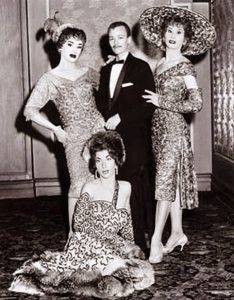
1. No one knows where or when the first “gay bar” popped into existence in the US. It is likely around the same time as such establishments as Europe, likely toward the end of the 19th or early 20th centuries. Such places would have been illegal based on local laws or, at a minimum, the people in them would be harassed and persecuted. As such, bars did not claim the identity of “gay bar” until around the mid-20th century. As early as the 1890s, historian George Chauncey writes, unnamed bars would have men singing in falsetto voices, acting in campy ways, or dressing in women’s clothes.
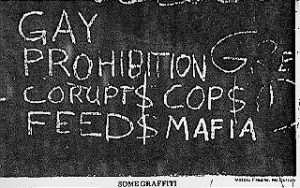
2. During World War II, formal lesbian and gay hubs began to congeal in major US cities. As historians John D’Emilio and Allen Bérubé revealed, same-sex segregation on the frontlines and at home allowed more gay men and lesbians to find one another.[1] Importantly, women could finally live away from home, by their own means, and as a group. However, heteronormative and racist moral policies and laws of the mid-20th century, such as the motion picture industry’s Hays Law, dominated everyday American life. Consequently, it was often the mafia with their kickbacks and connections who could create and sustain bars for LGBTQ people in urban areas.[2]
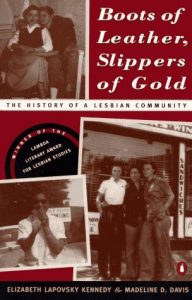
3. The most well-known and one of the only book-length lesbian histories, Boots of Leather, Slippers of Gold, includes an entire chapter on lesbian bars, titled “I Could Hardly Wait to Get Back to That Bar.” Writing about working- and middle-class, black and white lesbians in Buffalo, New York, from the 1930s to the 1960s, historian Elizabeth Kennedy and activist Madelyn Davis describe how the bar-lesbian only, or mixed lesbian and gay-was the only semi-public or public space available for lesbians. The bar, they argued, afforded a space for open sexuality, radical gender presentation, community socializing, and what they term “prepolitical” gatherings before the rise of a national gay and lesbian movement.
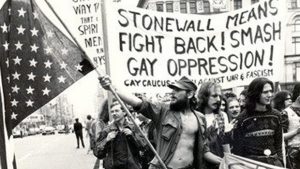
4. Drawing upon and also feeding the radical civil rights, feminist, Marxist, and Third World movements, the 1960s and 1970s lesbian and gay movement focused on what queer theorist Michael Warner calls a “democratic conception of activism.” The early movement called for “resistance to the regulation of sex and [an] aspiration to a queerer world,” namely in cities.[4] A small number of protests, riots, and acts of resistance throughout US cities, largely conducted by working-class people of color and gender non-conforming people, paved the way for the most well-known and spontaneous riot on June 27, 1969 at Greenwich Village’s own The Stonewall Inn. On that day, LGBTQ people, largely poor and working-class people of color, fought back against police violence. The march following the five days of the Stonewall Riot continues to be celebrated annually and internationally as Pride.[5]
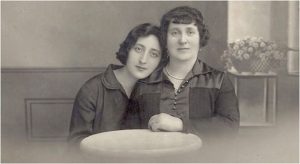
5. Historian Lillian Faderman wrote that “lesbians claimed a bit of space for themselves in the clubs that catered to them and featured lesbian entertainers.”[6] At 129 MacDougal Street from 1925 to 1926, the brief but popular Eve Addams’ Tearoom posted a sign that read, “Men are admitted but not welcome.”[7] The after-theater club may have been the first equivalent to modern lesbian bars; Faderman notes that “there were not…enough females to support all-women’s clubs” until the 1930s.[8]
6. In 1979, Esta Noche, the first Latino gay bar in San Francisco, opened its doors. This bar provided a space for LGBTQ Latinos to socialize and be socialized. It was a space to watch drag performances and enjoy comedy shows. Beyond the entertainment, Esta Noche was a safe space for gay latinos. Bars and nightclubs have often become safe spaces for LGBTQ people to gather and to be free to be themselves without scrutiny or fear. Greggor Mattson wrote in his article about homonormative gay place making that bars “were the most important cultural institution where newly ‘out’ men were socialized, interpersonal contacts were made, social isolation was alleviated, and community art exhibitions, charity auctions and political meetings were held.”[24] For LGBTQ Latinos, a group that had faced a trifecta of discrimination, Esta Noche provided that space. Journalist Paul Flynn wrote in an article in The Guardian explaining that in gay bars “there is a shared vocabulary, built partly around disposition but also the raw necessity to pass on the things that school couldn’t teach you and that church refuses to.[25] He goes on to write “after the coat-check, you are the majority, not the minority. It is a feeling both strange and new. Because it is essentially a mating ground, it can be cruel and pernicious, but that hardness is dealt out on equal terms.”[26] Gay bars are more than just a place to dance and have fun they are places to learn about and understand yourself. They are places to find your people, to feel acceptance and to feel at home.
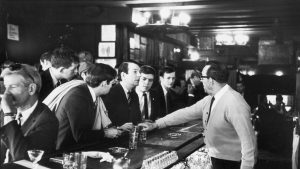
7. “Cruising” is the term for walking or driving around in search of a partner for a sexual encounter. The slang term was and is still often used as a code word among gay men, and is still one that most heterosexuals didn’t pick up on. Gieseking writes, “By the sexual revolution of the late 1910s and 1920s, the first lesbian and gay bars of the city could be found in the left-leaning, already gentrifying, bohemian Greenwich Village neighborhood. Included were balls, saloons, parks, and waterfront cruising grounds of gay men.[9] Gay men “converted the street into a major cruising area, and it was soon called the Auction Block”. While in the past, cruising would usually take place on the street or in a park, bars and bath houses were also locations were cruising was common. Today, cruising can even be done online on chat rooms and through dating/hookup apps such as Grindr, Scruff, and Tinder.
8. Lesbians had bars since the 1920s and 1940s. After raids on bars began to slow and then stop in the 1960s and 1970s, some bars began to very slowly racially integrate but to divide by gender. The once required interdependence between gay men and women and their shared spaces would fade until the AIDS epidemic in the 1980s and 1990s. In the 1990s, the number of women-only bars multiplied, inspired by the feminist project to produce rooms and now bars of their own.[10]
9. Urban geographer Jack Gieseking’s forthcoming book, A Queer New York: Geographies of Lesbians, Dykes, and Queers, 1983-2008, will be the first lesbian and/or queer history of New York City. In his book, he explains that, given the emphasis on the roles of bars and parties in lesbian-queer lives, it is revealing that there were over 52 of these places for men on a 2008 Pride map of the southern half of Manhattan, and only four bars for women; only two lesbian bars remain there as of 2018.[11] Gieseking suggests this is largely linked to men’s greater incomes, political power, and claims to public space.
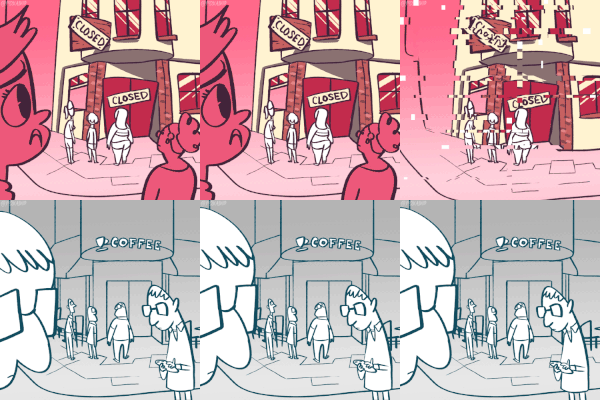
10. “To My Dear Community- It is with a heavy heart, great thought and consideration that I have made the very difficult decision to sell The Lexington Club,” wrote the owner of the only lesbian bar in San Francisco.[12] The 2014 Facebook post went on to list the reasons for closing, namely gentrification that pushed lesbians out of the Mission District and made the Lex’s rent and patron’s drinks too costly. The mainstream, straight media erupted in shock and awe at the 2014 closing of the last, let alone only, lesbian bar in America’s gayest city, and instead suggested explanations ranging from the “assimilation” of gays and lesbians to the end of lesbian culture itself. Since 2006, the last lesbian bars of many large cities had closed, including Philadelphia, Washington, D.C., Omaha, Salt Lake City, Buffalo, Amarillo, Toronto, Louisville, Chicago, Albuquerque, Kansas City, Cleveland, and both Portlands. More had closed before; more would close thereafter; and gay men’s bars have also begin to close.[13] Some put the blame wholly on the rise of the internet, social media, and dating/hookup apps like Grindr, Scruff, OkCupid, and Tinder, however, as Gieseking writes, the increasing cost of residential and commercial properties, coupled with increasing cost of consumer goods and a stagnated wage rate has left little funds for leisure activities for most Americans.[14] Further, the lesser incomes and political power of women and gender non-conforming people have left much less space for lesbians, queers, and trans people, as well as LGBTQ people of color and LGBTQ working-class and even middle-class people. Yet, “as long as non-heterosexuals are discriminated against,” queer geographer Natalie Oswin writes, “queer spaces will remain something that, to borrow Spivak’s phrase, queers cannot not want.”[15] Surely, many LGBTQ people feel the need to create and share these very important and disappearing spaces.
FOOTNOTES
[1] John D’Emilio, “Capitalism and Gay Identity,” in Powers of Desire: The Politics of Sexuality, ed. Ann Snitow, Christine Stansell, and Sharon Thompson (New York: Monthly Review Press, 1983), 100-113; Sexual Politics, Sexual Communities (Chicago: University Of Chicago Press, 1983); Allan Bérubé, Coming Out Under Fire (New York: Plume, 1990).
[2] Vito Russo, The Celluloid Closet: Homosexuality in the Movies (New York: Harper & Row, 1987); Joan Nestle, A Restricted Country: Essays and Short Stories (New York: Rivers Oram Press/Pandora List, 1988).
[3] Elizabeth Kennedy and Madeline Davis, Boots of Leather, Slippers of Gold: The History of a Lesbian Community (New York: Penguin, 1994).
[4] Michael Warner, “Media Gays: A New Stone Wall,” The Nation, July 14, 1997, 15.
[5] These protests and riots included the 1959 Cooper’s Donuts Riot in Philadelphia, the 1965 Dewey’s Sit-In in Philadelphia, and the 1966 Compton’s Cafeteria Riot in the Tenderloin of San Francisco. Marc Stein, City of Sisterly and Brotherly Loves: Lesbian and Gay Philadelphia, 1945-1972 (Philadelphia: Temple University Press, 2004); Susan Stryker, “Transgender History, Homonormativity, and Disciplinarity,” Radical History Review, no. 100 (2008): 144-57; Susan Stryker, Transgender History (Berkeley, CA: Seal Press, 2008).
[6] Lillian Faderman, Odd Girls and Twilight Lovers: A History of Lesbian Life in Twentieth-Century America (New York: Penguin, 1992), 88.
[7] In his NYC chapter for the National Park Service LGBTQ theme study, Shockley writes, “A Village columnist in 1931 reminisced that her club was ‘one of the most delightful hang-outs the Village ever had’ (Chauncey 242). After a police raid, Kotchever was convicted of ‘obscenity’ (for _Lesbian Love_, a collection of her short stories) and disorderly conduct, and was deported. Allegedly, ‘the police had received many complaints about objectionable persons visiting the tea room.'” Jay Shockley, “Preservation of LGBTQ Historic & Cultural Sites – A New York City Perspective,” in LGBTQ America: A Theme Study of Lesbian, Gay, Bisexual, Transgender, and Queer History, ed. Megan Springate (Washington, D.C.: National Parks Service, U.S. Department of the Interior, 2016), 17-18; see also Chauncey, Gay New York.
[8] Faderman, Odd Girls and Twilight Lovers, 84, 88.
[9] George Chauncey, “Privacy Could Only Be Had in Public: Gay Uses of the Streets,” in Stud: Architectures of Masculinity, ed. Joel Sanders (Princeton, NJ: Princeton Architectural Press, 1996), 224-67; Rich Wandel, “LGBT Community Center National History Archive: Gay Beach Photographs (c. 1950 – c. 1980)” (LGBT Community Center of New York City, 2017), LGBT Community Center National History Archive.
[10] Faderman, Odd Girls and Twilight Lovers; Julie Abraham, “Review: Tales of the City,” The Women’s Review of Books 21, no. 3 (December 2003): 1-3.
[11] Next Magazine, “Pride Map 2008,” Next Magazine, June 2008.
[12] Lila Thirkfield, “Lexington Club: To My Dear Community,” Facebook (blog), October 23, 2014, http://www.facebook.com/LexingtonClub/posts/10152758004223503.
[13] Greggor Mattson, “Lesbian Bar Closures, Lost Womyn’s Space,” Greggor Mattson (blog), August 5, 2016, https://greggormattson.com/2016/08/05/lesbian-bar-closures-lost-womyns-space/.
[14] Jen Jack Gieseking, A Queer New York: Geographies of Lesbians, Dykes, and Queers, 1983-2008 (New York: NYU Press, 2019).
[15] Natalie Oswin, “Critical Geographies and the Uses of Sexuality: Deconstructing Queer Space,” Progress in Human Geography 32, no. 1 (2008): 100.