An Exploration of the History of the Vacation Home and Frank Lloyd Wright’s Designs

Works Cited:

[1] Hamilton, Alexander, Albert Bushnell Hart, Bruce Rogers, and Pforzheimer Bruce Rogers Collection. Hamilton’s Itinerarium: being a narrative of a journey from Annapolis, Maryland, through Delaware, Pennsylvania, New York, New Jersey, Connecticut, Rhode Island, Massachusetts and New Hampshire, from May to September. Saint Louis, Missouri: Printed only for private distribution by William K. Bixby, 1907. Online Text. Retrieved from the Library of Congress, https://www.loc.gov/item/08002374/. (Accessed April 08, 2018.)

[2] Aron, Cindy S. Working At Play: A History of Vacations in the United States. New York, NY: Oxford University Press Inc., 1991. Accessed March 3, 2018. https://www.amazon.com/Working-At-Play-History-Vacations/dp/0195142349. Page 18.

[3] Harrington, Elaine. “BOOKS AND LIBRARIES IN FRANK LLOYD WRIGHT’S OAK PARK DAYS.” In American Architects and Their Books, 18401915, edited by Hafertepe Kenneth and O’Gorman James F., 231-56. University of Massachusetts Press, 2007. http://www.jstor.org.ezproxy.trincoll.edu/stable/j.ctt5vk766.14. Page 231-256.

[4] “Frank Lloyd Wright.” Design Quarterly, no. 74/75 (1969): 13-15. doi:10.2307/4047362. Page 13.

[5] Hanks, David. “A Frank Lloyd Wright Dining Chair.” Bulletin (St. Louis Art Museum) 14, no. 4 (1978): 135-38. http://www.jstor.org.ezproxy.trincoll.edu/stable/40716009. Page 135.

[6] Ibid.

[7] “Living Room from the Francis W. Little House: Windows and Paneling | Frank Lloyd Wright | 1972.60.1 | Work of Art | Heilbrunn Timeline of Art History | The Metropolitan Museum of Art.” The Met’s Heilbrunn Timeline of Art History. Accessed April 07, 2018. https://www.metmuseum.org/toah/works-of-art/1972.60.1/.

[8] “Frank Lloyd Wright – Tour the House Today – Pennsylvania.” Fallingwater. Accessed April 06, 2018. https://www.fallingwater.org/.

[9] “Taliesin West.” Frank Lloyd Wright Foundation. Accessed April 08, 2018. http://franklloydwright.org/taliesin-west/.

[10] ROSENFELD, LUCY D., and MARINA HARRISON. “FRANK LLOYD WRIGHT’S “USONIA”: A Planned Community, Pleasantville.” In Architecture Walks: The Best Outings Near New York City, 54-58. Rutgers University Press, 2010. http://www.jstor.org.ezproxy.trincoll.edu/stable/j.ctt1bmzn49.21. Page 54.

[11] Donoian, John, Dennis Doordan, and Sarah Smith. “”A Magnificent Adventure”: An Interview with Mrs. Sarah (Melvyn) Maxwell Smith about the Smith House by Frank Lloyd Wright.” Journal of Architectural Education (1984-) 39, no. 4 (1986): 7-10. doi:10.2307/1424790. Page 7.

[12] “Frank Lloyd Wright.” Design Quarterly, no. 74/75 (1969): 13-15. doi:10.2307/4047362. Page 14-15.

[13] “The History of Vacation Rentals – Infographic.” Rentals United. February 19, 2018. Accessed April 09, 2018. https://rentalsunited.com/blog/history-of-vacation-rentals-infographic/.

[14] Moholy-Nagy, Sibyl. “Frank Lloyd Wright’s Testament.” College Art Journal 18, no. 4 (1959): 319-29. doi:10.2307/774026. Page 319.

[15] Ibid. Page 320.

[16] Quinan, Jack. “Frank Lloyd Wright’s Guggenheim Museum: A Historian’s Report.” Journal of the Society of Architectural Historians 52, no. 4 (1993): 466-82. doi:10.2307/990869. Page 469.

[17] Ibid. Page 466.

[18] Donoian, John, Dennis Doordan, and Sarah Smith. “”A Magnificent Adventure”: An Interview with Mrs. Sarah (Melvyn) Maxwell Smith about the Smith House by Frank Lloyd Wright.” Journal of Architectural Education (1984-) 39, no. 4 (1986): 7-10. doi:10.2307/1424790. Page 10.

[19] “Frank Lloyd Wright House.” South Kohala Management. April 08, 2018. Accessed April 09, 2018. http://www.southkohala.com/vacation-rentals/frank-lloyd-wright-house.

[20] Bureau, US Census. “Data.” Historical Census of Housing Tables: Vacation Homes. January 01, 1970. Accessed March 03, 2018. https://www.census.gov/data/tables/time-series/dec/coh-vacation.html.

[21] “Airbnb Fast Facts.” Airbnb. Accessed March 4 , 2018. https://press.atairbnb.com/app/uploads/2017/08/4-Million-Listings-Announcement-1.pdf.

[22] “Vacation and Investment Home Sales: A Breakdown for 2017.” Economists Outlook. Accessed April 09, 2018. http://economistsoutlook.blogs.realtor.org/2017/04/26/vacation-and-investment-home-sales-a-breakdown-for-2017/.

[23] Ro, Lauren. “Lakefront Frank Lloyd Wright House with Original Furniture Returns to Market.” Curbed. August 18, 2016. Accessed April 09, 2018. https://www.curbed.com/2016/8/18/12539882/frank-lloyd-wright-cooke-house-virginia-home-for-sale.

[24] Tardiff, Sara. “Celebrate Frank Lloyd Wright’s Birthday By Staying In One Of His Houses.” ELLE Decor. July 15, 2017. Accessed April 09, 2018. https://www.elledecor.com/life-culture/travel/g9984630/frank-lloyd-wright-vacation-houses/.

[25] Ragatz, Richard Lee. 1970. “Vacation Homes in the Northeastern United States: Seasonlity in Population Distribution.” Annals of the Association of American Geographers 60, no. 3: 447-455. Academic Search Premier, EBSCO host (accessed March 4, 2018).


I chose to represent both the history of the vacation home and Frank Lloyd Wright’s designs because there was more information on the two subjects combined. Although the topics are not directly related, they both incorporate the importance of the vacation home and how it relates to American ideals. I felt that without knowing the history of the vacation home and more recent statistics, information about Wright would not be as meaningful. I thought I would start the timeline with the first vacation recorded because it is vital to know the background on the subject before learning about more current information regarding vacations.

Prior to doing this project, I did not know Frank Lloyd Wright, and I have learned so much about him. He really made an impact on design and architecture in America and beyond and it is fascinating that many of his homes have turned into houses that are open to the public or available to rent. I chose not to focus on one of his homes, but rather include many of his creations, such as Fallingwater, Usonia, and Taliesin West, in order to compare and contrast and learn more about him.

It was interesting to make the connection between Airbnb (which I had researched for my listicle) and how many of Wright’s homes are listed on the website. Wright was clearly such an influential architect and designer and it is so fascinating that his homes are available to rent, especially on such an accessible platform such as Airbnb.

At times, I found it hard to make the timeline flow between information regarding the history of the vacation home which was broader and material on Wright’s homes which was very specific. For certain timeline points, I talked about the history of the vacation home and then would write a sentence or two at the end about how the history relates to Wright in one way or another. I incorporated YouTube videos, which are very useful tools, songs from Spotify relating to vacation, GIF’s, and many images (specifically of Wright’s homes) to give the reader more information without including too many words on the page. I used a total of 20 sources, 10 academic and 10 trusted media sources. Of these 20 sources, 5 were taken from my listicle.

The listicle was really a jumpstart to this project, but after doing the timeline I feel much more confident on this subject. It is such a fascinating part to our culture that I do not think is analyzed enough. I am looking forward to using the information I already have and expanding this project even further and completing my final paper!

ATL

Reasoning:

No city is exactly the same. They may all have qualities that resemble one another but they are never identical. A city in the North is different than a city in the South and an American city is different than an European City. American cities are not that old but have a ton of history packed in.

Atlanta is the place I have grown up my whole life but much of its history has been hidden from me. Like many part of America, people would rather ignore the painful events that happened in the past. Atlanta very obviously does this.  This is why I chose to represent Atlanta as a city that has had a painful history.

Georgia was a colony founded with the idea that it would be a new opportunity for the prisoners in England. In order for this dream to become a reality. the Americans had to take the land for the Cherokee Indians. They did not ask for the Americans to come and yet here they were faced with losing their home. This is not something that only happened in Georgia. It occured all over the US with the Indian Removal Act. This along with the slavery that was occuring in the country at the time is an example of the superiority Americans feel they have other minorities.

Atlanta went through many different periods and yet the suppression of certain individuals has been a common theme. Atlanta, just like many of other southern cities, has an evil past. There is a painful history. Instead of learning from its mistakes or owning their past pitfalls, the city attempts to ignore the  past. This is an issue that has led to the problems that we are facing today. In order to understand where we are today we need to understand what happened in the past.

Atlanta likes to make that claim that it is a city “Too Busy To Hate”. This is not true. Atlanta is a city that would rather act like the past did not happen. I chose to represent in Atlanta this way because many of the events I chose are things I never learned about. They are events that everyone should know in order to understand the true issues that we are facing today.

We are facing many issues today that were never dealt with many years ago. In order to learn and understand how to solve the problem, we need to understand how we got here. This is why it is important to look at the past. In order for Atlanta to actually become a city “Too Busy To Hate”, they need to understand the issues that are embedded in the society.

I wanted to show the more painful history of Atlanta because it is a history that many other American Southern cities went through. The best way to understand today and learn what not to do is by looking at the past to understand our issues at hand.

Bibliography:

[1] Brooks, Robert Preston. History of Georgia. Nabu Press, 2010, books.google.com/books?hl=en&lr=&id=QA_VAAAAMAAJ&oi=fnd&pg=PA5&dq=history of georgia&ots=a-ZZe8fE73&sig=u9K5YCNJRPL7KHl5tFAt_F0bLcc#v=onepage&q=atlanta&f=false.

[2] REED, WALLACE PUTNAM. HISTORY OF ATLANTA, GEORGIA: with Illustrations and Biographical Sketches of Some of Its… Prominent Men and Pioneers (Classic Reprint). FORGOTTEN BOOKS, 2016, History of Atlanta, Georgia: With Illustrations and Biographical Sketches of …

[3] Garrett, Franklin M., and Harold H. Martin. Atlanta and Environs: a Chronicle of Its People and Events. University of Georgia Press, 2011, books.google.com/books?hl=en&lr=&id=CF49PqgO33AC&oi=fnd&pg=PR4&dq=atlanta and environs&ots=anpBWldI48&sig=WxPGESJEqiA59Www0oURVEanvkk#v=onepage&q=atlanta and environs&f=false.

[4] “Atlanta.” New Georgia Encyclopedia, www.georgiaencyclopedia.org/articles/counties-cities-neighborhoods/atlanta.

[5] Garrett, Franklin M., and Harold H. Martin. Atlanta and Environs: a Chronicle of Its People and Events. University of Georgia Press, 2011, books.google.com/books?hl=en&lr=&id=CF49PqgO33AC&oi=fnd&pg=PR4&dq=atlanta and environs&ots=anpBWldI48&sig=WxPGESJEqiA59Www0oURVEanvkk#v=onepage&q=atlanta and environs&f=false.

[6] Bates, Christopher G. The Early Republic and Antebellum America. Sharpe//Online Reference, 2010, books.google.com/books?hl=en&lr=&id=pWLxBwAAQBAJ&oi=fnd&pg=PA106&dq=atlanta 1850s&ots=xKTdxHutpW&sig=m6Zl5QffiTaNi1Kucy6foKMuNVU#v=onepage&q=atlanta 1850s&f=false.

[7] Leigh, Phil. “Who Burned Atlanta?” The New York Times, The New York Times, 13 Nov. 2014, opinionator.blogs.nytimes.com/2014/11/13/who-burned-atlanta/?mtrref=www.google.com&assetType=opinion&login=email&auth=login-email.

[8] Link, William A. Atlanta, Cradle of the New South: Race and Remembering in the Civil Wars Aftermath. University of North Carolina Press, 2015, books.google.com/books?hl=en&lr=&id=2aDGVkZGP9sC&oi=fnd&pg=PP2&dq=atlanta 1850s&ots=FfctGumdFX&sig=ljnNK87fHrN4pDd1Z-T9dbttZxU#v=onepage&q=1868&f=false.

[9] Jewell, Joseph O. Race, Social Reform, and the Making of a Middle Class: the American Missionary Association and Black Atlanta, 1870-1900. Rowman & Littlefield, 2007, books.google.com/books?hl=en&lr=&id=S3td82ttfZUC&oi=fnd&pg=PR7&dq=A Short History of Black Atlanta&ots=PH_nSx7rTC&sig=7a_Te_k6-8Tk9kapievjzgEgHgg#v=onepage&q=1950&f=false.

[10] Watts, Eugene J. “The Police in Atlanta, 1890-1905.” The Journal of Southern History, vol. 39, no. 2, 1973, pp. 165–182. JSTOR, JSTOR, www.jstor.org/stable/2205612.

[11] Grem, Darren E. “Sam Jones, Sam Hose, and the Theology of Racial Violence.” The Georgia Historical Quarterly, vol. 90, no. 1, 2006, pp. 35–61. JSTOR, JSTOR, www.jstor.org/stable/40584885.

[12] Burns, Rebecca. Rage in the Gate City the Story of the 1906 Atlanta Race Riot. University of Georgia Press, 2009, books.google.com/books?hl=en&lr=&id=aLoFBAAAQBAJ&oi=fnd&pg=PP1&dq=1906 atlanta&ots=cp9uGNfbf5&sig=FTct-LJQNcdkEqlK04oZFIV5FOw#v=onepage&q=1906 atlanta&f=false.

[13] “Segregation.” New Georgia Encyclopedia, www.georgiaencyclopedia.org/articles/history-archaeology/segregation.

[14 ] Dixon, Thomas. “The Clansman: An Historical Romance of the Ku Klux Klan.” 2000, doi:10.4324/9781315700113.

[15] Goetz, Edward G. New Deal Ruins: Race, Economic Justice, and Public Housing Policy. Cornell Univ. Press, 2013, books.google.com/books?hl=en&lr=&id=IqudDgAAQBAJ&oi=fnd&pg=PR7&dq=atlanta public housing&ots=b0FE8jAY-S&sig=f8eZ2-SkOTdHpEbk5tMgWrnteLw#v=onepage&q=atlanta&f=false.

[16] Higgins, Jack. Without Mercy. Thorndike Press, 2005.

[17] Morris, Aldon D. The Origins of the Civil Rights Movement Black Communities Organizing for Change. The Free Press, 1986, books.google.com/books?hl=en&lr=&id=7vyHY9DWcu8C&oi=fnd&pg=PR5&dq=civil rights atlanta&ots=NRtxfkAIcY&sig=nCvRmn_Ry5lSQTRNuFeowwsB9BY#v=onepage&q=atlanta&f=false.

[18] Dyson, Michael Eric. April 4, 1968 Martin Luther King, Jrs Death and How It Changed America. Basic Civitas Books, 2008, books.google.com/books?hl=en&lr=&id=C6te0-BLyy0C&oi=fnd&pg=PT6&dq=martin luther king jr assassination&ots=8oz5XbAulj&sig=KGrZFmzxR71QnAodkfXYfvU1LjQ#v=onepage&q=atlanta&f=false.

[19] Abney, F. Glenn, and John D. Hutcheson. “Race, Representation, and Trust: Changes in Attitudes After the Election of a Black Mayor.” The Public Opinion Quarterly, vol. 45, no. 1, 1981, pp. 91–101. JSTOR, JSTOR, www.jstor.org/stable/2748320.

[20] Quinn, David, et al. Mindhunter. Dark Horse Comics, 2001.

[21] Goetz, Edward G. New Deal Ruins: Race, Economic Justice, and Public Housing Policy. Cornell Univ. Press, 2013, books.google.com/books?hl=en&lr=&id=IqudDgAAQBAJ&oi=fnd&pg=PR7&dq=atlanta public housing&ots=b0FE8jAY-S&sig=f8eZ2-SkOTdHpEbk5tMgWrnteLw#v=onepage&q=atlanta&f=false.


Timeline of Wayland’s History – Corey


AMST 335

Professor Gieseking

Corey Wise

Research Project Statement

In putting together the Listicle for the concept of the New England Village, it suddenly dawned on me that my hometown of Wayland, Massachusetts, has all of the elements of the concept of the New England Village.  This realization excited me and spurred me to learn about my hometown in greater depth.  I already knew some facts about Wayland that I learned over the years, having never moved from our home there since in-utero.  However, I learned so many more interesting facts about my hometown.  Wayland is truly a microcosm for the concept of the New England Village.

I wanted to show and describe a little bit of Wayland’s pre-Colonial and Colonial history in my timeline.  This is the era that I learned the most about in my excellent history classes in Wayland, so I felt the most comfortable researching and re-learning it.  The first settlement of Sudbury Plantation was established in 1638 in what is now the town of Wayland.  Residents of Watertown wanted more land and less crowding and were granted this land east of the Sudbury River.  Sudbury Plantation separated into Sudbury and East Sudbury in 1780, with the Sudbury River acting as their border.  The decision to separate was largely due to the difficulties of citizens in the western part of Sudbury to cross the river to get to church and town meeting, especially in the spring.  Until the Industrial and Transportation Revolutions of the mid-1800s, Wayland was a sleepy, inland farming community.

The next main time period I was trying to display about Wayland, was their industrial period.  Initially, I did not know that much about this period of Wayland’s history, so it was fascinating to learn about the industrial and manufacturing history of my hometown.  It was also interesting to learn about how long the north-south divide in town has been prevalent.  In the 1830’s, the Bent brothers, James and William, expanded their small shoe shop into a manufacturing powerhouse.  Numerous shoe factories were built in the southern part of Wayland, which was renamed Cochituate at this time.  Modern amenities, such as streetlights and streetcars, were brought into Cochituate, as this southern part of town prospered.  There is also a separate post office for Cochituate residents to this day, while North Wayland remained a quiet, farming community.  Eventually, the building of the railroad through North Wayland helped this area greatly, allowing farmers to bring their produce into Boston to sell to a larger market.  This helped northern Wayland to catch up to the rapidly advancing southern Wayland.

The last time period I tried to display in my timeline, was suburban Wayland.  This was another time period in Wayland’s history that I did not know that much about, although I had familiarity with the school system, since I had attended Wayland schools my entire life before coming to Trinity.  This time period saw an absolute explosion in population after World War II, due in part to 3 events:  1) the Baby Boom, 2) the construction of Rte 128 (I-95), and 3) the construction of the Mass Pike.  According to the U.S. census, the population of Wayland surged 137% in the 1950s from 4407 to 10, 444.  To accommodate the school-aged children, 3 new elementary schools were built, as well as a new Middle School and state-of-the-art, Walter Gropius-designed mid-century modern High School.  Wayland had the foresight to preserve some of its farming heritage through preservation of conservation land in conjunction with housing development, so that now 25% of Wayland land is conservation land.

Little did I realize when I first produced my Listicle for the concept of the New England Village that I was basically writing about my hometown of Wayland, Massachusetts.  It was fascinating to learn about all of the history that I’ve been surrounded with literally my entire life.  The history that I’ve learned about the town explains so many of the details of Wayland that I have always wondered about, but never knew until now.  So many of the towns in New England share this similar history, however it is also interesting to note that some have also struggled, largely left behind recently when the infrastructure of the interstate system drove opportunity to other New England villages.  I am proud that so many of the trends in American life occurred on a smaller scale within my small hometown.


Timeline Bibliography

“About Us: Town Hall.” Wayland Massachusetts. January 01, 2014. Accessed April 09, 2018. https://www.wayland.ma.us/about-us.


Capriani, Christine. “Days Numbered for Midcentury-Modern School by The Architects Collaborative.” Architectural Record. February 25, 2011. Accessed April 9, 2018. https://www.architecturalrecord.com/articles/2120-days-numbered-for-midcentury-modern-school-by-the-architects-collaborative?v=preview.


Carter, Allison. “A City Divided: The Building of the Mass Turnpike Extension in Newton (Pt. 1).” Newton Patch. September 13, 2011. Accessed April 09, 2018. https://patch.com/massachusetts/newton/a-city-divided-the-building-of-the-mass-turnpike-exted81c1af1db.


Dame, Jonathan. “Eversource to Begin Rail Trail Work in Weston and Wayland.” The Metro West Daily News. August 1, 2017. Accessed April 9, 2018. http://www.metrowestdailynews.com/news/20170801/eversource-to-begin-rail-trail-work-in-weston-and-wayland.


Dudley Pond. “History of the Pond.” Dudley Pond Association. Accessed April 09, 2018. http://www.dudleypond.org/history-of-the-pond.html.


Eastern Roads. “Historic Overview.” Massachusetts Turnpike (I-90). Accessed April 09, 2018. http://www.bostonroads.com/roads/mass-pike/.


Emery, Helen Fitch. The Puritan Village Evolves: A History of the Town of Wayland, Massachusetts. 1st ed. Phoenix Pub, 1981.


The Fair Housing Center of Greater Boston. “1950s–1975: Impact of Rte 128 & Rte 495.” Historic Shift Explicit to Implicit Policies Affecting Housing Segregation in Eastern Massachusetts. Accessed April 09, 2018. http://www.bostonfairhousing.org/timeline/1950s-1975-Suburbs.html.


Foster, David R., Brian Donahue, David Kittredge, Glenn Motzkin, Brian Hall, Billie Turner, and Elizabeth Chilton. “New England’s Forest Landscape: Ecological Legacies and Conservation Patterns Shaped by Agrarian History.” 2008.


Hogan, Dan, and Will Engel. “Cold War Wayland: Raytheon.” Wayland High School History Project. Accessed April 09, 2018. http://whshistoryproject.org/1950s/missiles.html.


Islamic Center of Boston. “About IBC.” Islamic Center of Boston, Wayland, Massachusetts. Accessed April 09, 2018. http://www.icbwayland.org/.


Labaree, Benjamin. “New England Town Meeting.” The American Archivist 25, no. 2 (1962): 165-72. doi:10.17723/aarc.25.2.a41x928626p71t16.


Massachusetts Cultural Resource Information System. “Hopestill Bent Tavern.” MACRIS Details. Accessed April 09, 2018. http://mhc-macris.net/Details.aspx?MhcId=WAY.116.


Ogletree, Andrew, and Ben Peterson. “Old Meets New: Dudley Pond.” Wayland High School History Project: Main Page. Accessed April 09, 2018. http://whshistoryproject.org/1950s/pond.html.


Raytheon. “Site Background.” Raytheon. Accessed April 09, 2018. http://raytheon.erm.com/home.htm.


Reich, Robert B. “Secession of the Successful.” The New York Times. January 20, 1991. Accessed April 09, 2018. https://www.nytimes.com/1991/01/20/magazine/secession-of-the-successful.html?pagewanted=all.


Renschler, Catherine. “Hopestill Bent.” Catherines Corner. February 23, 2015. Accessed April 09, 2018. http://catherinescorner.net/?p=107.


Richard, Bay. “Cars, Trucks in Big Parade on New Pike.” The Boston Daily Globe (Boston), May 16, 1957.


Rotker, Drew, and Jarrett Lerner. “Cold War Wayland: The Nike Missile Site.” Wayland High School History Project. Accessed April 09, 2018. http://whshistoryproject.org/1950s/missiles.html.


“Route 128: Boston’s Road to Segregation.” Patricia A. Morse, Others, and Massachusetts State Advisory Committee to U.S. Commission on Civil Rights. January 1975. Boston, Massachusetts.


Strum, Beckie. “A Feast for the Eyes: 4 Pilgrim-era Mansions on the Market.” Mansion Global. November 24, 2016. Accessed April 09, 2018. https://www.mansionglobal.com/articles/46856-a-feast-for-the-eyes-4-pilgrim-era-mansions-on-the-market.


Temple Shir Tikva. “Shir Tikva: About.” The Temple Shir Tikva. Accessed April 9, 2018. http://www.shirtikva.org/about.


Thoreau, Henry David. Walden. Boston: Ticknor and Fields, 1854.


Unitarian Universalist Community. “First Parish: Our History.” The First Parish in Wayland. Accessed April 9, 2018. https://www.uuwayland.org/.


The Wayland Depot. “History.” The Wayland Depot. Accessed April 09, 2018. http://thewaylanddepot.com/about-us/history/.


Wayland Historical Society. “TOWN HISTORY: A SHORT HISTORY OF WAYLAND, MA.” Wayland Museum. Accessed April 9, 2018. https://www.waylandmuseum.org/history-of-wayland/.


Wayland Public Schools Foundation. Lt. Col. Martin W. Joyce Papers. Accessed April 09, 2018. https://www.ltcoljoycepapers.org/.


Wolfson, Evelyn, and Dick Hoyt. “‘A to Z’: ‘S’ Is for ‘Shoe Industry’.” Wicked Local. January 28, 2010. Accessed April 09, 2018. http://www.wickedlocal.com/x1090822482/A-to-Z-S-is-for-Shoe-Industry.


Zarracina, Javier. “How the Post Road Wrote New England’s History.” Boston.com. Accessed April 09, 2018. http://archive.boston.com/bostonglobe/ideas/graphics/10_17_10_postroad/.


Levittown timeline

Sources

[1] Richard Harris, and Peter J. Larkham, eds. 1999. Changing Suburbs: Foundation, Form and Function. Planning, History and Environment Series. New York, NY: Routledge 6

[2] Bruce Lesh. n.d. “Post-War Suburbanization: Homogenization or the American Dream?” Baltimore County Public Schools. http://www.umbc.edu/che/tahlessons/pdf/Post-War_Suburbanization_Homogenization(PrinterFriendly).pdf. 3

[3] Margaret Lundrigan Ferrer, and Tova Navarra. 1997. Levittown: The First 50 Years. United States of America: Arcadia Publishing. https://books.google.com/books?hl=en&lr=&id=yh0nM4sIH14C&oi=fnd&pg=PA6&dq=%22island+trees%22+%22levittown%22&ots=DF0u7jdKVV&sig=H19RY647YASUM5OBpTHwlpPuIK4#v=onepage&q=%22island%20trees%22%20%22levittown%22&f=false. 7

[4] Margaret Lundrigan Ferrer, and Tova Navarra. 1997. Levittown: The First 50 Years. United States of America: Arcadia Publishing. https://books.google.com/books?hl=en&lr=&id=yh0nM4sIH14C&oi=fnd&pg=PA6&dq=%22island+trees%22+%22levittown%22&ots=DF0u7jdKVV&sig=H19RY647YASUM5OBpTHwlpPuIK4#v=onepage&q=%22island%20trees%22%20%22levittown%22&f=false 8

[5] Peter Bacon Hales. n.d. “Levittown: Documents of an Ideal American Suburb.” University of Illinois at Chicago. http://websupport1.citytech.cuny.edu/faculty/pcatapano/US2/US%20Documents/Levittown%20Documents%20of%20an%20Ideal%20American%20Suburb.pdf. 3

[6] Kenneth T. Jackson. 1985. Crabgrass Frontier: The Suburbanization of the United States. New York, NY: Oxford University Press. http://www.csun.edu/~rdavids/350fall08/350readings/Jackson_Federal_Subsidy_and_Suburban_Dream.pdf. 204

[7] Weingroff, R F. 1996. “FEDERAL-AID HIGHWAY ACT OF 1956: CREATING THE INTERSTATE SYSTEM.” Federal Highway Administration 60 (1). https://trid.trb.org/view/469739.

[8] Alfred S. Levitt. 1951. “A Community Builder Looks At Community Planning.” Journal of the American Institute of Planners 17 (2): 80–88. https://doi.org/10.1080/01944365108979318. 98

[9] Richard Longstreth. 2010. “The Levitts, Mass-Produced Houses, and Community Planning in the Midtwentieth Century.” In Second Suburbs, edited by Dianne Harris, 123–74. University of Pittsburgh Press. http://www.jstor.org/stable/j.ctt83jhq9.11. 123

[10] Chad M. Kimmel. n.d. “Community in History: Levittown and the Decline of a Postwar American Dream.” Shippensburg University of Pennsylvania. http://www.asanet.org/sites/default/files/savvy/footnotes/nov03/fn8.html.

[11] Dianne Suzette Harris. 2010. Second Suburb: Levittown, Pennsylvania. University of Pittsburgh Press. https://books.google.com/books?hl=en&lr=&id=Rbfy5gikEpwC&oi=fnd&pg=PP1&dq=%22levittown%22+history&ots=OXLLNeEdZb&sig=Awn24rDlCWtwdwWu_fosNLw–k8#v=onepage&q=%22levittown%22%20history&f=false. 7

[12] Richard Garber, and Nicole Robertson. 2006. “The Pleated Cape From the Mass-Standardization of Levittown to Mass Customization Today.” ACADIA, 426–39. 428

[13] Alfred S. Levitt. 1951. “A Community Builder Looks At Community Planning.” Journal of the American Institute of Planners 17 (2): 80–88. https://doi.org/10.1080/01944365108979318. 80

[14] “Levittown.” 2016. .edu. Digital History. 2016. http://www.digitalhistory.uh.edu/disp_textbook.cfm?smtid=2&psid=3427.

[15] Peter Bacon Hales. n.d. “Levittown: Documents of an Ideal American Suburb.” University of Illinois at Chicago. http://websupport1.citytech.cuny.edu/faculty/pcatapano/US2/US%20Documents/Levittown%20Documents%20of%20an%20Ideal%20American%20Suburb.pdf. 5

[16] Levittown Public Library. n.d. “Levittown History.” .org. Levittown Public Library. https://www.levittownpl.org/research-history.

[17] Kathryn T. Flannery. 2007. “Levittown Breeds Anarchists! Film at 11.” In Placing the Academy, edited by Jennifer Sinor and Rona Kaufman, 109–24. University Press of Colorado, Utah State University Press. http://www.jstor.org/stable/j.ctt4cgq72.10. 120

[18] Barbara M. Kelly. 1993. “Little Boxes, Big Ideas.” Design Quarterly 158: 26–31. https://doi.org/10.2307/4091292. 28-29

[19] Barbara M. Kelly. 1993. “Little Boxes, Big Ideas.” Design Quarterly 158: 26–31. https://doi.org/10.2307/4091292. 28

[20] James Leach, and Lee Wilson, eds. 2014. Subversion, Conversion, Development: Cross-Cultural Knowledge Exchange and the Politics of Design. Massachusetts Institute of Technology. https://books.google.com/books?hl=en&lr=&id=E42AAwAAQBAJ&oi=fnd&pg=PA1&dq=design+of+%22levittown%22&ots=fiSItE4bGw&sig=UJJP7OU73hAsdZqvZ9fy2BfYEhU#v=onepage&q=remolding&f=false. 11

[21] David Kushner. 2009. Levittown: Two Families, One Tycoon, and the Fight for Civil Rights in America’s Legendary Suburb. New York, NY: Walker & Company. https://books.google.com/books?hl=en&lr=&id=2KqsKUk36ZkC&oi=fnd&pg=PR9&dq=evittown:+Two+Families,+One+Tycoon,+and+the+Fight+for+Civil+Rights+in+America%E2%80%99s+Legendary+Suburb.+&ots=4BwPcSVSHO&sig=ZjjJp7DZ–faMHRzS4BdFDt1bpU#v=onepage&q=levittown&f=false. Xvi

[22] Barbara M. Kelly. n.d. “The Houses of Levittown in the Context of Postwar American Culture.” West Babylon, New York. https://www.nps.gov/nr/publications/bulletins/suburbs/Kelly.pdf. 5

[23] MARTIN DINES. 2015. “Metaburbia: The Evolving Suburb in Contemporary Fiction.” In Making Suburbia, edited by John Archer, Katherine Solomonson, and Paul J. P. Sandul, 81–90. University of Minnesota Press. http://www.jstor.org/stable/10.5749/j.ctt17t77s8.9. 84

[24] New York Times. 1994. “How William Levitt Helped to Fulfill the American Dream.” New York Times, February 6, 1994.

[25] Richard Rothstein. 2015. “The Racial Achievement Gap, Segregated Schools, and Segregated Neighborhoods: A Constitutional Insult.” Economic Policy Institute, Race and Soical Problems, 7 (1): 21–30. https://doi.org/10.1007/s12552-014-9134-1. 27

[26] James Wolfinger. 2012. “‘The American Dream—For All Americans’ Race, Politics, and the Campaign to Desegregate Levittown.” Journal of Urban History 38 (3): 430–51. https://doi.org/10.1177/0096144212445452.

[27] Bernadette Hanlon. 2010. “Once the American Dream.” In Once the American Dream: Inner-Ring Suburbs of the Metropolitan United States, 1–11. Temple University Press. http://www.jstor.org/stable/j.ctt14btdf6.6. 4

[28] Susan Saegert. 1980. “Masculine Cities and Feminine Suburbs: Polarized Ideas, Contradictory Realities.” Signs, The University of Chicago Press, 5 (3): S96–S111. S102

[29] Charles E. Redfield. 1951. “The Impact of Levittown on Local Government.” Journal of the American Institute of Planners 17 (3): 130–41. https://doi.org/10.1080/01944365108979326. 136

[30] “Billy Joel Biography.” n.d. .com. Biography. https://www.biography.com/people/billy-joel-9354859.

[31] “Little Boxes.” n.d. .com. Genius. https://genius.com/Malvina-reynolds-little-boxes-lyrics.

Reasoning

            Levittown is often credited as America’s first suburbs, a picturesque town symbolizing the American Dream at the time. Before World War II, housing and buying a house was very expensive and mainly only rich, upper-middle class white families could afford to own nice a home all to themselves. This led to many middle, working, and lower class families to be stuck in crowded houses or apartments in urban centers like New York City. After World War II, however, the economy began to thrive and Americans sequentially took advantage of the new economic freedoms, like being able to afford a home of their own. The reason why I choose to present Levittown the way I did was to show how William Levitt capitalized on an untouched market, the US housing disaster, and how he was a beneficiary to the timely arrival of the GI Bill, which helped veterans (specifically white ones) get mortgages – making it easier for them to pay for houses. The Federal Highway Act was another piece of legislation put in place around the time of Levitt, allowing thousands of Americans to more easily commute from their suburban neighborhoods into and out of the urban centers where they were employed. All of these dynamics helped change the face of American suburbs and also how Americans perceived the their livelihood, their community, family life, family ideals, gender roles, gender norms, racism, classism, individualism and the American Dream. Amongst all this radical change, however, Levittown acted as a stabling force for many white Americans looking for the social bubble suburbs ultimately provided. In the wake of the Second World War, the American Dream became the ability to buy and own a house, made possible by the new and innovative federal legislation. Levitt understood how to capitalize on the circumstances at hand and seized the opportunity to produce affordable housing, showing his innovate thinking in a time where so many would end up following his model.

I really wanted to display the layouts of the houses and how they were constructed because of the apparent gender roles we can synthesize from them. Leaving the attic or second floor unfinished, having no garage, or basement gives men the opportunity to display their manhood in subtle ways they may have even been unaware to. Men are often perceived as the logical candidate to be able to handle manual work or renovation projects, yet this is a tool that could really be used for men to show off their masculinity. On the other hand, these masculine gender roles also carve out a woman’s role was also perceived, as the men take the part of doing all the “dirty” work of home renovation and women get the “clean” work in this renovation process. For example, women are expected to be the ones to provide guidance with interior decor, not men. Levitt made and planned the Levittown houses with these gender constructs in mind, accepting that the interior of houses would likely be renovation to one’s own liking, not the outside. Levitt wanted the outside of his suburban neighborhoods to all be the same. Levitt did not want any individualization to distinguish homes from one another, which became a personal brand for Levitt to produce these massive neighborhoods, filled with cookie-cutter homes. Residents who would renovate their homes provided distinction throughout the community as a symbol of class or monetary wealth. This too also makes competitions for which person has the best house, creating divides within certain classes. The construction of Levittown also brought up a various amount of other problems, such as racism. Levitt built Levittown as a new community, meant to exclude African Americans or any other force that would put his artificial utopia at risk. Personally, I felt it was important to highlight the overt racism Levitt certainly carried and his building of Levittown, and the obvious marginalization of African Americans, is proof of it. By highlighting that I wanted to enlighten those who were not aware about this reality of early-American suburbs so as to portray a more complete reflection on the realities of the time. Levittown was a community of shelter and oppressive tendencies, and when they did not approve of someone or something, they were place in a constrained, social box, removed from their suburban dream.


Strip Malls in America

1.“About half way between West Egg and New York the motor road hastily joins the railroad and runs beside it for a quarter of a mile, so as to shrink away from a certain desolate area of land. This is a valley of ashes—a fantastic farm where ashes grow like wheat into ridges and hills and grotesque gardens; where ashes take the forms of houses and chimneys and rising smoke and, finally, with a transcendent effort, of men who move dimly and already crumbling through the powdery air.” – The Great Gatsby by F. Scott Fitzgerald

“T.J. Eckleberg from The Great Gatsby”

Today, strip malls are a great American tradition. They are a pillar of Suburban Sprawl and the face of American architecture. Patrick Gallagher of the American Bar Association describes Suburban Sprawl as “uncontrolled development that expands outward from city centers and consumes otherwise undeveloped land.” (219). Strip malls and small shopping centers consume the journey between urban districts and affluent suburban neighborhoods. They create a wasteland of passerby’s and short-term renters. F. Scott Fitzgerald provides an excellent description and foreshadow in The Great Gatsby’s Valley of Ashes. Since the 1920s strip malls have defined the American aesthetic and provided a platform for the impediment of upward mobility. As a result, the demise of the American Dream can be traced to the introduction of small-scale shopping centers.

2. “Modernism is about space. Postmodernism is about communication. You should do what turns you on.” –Robert Venturi

“Strip Mall, 1960”

Baltimore, 1907. Pilot shopping centers were introduced in Baltimore as social spaces for community engagement. By 1931 these shopping centers began to be built deliberately beyond walking distance, begging the need for cars. The Highland Park Shopping Village in Dallas, TX began this automobile-dependent economy. Richard Feinberg of Purdue University explains “Whatever and wherever its start, the phenomenal growth and development of shopping centers naturally followed the migration of population out from the cities and paralleled the growth of the use of the automobile.” (426). This phenomenon is referred to as Suburban Sprawl and defined the spatiality and subsequent social structure of America. As the nation moved into the 20th century their homes became bigger, their cars faster, and their neighbors whiter. In this sense strip malls became a necessary redistricting mechanism, which had profound ramifications on group identity.

3. “In the 1954 Internal Revenue Code, a Republican Congress changed forty-year, straight-line depreciation for buildings to permit ‘accelerated depreciation’ of greenfield income-producing property in seven years. By enabling owners to depreciate or write off the value of a building in such a short time, the law created a gigantic hidden subsidy for the developers of cheap new commercial buildings located on strips.” – Dolores Hayden, Building Suburbia: Green Fields and Urban Growth, 1820-2000

Strip malls emerged and took hold of Suburban America as white families began their “sprawl” beyond city lines. Following World War II city planners deliberately built these quasi-malls in order to offset the formerly rural suburban towns. Strip malls created a sense of purpose for white suburban dwellers. Residents hoped their new neighborhoods would become a hybrid between urban and rural neighborhoods. Moving beyond city limits they yearned for spacious, crime-free, demographically homogenous landscapes to raise their children. However, many families were weary to settle too far beyond a sense of civilization. The popularization and affordability of automobiles allowed middle-class white families access to out-of-reach areas. City planners jumped at this opportunity by creating small shopping centers just far enough out of site to avoid obstruction of the spacious landscape.

4. “It was very unusual to employ prettiness as part of a building.” –Robert Venturi

Strip malls are notoriously ugly. However, wealthy, well-kempt neighborhoods across America depend on strip malls in order to maintain their status. This paradox stems from the functionality of strip malls; their scale and semi-accessibility allow them to be near wealthy suburbs, but just far enough out of site as to not diminish status. Jane Gross defines this functionality as allowing suburban dwellers to “have our cake and eat it too”. Gross uses Westchester County as her primary example. Westchester includes many of these affluent, well-kempt neighborhoods, however, it also includes 10-miles of consecutive strip malls. The two are able to coexist, and even flourish simultaneously due to their extreme concentration.

5. “It was clear that there needed to be a movement for the architects of the middle ground, once the elite became inaccessible.” –Elizabeth Plater-Zyberk, architect, Seaside, FL.

“Housewives shopping, 1950”

Whoever said housewives don’t do anything was seriously disturbed. Strip malls acted like a kryptonite for these white, middle-class housewives, and they still do. The end of World War II diminished female roles in society. As men returned home, women were no longer required to pick up their slack on the home front. As a result, most women quit their industrial jobs, married, and settled down. Bored at home and searching for purpose while their husbands went to work, housewives took to these shopping centers. As shopping centers moved out of cities, so did housewives and their families. In fact, housewives acted as the “invisible hand” behind the so-called “uncontrolled development”. For this reason, housewives deserve far more recognition for their contributions to American national identity as well as the many ramifications resulting from Suburban Sprawl.

6. “Modern architects contradict themselves when they support functionalism and  megastructure. They do not recognize the image of the processed city when they see it on the Strip, because it is both too familiar and too different from what they have been trained to accept.” –Robert Venturi

“Randy’s Donuts, Los Angelos, California”

Strip malls can teach us a lot about urban planning. Architects began studying strip mall culture during the post-modern era. By this time strip malls were an established feature of American architecture and worthy of deeper study. Famed architect Robert Venturi of the University of Pennsylvania and founder of the Philadelphia School, a philosophy of post-modernism in America, devoted his studies to strip mall architecture. With the help of his students he used the Las Vegas Strip as the focal point of his study. The Las Vegas Strip exemplifies how strip malls have come to established cultural dependencies on spatial constructions. Venturi introduced the “Duck v. Decorated Shed” theory as an exploration of the use of signs over space.

“Robert Venturi’s Duck v. Decorated Shed model”

Venturi advocates for structures that exemplify their intended use through their shape and structure, also known as a the “duck” approach. Signs dominate the Las Vegas Strip telling drivers and passerbies where to go and what they need. Venturi explains that strip mall parking lots are essential to the workings of this phenomenon. Strip malls do not offer window displays; therefore, they depend upon signs to lure shoppers into stores. These signs and advertisements are more easily read as shoppers approach their parking lots, which play host to many stores allowing choices. Choices increase a driver’s likelihood to approach a shopping center.

7. “Cars moving through neighborhoods are only borrowing the public space of the dwellings facing the street.” –Elizabeth Plater-Zyberk architect, Seaside, FL

“Las Vegas Strip, Nevada”

Strip malls invented U-turns. Busy roads alongside strip mall-ed areas, such as along the Las Vegas Strip, developed U-turns in order to allow drivers to easily return to a center they may have driven past. Storeowners and investors lobbied for the current turning systems in order to aid their own economic growth. Venturi explains, “the continuous highway itself and its systems for turning are absolutely consistent.

“Las Vegas Strip”

The medium strip accommodates the U-turns necessary to a vehicular promenade for casino crawlers as well as left turns onto the local streets pattern that the Strip intersects. The curbing allows for frequent right turns for casinos and other commercial enterprises and eases the difficult transition from highway to parking.”. In other words, the U-turn was invented to propel strip mall culture.

8. “Strip malls are history.” –Jeff Bezos CEO, Amazon

“Midlothian Turnpike, Richmond, Virginia”

There are many negative impacts of strip malls on the population, including air and water quality, and urban decline. Sprawl propelled the automobile industry, and, with it atmospheric carbon emissions. With the population influx to rural areas, Sprawl begged the need to increase water consumption. This meant a higher dependency on ground-water digging. However, by implementing pavement suburban areas are not conducive to ground-water digging. As a result, water must be transported into suburbs. Most concerning is the abandonment of smaller urban areas. Sprawl diminished municipal tax bases by removing wealthy residents from urban areas. This problem persists today.

Richard A. Feinberg and Jennifer Meoli (1991) ,”A Brief History of the Mall”, in NA – Advances in Consumer Research Volume 18, eds. Rebecca H. Holman and Michael R. Solomon, Provo, UT : Association for Consumer Research, Pages: 426-427.

Gross, J. (2001, Mar 31). Westchester’s 10-mile strip mall. New York Times (1923-Current File) Retrieved from https://search-proquest-com.ezproxy.trincoll.edu/docview/92137419?accountid=14405

Gallagher, Patrick. “The Environmental, Social, and Cultural Impacts of Sprawl.” Natural Resources & Environment, vol. 15, no. 4, 2001, pp. 219–267. JSTOR, JSTOR, www.jstor.org/stable/40924406. 

Venturi, Robert, et al. Learning from Las Vegas : The Forgotten Symbolism of Architectural Form. Rev. ed. ed., MIT Press, 1977.

Venturi, Robert, and Museum of Modern Art (New York, N.Y.). Complexity and Contradiction in Architecture. Museum of Modern Art, 1966.

The Evolution of U.S Prisons

The idea of crime and punishment is not new to society, as every group of people establishing a set of rules must decide what happens when those rules are broken. The authority of law is dependent upon the idea that breaking rules results in consequences. Yet, the ways in which societies have dealt with crime and punishment looks different depending on the geographic location and time period. The following points aim to capture the evolution of prisons in the United States as an adopted solution to crime. 

1. Crime and Punishment as a Colony

Prior to independence, the colonies established through England’s rule practiced forms of punishment that mirrored England’s existing structure. For instance, the presence of certain jailhouses existed in the colonies with a pre-trail role rather than detaining individuals for long periods of time. Upon being found guilty of the crime (not in a trial the way we imagine today), the person faced a  form of punishment based in public humiliation and torture. Public whippings, pillory, and in extreme cases castration are referred to as sanguinary punishment. It wasn’t until after the American Revolution and the expansion of new legal principles that role of jails/prisons shifted.

2. Population Growth

As the American Revolution approached, people were tasked with organizing a
government and set of rules and practices that would guide the society. Rather than being based on public humiliation, punishment shifted to being rooted in the use of hard labor as a deterrence against crime but also as a way to maintain a particular set of values deemed socially as “good.” Corporal punishment that was rooted in England’s intellectual basis of crime and punishment was replaced with an movement towards intense physical labor. Many proponents of the prison over corporal punishment associated prior forms of punishment as cruel and outdated. So a system where people are instead held for extended periods of times, have their movement controlled, and are forced to work endless hours a day: sounds like something familiar in U.S history. That is because the adoption expanded use of penitentiaries is heavily influenced by the prospect of economic productivity similar to persistence of slavery.  

3. Penitentiary Movement

Reforms in state penal codes allowed for the expansion of prisons to occur by providing judges with the option to sentence those found guilty to imprisonment, which differed dramatically from a judge simply deciding a physical punishment appropriate for the crime. Legislative shifts in the context of population growth, social mobility, and economic opportunity created a perfect storm by which prisons became the tool used to address crime and punishment. Proponents of penitentiary viewed it as a more humane way to address crime, while opponents (especially in the South) argued against this institution. 

4.  Newgate Prison

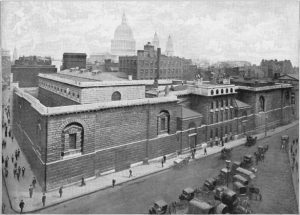
In 1797, New York State built its first penitentiary: Newgate Prison in Greenwich Village. This institution only remained open for 27 years, as several design flaws led to its ultimate destruction. The idea to move away from corporal punishment because of its violent nature was significantly undermined by the presence of violence for several reasons, one of which were cell designs that placed eight people in one cell to sleep. Prisons were justified as a place where human lives could be rehabilitated to prevent future criminal activity. The construction of Newgate and subsequent prisons call into the question the possibility to achieve that goal given the environment that results from the physical design of these institutions.

5.  Auburn System

Eastern State Penitentiary in Pennsylvania was a prison built in the context of the the “Auburn system.” A central idea behind the physical designs of prions fitting this model encourage separation/isolation as a form of rehabilitation, where the only “services” provided was a daily visit from the Warden. There were many complaints about cell designs, which aimed to minimize threats to the guards, yet it made it extremely difficult to pass food and transport inmates, presenting various human rights concerns.

6. The Reconstruction Era and Prisons

During the Civil War and Antebellum period, ideas about punishment shifted as well as the reality of overcrowding in prisons. The Jackson Era is well known for its negative influence on prisons, especially in regards to the physical deterioration the physical structures endured, which exacerbated conditions for people within the prisons. Several strategies – now viewed as cruel – were implemented during this time period, such as solitary confinement, straightjackets, the iron cage, etc.

7. Debt & Prison

While most people associate prison as a place where violent criminals are sent, this institution has been used as a tool to punish people for uncollected debt. The term “debtors prison” captures the ability of the state to punish people for unpaid fines through imprisonment. As an institution, prisons promote capitalism through the profits gained through privatization as well as the ability to use it as a tool for those who do not have the ability to pay a fine, child support, garnishments, etc.

8. Gender and Prisons

Gender identity within the prison context has become increasingly more known to people as women – especially women of color – started facing incarceration at higher rates during mass incarceration. Moreover, prisons are separated based upon a gender binary, which often forces people in the trans community to be incarcerated based on their sex rather than gender identity, which often creates violently dangerous situations.

9. Prisons Today: Guantanamo Bay

One of the most controversial prisons in existence today is arguably Guantanamo Bay Detention Camp, which is a U.S naval base. A large part of the controversy is two-fold. On one hand, it is well known that people often end up in Guantanamo Bay for long periods of time without a trial, eliminating any presumption of innocence and directly contradicting the U.S Constitution. On the other hand, a huge focus on the use of torture against people being detained is repeatedly cited as a reason for advocating for the prison to be closed.

10. Prisons Today: Mass Incarceration

Mass incarceration can be understood as the system by which people of color are subjected to disparate rates of policing, arrests, and imprisonment. Several books and even documentaries outline the inherent racial bias of the U.S criminal justice system, which can be understood through various institutions and laws. Today, the privatization of prisons – in the context of the prison-industrial complex – has led to a system where economic profit drives incarceration rates, leading to the connection of mass incarceration being the new form of enslavement.

                        Works Cited 
1. James, Kirk. "The History of Prisons in America." Huffington Post. https://www.huffingtonpost.com/dr-kirk-anthony-james/a-history-of-prisons-in-a_b_9299850.html 

2. Meskell, Matthew W. "An American Resolution: The History of Prisons in the United States from 1777 to 1877." Stanford Law Review 51, no. 4 (1999): 839-65. doi:10.2307/1229442.
3. Barnes, Harry E. "Historial Origin of the Prison System in America." Am. Inst. Crim. L.,& Criminology. 1921. 

4. O'connor, Rachel. "The United States Prison System: A Compartive Analysis" (2014). http://scholarcommons.usf.edu/etd/5086.
5. Alexander, Michelle (2012), The New Jim Crow: Mass Incarceration in the Age of Colorblindness, New York.

6. McKelvey, Blake (1936), American Prisons: A Study in American Social History Prior to 1915, Chicago.

7. Blackmon, Douglas A. (2008), Slavery by Another Name: The Re-Enslavement of Black Americans from the Civil War to World War II, New York.

The American Vacation Town

  1. How vacation towns came about…

Vacationing became increasingly popular in the 20th century, as commercial airlines came into existence which allowed for families that did not live near places like the beach to see these things. Ultimately, this leads to certain places across the country to become somewhat designated “vacation towns” or “beach towns” many of these communities are found throughout the northeast such as Maine and Cape Cod in Massachusetts. The introduction of commercial plains and trains made this easy for Americans to move throughout the country, to go to destinations such as beach towns or places such as ski resorts as well.  [1] 

2. How did beach vacations come about anyway?

To many, beach vacations seem to be a classic vacation, and one that they had ventured on throughout their childhood, and if asked you would probably say it was a classic American Vacation. While true, beach goers actually started in Britain in the lat


e 18th century. People originally attended the beach for the seas supposed “medical qualities” as well for the writings in the bible of the sea. [2] Ultimately this fad became popular throughout Britain, which lead to railroads being directed to the coast, and the introduction of the first Seaside resort called Blackpool. This tradition then spread to the United States, specifically New England and the Northeast first, and eventually to southern coastal states.

3. Vacation Towns are often made up of like minded people…

According to professor Gieseking’s article titled “U.S. National Park Service Essays on LGBTQ History Released”, people in communities such as LGBTQ communities go to places where they can be with like minded people. This is seen with communities such as Provincetown, MA on Cape Cod, where there is a very large LGBTQ community. This happened because of homophobia across the United States, and people within this community wanted to have a place of their own where they were able to escape the hate that they had seen in their old communities on a day to day basis. [3] Vacation towns are places that allow for people to gather, whether thats year round, or for a portion of their year, in order to be with people who are like them.

4. Why places like Provincetown need to continue to thrive…

While researching vacation towns, and then specifically Provincetown, there seemed to be a question as to why they need to still exist as we are trying to move towards a more excepting community overall. To that I say, there still needs to be a place where these like minded people I have mentioned are able to gather. Similar to this, why should any historical community need to change? This community specifically represents hope and change, and should continue to do so in order to shine a light for those who feel disenfranchised within the LGBTQ community.

http://www.slate.com/human-interest/2018/03/a-stone-butch-blues-movie-betrays-leslie-feinbergs-legacy.html

https://www.provincetownhotel.com/provincetown-attractions.html

5. In many towns, there is a divide between rich and poor…

In towns like Nantucket, MA, there is an idea that the island is an oasis for all. But a New York Times article poi

nts out that this is not the case for year round residents. In the summer, towns like Nantucket flourish with business and tourism, but they lack a steady economy in the offseason for year round residents. According to this article, there is also a severe drug problem on Nantucket, where many young men and women are abusing opioids and heroin. Unfortunately, this has been a problem for years, the New York Times article was written in 1985 and notes an apparent drug problem on the island, and it continues to be a problem to this day. [4] [5]  Not everyone in these towns are living the “lifestyle of the Rich and Famous”

6. Economic “roller coaster”

Ever think about the fact that those vacation towns probably don’t see a ton of action in winter/off months? Well you’re right. Many “vacation towns” have steep drop off in employment during their off months in fields that have to do with tourism. According to an article from City Lab, the national drop in leisure and hospitality employment is roughly 3% nationally between August and September, but big vacation spots in the northeast see a much more drastic dip.

via GIPHY

For example, Barnstable, MA in cape cod sees a roughly 20% drop in this time frame. [6] Many of these vacation towns, specifically in smaller locations such as Nantucket and Martha’s Vineyard,  see very steep drop-offs in their economies strictly because of their isolated locations.

7. Year round residents are fleeing…

Many people that love where they grew up and watched their towns turn into tourist destinations are now leaving and heading to other places. This has to do with a few factors, first of all many of these towns become too expensive because of increased popularity, and secondly they become over populated.

via GIPHY

Not only that, but people are becoming more intrigued with moving west rather than staying home in a place where homes cost more than they ever had. [7] It is interesting to see that many residents are actually leaving their once beloved towns. Many leave simply because the tourist season seems to be too much for them, or they were pushed out due to an increase in property cost. This is seen in Nantucket, where the median house cost on the island is more than $1 million. [7.1] This has forced many longtime residents to downsize significantly, or to move all together.

8. Once pristine coast lines destroyed because of development…

As people continue to move to coastal regions, there is a need for more infrastructure to contain the massive amounts of people who are looking to move to coastal regions and vacation towns. This unfortunately causes problems both for the towns themselves, as well as the beach, because while the beach is destroyed, erosion becomes a problem as coastlines are being washed away. [8] [9] People want to keep moving to these beaches, but eventually they won’t be there because of all of this increased development that is happening on and around the beaches.

9. Vacation towns no more…

Although there are still seemingly distinct vacation towns throughout the north east, there seems to be people wanting to move to ‘vacation towns’ year round. This is seen throughout the south and even the midwest, people wanting to ditch city lifestyle to live in a mire quaint town, that still seems to be a tourist destination. “Every year, thousands of working-age people move from big cities to smaller cities, often in scenic areas, that are better known for drawing seasonal tourists and retirees.” [10]

10. Will Vacations end?

Many people love taking vacations, and going to their favorite vacation town. Although, studies have shown that Americans are taking fewer days off on average every year. For the longest time, the average American would take 20 days off from work every year, this number has moved to 16.2 in 2015. [11] People are working harder than ever, which is a good thing, but people also need to understand

that it is necessary to take time off from time to time, in order to keep working as hard as they do. At this rate, it would not be surprising if vacations as a whole became a thing of the past, which would make ‘vacation towns’ a thing of the past as well. Personally, I think that vacation towns are already evolving anyway, becoming regular old towns with many year round visitors as well as full time residents, with a few exceptions. But the message is, keep vacationing, it is good for your health as well as the economies of big and small towns that are visited every year by tourists.

End Notes:

1. Travelex. “History of the Holiday.” Travelex, www.travelex.com/travelex-hub/travel-inspiration/history-of-the-vacation.
2.  Swanson, Ana. “The weird origins of going to the beach.” The Washington Post, WP Company, 3 July 2016, www.washingtonpost.com/news/wonk/wp/2016/07/03/the-weird-origins-of-going-to-the-beach/?utm_term=.759033f81d59.
3. Gieseking , Jack . “U.S. National Park Service Essays on LGBTQ History Released.” Jgieseking.org, 3 Nov. 2016, jgieseking.org/u-s-national-park-service-essays-on-lgbtq-history-released/.

4. “FOR YEAR-ROUND RESIDENTS, NANTUCKET IS NO OASIS.” The New York Times, The New York Times, 12 Oct. 1985, www.nytimes.com/1985/10/13/us/for-year-round-residents-nantucket-is-no-oasis.html.

5. Graziadei, Jason. “ISLAND EPIDEMIC.” Nantucket Magazine, 29 July 2016, www.n-magazine.com/island-epidemic/.

6.  Florida, Richard. “The Roller-Coaster Economies of Vacation Towns.” CityLab, 27 Aug. 2014, www.citylab.com/life/2014/08/the-roller-coaster-economies-of-vacation-towns/379207/.

7.  McIntyre, Douglas A. “10 states where the most people are moving (And leaving).” USA Today, Gannett Satellite Information Network, 3 Jan. 2018, www.usatoday.com/story/money/personalfinance/real-estate/2018/01/03/10-states-where-most-people-moving-and-leaving/999066001/.

7.1. Thomas, G. Scott. Nantucket has the highest housing prices of any U.S. county. Bizjournals.com, www.bizjournals.com/bizjournals/on-numbers/scott-thomas/2011/09/nantucket-has-the-highest-housing.html.

8.  “Illegal Sea Breeze Development & Hurricane Ingrid: Great Example of Bad Idea.” Waiting for the next swell., robnixon.blogspot.com/2013/09/illegal-sea-breeze-development.html.

9. Vidal, John. “World’s beaches being washed away due to coastal development.” The Guardian, Guardian News and Media, 15 Dec. 2014, www.theguardian.com/environment/2014/dec/15/worlds-beaches-being-washed-away-coastal-development#img-2.

  10. Martucci, Brian.@Brian_Martucci. “Topics.” Money Crashers, www.moneycrashers.com/best-american-vacation-towns-live-year-round/.

11.  “The State of American Vacation: How Vacation Became A Casualty of Our Work Culture.” Project: Time Off, 7 June 2017, www.projecttimeoff.com/research/state-american-vacation-2016.