The Two Faces of Urban Public Squares

Related image
A popular concert and festival in the Zócalo (Plaza de la Constitución), Mexico City, Mexico. The urban public square as a medium for artistic expression. Photo curtesy of MonitorLatino.com
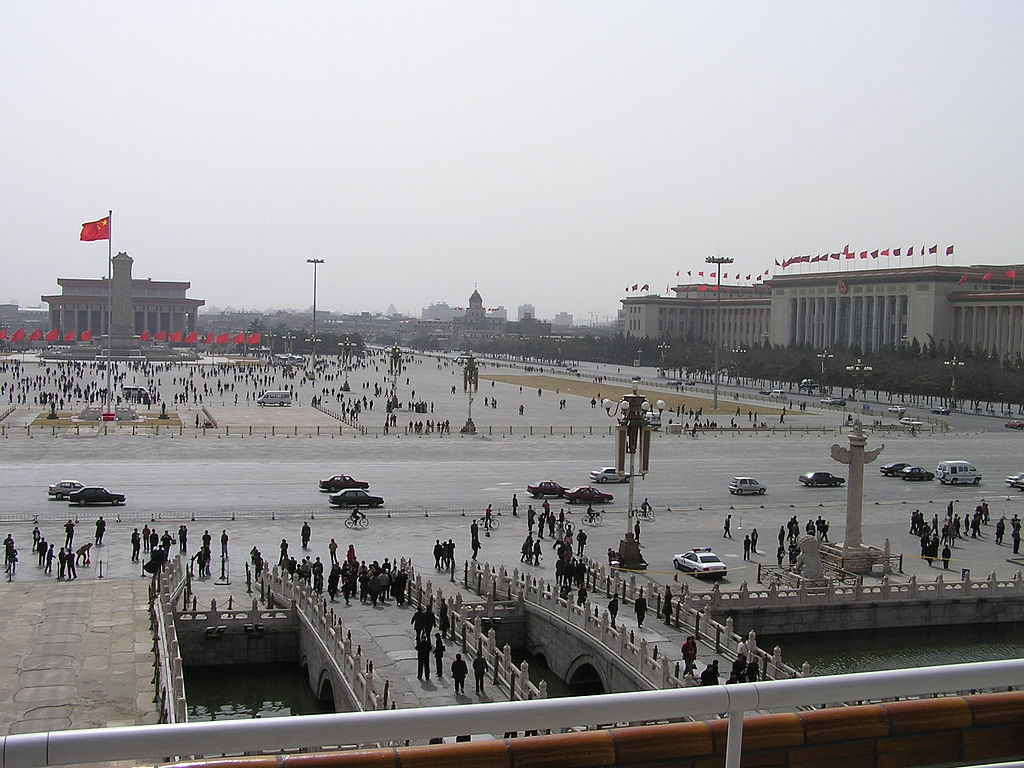
Tiananmen Square, Beijing, China. This square was the site of a deadly confrontation in 1989 between the Chinese military and university students seeking freedom of speech. It is also the largest public square in the world. Photo curtesy of Touropia.


Image result for arab spring square
A mass of protestors in Tahrir Square, Cairo, Egypt. Tahrir Square was the site of the 2011 Egyptian Revolution. Photo curtesy of Touropia.

Since the skeleton of the modern city began to ossify thousands of years ago, the public square has always been at its heart, pulsating the urban lifeblood of commerce, politics, religion, art, and culture throughout the city’s veiny streets. The physicality of the public square as an urban space is quite simple with only two essential ingredients – a breakup in a city’s density to allow for open space and people – but what occurs when those two elements are combined is a complex diversity of interactions, developments, chance-encounters, and confrontations. From Madrid’s Plaza Mayor and New York’s Times Square, to Rome’s Saint Peter’s Square and Mexico City’s Zocalo, the urban public square is an extraordinarily prominent, varied, contested, and beautiful part of the modern urban fabric. The square is where the joyous serendipity of everyday urban life can best be experienced, but also where revolutions begin when that urban life becomes threatened or oppressed.
Picture
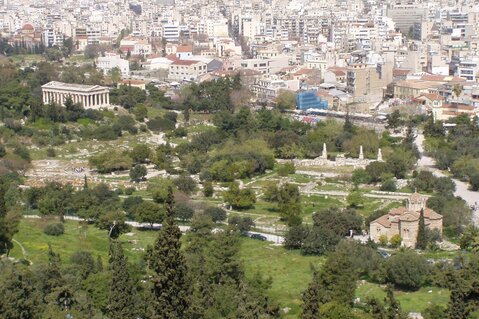
Aerial view of the ancient Athenian Agora. Photo curtesy of The Athens Key.

1. Various forms of public squares have existed since people first began to congregate in dwellings, but it was the Greek Empire’s creation of the agora that made the public square an infamous and essential part of everyday urban life. When Greek civilization entered its classical period around 600 B.C., almost every city of ancient Greece had an agora (Glancey). The agora, which translates to ‘meeting place,’ was located at the center of the city, making it easy to access for peasants and aristocrats alike, cementing the idea of a truly public space, open to all classes of people (Whipps). The agora consisted of a large central square surrounded by public buildings with space for market stalls where merchants sold their wares.
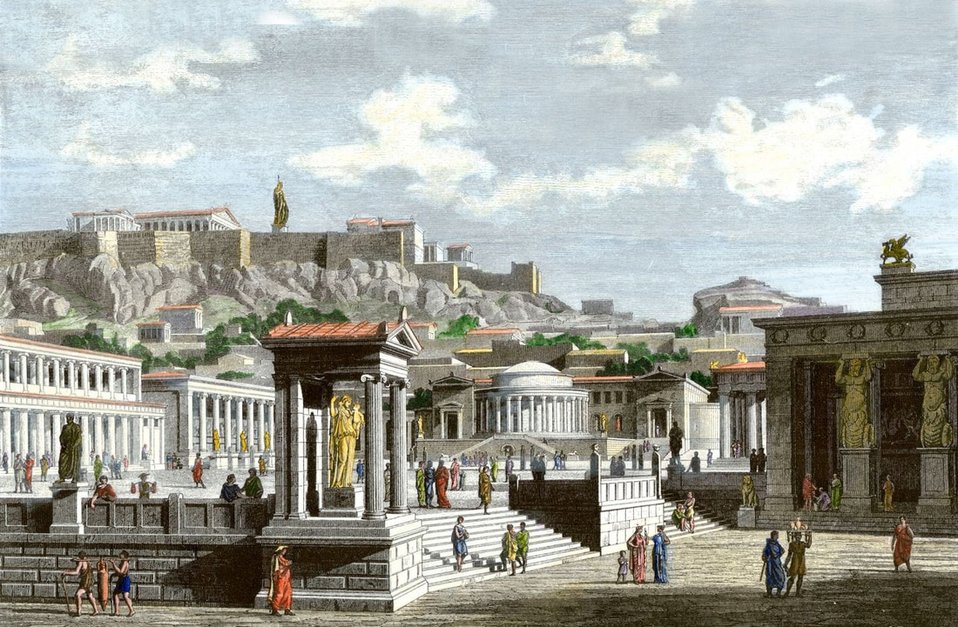
An imaginary depiction of the Agora of ancient Athens at the time of Pericles.
An artist’s rendering of the ancient agora in Athens. Photo curtesy of The Athens Key.

2. The hub of ancient Greek civilization was the Athenian agora, which was the largest public square of the time that stretched for more than 30 acres. Athens’ agora included numerous markets, three teaching porches or ‘stoas,’ two theaters, a gymnasium, five temples, a courthouse, and a prison (Light). This mixed-use agora was more extensive than the public square of today – resembling a modern civic center – but it attracted an equally diverse crowd as today with traders, scientists, politicians, slaves, state officials, and philosophers regularly brushing shoulders and conversing in the agora. Indeed, it was this high level of interaction between different classes of people that the agora facilitated, where “the sacred and the profane met on a daily basis,” which contributed to the creation of democracy in the Athenian agora (Light and Whipps). The concept of the Greek agora was transferred to the Roman empire under the new name of ‘forum,’ but continued the same traditions and structure as the agora.

Image result for renaissance city square
Piazza della Signoria in Florence, Italy. A good representation of a typical Renaissance city square. This space is now most commonly used by tourists seeking an authentic piazza experience. Photo curtesy of Wikipedia.

3. The grandiose scale of the first public squares, the Greek agoras and Roman forums, was gradually reduced to its current size and function as the products and services provided in public squares grew into entirely new industries requiring separate space (Light). As the Catholic Church gained power during the Middle Ages, space for worship was removed from the public square and placed inside of a church, separating the city square and the temple forever. During the Renaissance, simple peasant trades grew into full-blown, respected professions: architects, sculptors, and painters could no longer preform their work or advertise their products effectively within city squares, so they set up shop in buildings around the square and throughout the city (Light). Industrialization further shrunk the square’s marketplace due to mass merchandising, but also limited the social contributions of the public square. As more urbanites began grueling industrialized work, time became constrained between factory shifts, which allowed for less time spent lingering and conversing in the public city square. The advent of supermarkets, home refrigeration, and eventually freeways and office towers, further stripped the public square of its auxiliary uses, now only occasionally becoming a market place on weekends for small farmers and artisans (Light).

A bustling Times Square in New York City. An example of a modern, pre-designed square. Photo curtesy of Giffy

4. The modern form of the public square is completely redefined from its original agora structure, but the social and cultural effects radiating out from these open spaces in the middle of dense cities are equally important to society as the Greek agora was to the formation of democracy. As temples, marketplaces, and courthouses expanded out into the city from the public square, it allowed squares the increased freedom to be programmed in whatever way urbanites needed it to be – a need that can change on a daily basis. Today, public squares are divided between two categories: “one that is older, organic, chaotic, and populated; and one that is recent, planned, orderly, and deserted” (Marron Et Al). The first of these two variants grew organically to accommodate the needs and culture of ordinary urbanites as they arose throughout history, and usually results in a shared space with bustling activity. The second type of public square is built according to a pre-designed master plan to embody the values of the city in an attempt to reap the social benefits from the chance encounters of public space.

The above video from The Urban Land Institute awards six cities for their outstanding public squares and parks in 2015. Video curtesy of the Urban Land Institute

5. The issue with the second variety of public square stems from its artificiality that leaves no corner unplanned, largely defeating the public square’s greatest asset: it’s customizable, programmable quality, which allows citizens themselves to shape and appropriate the space through constant daily use. In the book City Squares, writer George Packer criticizes the newer generation of public square for its tendency to “leave nothing to chance. It tells people that they are subservient to the state and, in a sense, irrelevant to it” (Marron Et Al). When urbanites occupy a square designed for the sole purpose of glorifying a city or nation’s achievements, they feel a sense of powerlessness and lack of belonging, for they sense the space is monumental and not intended for their lived urban experiences. Moscow’s Red Square and Beijing’s Tiananmen Square are both examples of this “ceremonial model of public space,” in which civic planners create large-scale squares in dedication to the nation or city’s accomplishments (Iveson 187). Most public squares however, blend these two styles of public space together, so that urbanites shape the character of the square along with civic planners that incorporate national pride and triumph. The Three Cultures Square (Plaza de las Tres Culturas) in Mexico City has a rich history and represents a hybrid modern/ancient public square.

Related image
Three Cultures Square in Mexico City, Mexico. The three cultures are represented by the Aztec ruins, the Spanish church, and the Modernist Mexican high-rises. Photo curtesy of Esoteric Survey.

6. Three Cultures Square is located in the Cuauhtémoc borough of Mexico City and was first built in the mid-1960s. The space was originally planned to be a Corbusierian-style housing block and was included in the master plans for a modernist, one million square meter, high-rise housing project called Tlatelolco (Gallo 58). The sparse, high-rise apartments soared up, surrounding Three Cultures Square on all sides, but the Mexican developer responsible for Tlatelolco, Mario Pani, dared not touch the square due to what lay just underneath the surface: the ancient remains of an Aztec pyramid that had been razed by Spaniards in the sixteenth century. The stones from the pyramid were repurposed to build a Catholic church directly opposite the  partially destroyed pyramid. In a strange repetition of history, Pani sought to finish the job the Spanish started by clearing the remains of the pyramid and the colonial church to make way for a modernist, block-housing project of unbelievable scale. Luckily, archaeologists and Mexican authorities prohibited Pani from building on the ancient site. As a compromise, Pani incorporated the ruins into his design of the Tlatelolco housing project by making it into a public square (Gallo 59). Three Cultures Square is a unique blend of the two styles of public square – it is at once ancient and has been used as a congregating space for centuries, but has subsequently been highly planned and modernized, partially negating that history and the natural development of public squares. After Pani finished its design and construction, the square was named by Mexican officials to reflect the site’s contested history between the three cultures that each laid claim to the square at one period in history.

Related image
An alternative view of Three Cultures Square in Mexico City, Mexico. The three cultures that also represent the three races are prominently displayed. Photo curtesy of Mexico Lore.

7. Three Cultures Square is named after the three cultures that are visible from within it: Native Aztec, Colonial Spain, and Mexican. City officials created and promoted the name of Three Cultures Square due to the post-Revolutionary ideology that “modern Mexico was a new mestizo culture born out of the encounter of two previous civilizations: the Aztecs and the Spaniards” (Gallo 59). Thus, the ancient pyramid is a reminder of Aztec architecture, the church as an example of Spanish construction, and Pani’s modernist housing project serves to show how modern Mexico builds and lives today. A plaque located within the site reveals that Three Cultures Square is not only named in honor of the three different architectural styles and cultures, but also after the three separate races: “On August 13, 1521, after being heroically defended by Cuauhtémoc, Tlatelolco fell to Hernán Cortés. It was neither victory nor defeat, but the painful birth of the mixed-blood country that is Mexico today” (Gallo 60). Three Cultures Square is then also Three Races Square, allowing Pani’s modernist high rises to represent the mixed-blood inhabitants of modern Mexico. Pani honored this idea of intermixing by centering the housing project around the square and designing the tallest building in the Tlatelolco development to be a modernist interpretation of a pyramid (Gallo 60).

Related image
An aerial view of Pani’s Tlatelolco modernist housing project with the Three Cultures Square in the center. Photo curtesy of Pinterest.

8. The developer of Three Cultures Square and Tlatelolco, Mario Pani, the son of a diplomat, was born in 1911. He studied at École des Beaux Arts in Paris during the 1930s, which is when he discovered the philosophy and work of Le Corbusier. He cultivated a love for urban planning during his time in Paris, and upon his return to Mexico, began lobbying the Mexican government for large-scale urban transformation. In the late 1940s, he was commissioned to build the first Corbusierian housing project in Mexico City (Gallo 56). City officials had originally planned to build smaller houses or duplexes, but Pani convinced them that modern urbanism was the best route; so one thousand apartments were built within 12 large complexes. The Tlatelolco development was Pani’s third project and his largest and most monumental yet, setting out to build enough apartment blocks for one hundred thousand residents in fifteen thousand apartments (Gallo 56). Pani commented on his vision and reason for Tlatelolco: “We still need to regenerate over half of Mexico City, which is full of awful neighborhoods. The one advantage is that most of these neighborhoods are so awful that they are just waiting to be regenerated, to be torn down and rebuilt properly” (Gallo 55). Clearly a descendent of Corbusier’s style of urbanism, Pani had no regard for the history of place or patience for the accompanying urban chaos. Messy urban history would form within Pani’s master-planned Tlatelolco housing project nonetheless.

Image result for three cultures square massacre
A memorial to the massacre victims at Three Cultures Square. Photo curtesy of Wikipedia.

9. Only two years after construction was finished on the last building in the Tlatelolco housing project, a student protest in Three Cultures Square ended in the massacre of hundreds of students at the hands of Mexican police. In 1968, student movements and protests were breaking out across the world, and Mexico City was no exception. Thousands of National University students gathered in Three Cultures Square on October 2nd, just a week before the opening ceremonies of the 1968 Summer Olympics, to protest government repression and violence against students. As the rally was ending, soldiers arrived to arrest the student resistance leaders, but were greeted by gunshots from the surrounding high-rise apartments. The soldiers then opened fire on the crowd, turning the peaceful protest into a shooting that lasted two hours and took and estimated 200-400 student lives (NPR). It has since been revealed that a branch of the military, the Presidential Guard, had posted snipers in Pani’s high-rises surrounding the square with orders to shoot at the incoming soldiers to make them believe they were under fire from the students, resulting in the soldiers killing hundreds of people. The massacre at Three Cultures Square demonstrates the potential power held within the open spaces of public squares, and the consequential violence that can erupt when that power clashes. The massacre also reveals a government so desperate to present a civilized, peaceful image of Mexico City to the world during the 1968 Olympics, that they were willing to murder their own citizens to create it.

Related image
Gammeltorv Square in Copenhagen, Denmark. Copenhagen is known around the world for their vibrant and leisurely urban spaces. The city is sometimes referred to by residents as ‘our urban living room.’ Photo curtesy of NPR.

10. The creation of Three Cultures Square and subsequent protests and violence demonstrate the contrasting functions of public squares across the world: they are the spaces where urban life most visibly thrives, but also the first space people mobilize to when that urban life is prevented from thriving. An urbanite can read about civic unrest in Syria or watch a North Korean military parade that each make use of public squares for their respective ideologies, while sitting in a beautiful and serene public square, filled with people sipping hot mugs on outdoor café tables and children playing in fountains. The public square is simultaneously the arena of political confrontation and a destination for the foreign tourist; it is the platform through which the local merchant can sell her wares to busy urbanites passing through, while also being the site of immense bloodshed and loss in the name of a movement or revolution. It is this incredible dichotomy in how public squares are utilized that makes them the most vital organ in any city, where anyone from any walk of life can come together to organize, speak out, observe, or just be. Public squares are the ultimate physical manifestations of the sense of freedom urbanites experience in cities all over the world, so it is no surprise the public square gave birth to democracy.

Related image
Protesters participate in an anti-corruption rally in Palace Square, St. Petersburg, Russia. Photo Curtesy of NPR.


Bibliography

Anzilotti , Eillie. “What Public Squares Mean for Cities.” CityLab, 9 May 2016.

Gieseking, Jen Jack., et al. The People, Place, and Space Reader. Routledge, Taylor & Francis Group, 2014.

Glancey, Jonathan. “The Violent History of Public Squares.” BBC, 3 Dec. 2014.

Light, Richard. “The Agora from Athens to Atlanta: Public Space as Marketplace, Park and Center of Urban Life.” Planetizen – Urban Planning News, Jobs, and Education, 15 Apr. 2015.

Marron, Catie. City Squares: Eighteen Writers on the Spirit and Significance of Squares around the World. HarperCollins, 2016.

“Mexico’s 1968 Massacre: What Really Happened?” NPR, NPR, 1 Dec. 2008, www.npr.org/templates/story/story.php?storyId=97546687.

“Putting the Public Back into Public Space.” The People, Place, and Space Reader, by Kurt Iveson, Routledge, Taylor & Francis Group, 2014, pp. 187–191.

“Tlatelolco: Mexico City’s Urban Dystopia.” Noir Urbanisms: Dystopic Images of the Modern City, by Rubén Gallo, Princeton University Press, 2010, pp. 53–73.

Whipps, Heather. “How the Greek Agora Changed the World.” LiveScience, Purch, 16 Mar. 2008.


The Vacation Home: An Encouraged Staple of American Family Life

How did the idea of the vacation home start?  Why are vacations such an idealized concept? Think of any vacation homes that you have visited and their surrounding areas…now here are the top ten facts you did not know about vacation homes.

Some families consider having a vacation home the ultimate goal. Although the American Dream consists of having a nice house with a backyard and a pet, many people believe that having a vacation home is an element of the fantasized notion. Not only do they let families relax, but also come together, meet new people, and explore new places.


1-One of the first known accounts of a vacation was in 1744 when Dr. Alexander Hamilton left his home in Maryland for four months for relaxation and leisure purposes. At the time, there was no reason to believe that people needed breaks to relax. It is also apparent that people did not take vacations because carriages were not an adequate source of transportation and therefore they could not travel very far. Dr. Hamilton for instance, traveled on horseback. Taking a vacation was a very unusual habit during the mid-eighteenth century in America; however, perhaps Dr. Hamilton started the trend. By the 1760’s, American upper-class families were traveling to one of America’s first vacation destinations, Newport, Rhode Island which happens to still be a very popular vacation spot today. [1]

https://www.today.com/parents/throwback-road-trips-vintage-vacation-pics-summers-gone-1D79854275


2-Ironically, after Dr. Hamilton took his four-month-long vacation in 1744, doctors all over America began encouraging their patients to get away. However, it was not until the 1820’s that this idea of going on vacation began. Reasons to escape from daily-life included: health issues, weather conditions, and more generally, a need for relaxation. Doctors emphasized the importance of the climate, air, and water, and how it relates to one’s health in balancing bodily fluids. They also believed that warmer temperatures could cure diseases such as asthma, gout, and rheumatism. Thus began the movement of families vacationing in warm places. [2] Still to this day, doctors encourage their patients to take vacations and rest. It is not only vital to one’s happiness but also their health. Companies have to let their employees take a certain amount of vacation days for their well-being.

http://memebase.cheezburger.com/tag/vacation


3-Baby boomers during the late 20th century had a great effect on the vacation home market. In 1995, 44% of households believed they would be able to buy a second home within the decade up from the 26.2% in 1990. In 1994, 4.8 million households owned vacation homes or time-share condos. It was also reported that the group of people most likely to invest in second homes were those aged 35 to 50-year-olds whose kids had already left home. The article also discusses how demographics do not affect the investment in a vacation home because at the time, prices were expected to increase by an average 5% ever year. [3] It is interesting to compare these numbers to the 2000 census listed below. Surprisingly, the number of vacation homes decreased between 1994 and 2000, perhaps due to the market stability at the time.


4-Despite the belief that most people who own vacation homes occupy much of the Northeastern part of the United States, that is not true. According to the United States Census Bureau in 2000, vacation homes take up space predominantly in the northeast, south, and west coast. The Historical Census of Housing Tables: Vacation Homes shows that in 2000, there were 3,604,216 vacation homes out of 115,904,641 total homes in the United States. Out of the 3 million homes, the leading states with the most vacation homes were, Florida with 484,825, California with 239,062 and New York with 235,793. [4]

https://media.giphy.com/media/d2ZcjgIHBf3fvZtK/giphy.gif


5-Not all well-known vacation destinations have always been meant for vacations. Nantucket Island is a great example of this. Situated off the southeastern part of Massachusetts, Nantucket is a small island that is known today for its beautiful beaches and quaint town. Although the island is occupied by residents all year round, it thrives during the summer months with both tourists and visitors who vacation there year after year. However, from 1800-1805 the island focused on whale fishery and was occupied by ocean-going vessels. Then in the latter half of the nineteenth century, it ultimately became a desired vacation spot. Residents of the island formed the Nantucket Agricultural Society in 1856 which helped the island create a system that could support itself. In 1840, under 10,000 people lived on Nantucket full time and that number was returned again in 2002. [5] Although there are a good number of residents, the majority of houses on Nantucket are rented out during the summer because their owners can get desirable prices from renters who are just looking to be there for a mere three-month vacation.

http://www.travelandleisure.com/travel-guide/nantucket


6-In 2008, a website called “Airbnb” launched and is now one of the world’s leading online hospitality services used to rent vacation homes, cottages, apartments, etc. In 2017, Airbnb announced that it had 4 million listings worldwide in more than 191 countries, and it had over 200 million users since its launch in 2008. The website also reported that of the 4 million worldwide listings, the United States is the top country, with 660,000 listings. [6] With technology and fairly easy access to transportation, it seems as though people are beginning to travel more and are eager to visit new places. Websites like Airbnb are taking away from vacation home sales because people do not want to feel obligated to revisit the same town or home over and over again. That being said, Airbnb is benefitting many vacation towns as people have readily access to visiting almost anywhere they so desire.
 

7-Many people who do not own vacation homes might not know that there have been controversial tax implications in the past regarding second homes. In 1976, Congress added section 208A to the Internal Revenue Code because there was a concern that people who owned vacation homes were renting them out in order to subtract their own personal expenses. This section was intended to limit the amount of deductions those who owned vacation homes could benefit from. Owners were required to distinguish their personal expenses regarding the vacation home from their rental expenses. [7] This tax reform act of 1976 shows how the government does pay attention to those taxpayers who own second homes. Although it is clear from the United States Census Bureau that many people in the US own vacation homes, this tax reform also points to that. There was enough concern about deducting expenses regarding the vacation home that it was brought to the governments attention.

https://sayingimages.com/tax-meme/


8-Although there are many benefits associated with vacation homes, such as having a generally relaxing and enjoyable experience, there are also some negative impacts. Many people neglect to consider the potential problems that arise when vacation homes take up an area, specifically a rural setting. Despite many wealthy American families having second homes in typical vacation towns such as Cape Cod, Nantucket, and the Hamptons, many less affluent families resort to more rural lands to purchase vacation homes especially if they are interested in recreational activities such as fishing and hunting. In a journal article about vacation homes, the author, Richard Ragatz, argues that in rural towns with many vacation homes, public services, such as water and sewer systems, security protection (police and fire), and means of access (highways, roads, etc.) often have to be expanded. [8] This issue is more of an economic one; however, vacation homes also generate problems that are more psychological and impact the family itself.

https://www.oxhuntingranch.com/lodging/accommodation/


9-The same author, Richard Ragatz, writes about other issues surrounding vacation homes in his article, “Vacation Homes in the Northeastern United States: Seasonality in Population Distribution”. Although vacation homes can improve many towns and bring benefits to new areas, they can also infiltrate on spaces if they become overpopulated. Ragatz argues that if urban settings are very concentrated with people, health issues can arise. If one person catches a disease, it can be spread very quickly. Other problems concerning the congestion of vacation homes can occur on the roads with traffic and speeding, the loss of agricultural land due to the increase in homes, and the negative impact the densely populated areas can have on the environment. [9]

http://thechive.com/2017/01/29/the-most-densely-populated-places-on-earth-16-photos/


10-Similar to the ideas of Airbnb, timeshares allow people to rent and share a variety of homes. The family who is looking to travel signs up in advance for a week and a place they want to go. For instance, in December they will sign up to go to Los Angeles for the week of July 4th the following year. Another family will occupy the same house the next week and so on. In 2008, it was reported that there were more than 1,600 timeshares throughout the United States with an economical effect of more than $92 billion. In 2002, a timeshare survey of 1,062 owners discovered that 62% of them intended to participate in renting a timeshare within the next year. [10] These numbers show how popular timeshares are and how those involved continuously use the program. Between Airbnb and timeshares it seems as though the public is generally moving towards renting second homes rather than owning them because they do not want to feel obligated to revisit the same vacation spot time and time again.

http://www.safebee.com/money/considering-buying-timeshare-think-twice


Works Cited

[1] Aron, Cindy S. Working At Play: A History of Vacations in the United States. New York, NY: Oxford University Press Inc., 1991. Accessed March 3, 2018. https://www.amazon.com/Working-At-Play-History-Vacations/dp/0195142349.

[2]Ibid.

[3]Smith, Anna Kates, and Mike Tharp. 1995. “The New Vacation Home Bonanza.” U.S. News & World Report 118, no. 14: 64. Academic Search Premier, EBSCO host (accessed March 2, 2018).

[4] Bureau, US Census. “Data.” Historical Census of Housing Tables: Vacation Homes. January 01, 1970. Accessed March 03, 2018. https://www.census.gov/data/tables/time-series/dec/coh-vacation.html.

[5] Alsop, James D. “Island Refashioning: The Nantucket Agricultural Society, 1856-1880.” The New England Quarterly 77, no. 4 (2004): 563-87. http://www.jstor.org.ezproxy.trincoll.edu/stable/1559727.

[6]”Airbnb Fast Facts.” Airbnb. Accessed March 4 , 2018. https://press.atairbnb.com/app/uploads/2017/08/4-Million-Listings-Announcement-1.pdf.

[7] Lawyer, Jeffrey T. “Vacation Homes, Section 280A and Bolton v. Commissioner: The Right Result for the Wrong Reasons.” Duke Law Journal 1985, no. 3/4 (1985): 793-812. doi:10.2307/1372378.

[8] Ragatz, Richard Lee. “Vacation Housing: A Missing Component in Urban and Regional Theory.” Land Economics46, no. 2 (May 1970): 118-26. Accessed March 4, 2018. doi:10.2307/3145169.

[9] Ragatz, Richard Lee. 1970. “Vacation Homes in the Northeastern United States: Seasonlity in Population Distribution.” Annals of the Association of American Geographers 60, no. 3: 447-455. Academic Search Premier, EBSCO host (accessed March 4, 2018).

[10] Sampson, Scott E. “Optimization of Vacation Timeshare Scheduling.” Operations Research 56, no. 5 (2008): 1079-088. http://www.jstor.org.ezproxy.trincoll.edu/stable/25580867.

Healing America: Hospitals in U.S. History, Space, and Culture

The evolution of the hospital in America traces medicine’s shifting role in American society, and its interventions—for better and worse—into the lives of its citizens. More than a place to heal, hospitals have a complex political, social, and cultural history that both responded to and shaped every era in American history. By studying hospitals, we can perceive the material, human consequences of design, and trace the ways medical institutions have governed bodies and space in the U.S. Here are 10 facts about hospitals you should know.

  1. The first hospitals established in America were modeled after European ones, which were closer to workhouses or penitentiaries than to the therapeutic and scientific centers of today. Only the destitute and indigent were forced into hospitals. Anyone with means preferred to be cared for at home. The hospital usually cited as America’s first is the Pennsylvania Hospital, chartered in 1751. (Read Ben Franklin’s 1754 account of it here.) However, Marks and Beatty suggest an even earlier hospital existed at Jamestown, as far back as 1612. It contained 80 beds and was staffed by “keepers”—likely male nurses.[1].

    Pennsylvania Hospital (William Strickland, 1755)
  2. Marine Hospitals were instrumental in the consolidation of the early American State. The 1798 “Act for Relief of Sick and Disabled Seamen” established a tax on the wages of merchant seamen with which the federal government established and operated a series of Marine Hospitals. While these operated much like other early hospitals by accepting local poor patients, they served primarily for the rehabilitation of sailors. Gautham Ra
    U.S. Public Health service considers the 1798 Marine Hospital Act their founding.

    o explains that Marine Hospitals, which were modeled after similar British institutions, served to maintain an adequate maritime labor force, necessary for the development and expansion of the young state’s imperial and economic interests.[2] Rao argues that the program “fit squarely within the main themes of early American statecraft—associative structure, tax and revenue power, local influence, and contested centralization.”[3] Marine Hospitals provided a basis on which essential functions of the U.S. federal government were later elaborated, and constituted the first federal welfare program.

  3. Hospitals began to adopt their modern form in the mid-18th century, as young adults left family homes and moved to cities. As women got jobs outside the home, and living space became increasingly
    Operating room of the Massachusetts General Hospital, Boston, ca. 1850 (Southworth, Albert Sands, 1811-1894)

    compact, hospitals began to provide for a growing middle-class the healing functions previously handled by the family. As suburbanization increased travel times between work and home, working family members became less and less available to care for the sick at home. In this way, the emergence of modern hospitals reflected the segmentation and professionalization of services previously provided in the domestic sphere.[4]

  4. Hospitals’ designs reflect the social as well as the scientific conditions of their construction. In the second half of the 19th century, the “pavilion plan” dominated hospital design in North America, wherein patients would live in large, shared dormitories designed to let in light and circulate fresh air. This was in order to dispel “miasma”—an atmosphere thought to be the cause of infection.[5] Even as the germ theory of disease gained acceptance, “pavilion plan” hospitals remained the norm into the 1930s. Starting in the early 20th century, newer hospitals were designed with the goal of segregating patients from each other, both as an antiseptic medical principle and as an effort to appeal to new, paying middle-class customers. Some hospitals began to advertise themselves as akin to hotels, evoking luxury and domesticity. In Medicine by Design, Annmarie Adams discusses Royal Victoria Hospital in Montreal, a large public hospital which had two separate entrances. One—high on a hill overlooking manicured gardens—was for the paying middle- and upper- class patients, while the other—for its working class and poor patients—ran into the hospital through a tunnel nearly 60 feet below it, out of view and almost underground. As hospitals expanded their reach and services, they transformed from a last-resort site of destitution to an institution of civic pride and high regard that served the varying needs and expectations of different classes of patients.[6]

    Typhoid ward, Royal Victoria Hospital, ca. 1894
  5. Hospitals were starkly racially segregated after the Civil War. Black Americans’ access to hospitals was either limited to “colo
    One of the first “black hospitals” in America.

    red” wards or to a handful “black hospitals,” both offering vastly inferior care than that which was available to whites. In 1948, Mississippi had only five general hospital beds per 100,000 black citizens.[7] Further, many hospitals subjected black patients to non-consensual scientific testing and forced sterilization as part of racist eugenic efforts at population control.[8]

    Second-floor plan, Royal Victoria Montreal Maternity Hospital
  6. The designs of maternity wards reflected and transmitted cultural notions of motherhood. At the Royal Victoria Hospital, Adams notes, the maternity ward catered to two competing versions of birth popular in the early 20th century. One held that birth was a natural event to be treated as routine and normal. The maternity ward for middle-class patients was accordingly decorated to suggest a “homelike” environment, with comfortably furnished social space for the patients designated “maternity lounges.”[9] At the same time, the architects responded to residual notions of birth as pathological, which manifested as “extensive record keeping and observation,” as well as the institutional regimes of a rehabilitative hospital.  In William Rosengren and Spencer DeVault’s fascinating 1958 study, “The Sociology of Time and Space in an Obstetrical Hospital,” they examine the ways American maternity clinics were spatially organized.[10] They note—similarly to Adams—that expecting patients were coded somewhere between “ill” and “not ill.” They examine the ways nurses, doctors, and patients behaved differently in “backstage” areas like offices or break rooms than they did in “onstage” areas such as the labor room, in which delivery nurses were segregated from other personnel by non-functional barriers denoting their authority. Rosengren and DeVault also suggest what they call an “ecology of pain,” remarking that, “spatially there appeared to be a kind of gradient as to the legitimation of pain, with the greater sanctioning of pain found the closer the ‘place’ is to the delivery rooms.”[11] They note that it is the delivery room where nurses and doctors were most able to medically manage pain with anesthesia and were not required, as in other spaces of the clinic, to respond to patients’ pain affectively and emotionally. The space of the clinic is thus organized in order to maintain a professional, “affectively neutral” attitude towards patients.
  7. During the Cold War, American maternity wards began to deploy a clinical practice called “rooming-in”. Shortages of hospital staff and a high birth rate meant that it became effective for hospi
    Preventing neurosis. Source: M. Edward Davis and Catherine E. Sheckler, De Lee’s Obstetrics for Nurses, 15th ed. (Philadelphia: Saunders, 1951), p. 499.

    tals to have infants stay in mothers’ rooms rather than in a central nursery. Elizabeth Temkin explains that this practice resonated with a post-Hiroshima fear of science and a cultural imperative to privilege individuality and family over uniformity and autocracy: “In other words, only Nazis would insist on feeding infants on a schedule in an impersonal central nursery. Rooming-in was not just a floor plan for the maternity ward, it was the basis of democracy.”[12] This development demonstrates the ways hospital designs are negotiations among medical technology, institutional circumstance, and the political moment. It also suggests the power the hospital holds as a national imaginary—a place where the nation is alternatively healed and born.

  8. 99% invisible: the blue yarn.

    An episode of 99% Invisible about the redesign of Virginia Mason Medical Center in Seattle according to the principles of a Toyota assembly line. The results, in many ways in line with “modern,” patient-focused thought, suggestively recall some principles from 19th-century medical philosophy: the

    Virginia Mason Medical Center, Seattle, WA

    value of natural beauty, limits on mobility, lots of light. But the redesign also suggests a reconsideration of the hierarchy implied by the “backstage/onstage” nature of modern medical care, as well as the temporalities of treatment. (You can find another great 99% Invisible, this one on an iconic 19th-century cancer hospital in New York, here. )

  9. Since the dawn of the field, psychiatric hospitals in America have operated on the notion that a patient’s environment is instrumental in the therapeutic treatment of mental illness.[13] In the second half of
    Dining Room, Green Door Clubhouse, Washington, D.C.

    the 20th century, however, psychiatric consensus shifted towards outpatient treatment, pharmaceutical management, and deinstitutionalization. Carla Yanni puts it this way: “The profession needed to disassociate itself from the once-grand claims of environmental determinism, because, quite evidently, the environment had not determined many cures.”[14] But Yanni notes that the shift in focus to non-institutionalized patients has left those that previously depended on the structure of the hospital—the poorest, most severe cases—without adequate care.[15] The elimination of the hospital, for all its faults, threatens its original mission of public welfare. Yanni discusses a new kind of institution gaining popularity in American cities. Called “clubhouses,” such organizations provide community and social services to the mentally ill without the institutional and repressive strategies that have historically characterised psychiatric hospitals.[16]

  10. In a New York Times op-ed published last year, Dhruv Khular argues that “bad hospital design is making us sicker.”[17] He suggests rooming patients together exacerbates hospital-acquired illness, and notes that money potentially saved fighting infections could offset the cost of housing patients individually. He advocates design changes that lower sound levels and make patients less prone to falls. He also offers evidence for the therapeutic value of access to nature in treatment settings. Khular’s perspective suggests that future design decisions could be based on research and critical attention to the built environment. At the same time, his concerns resonate with over 200 years of American hospital design and culture by weighing the values of community vs. individuality, idealizing “natural” healing, and affirming the sense that in America, effective and mutually beneficial hospitals are crucial for a healthy democracy.

    The newly built Eskenazi Hospital and Health Campus in Indiannapolis, IN

ENDNOTES

[1] Geoffrey Marks and William K. Beatty, The Story of Medicine in America (New York: Charles Scribner’s Sons, 1973), chap. 5.

[2] Alexander Hamilton wrote in 1787: “As a nursery of seamen it now is, or when time shall have more nearly assimilated the principles of navigation in the several States, will become an universal resource. To the establishment of a navy it must be indispensible.” (Alexander Hamilton, Federalist, no. 11, 65—73; press pubs.uchicago.edu/founders/documents/v1ch7s13.html)

[3] Gautham Rao, “The Early American State ‘In Action’: The Federal Marine Hospitals, 1789-1860,” in Boundaries of the State in US History, ed. James T. Sparrow, William J. Novak, and Stephen W. Sawyer (Chicago: The University of Chicago Press, 2015), 47.

[4] Morris J. Vogel, “The Transformation of the American Hospital,” in Institutions of Confinement: Hospitals, Asylums, and Prisons in Western Europe and North America, 1500-1950, ed. Norbert Finzsch and Robert Jütte, Publications of the German Historical Institute (New York: Cambridge University Press, 1996), 45–46.

[5] The cross-contamination of patients was called “hospitalism.” (Vogel, 46.)

[6] Not to mention religions. Hospitals operated by people of particular faiths were an important feature in the emergence of modern hospital systems in the mid-18th to 20th centuries. For an account of the emergence of Catholic hospitals, see Bernadette McCauley, Who Shall Take Care of Our Sick? Roman Catholic Sisters and the Development of Catholic Hospitals in New York City (Baltimore: Johns Hopkins University Press, 2005).

[7] Coli Gordon, Dead on Arrival: The Politics of Health Care in Twentieth-Century America (Politics and Society in Twentieth-Century America) (Princeton: Princeton University Press, 2003), 149.

[8] Harriet A. Washington, Medical Apartheid: The Dark History of Medical Experimentation on Black Americans from Colonial Times to the Present (New York: Harlem Moon, 2006), chaps. 8–11.

[9] Annmarie Adams, Medicine by Design: The Architect and the Modern Hospital, 1893-1943 (Minneapolis: University of Minnesota Press, 2008), 48.

[10] William R. Rosengren and Spencer DeVault, “The Sociology of Time and Space in an Obstetrical Hospital,” in The Hospital in Modern Society, ed. Eliot Freidson (New York: Free Press, 1963), 266–92.

[11] Rosengren and DeVault, 285.

[12] Elizabeth Temkin, “Rooming-In: Redesigning Hospitals and Motherhood in Cold War America,” Bulletin of the History of Medicine 76, no. 2 (Summer 2002): 285.

[13] Discussed in Marks and Beatty, The Story of Medicine in America, 64–70. Benjamin Rush, considered the father of modern psychiatry, believed that “good health depended on the social, political, and economic environment as well as on physical factors.”

[14] Carla Yanni, The Architecture of Madness: Insane Asylums in the United States (Minneapolis: University of Minnesota Press, 2007), 146.

[15] Yanni, 147.

[16] Yanni, 153–58.

[17] Dhruv Khullar, “Bad Hospital Design Is Making Us Sicker,” The New York Times, February 22, 2017, https://www.nytimes.com/2017/02/22/well/live/bad-hospital-design-is-making-us-sicker.html.

The Value We Place On Metal and Stone; Monuments in America

1. Definition of a Monument:

The official definition of a monument is “something erected in memory of a person, event, etc. as a building, pillar or statue.” The name monument comes from the Latin term Monitor, which means “to signify all things which call to mind the memory of some subject to those absent from this place or time.” Since the development of ancient civilizations, such as Ancient Egypt, the practice of memorializing or honoring someone or something came to be. At these times monuments were largely made in honor of the great and powerful. Over the course of history, people created monuments to honor and preserve the memory of a person, place, or event, big and small. In many instances, these statues and monuments honor war heroes or the victims of a war and other influential members of society. These war memorials offer insights into the ways in which national cultures conceive their pasts.

For this reason, monuments can carry political and social implications in how an audience may chose to interpret what they represent. Many factors contribute to the interpretation of a statue and what it may or may not symbolize. The geographical positioning of a statue affects the way the audience values the statue, for example a statue of Robert E. Lee may be received differently in a town in the south compared to a northern city. Monuments are simply objects that we then place value on and emotion into. Since historical events upon retrospective examination can be viewed as controversial, the monuments honoring them can create controversy as well. This relationship between history and a nation show the connection that the people have with that event and how they view and choose to remember a time in the past.

Source: Hamilton, Annette. “Monuments and memory.” Continuum 3, no. 1 (1990): 101-114.

(https://goo.gl/images/4JgXHs)

2. Monuments and Memory: 

Monuments carry a deep connection with history and memory. History and memory are not synonymous. Memory is “life, borne by living societies founded in its name” and history is, on the other hand, “the reconstruction, always problematic and incomplete, of what is no longer” (8). Various cultures and countries influence how history is portrayed and what is memorialized. “In the United States, for example, a country of plural memories and diverse traditions, historiography is more pragmatic. Different interpretations of the Revolution or of the Civil War do not threaten the American tradition because, in some sense, no such thing exists” (10). The definition of the present as defined by the nation, is greatly influenced by the past and the history of the country.

Monuments and memorials stemmed out of this national desire to preserve a country’s heritage and history. By honoring the past it helps to develop the type of values that the nation hopes to portray and express in the future. The Washington Monument stands tall over the capital of the United States and nothing can exceed its height according to building code in Washington D.C. It symbolizes the power of America and the desire to express this throughout the world.

Source: Nora, Pierre. “Between memory and history: Les lieux de mémoire.” Representations (1989): 7-24.

(https://goo.gl/images/Y77AJW)

3. American Example:

The Lincoln Memorial in Washington D.C. is a national symbol. The “Lincoln Memorial was conceived as a symbol of national consensus, linking North and South on holy, national ground” (141). We know this location as the setting of Martin Luther King Jr.’s “I Have a Dream” speech. In King’s speech he begins by stating, “Five score years ago, a great American, in whose symbolic shadow we stand today, signed the Emancipation Proclamation” (157). It is where thousands protested the Vietnam War, where the March on Washington for Jobs and Freedom occurred.

For decades the Lincoln Memorial represents the history of the past and also represents a symbol of protests to change the future. Not only is it a symbol of the nation, but it also is the location for many historical political protests. In 1939, an African-American woman by the name of Marian Anderson sung the song “My Country ‘Tis of thee” on the steps of the Lincoln Memorial. The concert was held by a civil rights leader and soon it became an exciting new beginning for the Lincoln Memorial as a stage for progressive ideas. It was not the first use of the Lincoln Memorial as a grounds for protest but it was the first mass gathering of black protestors attempting to gain national publicity. This particular setting is interesting given the uncertain relationship between African Americans and Abraham Lincoln himself. Those protesting utilized the memory of Lincoln in their favor as a “political weapon, in the process of layering and changing the public meanings of the hero and his shrine” (136). Pierre Nora called the Lincoln Memorial the best American example of a ‘memory site’ which is a place where “we struggle over the tensions between our experience of the past (memory) and our organization of it (history)… Memory sites are loci of struggle between the official groups that often create them and the vernacular groups that inevitably interpret and reinterpret them in competing ways” (137).

Source: Sandage, Scott A. “A marble house divided: The Lincoln Memorial, the civil rights movement, and the politics of memory, 1939-1963.” The Journal of American History 80, no. 1 (1993): 135-167.

4. Trinity Example:

Directly in the center of the quad we have our own Trinity example of a monument. Originally made to be placed over his grave, the statue of Bishop Thomas Church Brownell who founded and was the first president of Trinity College in Hartford, Connecticut in 1823, stands tall over Trinity’s campus. In the statue he stands with his right hand outstretched and his left hand holding a Bible, which is a pose representative of traditional orators. The statue first was erected in 1869 and stood on the college’s original location of Bushnell Park and was later moved to Trinity College’s current campus in 1878. The statue is made of bronze and sits on top of a 16-foot-tall granite pedestal. The statue was gifted to the college by Brownell’s son-in-law, Gordon W. Burnham.

He stands at the center of the quad and is the backdrop for matriculation, convocation, and eventually graduation every year for all incoming and graduating classes.

Source: https://commons.trincoll.edu/commons-2/artwork/statue-of-bishop-brownell/

Statue of Thomas Church Brownell at Trinity College, Hartford, Connecticut

5. Symbolism of Monuments:

As mentioned before, monuments are not just blocks of stone created for people to look at in awe. They are made in representation of someone or something. Sometimes the symbolism of these statues or monuments change over time and develop new meanings. An example of this would be the Statue of Liberty found in New York, New York. The Statue of Liberty, also know as “Lady Liberty” came to the United States as a gift from Frenchman Edouard de Laboulaye. It was created to celebrate and honor the centennial of the American Declaration and the United States of America. Its original name was “Liberty Enlightening the World.” The Americans built the pedestal and the French sculpted the statue. Funding was slow and difficult but eventually she was built and shipped in 350 separate parts across the Atlantic Ocean. She arrived as a symbol of the nation’s birth but grew into much more than that. During this time period, many immigrants were entering into the United States by way of Ellis Island, New York. Those immigrants who sailed past her on their way into the America that they had dreamed of saw her as a beacon of hope. She became an emblem and a mascot of sorts to the millions of immigrants who came to America following a dream of a better way of life than where they had come from. A comfort of sorts that they had at last arrived at their destination.

On October 28, 1936 on the Statue of Liberty’s fiftieth anniversary President Franklin D. Roosevelt spoke, “It is the memory of all these eager seeking millions that makes this one of America’s places of great romance. Looking down this great harbor I like to think of the countless numbers of inbound vessels that have made this port. I like to think of the men and women who, with the break of dawn off Sandy Hook, have strained their eyes to the west for a glimpse of the New World.” His profound words further highlight the theme of monuments as areas of emotion and artifacts that symbolize more than they may initially intend.

Source: Lazarus, Emma, and Valenti Angelo. The new colossus. Project Gutenberg, 1949.

6. Term’s Transformation:

Monuments traditionally commemorate veterans, philosophers, and society’s most influential members, but in more modern times we have seen the introduction of pop culture into monuments. An example of this is the Rocky Balboa statue in Philadelphia, Pennsylvania. The scene in the movie shows Rocky running through the streets of Philadelphia with the famous Rocky Theme song cheering him and the Philadelphians that join him along his trek up the Art Museum steps. When he reaches the top he throws his hands up in victory and this is the exact moment that the statue memorializes. The statue was introduced to the city for the filming of Rocky III later donated to the city that now remains as a monument to a fictional boxer…but it is so much more than that to the city of Philadelphia. As one of the city’s most famous pieces of public art the statue sees thousands of tourists each year. Initially, there was much negative response to the sculpture claiming that it was an ugly movie prop and that it should not be at the base of the city’s esteemed art museum, some claiming that they hoped it would be dumped into the Schuylkill River. This debate over whether it was appropriate to keep Rocky where he was, demonstrates a debate over public art and memorialism, in its portray of a moment in pop culture and not in relation to the history of Philadelphia itself. Despite the fact that the statue represents a fictional character the city of Philadelphia continues to rally behind it, believing that it is a metaphor for hope and a symbol that “greatness can come out of this city” and an artistic representation of the hopes and dreams of Philly.

During the Super Bowl LII, the statue came under attack by Vikings fans and Patriots fans, adorning him in the opposing team’s gear. This action rattled the city of Philadelphia in what it represented. Rocky stands for Philly and for all of it means and therefore, Eagles fans believed that the only colors he should be decorated in are green and white. This is an example of the social consequences that statues can create. An entire city can rally behind a statue of a fictional man who they believe embodies the city’s goals and aspirations. People from other places recognize this statue as just that and target it in a way to create an uproar. Although not a political statement or a largely historically significant commemoration, the shift of statues from honoring war heroes to pop culture emblems may not be as terrible as the initial protestors thought.

Source: Burling, Elizabeth J. “Policy Strategies for Monuments and Memorials.” (2005).

Rocky running up the Philadelphia Art Museum steps. (https://goo.gl/images/4JgXHs)

7. Controversy Behind Monuments:

In the summer of 2017, controversy arose in Charlottesville, VA over a statue of Robert E. Lee. Questions over whether a statue of the Confederate General should be honored and maintained during this day in age and what is represented arose. Riots and protests began all stemming from the statue. The statue shows Lee on horseback with just the words Robert Edward Lee written on it. White nationalists marched on the city to protest its plans to remove the statue that had been there since 1924. Residents of the city, as well as members of the N.A.A.C.P. wished for it to be removed. This debate highlights the overall issue of whether confederate soldiers should be memorized at all. “The violence this weekend was one of the bloodiest fights over the campaigns across the South to remove Confederate monuments, and the statue remains a lightning rod in Charlottesville.” This sentiment demonstrates the severity of the issue at hand. The struggle between the north and the south still holds its roots, one hundred and fifty years later. It goes beyond waving the Confederate flag and showing your ‘loyalty to the South’ but to statues that at one point in time people were accepting of and now questions are arising on why we should memorialize someone who did not support the nation that we currently are a part of.

This highlights the various values and emotions that people place on monuments. The meaning behind a statue or a building created in honor of someone or something can create controversy and conflict. A person viewed as a hero to one group may be viewed the opposite by another.

Source: Fortin, Jacey. “The Statue at the Center of Charlottesville’s Storm.” The New York Times (2017).

8. Animals and Monuments:

In 1925, a statue of a dog (either a Husky, Alaskan Malamute, or Siberian wolfhound), by the name of Balto, called Central Park in New York City his home. Balto was a real dog, he rose to national fame in January of 1925 as the leader of a dog sled team. Balto set out with his team on a 650-mile trek to deliver a diphtheria anti-toxin that would successfully thwarted an epidemic in Nome, Alaska. The trip only took them five and a half days to complete. Nome, Alaska is the town where the Iditarod sled dog race ends and Balto, along with his team, participated in as well. When word of this story of triumph over nature and human and animal connection and cooperation got out to the rest of the world, Balto and his team went from local heroes to national ones. The story would be repeated for generations as the quintessential tale of survival. Soon after the event, decisions were made to create a commemorative statue of Balto in Central Park in New York City.

There is a great human connection between humans and animals and particularly humans and service animals. A statue was erected of Sirius, the only rescue dog to die in the 2001 World Trade Center attacks. We create attachments to animals in the same way that we do to human beings, therefore, it makes sense that we would want to memorialize those creatures who impacted our lives in similar ways to the influential human beings that we see preserved in stone and metal.

Source: Kean, Hilda. “Balto, the Alaskan dog and his statue in New York’s Central Park: animal representation and national heritage.” International Journal of Heritage Studies 15, no. 5 (2009): 413-430.

Balto Statue in Central Park, New York, NY (https://goo.gl/images/v6oTNL)

9. Famous Speech:

On January 18, 2009 President Barack Obama gave a speech in front of the Lincoln Memorial. This speech was given two days prior to his inauguration and was in honor of the anniversary of Martin Luther King’s speech given at the exact same location. He chose to speak at this location for what it means to the American people and the historical significance it beholds. He states “what gives me that hope is what I see when I look out across this mall. For in these monuments are chiseled those unlikely stories that affirm our unyielding faith–a faith that anything is possible in America.” This idea embodies what a monument is to society. How an object can become so much more through the placement of emotions and value on it. He describes the Washington Monument saying, “rising before us stands a memorial to a man who led a small band of farmers and shopkeepers in revolution against the army of an Empire, all for the sake of an idea.” He then references Martin Luther King Jr. stating, “directly in front of us is a pool that still reflects the dream of a King, and the glory of a people who marched and bled so that their children might be judged by their character’s content.” Lastly he references Abraham Lincoln and the memorial created in his honor, “behind me, watching over the union he saved, sits the man who in so many ways made this day possible.” As the first black president Obama was referencing the strides that Lincoln took in preparing the nation to reach this momentous day, through compromise and strife he united the two sides of the Civil War and also in the process, emancipated the slaves. He then states that it is not the stone and marble that he finds the most hope in, but in the American people themselves and that these memorials embody these values and that this common thread “runs through every memorial on this mall; that connects us to all those who struggled and sacrificed and stood here before.”

Source: http://www.nytimes.com/2009/01/18/us/politics/18text-obama.html

President Barack Obama giving a speech in front of the Lincoln Memorial (https://goo.gl/images/fL9SPd)

10. Fun Facts: 

The Washington Monument in Washington, D.C. is 555 feet tall. It was built in two separate phases, one was private from 1848-1854 and the other one was public from 1876-1884. Throughout this timeframe there were many different versions and plans of what it would look like. Eventually, it was built after the shape of an Egyptian obelisk as a demonstration of ancient civilizations and their timelessness. It was built as a tribute to George Washington, the “most essential Founding Father.” At the time that it was built it was the tallest building the world. Originally the elevator installed in the monument was steam-driven and took 10-12 minutes to reach the top of the monument, it was later replaced with an electric elevator that shortened the ride time.

The 13 Colonies

    1. “The Colonies” refers to the thirteen original colonies that comprised pre-revolutionary and revolutionary America (1607-1776).  All located on the East Coast, the colonies included New Hampshire, Massachusetts, Rhode Island, Connecticut, New York, New Jersey, Delaware, Pennsylvania, Maryland, Virginia, North Carolina, South Carolina, and Georgia.  The term “the colonies” has been in use since the early 1700’s.  Each colony was founded on different principals based on its original settlers.  For example, Massachusetts served as a refuge for English Puritans and its society and cultural norms mirrored their strict religious practices.

      Map of the Thirteen Colonies (shown in red). Wikipedia.
    2. What is colonialism?  Colonialism is widely understood as political system that involves one country asserting economic and military domination over another.  This relationship takes on many forms depending on the conditions of the colonizer and colonized.  Due to Western technological advances in the 1500’s colonialism as it is currently understood started to take form: “it became possible to move large numbers of people across the ocean and to maintain political sovereignty in spite of geographical dispersion”[1]. The colonization of the early United States can be best represented by the system of settler colonialism, which consists of a foreign population replacing the indigenous populations of an area. This system differs from the imperial systems of exploitation that was experienced in Latin America, Africa and, Asia for centuries.

      An early 20th century advertisement selling Native American lands to those interested in moving out west.
    3. The Jamestown Settlement in Virginia was the first successful British colony in the United States.  The first English ship arrived on April 26, 1607 carrying 143 Englishmen who would establish a proper colonial outpost modeled after the French and Spanish models in Louisiana and Florida, respectively.  What differentiated Jamestown from other colonies was that its original inhabitants were all men seeking fortunes through landownership, as opposed to families escaping religious persecution.  The colonists’ survival was dependent on a trading relationship with local Native American tribes, despite seemingly constant violent outbreaks between the two groups.  Through this relationship, the early colonists learned how to grow tobacco, which became wildly popular in both the colony and in England.  The tobacco industry ensured the economic success of Virginia, but required a larger workforce.  Therefore, in 1619 the first slaves arrived from Angola, as well as an abundance of indentured servants from the Netherlands and England.

      Arial depiction of the Jamestown settlement. History.com
    4.  The Massachusetts Bay Colony was founded in 1620 when the Mayflower arrived in Provincetown Harbor on Cape Cod.  Those aboard the Mayflower were British Puritans seeking religious freedom for their separatist protestant beliefs.  The pilgrims on the Mayflower intended to create a settlement in Virginia, but harsh weather conditions and a taxing 65-day journey across the Atlantic made finishing the voyage to Virginia implausible.  The Mayflower Compact was signed by all the surviving men on the ship and founded the legal basis for the future Massachusetts Bay Colony by establishing a voluntary government in Massachusetts instead of Virginia. The colony continued to grow and soon Boston was established as the commercial center of the colony, creating a burgeoning merchant class.  Boston would later become a place of key importance during the Revolutionary War.

      Colonists trading their goods on the harbor.
    5. The Colonial Economy: The American colonies grew to be an economic success in each region (South, Middle Colonies, and New England).  Most of these economies were agricultural, but areas with poor soil or terrains that made farming difficult found success in industries such as trapping or fishing.  Regional specialization and seemingly abundant land gave the colonies a comparative advantage over their European counterparts and allowed for their entry into the global economy.  Rice and tobacco that was grown in the South and grains that were grown in the Middle Colonies (the area between the Potomac River and the Hudson River) were referred to as cash crops.  Despite unfavorable agricultural conditions, the New England colonies rose to economic prominence due to their involvement in fishing and shipping industries.  Other colonial industries included shipbuilding, resource extraction, fur trading, and textile production.

      A Pennsylvania farm. Spiritualpilgrim.net
    6. Colonial Society: The character of the societies of the colonies was dependent on its geographic location, their economies, and the general values held by its inhabitants.  What remained constant throughout all thirteen colonies, however, was that white, landowning, protestant men maintained a privileged role in society.  Furthermore, most societies were more or less based on social structures in Europe, creating highly stratified communities.  Slavery and indentured servitude were staples of colonial society until the Revolutionary period in some colonies and remained until the Civil War in others.  Interestingly, due to the seasonal agricultural practices of the Middle Colonies and the lack of a strong agricultural economy in New England, the need for slavery was not as strongly felt: leaving a dramatically different legacy than in the South.  Native Americans were forcibly removed from their lands and were deemed inhuman.  Women occupied an interesting role within the home and in the greater community.  At the dawn of the Revolution, women were expected to raise families based on the notions of republicanism, which turned the norm that a woman’s place was in the home into a patriotic responsibility.

      Painting of the prominent Royall family (Robert Feke 1741). (royallhouse.org)
    7. The Seven Years Year/ the French and Indian War: Many consider the catalyst for American independence (and the end of the colonies) to be the Seven Years War (also referred to as the French and Indian War), fought from 1756 to 1763.  The war began as an imperialist conflict due to Britain’s desire to expand westward the French controlled Ohio Valley to expand the capacity to trade.  Despite the British victory, the expense of the war caused the British monarchy to levy a series of controversial taxes, such as the Stamp Act in 1765, that was ultimately part of the driving force that led the American colonists to seek independence.

      The Join or Die cartoon was popularized during the American Revolution, but was originally used during the French and Indian War.
    8. Historic Preservation: A number of colonial settlements and areas have been preserved to educate the public about a previous era and how it has informed American life today.  Historic districts bring revenue to cities and states through investment and tourism and can regenerate struggling local economies.  Additionally, they provide a sense of identity and community for the area they are located in.  Examples of colonial historic districts and sites today include Colonial Williamsburg, the Betsy Ross House in Philadelphia and Valley Forge, and the Paul Revere House in Boston.

9. In popular culture, the colonies are portrayed in a number of freely interpreted ways that fail to properly depict what the typical day to day would have been for a colonist.  The motifs used most often are the puritans in the Massachusetts Bay Colony and the relationships between the colonists and Native Americans.  The New England settlers are often depicted as narrow minded, religious zealots, or used as a vehicle for depictions of horror, often associated with the Salem witch trials.  For example, in Arthur Miller’s The Crucible, he conflates narratives of the Salem witch trials with Puritan settlements, while depicting few positive characters (Miller wrote the play as an allegory for McCarthyism in the 1950’s).            

Popular culture also has a habit of romanticizing the relationships between indigenous Americans and the colonists.  For example, Disney’s Pocahontas uses real historical figures to tell the story of a Native American princess and British soldier defying their superiors by falling in love.  While Pocahontas did marry an Englishman (John Rolfe, not John Smith), it was largely a political relationship and grounds for a truce after her abduction by the Jamestown settlers.

10. When studying colonial America, it is important to recognize that most scholarship on the subject has a colonial bias that can best be described using the saying “history is told by the victors”.  For example, the history of the relationship between Native Americans and the colonists seems to end after the initial settlements of the colonies in the 1600’s, when in reality the effects of these early relationships are still felt in many native communities today.  The current understanding of a number of tribes is based off of primary sources recorded by European explorers and settlers, which creates a seemingly unavoidable conflict when trying to accurately understand the colonial community at the time: “In the past many historians…[portrayed] the Indians as the  helpless victims of European colonizers who had superior technology, broader worldly experience, and more lethal diseases” (Lombard and Middleton, n.p.).  In addition, the role of Native Americans in the survival of many early colonists is quite large, but often overlooked.

A depiction of a Native American offering advice on how to farm.

Bibliography :

Baker, Paula. “The Domestication of Politics: Women and American Political Society, 1780-1920.” The American Historical Review 89, no. 3 (1984): 620-47. doi:10.2307/1856119.

Bremer, Francis J. The Puritan Experiment: New England Society from    Bradford to Edwards. University Press of New England, 1995.

Heinemann, Ronald L. Old Dominion, New Commonwealth: A History of Virginia, 1607-2007. University of Virginia Press, 2007.

Kohn, Margaret and Reddy, Kavita, “Colonialism”, The Stanford Encyclopedia of Philosophy (Fall 2017 Edition), Edward N. Zalta (ed.), https://plato.stanford.edu/archives/fall2017/entries/colonialism/

Lombard, Anne and Richard Middleton, Colonial America: A History to 1763. John Wiley and Sons, 2011.

Phil Rabinowitz, “Changing the Physical and Social Environment: Encouraging Historic Preservation”. https://ctb.ku.edu/en/table-of-contents/implement/physical-social-environment/historic-preservation/main 

Rockoff, Hugh and Gary M. Walton, History of the American Economy. Cengage Learning, 2013.

Rollins, Peter C. The Columbia Companion to American History on Film: How the Movies Have Portrayed the American Past. Columbia University Press, 2004.

The Pitfalls of the City

The Pitfalls of the City:

When considering the American landscape, there are three geographical spaces for living: the city, the rural, the suburbs. Each space has advantages and disadvantages for its residents. Each space containing unique characteristics. The cities that span across this country have the unique quality of representing both wealth and poverty. There is a juxtaposition and the definition of a city varies based on its residents. For one it can be a beautiful apartment overlooking Central Park in New York City, while another lives on the streets just outside. Two polar opposite experiences that are each defined by a city.

City Skyline GIPHY  

1 The “definition” of a city: Can there be one definition for a city? How does one create a definitive and all encompassing meaning for a place that has changed and developed over time? Merriam- Webster defines a city as “an inhabited place of greater size, population, or importance than a town or village”.  In the book, The Organic City, takes an extensive look into the development of the city through 19th and 20th century. As the city became popular “during the late nineteenth century, Americans confronted the challenge of a seemingly new urban form.  Americans [were] attempting to impose order on a rapidly changing society caught in the throes of industrialization and urbanization, the men and women interested in urban affairs embraced the notion of interdependence popular in descriptions of society and started to view the city as an organism- as an interdependent system of complementary parts or neighborhoods.” Urban Sociologist Ernest W. Burgess in 1926 also defined a city as an “organism” (pg 1). Cities are an organism in the sense that they are a system that is both dependent and also interdependent. The city influences the people while the people also influence the city. The rapid increase and development of cities develops a diverse demographic of people and industries. This results in different experiences and the inequalities of life to develop. [1]

2 Housing Divide in Cities: There is no doubt that there are class difference across not only America but also the world but there is no better place to see the clash and divide of class like housing in cities. Although there are classes that help define economic differences there is a clear racial wealth gap. The racial wealth gap between white and black homeownership in cities is significant. Through the process of privatization or “de facto segregation” is commonly thought of as private activity. This private activity is what led to highly segregated cities and the movement of upper class whites to the suburbs. In Richard Rothstein’s book, The Color of Law, he points out that the private activity and segregation would not have been possible without the government laws that explicitly promote white and black segregation. The housing segregation led to the exploitation of the blacks in cities and over time has created a huge wealth gap. The lack of attention paid to those in the lower economic bracket has allowed for the continuation of neglect to these communities and people. [2]

The Color of Law

3 Crime in Cities: In the late 1990’s there appeared to be a decrease in crime throughout American cities. This would make people believe that living conditions in cities were evening out and that the city was becoming gentrified in a positive way. This lack or decrease of crime in cities did not last long. In the mid 2000’s, there was a spike in crime in American cities. The main spike in crime is coming from the poorer areas of cities such as the south side of LA. Police in many of the poor parts of cities say that of the many factors that contribute to this rise in crime that high poverty rates is one of the key factors. People in these poorer parts of the city are joining gangs and getting guns due to the easy access. The desperation many of these people is causing many to commit both senseless crimes as well as crimes out of desperation; “Seventy-one percent of the cities surveyed had an increase in homicides, 80 percent had an increase in robberies, and 67 percent reported an increase in aggravated assaults with guns.” [3]

Police tape across city skyline

4 Housing and Crime: The mix of neighborhoods and crime in cities. The demographic of neighborhoods influences the residents as well as the crime.  A wealthy upper class tends to inhabit the nicer areas of the city while the poorer and generally black class is left with little to live off of. The poor are left in the neighbors with little and generally ignored by the city. In these areas there is a lot of crime. In a study done by the University of Wisconsin, they examine the mix of both crime and the housing crisis in many cities. The start of the problem lies with the white avoidance. [4] While the socioeconomic demographics between whites and blacks is shrinking (albeit not entirely quickly), the mix of neighborhoods does not show this. Blacks are still being segregated in housing even though it is more of a social practice. Whites have said that they would move out of neighborhoods that are 1/3 or more black. [4] This is the start of the problem. The segregation allows of the development of neighborhoods and areas that are not diverse. Without the resources being put in to the development of the poorer areas, these areas continue to remain underdeveloped. The areas that are predominately black are perceived to have more crime. This seems like a chicken and egg situation. Do these areas have more crime because they are underdeveloped? If this is the case, they will never improve if people continue to turn a blind eye to the areas in need. This is causing a stereotype of black neighborhoods to be created and perpetuated across this country. It has incredibly negative repercussions.

5 Atlanta Housing and Crime: The University of Georgia did a case study on Atlanta and crime. They looked at how crime changed the further away from the public housing you got. This is an important study because it assumes that those with a poorer background will have a higher crime rate. Public housing was a huge urban establishment in the early 1950’s where “many have evolved into warehouses for the most disadvantaged segments of the urban population, intensifying racial/ethnic segregation and the social isolation of their residents” [5] Many state the lack of attention paid to this buildings along with the people these buildings attract, that they are resulting in surrounding neighborhoods to also have the same demographic. When looking at the Atlanta crime and public housing the correlation is clear. In Atlanta, “predominantly black neighborhoods in close proximity to public housing exhibit the highest crime rates, but those further removed from public housing sites are no more likely to exhibit high crime rates than predominantly white neighborhoods.” [5] One can assume that this is not unique to just the Atlanta city but also is reproduced in the majority of cities across America.

Chicago Crime: Chicago is one of the most crime ridden cities in America. There are many crimes commit there every day. I personally have many family members that live both in the suburban and urban spaces of Chicago. There are clear areas of the city that one should not go in to alone. Getting lost in downtown in Chicago can be terrifying. This fear arises out of the distrust people feel towards the areas residents. Much of the crime in Chicago is organized crime that steams for gangs. The crimes tend to be violent. Last year as of June 30th, Chicago had already had 1,760 people shot by guns. [6] That is an incredibly high number. That is a problem. Many if not all these shootings were taking place in the most poor areas in Chicago. At this point last year, Trump also decided to send the Feds in as an attempt to prevent further crime. This violence in Chicago is not new, but rather is an epidemic that reoccurs year after year. It is horrible to think that there is an issue that people are turning a blind eye to even though they are aware of the problem. Last year Chicago, which is the third largest city in the country, had more than twice the number of murders as LA or NYC. [7] Although with the intervention of the Feds, the crime still persists. Many of the reasons why there is so much crime in Chicago is because of the racial makeup of certain parts of the city. Those living in the poor area of the city are desperate to live and do whatever they need in order survive.

Cartoon “Fleeing Violence” From the Chicago Tribune
Cartoon from Progress Illinois

Police Brutality in Cities: Police brutality is something not unfamiliar to us. There have many examples in the 21st century that reinforce the idea of unfair policing. Many of the poor policing practices and discrimination that we see today stems from the miss conduct of policing in the 1960s. In the early 1960’s there was the eruption of the Civil Rights Movement. Many blacks fighting for their rights came to clash with the police in certain areas. Police at this time used extreme force as a way to prevent protests from moving forward. This level of force was not necessarily new but now was in the public eye. The idea that police could be brutal to the blacks in this country was instilled in their practice. Out of the violence that was emerging, the US government in 1968 attempted to take action. A commission was created and the ultimate findings were that “the nation is moving toward two societies, one black and one white — separate and unequal” and as the Marshall Project, a non for profit news paper, states these findings still “ring true”. [8] The report found determined that it was not the police’s’ fault rather the fault of the black Americans. This shows the systematic issues that cities face with race and police. The blame is not placed on the government rather the individual. At time when cities were meant to be integrating, there appeared to be more racial segregation than ever. The policing issue of the late 1960’s allowed for mayoral candidates to call for a more integrated police force. [8] This integrated police force in Atlanta at the time is what some site as being the problem in the Atlanta Serial Murders. Over the years and since this report emerged, city police and the unfair violence against minorities has continued to occur. Many state that nothing has changed since the extreme brutality of the policing in the 1960’s. Many lawmakers chose to ignore the racial/class issue and instead attempt to fix the policing. This is the wrong way to go about it because most of the crime issues stems from poverty and inequality on all levels in America. [8]

A protest in Baltimore, in 2015. JABIN BOTSFORD/THE WASHINGTON POST, VIA GETTY IMAGES https://www.themarshallproject.org/2018/03/01/the-kerner-omission

8 Gender in Cities: The overarching theme of cities is that there is a huge group of people that are being ignored. They are being left out of the story. Although many of those forgotten are because of race, there are also many of the LGBTQ community that are ignored. Their stories not being told and spaces for them to thrive are not being created. A prime example of this is the police raid that occured in NYC at the bar Blue’s in the fall of 1982. [9] Although this event created a huge amount of controversy within the community and on top of that was overly violent, the media paid no attention to this. The raid essentially went ignored. This is an example of the city choosing to ignore those that do not fit its “mold”. The police were discriminating against those different from them. (sound familiar?) This phenomenon is something that blacks have been also facing in cities for years. This is also another example of the housing privatization choice who is ignored. The people in the LGBTQ community were all put in to neighborhoods by themselves. These neighborhoods are still define today. Many policies, whether lawful or not, have created policy violence and exclusion. The gentrification has only proved positive for a certain group and exclusionary to everyone else.

Blues protest 1982

9 The Atlanta Monster: Born and raised in Atlanta, I take tremendous pride in my city but there was also something missing from my knowledge about my beloved home. In 1979-81, 28 young black kids from the downtown area of Atlanta were either missing or murdered. This is an incredibly high number of murders in such a small amount of time. Few people took notice and the murders continued to occur. Finally after people begging for help, the government began to take action. People at the time recall the fear and lack of help they received. It’s hard not to think that had this occured in another part in the city with more affluent white kids that measures would have been taken almost immediately. These kids seemed to be forgotten in a time when they were in desperate need of protection. The podcast “Atlanta Monster” takes an investigative look in to the story of the kids and what transpired in the city at the time. Nearly 40 years later this is still something that goes untalked about in the city. It is almost like they are trying to cover it up, but the reality is this is happening all over the country. Crimes are being committed in cities and because they are not happening to the wealthiest or dominate group they are going ignored. Especially interesting is that at this time Atlanta had their first black mayor. One would have thought that this would have made people pay more attention to the serial killings and yet this is not what happened. This is still present in cities across the country today where people are being ignored because they are not deemed important. [10]

The Atlanta Monster Podcast cover https://www.stitcher.com/podcast/how-stuff-works/atlanta-monster

10 The Future of Cities: The Wired has an article that describes what cities will look like in the future. The only thing missing is that it does not talk about the demographics or the human make up of the cities. The article opens by stating “around the second decade of the 20th century, things changed. Cities started to happen on purpose. Beginning with New York City’s zoning laws in 1916, development began to occur by commission, not omission. Laws and regulations dictated the shape of the envelope.” [11] This current day article talks nothing about the past and the developments of cities rather the improvements cities will make in the future. I included this article because it shows how cities look to move forward but there is no talk about the development of the “problem” areas. How can a city move forward if it continues to ignore the citizens that need help the most. While it is important to celebrate our improvements it is important to recognize the pitfalls and attempt to fix our previous mistakes. [11]


Bibliography:

Ferkenhoff, Eric , and Darnell Little. “The Bleeding of Chicago.” CityLab, 27 Feb. 2018, www.citylab.com/equity/2018/02/the-bleeding-of-chicago/554141/.

Gorner, Jeremy. “As feds help Chicago on guns, Trump aide says city’s crime more about ‘morality’.” Chicagotribune.com, 1 July 2017, www.chicagotribune.com/news/local/breaking/ct-federal-agents-gun-crimes-trump-20170630-story.html.

Hanhardt, Christina B. “Broken Windows at Blue’s: A Queer History of Gentrification and Policing.” Versobooks.com, 14 June 2016, www.versobooks.com/blogs/2704-broken-windows-at-blue-s-a-queer-history-of-gentrification-and-policing.

Larson, Sarah. “”Atlanta Monster”: In Pursuit of Justice and a Hit Podcast.” The New Yorker, The New Yorker, 12 Feb. 2018, www.newyorker.com/culture/podcast-dept/atlanta-monster-in-pursuit-of-justice-and-a-hit-podcast.

Library, Yoichi Okamoto/LBJ, et al. “How a Landmark Report on 1960s Race Riots Fell Short on Police Reform.” The Marshall Project, 2 Mar. 2018, www.themarshallproject.org/2018/03/01/the-kerner-omission.

Mcnulty, Thomas L., and Steven R. Holloway. “Race, Crime, and Public Housing in Atlanta: Testing a Conditional Effect Hypothesis.” Social Forces, vol. 79, no. 2, 2000, p. 707., doi:10.2307/2675514.

Melvin, Patricia Mooney. Organic city: urban definition and neighborhood organization 1880-1920. Univ Pr Of Kentucky, 2014, books.google.com/books/about/The_Organic_City.html?id=z8IfBgAAQBAJ&printsec=frontcover&source=kp_read_button#v=onepage&q&f=false.

Nodjimbadem, Katie. “The Racial Segregation of American Cities Was Anything But Accidental.” Smithsonian.com, Smithsonian Institution, 30 May 2017, www.smithsonianmag.com/history/how-federal-government-intentionally-racially-segregated-american-cities-180963494/.

Quillian, Lincoln, and Devah Pager. “Black Neighbors, Higher Crime? The Role of Racial Stereotypes in Evaluations of Neighborhood Crime.” American Journal of Sociology, vol. 107, no. 3, Nov. 2001, pp. 717–767., doi:10.1086/338938.

Rogers, Adam. “8 Cities That Show You What the Future Will Look Like.” Wired, Conde Nast, 1 May 2017, www.wired.com/2015/09/design-issue-future-of-cities/#chapter-7.

Rothstein, Richard. “The Color of Law: A Forgotten History of How Our Government Segregated America.” Economic Policy Institute, 2017, www.epi.org/publication/the-color-of-law-a-forgotten-history-of-how-our-government-segregated-america/.

Zernike, Kate. “Violent Crime in Cities Shows Sharp Surge.” The New York Times, 9 Mar. 2007, sentencing.nj.gov/downloads/pdf/articles/2007/Apr2007/story11.pdf.

Exploring Our Nation’s Playground: A Closer Look at National Parks in America


1. What really IS a National Park?

So…what really is the definition of a ‘national park’? Well, it’s actually a little trickier than it might seem at first glance. The National Park Service (NPS) is an agency under the United States federal government that was created with the purpose of controlling and maintaining national parks, national monuments, and other sites including recreation areas, military parks, historic sites, and urban preserves. So while the NPS is responsible for the conservation of all these lands, true ‘national parks’ are just one category within the whole array. In America, we have 60 protected lands that are given the title “National Parks” they are represented in 28 out of our 50 states and have a total area of nearly 52.2 million acres of protected land! (Runte, 2010)

National parks were created with the purpose of making our nation’s natural wonders “held in trust for all people for all time” (Runte, 2010, p. 1). In order to reach “national park” status, a land must not only exhibit a landscape of natural beauty, but must also contain geological features and ecosystems that are unique in comparison to the rest of the nation, and must have recreational opportunities for visitors to pursue. (Runte, 2010).


2. How the heck did we get National Parks?

We have not always had national parks in America. And they most certainly did not appear all at once. In 1872 Yellowstone National Park was established as the nation’s first national park (Sellers, 2009). And it was not until February 22, 2018 that the Gateway Arch in Missouri was deemed the nation’s most recent national park (Reports, 2018).

Theodore Roosevelt and John Muir at Yosemite 1903 (www.history.com)

John Muir is considered to be the “Father of National Parks” because of his early push for environmental conservation and wilderness protection. He advocated for the protection of lands that are now Yosemite National Park. On July 1, 1864 President Abraham Lincoln signed an Act of Congress that designated Yosemite Valley as state land of California (meaning that private ownership was no longer permitted). Eight years later, in 1872, Yellowstone National Park was created due to the fact that its land was federally governed and there was no state government that could control its management. It not only became the nation’s first national park, but also the world’s. However, it was the efforts of conservationists that allowed national parks to thrive and become what they are today. Theodore Roosevelt was founder of our nation’s oldest wildlife and habitat conservation organization known as the Boone and Crockett Club. Roosevelt and his club headed the efforts to prevent the hunting and poaching of natural resources in Yellowstone National Park. Ultimately, their success  led to laws being developed by the government to protect not only Yellowstone, but all of the parks that would follow. The official federal government branch of the National Park Service (NPS) was later established on August 25, 1916 and today oversees upwards of four hundred units and sixty national parks (Sellers, 2009).


3. Why doesn’t everyone know about Indian removal?

indiancountrymedianetwork.com
A Different View of Mount Rushmore (indiancountrymedianetwork.com)

When we think of our national parks we often focus on the natural beauty of pristine landscapes and wild environments that they provide us with. What we overlook is the fact that these lands were not always uninhabited. In order to create these spaces we now cherish, the US had to first dispossess the Native Americans who were living on the land. The earliest national park advocates had the aim of not only protecting the “wild” environments, but also the native people who called those lands their homes. However, advocacy for national parks did not succeed until their concept was changed to instead represent an uninhabited nature that should be set aside for the purpose of American pleasure. Having Native Americans living, cultivating, and hunting on the lands did not fit this picture. In order to achieve these ‘ideals’ it meant the forced removal of the native people (Spence, 2000). 

Claiming the national park lands played an important role in the establishment of the reservation system in America. In fact, Americans soon came to view reservations as the ‘appropriate’ place for Native Americans to live rather than in their original, natural environments. Despite the removal of the Native Americans to reservations, their occupancy and use of the national park lands often continued and new legislature had to be put in place to restrict these ‘violations’.  Although it is seldom discussed when talking about national parks we must remember that before these uninhabited lands were even capable of being preserved, they had to be created (Spence, 2000). 


4. Are these places REALLY protected?

Alt NPS to Trump: you can’t shut down the internet (grandcanyonnews.com)

In the past, conservationists concerned themselves with decreasing hunting and poaching, maintaining trails after erosion, and encouraging practices of ‘leave no trace’ to keep our national parks safe. Now, a newer, bigger threat lies on the horizon: climate change. The rate at which climate change is affectingour parks varies depending on park location or topography. Forexample, climate warming and drying has been especially prominent win the western regions of America. What this means is that these parks are at risk for increased chance of wildfires, forest drought, and pest outbreaks. AKA large scale forest die off is coming!  (Hansen et al. 2014).

So then…what’s the next step? Well, movements are starting to be made with the attempt to collect data on climate change effects within national parks. This is done with the goal of determining the vulnerability of parks on an individual level so that parks can be addressed on a case-specific basis. Similarly, parks are being assessed on the environment’s capabilities of adapting to change in climate. The hopes of these movements is to better understand how to manage the detrimental effects of climate change as it pertains to each park (Monahan et al. 2014).


5. Why are the so many dang tourists?

https://media.giphy.com/media/u9G9kyO6CEN9K/giphy.gif

The image of National Parks is very positive in the eyes of the public and possibly plays a large role in the good reputation of the western regions in our country. As it turns out, only education and income levels are what mainly determines which tourists are most strongly attracted to national parks. Most of the tourists who pursue the parks are impulsive, adventurous, and action-oriented individuals who view the parks as the perfect vacation spot. They are the types of people who want to explore the great outdoors and escaping people (Mayo, 1975). However…are they really avoiding the crowds nowadays?

Tourism at parks is an ever growing number these days. From 1904 to 2017 a total of 13,918,617,696 people have visited our nation’s parks. 13 BILLION!! From around 100 thousand in the early 1900s to over 300 million in the early 2000s – and the number is just going up and up every year! (National Park Services, 2017) Tourism has been accused as “loving a park to death” (Eagles et al. 2007, p. 72).  And indeed this is true. High levels of tourism in national parks has the potential to lead to detrimental environmental impacts including destruction of species habitat, disruption of migratory patterns, or negative impacts on water or air quality (Eagles et al. 2007).

Grand Canyon National Park Tourism (nps.gov)


6. How are the animals doing in these parks?

National Park Service if you can keep it (weeklystorybook.com)

Given the fact that human population in America is ever growing and taking up more and more land, national parks are really the only place that much of our nation’s animals and plants have to go.  However, the fact of the matter is that our national parks are just too small to support many large mammalian species! All around park boundaries exists the construction of new roads, housing developments, and vast deforestation. This forces species to be isolated within park boundaries. In a way our national parks are said to be becoming islands of natural habitat that are entirely surrounded by manmade oceans. (Newmark, 1995)

As a result of this isolation of species, large mammals have been exhibited striking losses in many of our parks. Many parks have seen loses as big as 35-40% of the species originally found there. Larger parks such as Yosemite or Mount Rainier are close behind these smaller parks, loosing more than 25% of the original species. The parks are no longer the vast expanses of open nature that they were 70 to 90 years ago and we must adopt our conservation efforts to account for this. No longer should we focus our attention on the parks themselves but also the surrounding areas, or sooner or later we may not have parks left (Newmark, 1995).


7. Where do women fit into this thing?

At the start of the creation of national parks, the Park Service held a male-defined culture. Not many women were represented within ranger ranks and even as the organization began to grow, women were primarily hired in clerical positions. Old-time rangers believed that their job was solely a man’s work and could not be adequately accomplished by a woman in the same role. Women have historically struggled to be heard in settings that were related with the outdoors. The male-driven culture of conservation eventually led to women creating their own environmental organizations run entirely by women (Norwood et al. 1997).

https://www.pinterest.com/pin/205828645439931944/
National Park ranger female meme (pinterest.com)

In the national parks system women brought a culture that focused on communication rather than confrontation. Women also found less intrusive ways to organize landscape designs within the national parks and were more willing to be the ones to speak out against those who threatened national park integrity than the men had been. Little is known about the presence of women in the history of our national parks, yet they took on a larger role than many might initially think (Norwood et al. 1997).


8. How about people of color?

It has been long noticed that one main thing missing from our country’s national parks are people from racial and ethnic minority groups. But just why is that? Well it’s quite simple really. The US national parks were literally built on top of upper- and middle-class ideals of what ‘pristine’ nature is…in a sense, national parks were designed to represent a ‘White nature’. They were originally designed in a way that made exclusion of minority groups inevitable (Byrne et al. 2009).

I know what you’re thinking. That’s a historical explanation for its, but why is it an on going problem? There have been a number of possible explanations for that very question. First and foremost it has been speculated that it is a result of marginality – that minority groups are unable to visit national parks as a result of economic disparities.  It has been suggested that minority groups as a whole (but more specifically black Americans) historically suffer from economic disadvantages and therefore cannot afford the luxury of visiting a national park. Another reasoning is that it is due to differences ethnicity – that minority groups are underrepresented due to the fact that they hold cultural values that differ from white Americans. Lastly, there is their underrepresentation stems from discrimination – that minority groups do not feel welcome in national parks and therefore do not visit them. Findings have indicated that there is not just one explanation for why we do not see minority groups adequately represented in our national parks, but rather all three possibilities play a role in this issue (Krymkowski et al. 2014).


9. How about that government shut down?

US-NationalParkService-ShadedLogo.svg
National Park Service Arrowhead (nps.gov)

Both national parks as well as national monuments were previously managed on an individual basis within the US Department of the Interior. Stephen Mather and J. Horace McFarland both played influence roles in the push to create an independent agency to be in charge of national parks. They spearheaded campaigns and wrote articles that eventually lead to the creation of the National Park Service (NPS) in 1916. Up until 1966 effortswere put toward conserving unique landscapes within the country. However, as NPS celebrated its 50th anniversary, a new emphasis was placed on an effort to make the parks more accessible to the public (Everhart, 1983).

Government Logic (memecenter.com)

Since the National Park Service is an agency of the US Federal Government and therefore must operate under the same conditions that the government itself operates under. Essentially meaning, if the US Government shuts down…our national parks shut down along with it. In both 2013 and 2018 Congress failed to pass a bill to provide funds to the government and so the government went into a full shut down. What this meant for national parks and other units controlled by the NPS is that they had to close their doors. Now, I know what you’re thinking, it’s hard to close the doors on national parks given the fact that they a essentially protected landscapes. In these cases, park staff were required to close visitor centers, museums, memorials, full-service bathrooms, and essentially any other indoor structures they maintained. All events including educational sessions, hiking tours, and even weddings were cancelled. In reality, a government shut down can’t prevent visitors from taking  walk in the woods or through the desert, however, it can cause significant financial hits for the NPS and its employees (Gardner, 2018).

Donald Trump’s Stance on the Environment (imgflip.com)


10. Which National Park should be at the tippity top of your bucket list?

It’s the hottest, driest, and lowest national park in America – how could that not make it automatically end up at the top of your bucket list? Death Valley National Park straddles the border of California and Nevada and is one of the most diverse environments in the United States. Landscapes include: below-sea-level salt flats, canyons, valleys, sand-dunes, badlands, as well as towering snow-capped mountains. If those didn’t catch your attention yet – have you

Mysterious moving rocks.
Jeffery Aiello (nps.gov)

heard about Racetrack Playa? It’s been a phenomena and an unsolved mystery for a long time now, so you’ve been missing out it you haven’t. Racetrack Playa is a dried lake which has hundreds of tracks left by moving rocks. Yes…MOVING ROCKS! It has been since discovered that these rocks move when a specific thickness of ice forms on the ground’s surface and the rocks are then moved at unbelievably slow speeds (2-5m/min) in directions  determined by the wind and water flow beneath the ice sheets (Norries et al. 2014).

One internet craze that I stumbled upon while doing research for the listicle were people absolutely obsessed with finding and reading one-star reviews of national parks. And I can’t help but say I joined the craze for a bit myself. Below you’ll find ones for Yellowstone, the Badlands, Arches, and of course, Death Valley. I hope you can appreciate these as much as I did.

Yellowstone yelp review
Badlands yelp review
Arches yelp review
Death Valley yelp review


References:

Byrne, J., & Wolch, J. (2009). Nature, race, and parks: past research and future directions for geographic research. Progress in Human Geography, 33(6), 743-765.

Eagles, P. F., Halpenny, E. A., Moisey, R. N., & McCool, S. F. (2007). Tourism in national parks and protected areas: planning and management. Wallingford: CABI Publishing.

Everhart, W. C. (1983). The National Park Service (2nd ed.). Boulder, Colo: Westview Press.

Gardner, J. (2018, January 20). What Does the Government Shutdown Mean for National Parks and Park Visitors? Retrieved March 04, 2018, from https://www.npca.org/articles/1733-what-does-the-government-shutdown-mean-for-national-parks-and-park-visitors

Hansen, A. J., Piekielek, N., Davis, C., Haas, J., Theobald, D. M., Gross, J. E., . . . Running, S. W. (2014). Exposure of U.S. National Parks to land use and climate change 1900–2100. Ecological Applications, 24(3), 484-502.

Krymkowski, D. H., Manning, R. E., & Valliere, W. A. (2014). Race, ethnicity, and visitation to national parks in the United States: Tests of the marginality, discrimination, and subculture hypotheses with national-level survey data. Journal of Outdoor Recreation and Tourism, 7-8, 35-43.

Mayo, E. (1975). Tourism and the National Parks: A Psychographic and Attitudinal Study. Journal of Travel Research, 14(1), 14-21.

Monahan, W. B., & Fisichelli, N. A. (2014). Climate Exposure of US National Parks in a New Era of Change. National Park Service, 9(7).

Newmark, W. D. (1995). Extinction of Mammal Populations in Western North American National Parks. Conservation Biology, 9(3), 512-526.

Norris, R. D., Norris, J. M., Lorenz, R. D., Ray, J., & Jackson, B. (2014). Sliding Rocks on Racetrack Playa, Death Valley National Park: First Observation of Rocks in Motion. PLoS ONE, 9(8).

Reports, F. S. (2018, February 23). Gateway Arch National Park gets presidential seal of approval. Retrieved March 04, 2018, from http://www.stltoday.com/news/local/metro/gateway-arch-national-park-gets-presidential-seal-of-approval/article_d5d582c3-4d30-53a1-854b-f1aa1c488ca3.html

Runte, A. (2010). National parks: the american experience. Lanham: Taylor Trade Publishing.

Sellars, R. W. (2009). Preserving nature in the national parks: a history: with a new preface and epilogue. New Haven, CT: Yale University Press.

Spence, M. D. (2000). Dispossessing the wilderness: Indian removal and the making of the national parks. Oxford: Oxford University Press.

10 Most Visited Units of the National Park System(2017) National Park Services. Retrieved from: https://www.nps.gov/subjects/socialscience/upload/Visitation-historic-and-top-10-sites-2017.pdf


Thymes Have Changed: Biting into the History of Eating Places 

Have you ever taken the time to think about why you eat at the places you eat? Maybe you have a favorite place to eat, or a place that reminds you of your childhood when you eat there. What’s the significance of eating at a restaurant versus at your home?

Eating places are exactly what it sounds like. Places where people consume food. This includes bistros, cafes, diners, restaurants, lunchrooms, and even your dining room. These spaces are often not just places for food consumption. They are places for ideas, fellowship, and business. The history of eating places is extremely complicated and has drastically changed in the past couple of centuries. Here are 10 things you didn’t know about eating places. 

1.) The first fast food restaurant wasn’t mcdonald’s

Historians actually consider the first fast food chain to be a restaurant called White Castle. White Castle was created by Walter Anderson around May 1921, during the roarin’ 20s in Wichita, Kansas. Anderson was not the richest man, but he was an entrepreneur. He decided to refurbish an old shoe repair stand and sell hamburgers for a nickel.[1]

Anderson began to make a profit and was able to eventually partner up with Billy Ingram to create the official White Castle design. Each restaurant or “Castle” had the same layout, with a grill, counter, 5 stools and was staffed by two male employees. The restaurant was known for its impeccable hygiene and speed.[1]

2.) Diners started in the United States

Diners actually evolved from lunch-wagons in the first decades of the 20th century.[2]  A lunch-wagon could be considered an early food truck made from a wagon. Later on, people began to use trolleys, streetcars, and railroad dining cars as a diner which is why the diner’s original style was narrow and elongated.[2]  The original diners were established in the North East of the United States because that is where there was a condensed population. Many diners were transported from New Jersey to other parts of New England, but not much farther out. It was very rare to see the early diner established south of Virginia or west of Ohio because traveling on local roads meant traveling at 10 miles per hour. [2] The streetcar era is what really spread the idea of the American diner we see today.

The menu of the diner stayed simple over time with basic American cuisine. The “true” diner rose around the 1920s; its menu is what most people are familiar with today. [2] This includes hamburgers, french fries, club sandwiches, and breakfast foods. Typically today the interior of a diner will be a rendition of the 1950s/1960s model.[2]

Miss Worchester Diner in Worchester, Massachusetts. Source: Photo via Flickr user Liz West
3.) Most colonial Americans never dined in a restaurant

Most of the Colonial Americans during the 17th and 18th century did not have any reason to dine in at commercial establishments – even if one was available to them. Before the industrial revolution, many colonials lived on farmland. They only traveled away from homes to go to the market or for civic duties. They did dine away from their homes, but only for special occasions such as church gatherings, weddings, funerals and other social events. Dining at taverns, inns, and boarding houses were seen as a luxury for the wealthy. [2]

4.) You’ve been eating wrong your whole life

According to Vivian Brown, author of Table Etiquette in The American Journal of Nursing, “If an individual does not know how to handle a cup of tea or a plate or a fork in an easy…manner [they] will find some opportunities closed to [them].”[3] Brown’s beliefs were not rare during the time she wrote her piece. Most people believed that having proper table manners was directly related to someones lifestyle. Her piece was published in 1933 during the Great Depression. A few of Browns “Nevers” include:

Never stir your tea and leave the spoon still standing.

Never fail to close the lips while you are chewing.

Never prop your weary head upon your forearm.

The video below will provide some more basic table manners.

5.) the white house’s old family dining room was opened to be viewed by the public for the first time in 2015

Michelle Obama who was the First Lady at the time opened the room for public viewing in 2015 through a joint effort with the Committee for the Preservation of the White house. [4] The room was refurbished for the special occasion with 20th century art and design. The history of the room dates back to 1825. A few items in the room include: 1939 ceramic plates, china and glassware; silver tea set manufactured by Graff, Washbourne, and Dun; 1950 pictorial weaving adapted as a wool rug; and New York World’s Fair Tableware.[4]


6.) females eat less and males eat more in mixed company


Date Eating. 2018. Man Eating Woman Watching. Image. https://www.thrillist.com/eat/nation/bad-foods-to-eat-on-dates-thrillist-nation.

According to a study in the Journal of Health Psychology done by scholars Emily Brindal, Carlene Wilson, Philip Mohr and Gary Wittert, males and females change their eating habits in mixed company. The group examined females eating with the same sex, men eating with the same sex, and then a large mixed company setting. Their goal was to discover whether there were multiple social influences in a fast food eating environment. They found that in a larger group females ate less when a male was present, as males in the larger group setting consumed more when a female was present. [5]

They believed this supported a cultural norm of minimal eating for females. Their conclusion derived from the negative judgements around eating fast food, females may have seen eating less as a way to express their femininity. This reasserted the injunctive norm of how women should behave when eating. [5] As for males, they believed their norm was the opposite of minimal eating. One where their consumption was a way for them to assert their masculinity.[5]

7.) THe civil rights movement is believed to have started at a diner

On February 1, 1960 four students who attended an all-black technical school in North Carolina walked into a diner with the intention of ordering lunch. The diner they walked into had a strict whites-only policy, however the men refused to budge, they ended up staying at the counter until closing and brought back 15 more students the next  day.[6]

The Counter At Woolworth’s on May 28, 1963. Blackwell, Fred. 1963. The Counter At Woolworth’S On May 28,1963. Image. http://www.jacksonfreepress.com/news/2013/may/23/real-violence-50-years-ago-woolworth/.

The movement continued to gain traction and reached Jackson, Mississippi where the photo featured took place. In the Mississippi NAACP two large figures, Medgar Evers and Doris Allison were the people who were really at the head of the local movement in Jackson. [7]This particular sector was “radical” and received extreme and severe backlash from their racial counterparts as pictured.[7] Unfortunately, Ever’s was assassinated in June of 1963 and the achievements of the Jackson movement were minimal.[7]

8.) You’re more likely to eat unhealthily if you don’t eat at a designated eating place

A study done by the RAND Corporation in Santa Monica, California concluded that non-eating places are related to the eating occasions and the type of food consumed there. The study included having participants measure their physical activity through an ActiGraph accelerometer and GPS monitor and have them record all the places they visited and the food the consumed there.[8] Their results showed that people eating in non-eating places  were 1.3 times more likely to eat an unhealthy snack compared to a designated eating place.[8] Non-designated eating places include the couch, in front of a TV and a work space. The study concluded that the reason people were more likely to consume unhealthy foods was because of the vulnerability to convenience. When a person is eating in a non-designated eating place they are most likely looking for the most convenient and accessible food like packaged snacks, vending machine items or fast food.[8]

9.) In 18th century America dining rooms and dining tables weren’t a thing

During this time in America, people had multi-use rooms and typically shared a space. If a family was going to eat a meal, they typically ate in shifts. [2] The idea of the American family dinner developed in the mid-19th century. The dinner table since then has been identified as an important place of socialization or “civilization” of children. [9] It was from the idea of the dining room as a training place for social interaction that eating in moderation, table etiquette, and self-control really became part of American social virtues.[9] From then birthed the stereotypical 1950s happy nuclear family image.[9]

A scene from the TV show Leave It to Beaver. The 1950s emphasized the importance of a happy nuclear family — and in popular media, the dining table often became a place to showcase these idealized dynamics.
ABC PHOTO ARCHIVES/ABC VIA GETTY IMAGES
10.) the idea of “home” is shaped by eating places

In the book Consuming Geographies, David Bell and Gill Valentine discuss the idea of “Home” and how it has shaped American eating functions. [9]The dinner table also functioned as a way to serve the idea of the American Dream. People began to associate an eating space with the ability to produce a happy family. When a person remembers their childhood home, they also associate that with experiences that were based around an eating space because that is typically the place where the entire family is gathered. For those who didn’t have proper eating places, or did not have an entire family gather at a dinner table, their idea of home is very different from those who did have one.

Family dinner table
https://pixabay.com/en/dinner-table-fancy-dinner-table-1433494/

 The authors believed the importance of shared meals in the social production of households is further emphasized by the role that food plays in people’s memories of “home.” [9]


Footnotes:

[1] Hogan, David G.. 1997. Selling ’em by the Sack : White Castle and the Creation of American Food. New York: NYU Press. Accessed February 28, 2018. ProQuest Ebook Central.

[2] Pillsbury, Richard. 1990. From Boarding House To Bistro. Unwin Hyman: Boston.

[3] Brown, Vivian. “Table Etiquette.” The American Journal of Nursing33, no. 11 (1933): 1063-066. doi:10.2307/3411513.

[4] William Allman, “The Old Family Dinging Room Made New Again,: February 10, 2015. http://www.whitehouse.gov/blog/2015/02/10/old-family-dining-room-made-new-again Accessed February 19, 2018.

[5] Brindal, Emily, Carlene Wilson, Philip Mohr, and Gary Wittert. 2015. “Eating In Groups: Do Multiple Social Influences Affect Intake In A Fast-Food Restaurant?”. Journal Of Health Psychology 20 (5): 483-489. doi:10.1177/1359105315576607.

[6] “Woolworth’s Lunch Counter – Separate Is Not Equal”. 2018. Americanhistory.Si.Edu. http://americanhistory.si.edu/brown/history/6-legacy/freedom-struggle-2.html.

[7] “We Shall Not Be Moved: The Jackson Woolworth’s Sit-In and the Movement It Inspired.” Journal Of Southern History 80, no. 3 (August 2014): 765-766. Academic Search Premier, EBSCOhost (accessed March 1, 2018).

[8] Liu, Jodi L., Bing Han, and Deborah A. Cohen. 2015. “Associations Between Eating Occasions And Places Of Consumption Among Adults”. Appetite 87: 199-204. doi:10.1016/j.appet.2014.12.217.

[9] Bell, David, and Gill Valentine. 2013. Consuming Geographies. Hoboken: Taylor and Francis.

A Basic Checklist of New England Villages

A New England Village is… Below, I describe ten key things that make up a village.

Maine Coast
Massachusetts Hill


A New England Village is a core geographical imagination and a term used a lot where I live in Massachusetts and Maine.  Just because a town is located in New England, many people think it automatically qualifies it as a “New England Village.”  However, that is simply not always the case, and to help clarify that confusion, I have comprised a list of the top ten key concepts that make a New England town a New England Village.


1) House of Worship:

Preach

From the arrival of the first English settlers in the mid-1600s, the cornerstone of any authentic New England Village is a House of Worship.  The majority of the original English settlers were from the East Anglia region of England, so most of the “First Parish” churches in New England are Congregational, which is what the religion of the Puritans eventually became.

First Parish in Wayland, MA. Courtesy of Wikipedia

Religious life acted as the hub for activity and dictated all facets of life, such as education, worship, and behavior.  Churches basically acted as the seat of local government to the early settlers, and many of the earliest churches housed records of births, deaths, marriages, and punishments.  Although not as influential now, the churches still stand in true New England Villages, and are often a center of social, if not religious, activity.  Many authentic New England churches still have architectural remnants such as the old horse stalls where the colonial settlers would house their horses and carriages during services, which typically lasted most of Sunday in the 17th and 18th centuries.

Academic source:  http://www.congregationallibrary.org/nehh/main


2) Town Meeting:

Another one of the key components of a New England Village is the existence of Town Meeting to debate and manage the important business of the town.  Town Meetings are an important part of town government in New England, and many towns in New England still operate through this manner.  It is a place for everyone to come and speak their minds, and debate in a parliamentary fashion.  It is the original form of representational government in colonial America.  Each person has a vote in town affairs which still exists today.  Originally, only men had the right to debate and vote, but Town Meeting has evolved over the centuries to include all citizens over the age of 18.  Town Meeting is a symbol of traditional American freedoms, in which basic levels of democracy are displayed.

Drawing of early town meeting.

The original intent of these town meetings was to disperse the settlement land out amongst the families in the village.  Land had to be distributed through the families and their offspring, as there were typically no pre-existing property boundaries with the original land grants.  Another important part of the original Town Meeting was to establish who would be the town minister.  The minister was basically the head of the town, acting as the main official in the newly formed government.

Academic source: http://americanarchivist.org/doi/pdf/10.17723/aarc.25.2.a41x928626p71t16?code=same-site


3) Commons:

One of the best ways to unify a community is to have shared spaces to work, mingle and converse.  That is why a New England Village must have shared Common land for townspeople to freely access.  It is similar in intent to college campuses and how they have commons or quads for all students to access.  The original intent of a town common was to graze livestock and gather for militia training, but over time it has evolved to include many different uses.  Many current activities on a town Common include gatherings and events like graduations and concerts.

Typically, a Common is what makes up the heart of a New England Village, so they typically were and are found in the center of the town.  Historically, often meetinghouses and churches were located on the Common, in large part because those were the most heavily visited buildings.  Additionally, usually main roads would converge there, helping to maximize the use of the town Common.  Particularly in the era of horse travel, it was important to locate most resources close to each other for the greatest efficiency of time and effort.  A Common, then and now, is a cultural hub for the town, where community can come together, and can observe traditions together.  It demonstrates the values of community and is a staple of any quintessential New England Village.  Perhaps the most famous Common of all is Boston Common, and all of the satellite elements surrounding a Common can be easily seen there, such as the State House, a historical church (Park Street Church), and a crazy convergence of busy roads.

Academic source: http://www.mass.gov/eea/docs/dcr/stewardship/histland/terra-firma6.pdf


4) Conservation Land:

Similar in concept to the town Common, another essential part of a New England Village is having conservation land for the public use.  This is land that won’t be developed, but rather is kept for its natural beauty and the enjoyment of its townspeople.  One of the original uses of conservation land was for hunting, but now that is usually prohibited, with the land being used primarily for recreational activities such as hiking, running, biking and trail-riding with horses.

Conservation Assessment and Prioritization System (CAPS) Statewide Massachusetts Assessment: November 2011

Conservation land in New England typically came about from donations by large landowners of unused farmland or of areas of geographical natural beauty, such as ponds, hills, and rivers.

Crystal Shores Conservation Area, Haverhill, MA

New England as a region seems rather unique in its preservation of conservation land and the importance of balancing development with responsible land stewardship.  One need only look at the suburban sprawl in places like Houston or St. Louis to appreciate this observation.  Farmland and pastures in these areas (and others like them) were turned over to rapid development without ecological consideration or protection.  Even though New England supports one of the densest human populations in the U.S., it is also one of the most heavily forested regions.

Academic source: https://www.sciencedirect.com/science/article/pii/S0006320714001244?showall%3Dtrue%26via%3Dihub

http://harvardforest.fas.harvard.edu/sites/harvardforest.fas.harvard.edu/files/publications/pdfs/Foster_NE_Forest_Landscape_2008.pdf


5) Cape Cod and Colonial Homes:

The classic architecture of homes that is seen in a drive through quaint New England towns and villages is either the Cape Cod or Colonial style.  There are original examples of this architecture still in existence today in this towns, but more commonly seen are modern, fancier versions that copy the basic features of these styles:  central chimney, steep roof, windows and dormers, and either clapboard or shingle siding.

Colonial Style House
Cape Cod Style House

As mentioned earlier, the original English settlers of New England were primarily families of East Anglian stock.  They were solidly middle-class and practical, and built homes that reflected this mindset.  Their homes were built to withstand the long, often snowy, bitter New England winters.  They used building materials that were readily available, which was wood, and employed techniques and styles that were familiar from their homeland.  In keeping with their focus on simplicity and plainness, there was little adornment on their homes.


Academic source: https://christinefranck.wordpress.com/2011/05/13/english-colonial-domestic-architecture-of-new-england/

Virginia Savage McAlester. A Field Guide to American Houses. Alfred A. Knopf, New York. 2015.


6) Agrarian Roots:

Most New England Villages began as farming communities, with very little industry.  The seemingly unlimited land that was available in the New World attracted settlers that cleared the land for agriculture and grazing.  For over 200 years, the land in New England was deforested, eventually resulting in more than 70% destruction of regional forest cover.

Reminders of the agrarian past can be seen in the remnants of stone walls on conservation land forest.  These walls were built, using easily found granite rocks, to mark the property lines between farms.  Interestingly, unlike many other regions of the U.S., most of the New England forest is owned either privately or by nonprofits.  This is likely a combined consequence of these agrarian roots and the shrinking of agriculture in the region.

2012 USDA Agricultural Stats

Academic source: http://harvardforest.fas.harvard.edu/sites/harvardforest.fas.harvard.edu/files/publications/pdfs/Foster_NE_Forest_Landscape_2008.pdf


7) Transcendentalism and Romanticism:

Jack and Rose from the Titanic

Ralph Waldo Emerson and Henry David Thoreau were among the literary giants who were proponents of these philosophies.  Both philosophies believe in the power of the individual and personal freedom and in the divinity within nature and humanity, not surprisingly cornerstones of the New England Village, which was the heritage of both of these men.

John Gast, “American Progress”, 1872

The combination of their educational and religious upbringing and the agrarian and forested natural beauty of the New England landscape were instrumental in shaping their beliefs in these philosophies.  The key components of the New England Village created an environment that nurtured this idealistic philosophy and social movement, which interestingly had progressive views on feminism and community, particularly for its time.

Academic source:  Wood, J.S. (1991), “Build, Therefore, Your Own World”; The New England Village as Settlement Ideal. Annals of the Association of American Geographers, 81: 32-50.


8) Manufacturing and Industrial Shift:

Industrial Shift

The shift from an agrarian to a manufacturing and industrial economy forever altered the idyllic image of the New England Village.  As the population shifted to the cities for job opportunities, many New England towns lost population and farms were either neglected or abandoned altogether.  The centerpieces of the agrarian New England Village, the church and obligation to community, were severely challenged and stressed.

Instead of largely self-contained farming communities, some New England towns and villages morphed into manufacturing and industrial hubs, often based on their proximity to falling water and newly-built road and railroads.  The urbanization of these towns and their surrounding towns marked the end of the New England Village in its original form in many of them.

Academic source:  http://harvardforest.fas.harvard.edu/sites/harvardforest.fas.harvard.edu/files/publications/pdfs/Foster_NE_Forest_Landscape_2008.pdf


9) Transportation:

New England Villages also experienced transformation as modes of efficient transportation changed from water-based schooners and steamboats to land-based railroads and then cars.  As mentioned previously, the prosperous coastal New England towns and villages were challenged in terms of population and opportunity by the growing industrial centers made easily accessible by rail and then car.

Night Highway

Post-World War II, New England saw the explosion of prosperity that the rest of the country experienced, often resulting in somewhat reckless development.  The mass availability of the automobile and development of the interstate system had a further deteriorating effect on the New England Village mystique.

Academic source: http://americanexperience.si.edu/wp-content/uploads/2016/02/The-Transportation-Revolution_.pdf


10) Suburbanization:

After World War II, many New England Villages were further transformed from self-contained towns into suburban extensions of their closest metropolitan area.  Examples of this are the MetroWest, North Shore, and South Shore suburbs of Boston, and the Westchester County and southern Connecticut suburbs of New York City.

Levittown, PA

Town interests have changed from being primarily town-focused to regionally-focused in many of these New England towns and villages.  The generational commitment to the community is often lacking, with the resulting diminishing interest in the participatory dimensions that define community, such as Town Meeting attendance, church attendance, and so forth.  Hopefully, the New England Village does not become a core geographical imagination that is a distant memory only.

Academic source: http://www.nytimes.com/1991/01/20/magazine/secession-of-the-successful.html?pagewanted=all

http://harvardforest.fas.harvard.edu/sites/harvardforest.fas.harvard.edu/files/publications/pdfs/Foster_NE_Forest_Landscape_2008.pdf

https://www.theatlantic.com/business/archive/2016/08/decline-suburbs/496445/

Example Listicle: The Radical and Untold History of Gay Bars

Below is an example Listicle. You need not follow this format, offer these types of points, use these kind of media, etc. This is JUST AN EXAMPLE. What it should offer you is an idea of the rigor and depth of each point. Given that I, Prof. Gieseking, and Ashley Hamelin created this based on my book (which took ten years) and Ashley’s 400-level research seminar paper from last spring, your Listicle will likely not be as well researched (yet!) but you have something to strive for! 😉

Gay bars are a staple of the American geographical imagination. Usually imagined to be in or linked to the LGBTQ (lesbian, gay, bisexual, transgender, and queer) neighborhood-and imagined as such straights and LGBTQ (lesbian, gay, bisexual, trans, and queer) people alike-the mythical, all-welcoming, and ever affordable “gay bar”-lesbian, gay and lesbian, or LGBTQ bar, party or club-is the one of if not the most widely mentioned place in lesbian, gay, bisexual, trans, or queer histories, memoirs, and documentaries. These spaces are shaped by race, class, and, especially, gender. But their history is much more radical, complicated, and tied to political economy than you would imagine. Here are the top ten things you didn’t know about gay bars…


http://www.homohistory.com/2014/05/a-tribute-to-storme-delarverie-by.html
“Stormé DeLarverié by Diamondback Annie” Homo History 2014.

1. No one knows where or when the first “gay bar” popped into existence in the US. It is likely around the same time as such establishments as Europe, likely toward the end of the 19th or early 20th centuries. Such places would have been illegal based on local laws or, at a minimum, the people in them would be harassed and persecuted. As such, bars did not claim the identity of “gay bar” until around the mid-20th century. As early as the 1890s, historian George Chauncey writes, unnamed bars would have men singing in falsetto voices, acting in campy ways, or dressing in women’s clothes.


http://bitterqueen.typepad.com/friends_of_ours/2010/06/the-stonewall-riots-a-gay-protest-against-mafia-bars.html
“Stonewall Riots: A Gay Protest Against Mafia Bars.” Friends of Ours: Mostly About Organized Crime 2010.

2. During World War II, formal lesbian and gay hubs began to congeal in major US cities. As historians John D’Emilio and Allen Bérubé revealed, same-sex segregation on the frontlines and at home allowed more gay men and lesbians to find one another.[1] Importantly, women could finally live away from home, by their own means, and as a group. However, heteronormative and racist moral policies and laws of the mid-20th century, such as the motion picture industry’s Hays Law, dominated everyday American life. Consequently, it was often the mafia with their kickbacks and connections who could create and sustain bars for LGBTQ people in urban areas.[2]

https://www.goodreads.com/book/show/187541.Boots_of_Leather_Slippers_of_Gold
Paperback cover of Boots of Leather, Slippers of Gold. 1995.

3. The most well-known and one of the only book-length lesbian histories, Boots of Leather, Slippers of Gold, includes an entire chapter on lesbian bars, titled “I Could Hardly Wait to Get Back to That Bar.” Writing about working- and middle-class, black and white lesbians in Buffalo, New York, from the 1930s to the 1960s, historian Elizabeth Kennedy and activist Madelyn Davis describe how the bar-lesbian only, or mixed lesbian and gay-was the only semi-public or public space available for lesbians. The bar, they argued, afforded a space for open sexuality, radical gender presentation, community socializing, and what they term “prepolitical” gatherings before the rise of a national gay and lesbian movement.


https://www.cbsnews.com/news/lgbt-rights-45-years-after-the-stonewall-riots/
1970 Stonewall March / First Pride Parade. Leonard Fink. 1970.

4. Drawing upon and also feeding the radical civil rights, feminist, Marxist, and Third World movements, the 1960s and 1970s lesbian and gay movement focused on what queer theorist Michael Warner calls a “democratic conception of activism.” The early movement called for “resistance to the regulation of sex and [an] aspiration to a queerer world,” namely in cities.[4]  A small number of protests, riots, and acts of resistance throughout US cities, largely conducted by working-class people of color and gender non-conforming people, paved the way for the most well-known and spontaneous riot on June 27, 1969 at Greenwich Village’s own The Stonewall Inn. On that day, LGBTQ people, largely poor and working-class people of color, fought back against police violence. The march following the five days of the Stonewall Riot continues to be celebrated annually and internationally as Pride.[5]

https://www.nyclgbtsites.org/site/eve-addams-tearoom/
Eva Kotchever (“Eve Addams”) on right with an unidentified woman. Source: Kheldara on Tumblr from NYC Historic Sites. Undated.

5. Historian Lillian Faderman wrote that “lesbians claimed a bit of space for themselves in the clubs that catered to them and featured lesbian entertainers.”[6] At 129 MacDougal Street from 1925 to 1926, the brief but popular Eve Addams’ Tearoom posted a sign that read, “Men are admitted but not welcome.”[7] The after-theater club may have been the first equivalent to modern lesbian bars; Faderman notes that “there were not…enough females to support all-women’s clubs” until the 1930s.[8]

6. In 1979, Esta Noche, the first Latino gay bar in San Francisco, opened its doors. This bar provided a space for LGBTQ Latinos to socialize and be socialized. It was a space to watch drag performances and enjoy comedy shows. Beyond the entertainment, Esta Noche was a safe space for gay latinos. Bars and nightclubs have often become safe spaces for LGBTQ people to gather and to be free to be themselves without scrutiny or fear. Greggor Mattson wrote in his article about homonormative gay place making that bars “were the most important cultural institution where newly ‘out’ men were socialized, interpersonal contacts were made, social isolation was alleviated, and community art exhibitions, charity auctions and political meetings were held.”[24] For LGBTQ Latinos, a group that had faced a trifecta of discrimination, Esta Noche provided that space. Journalist Paul Flynn wrote in an article in The Guardian explaining that in gay bars “there is a shared vocabulary, built partly around disposition but also the raw necessity to pass on the things that school couldn’t teach you and that church refuses to.[25] He goes on to write “after the coat-check, you are the majority, not the minority. It is a feeling both strange and new. Because it is essentially a mating ground, it can be cruel and pernicious, but that hardness is dealt out on equal terms.”[26] Gay bars are more than just a place to dance and have fun they are places to learn about and understand yourself. They are places to find your people, to feel acceptance and to feel at home.

https://www.thedailybeast.com/the-oldest-gay-bars-in-new-york
Sip-in Protest at Julius’, New York City. 1966.

7. “Cruising” is the term for walking or driving around in search of a partner for a sexual encounter. The slang term was and is still often used as a code word among gay men, and is still one that most heterosexuals didn’t pick up on. Gieseking writes, “By the sexual revolution of the late 1910s and 1920s, the first lesbian and gay bars of the city could be found in the left-leaning, already gentrifying, bohemian Greenwich Village neighborhood. Included were balls, saloons, parks, and waterfront cruising grounds of gay men.[9] Gay men “converted the street into a major cruising area, and it was soon called the Auction Block”. While in the past, cruising would usually take place on the street or in a park, bars and bath houses were also locations were cruising was common. Today, cruising can even be done online on chat rooms and through dating/hookup apps such as Grindr, Scruff, and Tinder.

8. Lesbians had bars since the 1920s and 1940s. After raids on bars began to slow and then stop in the 1960s and 1970s, some bars began to very slowly racially integrate but to divide by gender. The once required interdependence between gay men and women and their shared spaces would fade until the AIDS epidemic in the 1980s and 1990s. In the 1990s, the number of women-only bars multiplied, inspired by the feminist project to produce rooms and now bars of their own.[10]

tumblr_static_queer-nation-ny-logo
Queer Nation NY Logo 1992.

9. Urban geographer Jack Gieseking’s forthcoming book, A Queer New York: Geographies of Lesbians, Dykes, and Queers, 1983-2008, will be the first lesbian and/or queer history of New York City. In his book, he explains that, given the emphasis on the roles of bars and parties in lesbian-queer lives, it is revealing that there were over 52 of these places for men on a 2008 Pride map of the southern half of Manhattan, and only four bars for women; only two lesbian bars remain there as of 2018.[11] Gieseking suggests this is largely linked to men’s greater incomes, political power, and claims to public space.

https://gph.is/ZX7tnv
San Francisco Fox GIF by Animation Domination High-Def. Undated.

10. “To My Dear Community- It is with a heavy heart, great thought and consideration that I have made the very difficult decision to sell The Lexington Club,” wrote the owner of the only lesbian bar in San Francisco.[12] The 2014 Facebook post went on to list the reasons for closing, namely gentrification that pushed lesbians out of the Mission District and made the Lex’s rent and patron’s drinks too costly. The mainstream, straight media erupted in shock and awe at the 2014 closing of the last, let alone only, lesbian bar in America’s gayest city, and instead suggested explanations ranging from the “assimilation” of gays and lesbians to the end of lesbian culture itself. Since 2006, the last lesbian bars of many large cities had closed, including Philadelphia, Washington, D.C., Omaha, Salt Lake City, Buffalo, Amarillo, Toronto, Louisville, Chicago, Albuquerque, Kansas City, Cleveland, and both Portlands. More had closed before; more would close thereafter; and gay men’s bars have also begin to close.[13] Some put the blame wholly on the rise of the internet, social media, and dating/hookup apps like Grindr, Scruff, OkCupid, and Tinder, however, as Gieseking writes, the increasing cost of residential and commercial properties, coupled with increasing cost of consumer goods and a stagnated wage rate has left little funds for leisure activities for most Americans.[14] Further, the lesser incomes and political power of women and gender non-conforming people have left much less space for lesbians, queers, and trans people, as well as LGBTQ people of color and LGBTQ working-class and even middle-class people. Yet, “as long as non-heterosexuals are discriminated against,” queer geographer Natalie Oswin writes, “queer spaces will remain something that, to borrow Spivak’s phrase, queers cannot not want.”[15] Surely, many LGBTQ people feel the need to create and share these very important and disappearing spaces.

FOOTNOTES

[1] John D’Emilio, “Capitalism and Gay Identity,” in Powers of Desire: The Politics of Sexuality, ed. Ann Snitow, Christine Stansell, and Sharon Thompson (New York: Monthly Review Press, 1983), 100-113; Sexual Politics, Sexual Communities (Chicago: University Of Chicago Press, 1983); Allan Bérubé, Coming Out Under Fire (New York: Plume, 1990).

[2] Vito Russo, The Celluloid Closet: Homosexuality in the Movies (New York: Harper & Row, 1987); Joan Nestle, A Restricted Country: Essays and Short Stories (New York: Rivers Oram Press/Pandora List, 1988).

[3] Elizabeth Kennedy and Madeline Davis, Boots of Leather, Slippers of Gold: The History of a Lesbian Community (New York: Penguin, 1994).

[4] Michael Warner, “Media Gays: A New Stone Wall,” The Nation, July 14, 1997, 15.

[5] These protests and riots included the 1959 Cooper’s Donuts Riot in Philadelphia, the 1965 Dewey’s Sit-In in Philadelphia, and the 1966 Compton’s Cafeteria Riot in the Tenderloin of San Francisco. Marc Stein, City of Sisterly and Brotherly Loves: Lesbian and Gay Philadelphia, 1945-1972 (Philadelphia: Temple University Press, 2004); Susan Stryker, “Transgender History, Homonormativity, and Disciplinarity,” Radical History Review, no. 100 (2008): 144-57; Susan Stryker, Transgender History (Berkeley, CA: Seal Press, 2008).

[6] Lillian Faderman, Odd Girls and Twilight Lovers: A History of Lesbian Life in Twentieth-Century America (New York: Penguin, 1992), 88.

[7] In his NYC chapter for the National Park Service LGBTQ theme study, Shockley writes, “A Village columnist in 1931 reminisced that her club was ‘one of the most delightful hang-outs the Village ever had’ (Chauncey 242). After a police raid, Kotchever was convicted of ‘obscenity’ (for _Lesbian Love_, a collection of her short stories) and disorderly conduct, and was deported. Allegedly, ‘the police had received many complaints about objectionable persons visiting the tea room.'” Jay Shockley, “Preservation of LGBTQ Historic & Cultural Sites – A New York City Perspective,” in LGBTQ America: A Theme Study of Lesbian, Gay, Bisexual, Transgender, and Queer History, ed. Megan Springate (Washington, D.C.: National Parks Service, U.S. Department of the Interior, 2016), 17-18; see also Chauncey, Gay New York.

[8] Faderman, Odd Girls and Twilight Lovers, 84, 88.

[9] George Chauncey, “Privacy Could Only Be Had in Public: Gay Uses of the Streets,” in Stud: Architectures of Masculinity, ed. Joel Sanders (Princeton, NJ: Princeton Architectural Press, 1996), 224-67; Rich Wandel, “LGBT Community Center National History Archive: Gay Beach Photographs (c. 1950 – c. 1980)” (LGBT Community Center of New York City, 2017), LGBT Community Center National History Archive.

[10] Faderman, Odd Girls and Twilight Lovers; Julie Abraham, “Review: Tales of the City,” The Women’s Review of Books 21, no. 3 (December 2003): 1-3.

[11] Next Magazine, “Pride Map 2008,” Next Magazine, June 2008.

[12] Lila Thirkfield, “Lexington Club: To My Dear Community,” Facebook (blog), October 23, 2014, http://www.facebook.com/LexingtonClub/posts/10152758004223503.

[13] Greggor Mattson, “Lesbian Bar Closures, Lost Womyn’s Space,” Greggor Mattson (blog), August 5, 2016, https://greggormattson.com/2016/08/05/lesbian-bar-closures-lost-womyns-space/.

[14] Jen Jack Gieseking, A Queer New York: Geographies of Lesbians, Dykes, and Queers, 1983-2008 (New York: NYU Press, 2019).

[15] Natalie Oswin, “Critical Geographies and the Uses of Sexuality: Deconstructing Queer Space,” Progress in Human Geography 32, no. 1 (2008): 100.