“The Other Side” by Jacqueline Woodson is a children’s book that tells the story of two young girls who live on opposite sides of a fence that divides their town racially. The narrator is a young African American girl who lives on the “w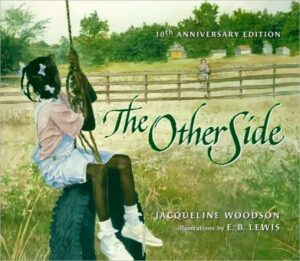 rong” side of the fence, while her new friend, a white girl named Clover, lives on the other side. The fence represented the dividing line between races in reality. Through the innocent eyes of the two young girls, the author emphasizes the power of friendship and the harm of discrimination.
Intro : Synopsis Video
“The Other Side” can be used to teach a wide range of lessons in a K-12 classroom, including language arts, social studies, and social-emotional learning. The book’s empathy, diversity, and inclusion themes make it a valuable resource for teachers and students alike. A lesson developed upon “The Other Side” could have several objectives, including:
- Promoting empathy and understanding: the story highlights the harmful effects of discrimination and segregation. By discussing the experiences of the two girls in the book, students can learn to empathize with others and understand the negative consequences of prejudice.
- Encouraging critical thinking: The book deals with complex themes such as racism, segregation, and friendship. Students can be encouraged to critically analyze and interpret the story to develop their analytical skills.
- Promoting diversity and inclusion: The story celebrates the diversity of the two girls and encourages readers to accept differences. Students can learn to value diversity and promote inclusion in their own lives.
- Develop language skills: The book features vivid descriptions and rich language that can be used to expand students’ vocabulary and improve their reading and writing skills.
To teach “The Other Side” in a K-12 classroom, the lesson can be divided into the following sections:
- Reading aloud section: the teacher can read the book aloud to the class and facilitate a discussion about the story’s themes and characters.
- Writing activity: Students will be asked to write a short essay or reflection on the book’s themes. They will also be encouraged to write a narrative from the perspective of one of the characters.
- Art activity: The book features vivid descriptions that can be used as inspiration for an art activity. Students will create illustrations of scenes from the book or make their own representations of the themes.
- Role-playing: Students will participate in role-playing activities where they act out scenes from the book or engage in dialogue as the characters. This can help them to understand the perspectives of others and build empathy.
- Cross-curricular activity: The book can be used in conjunction with other subjects. For instance, to explore topics such as segregation, civil rights, and diversity, the teacher could reference to history or social studies courses.
One of the key elements of critical literacy, as defined by Paulo Freire and adapted by Ira Shor, is the idea of practical pedagogy, an exercise for decoding and encoding words, which means that critical literacy involves analyzing both texts and the social, cultural, and political context in which they are produced and consumed. By Freire’s explanation, practical pedagogy focuses on writing, reading, and dialogue from generative themes based on student life (Shor, 22). Using the story of two young girls to explore issues of race, segregation, and discrimination, “The Other Side” demonstrated this element of critical literacy since the story highlights the social and political contexts in which the two girls live and how these contexts shape their lives. By presenting a complex and touching story that challenges traditional stereotypes and narratives, “The Other Side” encourages students to think critically about their own biases and prejudices. In this way, “The Other Side” can be used to promote critical literacy by encouraging students to analyze both the text and the world in which it was created. Encouraging them to become more engaged and active citizens who are able to challenge dominant narratives and promote social justice.
Contributor: Joe He