“The Proudest Blue: A Story of Hijab and Family”
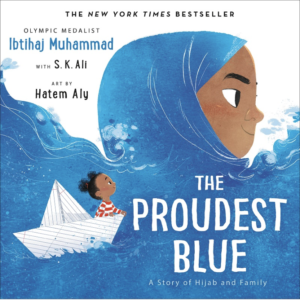
By: Ibtihaj Muhammad with S.K. Ali
Illustrator: Hatem Aly
Why this book?: “The Proudest Blue: A Story of Hijab and Family” is a storybook written by Ibtihaj Muhammad and S.K. Ali. The text shows two sisters before their first day of school. Their mom takes them to the store before the first day of school and the older sister gets her first hijab. The little sister thinks it is beautiful and sees her sister as a princess when she is wearing it. Faizah, the younger sister, is surprised and hurt when others don’t react kindly to the hijab, but together the siblings find ways to be strong and overcome the hurtful words of others. This beautiful story tells a tale of pride in who you are and your culture.
What is its message?: This book would be a great storybook to read aloud to a K-12 classroom. The objective of the lesson would be to learn about a new culture. Not only would this provide inclusion to students who wear a Hijab or have a family member who wears one, but it also teaches students in a non-mainstream way how important it is for them to have pride in themselves. This story demonstrates how students may face hurtful or discriminatory words, but that they can overcome this through connections with their family and their culture. Furthermore, I believe the lesson pushes students who have maybe never seen a Hijab, or don’t know what a Hijab is, to understand what is considered harmful, and that just because something is new to you, doesn’t mean you should criticize it. This teaches students to be more empathetic towards one another.
How would you teach it?: I would introduce this lesson by explaining some key-terms the book uses. I would explain what a Hijab is and give the religious context in which it is used. This could include a lesson about the Muslim region. After, I would read the book to the students, and follow it up with questions. I would ask the students questions like, “Why do you think students said hurtful things about Faizah’s sisters’ Hijab?” “What did Faizah do to move past these comments?” and “What is something you could say to someone if they are wearing something you don’t understand?” Prompting questions like this challenges students to think critically about the readings in class, as well as demonstrates the importance of reading this book.
Reference that collarated to this?: Ira Shor states in her reading on Critical Literacy that “critical literacy is language use that questions the social construction of the self” (Shor, 3). Asking questions about the books prompts students to think about Shor’s definition of Critical Literacy. Questioning why the students in the book said hurtful things, helps students to deconstruct biases that people hold against the Hijab. This is a critical skill that could translate to seeing biases in the other books that they read in class, but also in real life. Having students begin to think critically in class and about classroom texts, will push them to eventually bring this knowledge into the real world.
Work Cited
Shor, I. (1999). What is Critical Literacy? Journal of Pedagogy, Pluralism, and Practice, 1(4), 1–32.
Contributor: Hallie Bachman