In the year 2010, there were 365,000 children on waitlists to attend charter schools across the United States. A poignant documentary that provides a look at the education system in Harlem, New York, The Lottery places a special emphasis on charter schools in New York City School District 5, namely the Harlem Success Academy. We watch as Eric Roachford, Jr., Gregory Goodwine, Jr., Nadiyah Horne, and Christian Yoanson, five-year-old charter school hopefuls, and their parents wait the agonizing two months before “the lottery,” the random drawing of applicants that decides who will attend the Harlem Success Academy and who will attend one of the public schools in District 5. The documentary includes testimonials from a handful of educators and political figures that are prominent individuals in the education system, including Harlem Success Academy founder Eva Moskowitz.
All children are capable of success. Moskowitz and other proponents of charter school education argue that the current system employed in the United States does not provide students with fair and equal learning opportunities. The Lottery illuminates the achievement gap between students of different racial groups, citing the four-year disparity between white and black students: “The average black 12th grader performs as well as the average white 8th grader” (The Lottery 0:02:49) and “58% of black 4th graders are functionally illiterate” (The Lottery 0:03:06). Nevertheless, Moskowitz suggests that students of every race, background, and circumstance can, as her school’s motto suggests, become college graduates. The message is clear: the system is flawed the children are not. Every student deserves a phenomenal education, and if they are allowed one, they can achieve great success.
The overarching debate concerns the benefits and disadvantages of the choice movement and charter schools versus the public school system. The theory depicted in The Lottery on school reform is that public education is subpar and the problems lie with teachers’ inadequacies rather than the shortcomings of students or unsupportive, disinterested parents. Short-lived school reform programs have been implemented in public schools time and time again with unsatisfying results. There is a need to shut down failing public schools, according to filmmakers, and the presence of charter schools in districts with floundering public schools is a way to increase parental choice and student achievement.
Public Hearing. The Lottery (0:30:27)
The film includes shots of every day life in Harlem, endearing clips of teachers engaging their young students, and most powerfully, a public hearing in Harlem full of passionate parents and educators debating what is right for District 5. These scenes are so crucial because they demonstrate the reality of the situation and remind viewers that this is fact not fiction.
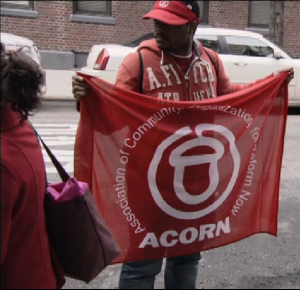
ACORN Protesters. The Lottery (0:26:34)
There is a point of view notably absent from this documentary. The only perspective viewers get on those who disagree with the establishment of charter schools is that of an aggressive, hostile opposition. The documentary paints those who combat the charter school movement as uninformed and irrational. The United Federation of Teachers (UFT) and Association of Community Organizations for Reform Now (ACORN), for example, vehemently oppose the charter school movement. Although ACORN is now defunct, at the time of filming, protesters gathered in the streets of Harlem vilifying the charter school movement and those who encourage it. The Teachers’ Union in New York City is also portrayed in a very negative light. Moskowitz accuses the UFT of utilizing “Godfather tactics” to bully anyone who opposes their views. Due to the size of the union, democratic politicians cannot possibly win elections without its support, making the Union a force to be reckoned with. The Lottery does not adequately provide the audience with an objective look at this side of the debate. The film is borderline propagandistic in favor of charter schools due to its one-sided nature.
Nevertheless, the film is moving. As viewers get to see the personal lives of four Harlem families, emotional attachment to these smiling five-year-olds becomes impossible to avoid. The filmmakers do a wonderful job at showing viewers that, contrary to public belief; parents in failing school districts are not always the problem. In fact, many of these parents are driven to help their children succeed. In an interview with film critic Thelma Adams, director Madeleine Sackler explains, “What gives me the most hope is the reason I made the movie: there are so many parents that are eager for something better” (Adams 1). At the very end of the documentary, viewers are called to action; called to“Mentor Teach Donate Vote” (The Lottery1:16:53), and in that moment you will never have wanted to do that quite so badly.
The Lottery (1:16:53)
Works Cited
Adams, Thelma. “Charter School Controversy: A Q&A With The Lottery Director Madeleine Sackler.” The Huffington Post. Web. 24 Feb. 2013.
“FAQs: Frequently Asked Questions About Charter Schools.” California Charter Schools Association. Web. 24 Feb. 2013.
“An education was something that would help you go very far in life, and something that wouldn’t be taken away from you.”
– Vicki Abeles, director of Race to Nowhere (2010)
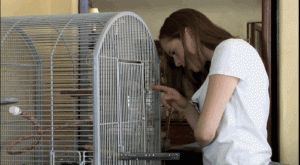
Director Vicki Abeles working with son (Race to Nowhere 4:40).
“Race to Nowhere” is a full-length documentary dedicated to education today. The film took shape when the director Vicki Abeles had learned of her daughters stomach pains being caused by stress. The mother in Abeles took the foreground, and never looked back, as she spoke with students, teachers, and parents coast to coast to try and determine what is to blame for the increase in stress amongst students today, and how our education system could be reconstructed to eliminate such pressures. Through the investigative work of Abeles, it is clear that the outrageous pressures of school, sports, and parents are piling up and invading the childhoods of today’s students, to the point where action is necessary.
In recent years, tests have been the primary measure of educational achievement. Tests are constructed long before lessons are taught, and lessons are therefore often overstuffed with content. This is where teachers feel the need to assign homework, to make up for the content that they are unable to cover in class. Sara Bennett, founder of Stop Homework, believes that the practice of homework can be traced back to the implementation of testing as a measure of success (and the aforementioned cycle) that came as a result of the 1983 publication of A Nation at Risk (Race to Nowhere 27:48). Similar to Bennett, author Diane Ravitch seems to trace the derailment of educational reformation to the same instance. Ravitch writes in The Death and Life of the Great American School System, “Where did education reform go wrong? …But all roads eventually lead back to a major report released in 1983 called A Nation at Risk” (Ravitch 22). Combined with The No Child Left Behind Act, never before have two documents placed such importance on “proficiency”. This can be seen in its mission, as described by President George W. Bush, “The principle behind the No Child Left Behind act is to set high standards, believe every child could learn, and measure to see if were getting results” (Race to Nowhere 28:10). Abeles believes that the words “high standards” and “measure” are where our country went wrong. That is when the whole “Race to Nowhere” went in motion, and the average student lost their place in society.
School as an institution is depicted within the film as a training facility rather than the learning facility that it is supposed to be. One of the film’s main themes is homework, and its effects, or lack thereof. The filmmaker attempts to get the viewer to truly question the purpose of homework with data as well as the use of her own feelings. It is meant to be shocking when Denise Pope of Stanford University gives evidence that suggests there is no correlation between homework and academic success at the elementary school level. When students do become old enough for a correlation to exist, homework eventually loses its effectiveness after about an hour (24:23). The film also made claims that homework times have doubled and tripled over the years. This may be true, but some critics argue that it is misleading. Some say that the numbers Ableles chose to use were too low (8 minutes a night in 1981 as compared to 22 in 2003, though the number is tripled, 16 minutes is not as provoking as the term tripled), therefore deeming the fact insignificant. Abeles described her own daughter as “a duck trying to paddle as quickly as she could to keep her head above water” as she continues her educational journey (24:10). Either way, that is not how I would like my child to appear to me at any time, ever. An AP Biology teacher tells of his recent decision to modify his students workload, “When you cut homework in half and AP scores improve, then what’s the value of the homework” (26:20). It seems that Abeles holds homework partly accountable for the fullness of her daughter’s daily schedule, and homework isn’t nearly as important as it was believed to be.
Another aspect that the filmmaker examines is how sports have grew less innocent. One story told is that of Sam, a high school wrestler. He describes how pressure can come from competition between the sport and the school. “The school is like you’re dedicating your whole life to your grades, and then the sport is like no you’re dedicating you’re whole life to me” (22:30). This is becoming common throughout the country, with athletics and academics fighting for the top spot in teenagers’ lives. For some, athletics have helped obtain an education. It also can be dangerous however, as in Sam’s case, where the pressures eventually grew too large and caused him to drop out. Balance is what our generation is missing, and Abeles makes that clear by including that pressure also comes from things that are thought to relieve it, such as sports.
The same can be said for the role of parents. Traditionally parents are viewed as a source of comfort, care and protection. But today, those qualities seem buried under a long list of achievements that a parent has for their child. Within the film is a clip from a forum on stress in a high school in Concord, CA. A young lady tells how the worst question parents are asking is “And?” The “and”, literally meaning “what else” or “that’s it”, sends a message to the child that what they’re doing isn’t enough in terms of AP Classes, sports teams, clubs and community service. Coming from the mouth of a young student, Abeles wants viewers to become aware of the fact that our generation has set such a high standard for everything, to the point in which everything is a competition. Our lives might as well be a race to nowhere. Darrick Smith, an Oakland teacher, claims that the process is actually “dehumanizing” (7:08). It is sickening to hear of the students who associate the feelings of rejection or failure with death. Furthermore, it is literally deadly, as evident in the disturbing examples of students who chose to escape all of the tumultuous pressures via suicide. Abeles actually dedicated the film to Devon Marvin, a friend of her daughter’s who tragically took her own life. There is no reason a child should ever have to live under such stress, yet it seems to becoming more common.
Race To Nowhere is a film that focuses on the student of today, and how he/she is pressured for success inside the classroom, as well as outside of it. It has captivated many Americans, and Abeles continues show the film off as well as host discussions afterwards for those interested (I found this pretty cool, that she comes to most of the screenings for discussion). It examines how the education policy of meeting proficiencies has actually had a negative affect, how students feel pressured to cheat just in order to pass, and how teachers fix scores in order to secure their job. Abeles tells of places that are trying to find that balance, like her son’s school that encourages days of no homework, and the success that has come of it. But she is careful to remind us, “There is no best anything, it is a match between children” (55:20). A film worth watching, it attempts to bring attention to the issue of stress among students in a numbers driven society, what the filmmakers believe to be primarily responsible for said stress, and how to combat the stress for many reasons, most importantly the health and futures of today’s students. Director Vicki Abeles seems to be urging parents to become involved before its too late.
Works Cited
Race to Nowhere. Dir. Vicki Abeles. Reel Link Films, 2010. Web.
Ravitch, Diane. The Death and Life of the Great American School System: How Testing
and Choice Are Undermining Education. New York: Basic, 2010. Print.
The film, Race to Nowhere, directed by Vicki Abeles, presented a take on education and the role of the family in schools that I had never been exposed to. Abeles uses her film to highlight the extensive pressures and demands that students are facing in America’s schools. She sets the tone for the film in the opening scene where we see students sharing the troubles they experience in schooling; this culminates with Abeles asking the question, “How come no one is insisting that it change?” This question is imperative to the main premise of this film. Abeles wanted to use this film to challenge the traditional notion of how schools function, the role of the family in education and to show how the emphasis on creating perfect students detracts from creating well-rounded citizens, and strays away from socializing the “whole” child. Abeles, who was formerly a Wall Street Lawyer, became a filmmaker after she noticed that her own children “began complaining of homework-induced headaches and test anxiety…” [The scenes I felt were the most critical to the film will be discussed in no particular order, but will include time stamps and screenshots.]
Understanding the pressures that students face are important in shaping the pedagogical processes that schools undertake to create good students. When students are constantly being pushed to not only do well in school, but to get straight A’s, look good for college and meet the high expectations set by their families, they are becoming what was described in the film as “little professionals,” that is, children who are performing to meet the high standards of the school but are taking on more than they can necessarily handle. One child described these pressures as the “and” factor. She articulates the idea that students are faced with having to do homework AND do well on that homework AND attend sports practice before doing homework AND volunteer in their community AND pay attention in school AND get good grades. The idea of the “and” factor is startling because of the problems that it presents. Students may constantly feel that they aren’t meeting someone’s standards, whether it is a parent, a coach, or a teacher, etc., because they are so preoccupied.
[Race to Nowhere]00:15:04
The scene that occurs at [00:15:04] when a young woman is describing her experience as a high-performing student while she was on the private school track was interesting to consider. The young woman, throughout her school career had to try to appease her teachers, parents and others who would constantly reinforce to her that they were placing such pressures on her in her best interest, when in fact, it was not. The young woman experienced bouts of depression, emotional breakdowns and a stint with anorexia that led her to be hospitalized. The pressures of schooling were so great on her that she left the private school track to pursue a GED and a High School equivalency certification. This scene was important to this narrative because of the tremendous pressures that so many students face. They find taking stimulants such as Adderall to be acceptable because it will help them stay awake to finish more work and “keep up with everyone else…” According to Darrick Smith, a teacher in Oakland, for those students who experience the tremendous pressures inside and out of the classroom, the schooling experience is “no longer about learning” and more so about trying to stay afloat.
After reading Diane Ravitch and analyzing her critique on the 1983 Nation at Risk report and NCLB legislation, I was fascinated when the film mentioned these important policies. In a scene where experts were analyzing the effects of homework, and how countries that outperform the U.S. in education give less homework, it was interesting to see where Nation at Risk and NCLB fit in. The filmmakers highlighted that increase in homework in schools began in 1983 and shot up again in 2002. The critique that the film presented was that of the ineffectiveness of said policies, which leads me to believe that Abeles may agree in some ways with Ravitch’s stance. A focus on measures that did not work, less funding for schools and teachers receiving bonuses for higher test scores vilified these policies as a rough time in American Education. The case against homework that the film presented was that homework was often ineffectual as a gauge of students’ understanding. If parents edit or do their child’s homework for them because a child is constantly frustrated by their own misunderstandings or feel that they just can’t do it, then homework is not doing what it is intended to do: reinforce what is learned in the classroom outside of the classroom for a more comprehensive understanding of the material. (Interestingly, the AP teacher who cut his Biology class’s homework in half and saw a rise in AP scores gives credence to the idea of less homework and more intensive and meaningful in-class interactions as an alternative and successful model.)
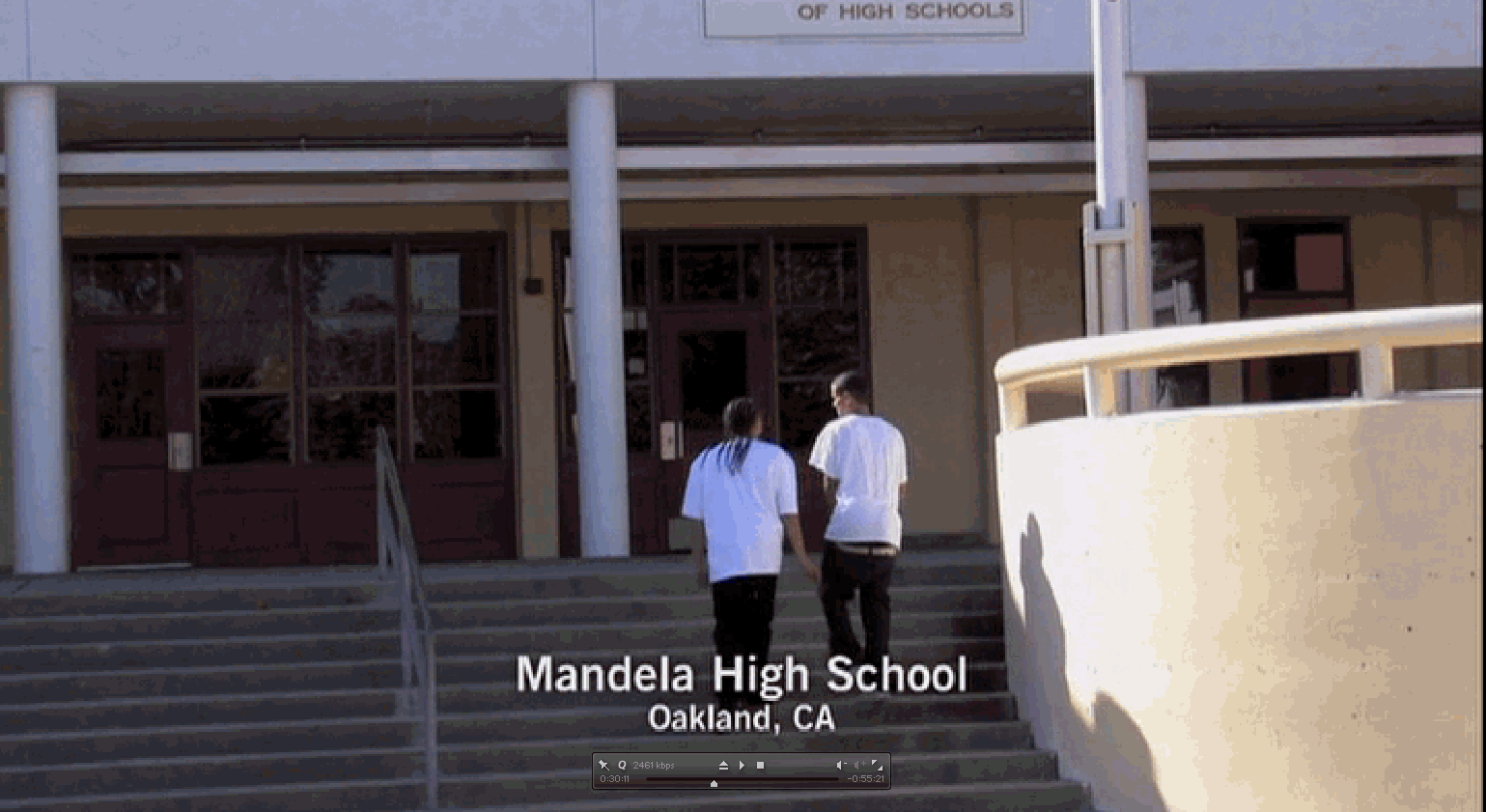
[Race to Nowhere]00:30:11In what I believe to be one of the most important scenes of the film, which starts at [00:30:11] we are introduced to Emma Batten-Bowman, a former English teacher at Mandela High School in Oakland, California. Ms. Batten-Bowman describes her desire to inspire her students in the classroom. She believed in the idea of meritocracy and that by teaching her students to work hard she could use education as a method to move students out of the socio-economic strata which they occupy. Her educational philosophy of “changing kids’ lives” and “learning as power” was combated by competing educational philosophies – the pressures and expectations set by the local school district. She said that the educational philosophy that she was trying to instill into her students was “not what the district wants you to do…” and she resigned. In this scene, and many others, the filmmakers educe a deeply emotional response from the viewers because of the deeply personal and emotional display that the teachers, parents and others display throughout the film. The appeal to emotion is used a method to gain support for the film.
In a similar type of scene in the film, when the parents of Devon, a bright young woman who took her own life because of the tremendous pressures she felt, viewers are forced to sympathize with the loss of the parents and to reflect on whether the models of education that are currently in place are actually worth the pressures that they inflict on children. [00:71:00]
[Race to Nowhere]00:71:00Devon’s parents described her as a bright young girl who was facing great internal pressure from an algebra class that she was enrolled in. She went from having a 100% average to failing a math test and could not cope with the consequences of performing below what she considered for her entire life to be “normal.” Parents who are watching the film will begin to seriously question their own children’s academic success and the pressures they are under. They may side with the filmmaker’s views about these pressures, and believe that the schools are “robbing children of their childhood…” because of the deep personal and emotional response that the film evokes from its viewers. I began to wonder about how families who have viewed the film reflected on the pressures that they impose on their children.
Another important scene in this film was at [00:42:00] when the shift focused from pressures of schooling to implications of those pressures – specifically, cheating in school. Danielle, a twelfth grader at Acalanes High School in Lafayette, California describes her experience, “Cheating has become another course. You learn how to do it from 9th-12thgrade and you just get better at it…” The film goes on to describe cheating as a result of too much work, greater pressures and/or teachers who do not care. Another student described her own cheating as a result of having “no room to make mistakes” in the classroom.
[Race to Nowhere]00:42:00The film’s focus on the pressures experienced by high performing students and the problems they face provides an inherent critique of the traditional school model. The idea of students spending more time on homework is not held in high regard, albeit levels of homework increase, should they move along in their educational careers. Furthermore, the emphasis on play and “kids not being allowed to find what they love to do” seems to be exaggerated. It is unlikely that children in public schools and elsewhere have absolutely no downtime and are constantly engaged in some sort of academic endeavor; school districts in the country are constantly trying to implement new and non-traditional methods in schools that create an experience that children find exciting, new and interesting. The pressures that students face are real, but it seems that the sample that Abeles surveys for the film is smaller and not representative of the problems and successes of many communities of educators and students across the nation. The film vilifies teachers and school administrators as not being able to relate to the families that they service. The film provides important insight into the changing role of the family but does not touch on the impact that the families have on schools. If parents see that a child is having a problem with homework for example and would rather blame the school or teachers (and advocate for less homework) than work in collaboration with the school to find a solution (such as supplementary or enrichment activities or special help), then the model of families as integral to the school community is null.
The companion website for Race to Nowhere encourages supporters to speak up and share opinions about policy decisions and to write to policy makers about them. Below is a sample template for a letter that parents can send to the superintendent of their district (that I downloaded directly from the companion website under the tab: advocacy tools) about their concerns:
Dear Superintendent:
I want to thank the district for making a showing of the movie “Race to Nowhere” available to our community. This is an important reflection of our education system and one worth considering in our school district. While our school district has many innovative education practices that represent best practices in the field of education, the movie made quite obvious one way we fall short is in our homework policies.
It is so frustrating for me as a parent of a [fourth] grader to realize that, according to most available research, all the time my child has spent doing homework has most likely not benefited her. This seems like a tragic waste of her time, her teacher’s time and our family time. After seeing the film, I looked at some of the research available about the value of homework. Harris Cooper, the researcher who suggested the 10 min. per grade policy, actually found that homework is of no benefit to grade schooler’s learning but, in fact, recommends this policy with no data to back it up. He simply states this policy in his conclusion as an opinion and adds that it might help children’s independent study habits. It doesn’t. No available research has found this. In fact, the only kind of learning that homework seems to be good for is short-term fact-cramming like spelling tests. This benefit is lost over time though, because after a few weeks children test at the same level as before studying. There does, however, seem to be a benefit to children reading at home. Tragically, this is the one thing children do not get to do because the homework takes up too much of their time.
All of my daughter’s teachers took and take great pains to make sure the homework they assign is for the most part relevant and of high quality. The sad truth is that their time and attention are wasted. Quality in elementary school has nothing to do with it. Elementary school children simply do not benefit from homework.
I was particularly disheartened to see how the middle school is assessing its homework load by asking parents’ opinions. Why can’t we look at what is actually beneficial for students? Research suggests it’s about 1 hour a night. Beyond that, the benefit falls off rapidly and we run the risk of sleep deprivation, burnout and lack of engagement for our students.
Children spend a long time in school every day and they need their time outside of school to benefit from the opportunities that unstructured time allows their development. This cannot be overstated. Earlier this year, I attended a PTSA meeting at _______________________________________ where students spoke about the academic climate in response to a speaker.
The speaker’s message was not popular among the students present at the meeting and one student stated that she didn’t want or need any free time. If she wasn’t doing homework, she said, she would just waste her time or get into trouble. Is this really what we want? Children who don’t know what to do with themselves with free time? Children who claim they are not feeling the stress but when asked about their friends, described depression, anxiety, stimulant use and coming to school sick having gotten no sleep?
Achievement takes tenacity and sometimes sacrifice but in the case of our elementary school’s and our middle school’s homework policies, we are asking for the sacrifice of children’s, teacher’s, and families’ time for no benefit. And, I would suggest, to the great harm of children. We as a district must take this research seriously and create expectations for our children’s education that are results-oriented, not opinion-oriented, and homework is not part of that picture in elementary school.
Please do the right thing by the children of our community.
Sincerely,
[your name]
* Contributed by a San Francisco Bay Area parent following a screening of the film, “Race to Nowhere
This letter was fascinating because it implies that policymakers in school districts are simply wrong and that they do not know what they are doing. From an administrative perspective, it would be of greater concern to me that parents are trying to influence policy instead of working with the district to achieve the set of goals of the school that they have decided to enroll their children in.
It shows a lack of faith in the district and suggests that parents know more about what works in education policy than those running the school district, which sets a dangerous precedent for parents who watch this film – the filmmakers are suggesting for parents to go against the grain and challenge the schools rather than cooperate with them to find a solution to the problems they are faced with. The filmmakers seem to stress the “I know what’s best for my child” model of education reform which does not take into account the continuous research that districts undertake as they try to make their schools better for students; rather, it places an emphasis on schools as the problem and encourages parents to go above the heads of the schools administration and teachers by advocating for policy changes – which seems to be a grandiose solution to a local problem. The schools are thus put on the backburner and disregarded as sites of reform. The emphasis is placed on administrative control rather than local control and makes schools out to be incapable of handling student issues and parent concerns.
The Lottery is a compelling and thought-provoking documentary directed by Madeleine Sackler. It came out in 2010 and since then has generated a large amount of controversy and debate. The film follows four families from the Harlem and Bronx who have entered their child in the charter school lottery. The charter school that is highlighted is the Harlem Success Academy, which has gained recognition in the New York City area due to its impressive results. Charter schools must be tuition-free and accept children based on a lottery system to ensure that everyone has an equal chance of being admitted. Harlem Success Academy has two schools (named one and two, respectively), but because of a limited number of seats many more children miss out on receiving this unique charter-school experience. The Lottery begins by introducing these four children and their families, and then segues into the work of Eva Moskowitz, the founder of the Harlem Success Academy, as she attempts to expand the Academy into more low-income communities and the challenges she faces while doing so. The film also goes into detail about the strained relationship between teacher unions and charter schools, as well as those who are against allowing charter-schools to be a publicly funded alternative to traditional district public schools. There are many interesting interviews with charter-school advocates and employees of district schools.
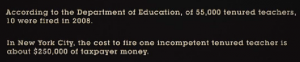
The overarching theme of The Lottery is the importance of equal education for all children, regardless of race or socioeconomic status. The film highlights the substantial achievement gap between African American children and white, upper to middle class, children. It is clear that Sackler created this documentary to expose the problems that exist within public schools systems and the strict regulations that they are force to follow. It is fervently against teachers’ unions, and portrays them as one of the major obstacles holding back student achievement on all levels. One particularly compelling moment in the film begins at 20.15, when then union president Randi Weingarten is interviewed on Charlie Rose. When asked if the statistic that out of 55,000 teachers working in the education sector, only 10 were fired, is true, she denied it on all accounts. There was a clear disconnect between the interviewer and Weingarten, which was highlighted by Sackler’s directive touch. After the short segment, the screen shifted to black and was filled by the words, “According to the Department of Education, of 55,000 tenured teachers, 10 were fired in 2008” (The Lottery 20.33), which directly contradicted what Weingarten said moments earlier. This was a powerful part of the film, and cemented it in a clearly anti-union light.
Randi Weingarten, President of the teachers' union, is interviewed (The Lottery 20.15).
Moskowitz is portrayed as the clear protagonist amongst many other people that come in and out of the film advocating for charter schools. The obstacles she faces as the leader of the charter school movement are carefully depicted throughout the film. At 29.44, a segment begins with Moskowitz speaking at a public hearing in order to try and move Harlem Success Academy 2 into the space of PS 194, which had recently shutdown and labeled due to its failing status. She is attacked by several community members who do not want a charter school to move into the neighborhood, as well as local politicians who question whether she is actually a resident of Harlem. Sackler carefully constructs this segment to portray Moskowitz as the victim who is confronted by challenge after challenge, all because she wants to implement a school that educates students no matter what the circumstances are.
There is no doubt that The Lottery is extremely one-sided in its take on the hype surrounding charter schools. It is opinionated and conveys the message that the underlying solution to the problems facing education is charter school implementation. The film’s final plea to its audience is to support great schools in the community, and to Sackler great schools come in the form of charter schools. One of the most profound quotes within the film that illuminates the importance of charter schools comes at 46.37 when Cory Booker, elected mayor of Newark, New Jersey, states that we should “make time the variable and achievement the constant,” (The Lottery) as charter schools do with their lengthened school day and year. The Lottery is uplifting in the sense that it provides a promising solution to public school education and establishes a clear villain—teachers’ unions. However, this biased approach naturally leaves several holes in the documentary and omits other possible solutions or problems that contribute to the large achievement gap and low graduation rates within inner-city schools.
The film fails to mention the negative results of charter schools, or what the possible effects of planting a charter school in the middle of a traditional neighborhood could be on the surrounding community. The problems that having a lottery system that admits students and essentially determines their academic success is problematic as well, and a theme the film only briefly mentions. The portrayal of the union as the enemy is also complex. Though the limited evidence the film brings up is interesting and undeniably supports charter school implementation, there are other issues that contribute to failing public schools. Insufficient funds, unsatisfactory teachers, and larger policy-related issues are not addressed, as William Tate addresses in his review of the film. He states that, “While no studies are presented in the documentary, there are plenty of descriptive statistics tossed about” (Tate 2). There is a lack of research and studies that support Sackler’s claims, and while testimonies are incredibly moving, it is easy to see how The Lottery generated so much debate when it was first shown. The depiction of the Harlem Success Academy is unbalanced, and we are shown very little of the success or results of these charter schools compared to their district counterparts.
Works Cited:
Tate, William. Rev. of The Lottery, directed by Madeleine Sackler. Web. 2 Feb. 2013
The Lottery. Dir. Madeleine Sackler. Great Curve Films, 2010. Online.
“The Lottery”is a documentary that follows four different families with the focus on four children, Eric Jr., Greg Jr., Christian, and Ameenah. Through the lens of these children, the film tracks their hopes of being admitted into a local charter school Harlem Success Academy through luck of the lottery. The film presents the knowledge of these individual children as well as the parents desires to send their children to an excellent school, which they believe is Harlem Success. It intertwines these personal stories with interviews that demonstrate the benefits of charter schools as well as the debate and controversy surrounding charter schools.
A movie review by the New York Times, highly criticizes the film “The Lottery”. In fact, the review critiques, “With a little tweaking “The Lottery” would fit nicely into the marketing materials for the Harlem Success Academy”.[1] The review continues to group this documentary with others such as “Cartel” for advocating for charter schools. However, unlike some other documentaries like “Cartel”, “The Lottery” pulls at the heartstrings of the viewer, hoping to convince people that more charter schools are needed.
In concordance with the New York Times review of the movie, the filmmaker makes very little effort to hide the support of charter schools. The movie comments on the ever-pressing achievement gap between white students and black students as well as the achievement of white students and Hispanic students. Without blatantly or directly stating that charter schools will fix this issue, the film actually comments on the importance of a good school, the value of motivated teachers, and the influence of parenting and the family life on a student’s performance. The filmmaker obviously believes that a good school consists of engaged teachers who can stimulate their students, while also having a strong support system of the family. In fact, the movie even states that it is not the children who fail the system, but rather it is the system that fails the children because all children are capable of learning.
The film also addresses some of the problems that public schools face. Through an interview of a principal at a local public school in Harlem, the bureaucracy that “saddles” the public school system, as Eva Moskowitz calls it, is presented. However, the film is making an attempt to not be completely biased by getting her opinion. Furthermore, Ms. Moskowitz comments on the issue with teachers unions and tenure. She argues that public schools have difficulty firing teachers that are not qualified or good teachers while at the same time insinuates that Harlem Success Academy is so successful because they can fire poor teachers without the bureaucratic process.
"The Lottery" - 0:20:49
The filmmaker uses a taped interview with Charlie Rose and the speaker for the Teachers Union as well as statistics to drive this point home.[2]
A direct consequence of the Teachers Union that Ms. Moskowitz argues against is that it prevents the collaboration of teachers, principals, and other people of authority such as herself to improve their teaching skills. In order to be able to participate in this engagement of collaboration though, Ms. Moskowitz feels it is necessary to be able to observe the teachers in their classroom, especially unannounced. However, public schools do not have that privilege because the Teachers Union prevents unannounced observations of teachers.
Continuing with the theme of playing on the emotions of the viewers, the principal of the Harlem Success Academy speaks of the public school where he formerly worked. To add to the dramatics, the principal tears up while he speaks of the poor conditions of the school and as a result the system failing the children he taught.
"The Lottery" - 0:26:28
To contrast all the promotion for charter schools, the film interviews the members of ACORN who were outsourced by the Teachers Union to help rally against Harlem Success Academy 2 take over the building of a current public school in Harlem.[3]
"The Lottery" - 0:32:58
Furthermore, the film shows part of a “space hearing” that was held in regards to Harlem Success Academy 2 replacing the local public school. Some of the mothers and families of the children who attend the local neighborhood public school feel very passionately against shutting down the public school and replacing it with a charter school. [4] The argument against the Harlem Success Academy 2 is not necessarily an argument about public school v. charter school but rather it is not necessary to close the neighborhood pubic school in order to create a new charter school.
However, it quickly moves back to appealing to people’s hearts with the scene of Greg Jr. going to visit his dad at the correctional facility.
"The Lottery" 0:42:09
Through segments of an interview with Greg Sr., the father of Greg Jr., he comments on the importance of education and how it may have prevented him from being where he is today. [5] He also reflects on the motto of the Harlem Success Academy of telling the children that their goal is to be a college graduate and says, that in his entire life he has never been told that, which is a powerful thing.
The interview with Greg Sr. is paired with an interview of a Harlem Success parent, Karl Willingham, who speaks of the greatness of the charter school. He says, “Do you remember when you were a child and you wanted to be an astronaut or a scientist or president of the United States and you couldn’t because no one taught you which direction to go to get there. So wanting to be an astronaut seemed as far away as the moon which, um, its really no that far but no one told you that and you just don’t want to see anyone else miss out because no one told them they could have it”.[6] This scene is very powerful because its asking a parent if they want to take away the dreams of their children, while also insinuating that charter schools are the way to put them on the path to the dreams because the public schools will fail them.
"The Lottery" 1:11:44
The last scene of the movie before recapping what the future holds for each child that they followed it the actual lottery. It is not possible to not tear up during this scene unless you are heartless and do not want any child to have a future. [7] That’s the power of the film, it convinces the audience that these kids will not have a future by going through the local public school system, they need to attend a charter school in order to achieve success in their life. The excitement expressed by the mother of Ameenah is relief and hope and confidence all raveled into one that her daughter will now have the best life possible for her because she will be attending Harlem Success Academy.
The film obviously advocates for the education reform movement of choice through the creation of charter schools. Besides addressing the flaw of charter schools taking the place of neighborhood public schools, the film fails to address any other flaws of the charter schools. For instance, it never addresses any of the statistics that state charter schools are not always more successful than the local public school. However, the film does do a rather impressive job of addressing the perspective of the children, the parents, the teachers, the members of the Teachers Union, and the principals. On the other hand, most of these people are advocates for charter schools.
Prompt: How do you find reviews and essays about video documentaries? Describe your search strategy and cite the 5 most thoughtful reviews or background essays on a designated video documentary. Your search results may include scholarly and/or popular press, but do your best not to include those featured on the film’s companion site. (Hint: the goal of this question is to help your classmates identify thoughtful sources that do not necessarily agree with the policy stance taken by the film.) Add a brief explanation for why you recommended each of the five sources you selected.
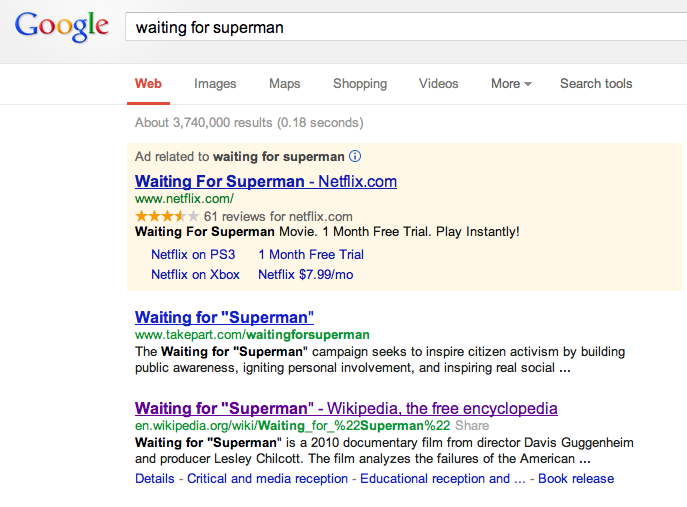
When starting my source detective question the first thing I did was go to the Google search bar and typed in what I was trying to find; in that case the film Waiting for Superman. Initially the first thing that popped up was the movie’s website. Before watching a movie I’d like to do some prior reading so the Wikipedia link is my first instinct to click on. The reason why Wikipedia is actually a useful source is because it can be edited, therefor is always relevant, and anyone can contribute whether biased or unbiased. The Wikipedia source helped me have a brief understanding of what the film is about.
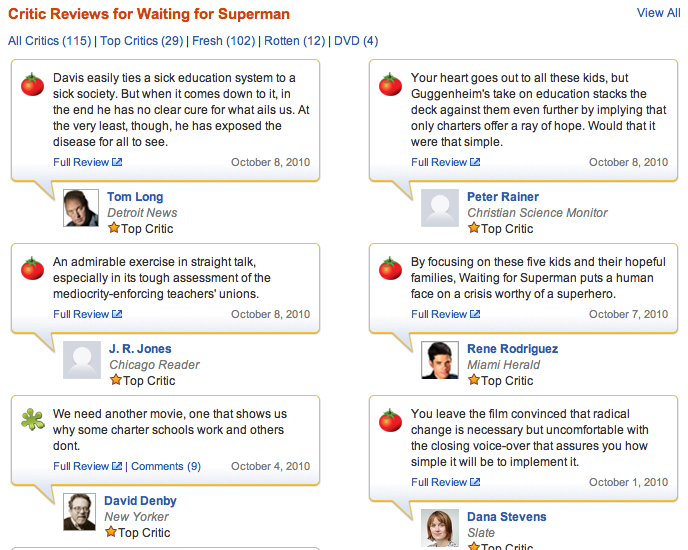
But then, I wanted to see some actual clips of the movie, maybe the trailer. YouTube gave a quick 2 minute trailer showing the emotion and almost the drama that a Wikipedia article cannot show. Although it is biased in the film’s favor, it gives the future viewers what to expect when watching. However the trailer only gives a single perspective. Rotten Tomatoes gives the perspective of nearly 17,000 raters and 114 critics. Seeing that the average rate was a 4/5 stars I figured that the audiences felt touch in what they were watching. The comments ranged from those who had similar experiences while in school to actual teachers totally agreeing with the message of the film.
However out of the 114 critics, there were 12 who considered the movie to be “rotten” and they expressed how some of these teaching strategies don’t work or how the director did a poor job not portraying the obstacles students faced outside of school that led to failing performances in school. Overall Rotten Tomatoes was a great source for me because it shows the good and the bad. Not to mention it being number 5 out of 3,540,000 search results on Google.
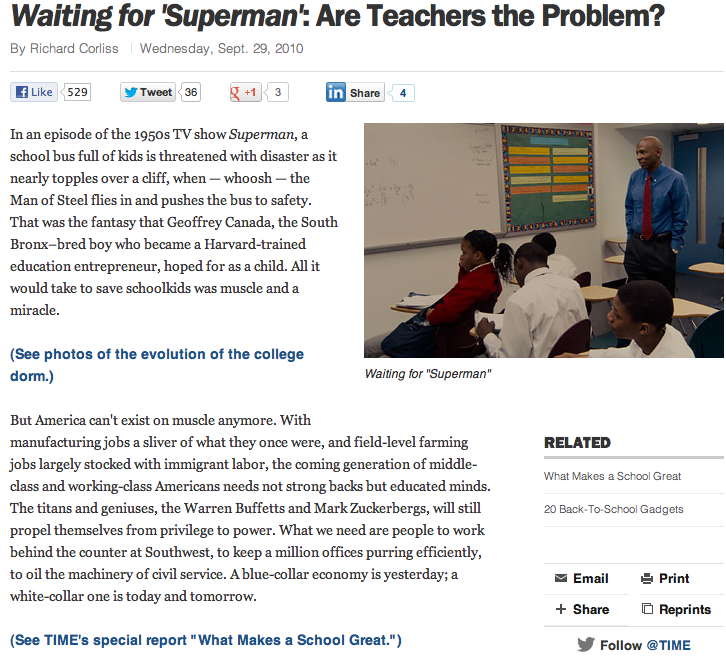
After unsuccessful attempts on JStor and the Trinity library data base searching for essays, I went back to Google. I spotted a Time Magazine link and knew Time likes to write up these “heroic” articles in order to give a normal person praise. In this example it was Geoffrey Canada and Michelle Rhee, two ordinary teachers who cared about the lives of children rather than their own salary. According to Time, these are the types of people that we need in the education system to “save our schools”. I feel that the purpose of a Time article is to help turn regular people into heroes, unlike the simple essay done by a college professor. In my opinion they do a good job because they depict these people as “tough sheriffs brought in to clean up a bad town”.
Scrolling down allowed me to find an article called NOT Waiting for Superman so I clicked on it in a heartbeat. This article is basically stating that the film is like a fairy tale, misleading everyone who is watching. I found it to be comical because it’s saying the steps that are being made to improve public schools: getting rid of “bad teachers”, firing principals, and bringing in new charter school teachers will not work and will end up hurting public schools. This alternative article attracts a bunch of commenters, most who are teachers who agree that the teachers cannot control a situation outside of school that is causing their students to fail and the “charter school solution” is not the way. This source helped me see the negative side of the film.
I was finished with Google and I wanted to check out what the Hartford Courant had to say. One of the first articles that popped up was one by Diane Ravitch. Since I had been reading her book The Death and Life of the Great American School System I was fascinated to see what she had to say. I liked this article because she gave a lot of statistics about state test scores which the other sources don’t give. Rather than being so much of a critic about the film, Ravitch gives out useful facts that can help an audience understand how students are actually performing in the schools that are failing and charter schools will help pan out the future of failing students.
Corliss, Richard. “Waiting for ‘Superman’: Are Teachers the Problem?” Time Magazine. N.p., 29 Sept. 2010. Web. 22 Feb. http://www.time.com/time/arts/article/0,8599,2021951,00.html
Karp, Stan. “We’re NOT “Waiting for Superman” .” famfamfam, 20 Sept. 2010. Web. 22 Feb. http://www.notwaitingforsuperman.org/Articles/20100920-RSEditorsNotWaiting
Ravitch, Diane. “The Myth of Charter Schools.” New York Review of Books, 10 Nov. 2010. Web. 22 Feb. http://lea-in.org/wordpress/wp-content/uploads/2010/11/The-Myth-of-Charter-Schools-by-Diane-Ravitch.pdf
For my source detective posting, I was posed with the question of finding reviews of the educational documentary “Race to Nowhere”. Initially, I read the ones found on the official “Race to Nowhere” site and found that they were all in praise of the documentary. While personally I found the movie incredibly movie, this seemed too one-sided. Upon further research, I found that many of the other reviews found the movie overly dramatic and meant to incite panic about the national education problems.
Trip Gabriel’s review of the documentary focuses on the positive effects the documentary may have yet does so without attempting to “sell” the movie out to the public. Coming from The New York times, I initially felt it would be a very objective and credible review. With further reading, I found that the greatest element of credible research he comes away with is the fact that the documentary achieved national recognition without a major ad campaign or large-scale distribution. The fact that the movie didn’t need to self-sell itself and still was adopted as credible on a national scale demonstrates it’s incredible impact.
Another positive review I found was Cynthia Joyce’s review from NBC news. The reason I chose this one was because rather than focusing on the recognition the documentary gained in the country, she focused on the message. She does mention the enthusiasm students and others had for seeing and taking about the documentary. However while doing so, she created a clear picture of the goal of the documentary: to raise awareness about the race toward “over-credentialism” and the effects of the pressure it creates.
After finding two very positive review of the documentary, I searched for a contrasting view. Jay Mathews of The Washington Post provides a very overt critique of the inaccuracies of the documentary. The focus of his critique is on the fact that the documentary doesn’t focus enough on the actual facts of the issue and rather the places a focus on the emotional problems that take place. While this may be true, the view may be short sighted because the issue of schooling can’t be analyzed purely by facts. The product that is researched when concerned with education is a child so the emotional problems that are being caused are as much a “fact” as any other statistic.
As another negative review, John Merrow highlights the narrow scope of the documentary. His critique is mainly focused on the fact that the movie demonstrates many aspects of schooling that are detrimental to the child yet it waits until the very end of the movie to show any sort of alternative schooling which, as we know, is a major portion of the national education spectrum. This review is the only negative one that I feel has merit. While I found the movie compelling and incredibly moving, I did get the feeling that it was attempting to be a scare tactic. This review shows the method in which it did so. He does spend a large portion of the article comparing “Race to Nowhere” to “Waiting for Superman” which isn’t as helpful when looking solely at this documentary. However, his critique remains accurate and thoughtful.
One thing I found when looking for reviews that weren’t listed on the official “Race to Nowhere” site is that many people adopted overly positive reviews. While the basis for the source detective post is to only post reviews that are helpful in finding objective and accurate reviews of the source, I feel that the number of dramatized and “over-kill” style review were overwhelming. For this reason I included the last of these five reviews. Ella Taylor’s review of “Race to Nowhere” is an example of the tendency to get swept up in the emotional component of the documentary and not fully analyze it. This review merely summarizes and even at times embellished the message of the movie rather than effectively convey the message to the audience.
Reviews:
Gabriel, Trip. “Parents Embrace Documentary on Pressures of School.” The New York Times. N.p., 8 Dec. 2010. Web. 20 Feb. 2013.
Joyce, Cynthia. “‘Race to Nowhere’ Targets Academic Pressures.” NBC News. N.p., 3 Aug. 2011. Web. 20 Feb. 2013. <http://www.nbcnews.com/id/41744061/ns/nightly_news/#.USgFO1qY584>.
Mathews, Jay. “Why ‘Race to Nowhere’ Documentary Is Wrong.” The Washington Post. N.p., 4 Mar. 2011. Web. 20 Feb. 2013.
Merrow, John. “‘Race to Nowhere:’ It’s No ‘Waiting for ‘Superman’, ‘ but It’s Honest.”The Huffington Post. N.p., 10 June 2010. Web. 20 Feb. 2013.
Taylor, Ella. “Mom’s Mad as Hell and Not Gonna Take It Anymore in Education Doc Race to Nowhere.” The Village Voice. N.p., 8 Sept. 2010. Web. 20 Feb. 2013.
How do you find reviews and essays about video documentaries? Describe your search strategy and cite the 5 most thoughtful reviews or background essays on a designated video documentary. Your search results may include scholarly and/or popular press, but do your best not to include those featured on the film’s companion site. (Hint: the goal of this question is to help your classmates identify thoughtful sources that do not necessarily agree with the policy stance taken by the film.) Add a brief explanation for why you recommended each of the five sources you selected
I have been anxiously awaiting being assigned my Source Detective[1] question. The format of this assignment has had me imagining myself as a cross between Sherlock Holmes and Harriet the Spy scouring various resources, following the clues and sharpening my “information literacy skills”.
I was assigned question #10 with my designated video documentary being, The Lottery (2010) by Madeleine Sackler. With that said I put on my best deerstalker hat[2] and began my search. I started at the International Movie Data Base website (IMDB) http://www.imdb.com/[3]. I started here because this is not the movie which I will be watching for class and I wanted to have an idea of the storyline, cast, previous work by the director, etc… IMDB is probably one of the main apps I rely on in life. I’m not quite sure what I did before it.
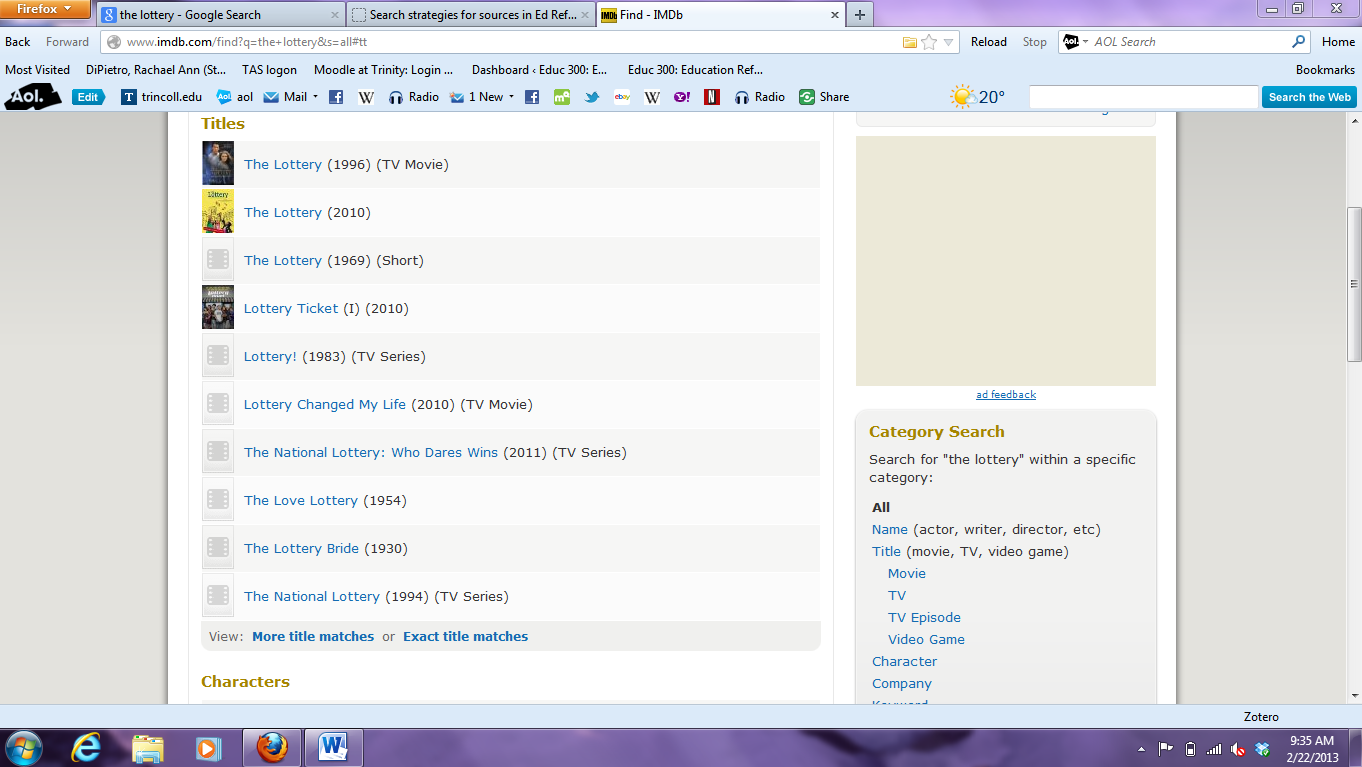
**At this juncture I would like to insert a little helpful tip borne out of personal experience. When undertaking any kind of search it is imperative to make sure your results are for the correct item! In my initial IMDB search I came across two other movies named The Lottery. One stars Keri Russell and debuted in 1996 and the other is a short horror film made in 1969.
This is a good general rule to follow, and while it seems like common sense it’s worth repeating. In all subsequent searches I made sure to include the director, Madeleine Sackler’s name when possible. Moment of truth, in the world we live in it’s easy to assume to the first result you get is the best result. Last semester when ordering books on-line at Amazon I only entered the titles of books- needless to say, there were two books called “Freedom Summer”; one of which I needed for my class, and the other was a children’s book. I ordered the children’s book. Paying attention to the result is important! **
Now back to the task at hand. So at this stage of my search I know I need to be very specific when searching for reviews and thoughtful background on my film as there are other films with the same name. I also know an overview of what my film is about which can help me discern which reviews are touting this documentary and which are taking an oppositional stance. I also have the link to the website for the film, as this was posted on the assignment page.
I proceeded to check out the official website for the documentary, http://thelotteryfilm.com/[4]. I did this so I could compile a quick list of the 23 sources cited on the film’s companion site as part of the assignment urged us to find something not featured there.
Armed with all this information I made my way over to LexisNexis and searched for The Lottery by Madeleine Sackler in all Major World Publications. This search retrieved 25 results. With two windows open, my results page on the left and the list from the companion site on the right I began to go through the results avoiding those on the companion site.
What I started to notice as I went through the articles on LexisNexis is that many of them were articles jointly reviewing my assigned documentary, The Cartel (2009) and Waiting for Superman (2010). These three films came out in a relatively short span of time, share a similar subject matter and therefore seem to be spoken of together often.
Result 14 was the first article that was neither on the companion site and was exclusively dedicated to The Lottery. From the Washington Post on June 25, 2010 Jen Chaney’s Article, Competing for a chance to succeed, provides a succinct summary of what differentiates this film from the rest in its genre. Chaney criticizes Sackler’s limited inclusion of opposing viewpoints in her film stating this” would have made for a stronger movie”. Here is the link to this review which gives the film 2/4 stars: http://www.washingtonpost.com/gog/movies/the-lottery,1164454/critic-review.html[5]
Result 16 which is from the Daily Variety is a scathing review of the film accusing it of being “advocacy to the point of propaganda”. I found this review by John Anderson to be incredibly thoughtful: http://www.variety.com/review/VE1117942939/[6]
Result 24 is a New York Times review published on June 11, 2010 by Jeannette Catsoulis that concisely questions if the heart-wrenching tactic of this film is “ the best foundation on which to build successful education reform.” http://movies.nytimes.com/2010/06/11/movies/11lottery.html[7]
I then made my way over to Google Scholar and came up with these two reviews:
http://www.greenwichmag.com/g/March-2011/School-of-Thought/[8]I chose this one because it gives a lot of background information on Madeleine Stackler. Apparently, she was a resident of Greenwich, CT!! This article is less about the movie itself, but rather Madeleine’s educational experiences and her process of coming to making this documentary. I found this an interesting way to understand Stackler’s motives, biases and as a former Greenwich resident myself, I felt this piece was relevant.
My final and in my humble opinion, best review is http://nepc.colorado.edu/files/TTR-Lottery-Tate_0.pdf[9]. This piece, published by the National Education Policy Center, was written by William Tate from the Washington University in St. Louis. Tate is the Chair of the Department of Education. This article is a scholarly review and thus is able to provide the most thoughtful and thorough review of all the sources I found.
So there it is, and I saved the best for last. At points during this assignment I had more windows open than screen space available, but I appreciated the opportunity to be exhaustive and take you all through my process.
*Citation list added on Wednesday February 27,2013*
[1] Dougherty, Jack. “Source Detective Questions | Educ 300: Education Reform, Past and Present.” Educ 300: Education Reform, Past and Present. Accessed February 27, 2013. http://commons.trincoll.edu/edreform/assignments/source-detective/.
[2] “Deerstalker Hat – Google Search.” Accessed February 27, 2013. https://www.google.com/#hl=en&sugexp=les%3B&gs_rn=4&gs_ri=psy-ab&tok=ifR48xB6L7kJ_CykzEBLfQ&pq=what%20kind%20of%20hat%20does%20sherlock%20holmes%20wear&cp=15&gs_id=ao&xhr=t&q=deerstalker+hat&es_nrs=true&pf=p&sclient=psy-ab&oq=deerstalker+hat&gs_l=&pbx=1&fp=1&bav=on.2,or.r_gc.r_pw.r_qf.&cad=b.
[3] “IMDb – Movies, TV and Celebrities.” Accessed February 27, 2013. http://www.imdb.com/.
[4] “The Lottery.” The Lottery Film, 2013. http://thelotteryfilm.com/.
[5]Chaney, Jen. “Critic Review for The Lottery on Washingtonpost.com.” The Washington Post, June 10, 2010. http://www.washingtonpost.com/gog/movies/the-lottery,1164454/critic-review.html.
[6] Anderson, John. “The Lottery | Variety.” Variety, June 8, 2010. http://www.variety.com/review/VE1117942939/.
[7] Catsoulis, Jeannett. “Movie Review – ‘The Lottery’ – Documentary About the Harlem Success Academy – NYTimes.com.” The New York Times, June 11, 2010. http://movies.nytimes.com/2010/06/11/movies/11lottery.html?_r=1&.
[8] Sawicki, Stephen. “School of Thought – Greenwich Magazine – March 2011 – Greenwich, Connecticut.” Greenwich by Moffly Media. Accessed February 27, 2013. http://www.greenwichmag.com/g/March-2011/School-of-Thought/.
[9] William Tate, “Review of The Lottery”, National Education Policy Center (January 2011). Accessed February 27, 2013. http://nepc.colorado.edu/thinktank/review-lottery.
Question: How do you find reviews and essays about video documentaries? Describe your search strategy and cite the 5 most thoughtful reviews or background essays on a designated video documentary. Your search results may include scholarly and/or popular press, but do your best not to include those featured on the film’s companion site. (Hint: the goal of this question is to help your classmates identify thoughtful sources that do not necessarily agree with the policy stance taken by the film.) Add a brief explanation for why you recommended each of the five sources you selected.
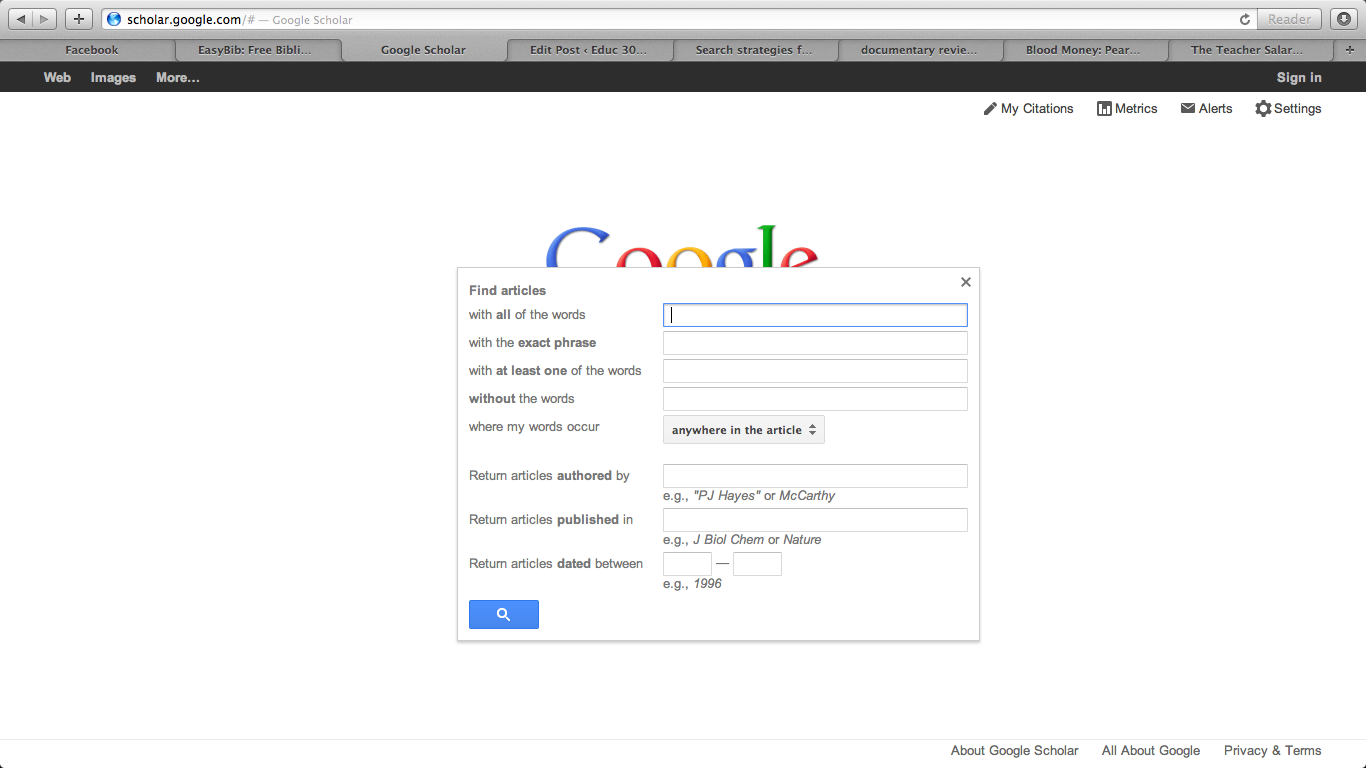
When looking for reliable material, everyone’s initial response to figure out something they don’t know is to Google the material. So, that’s what I did. Using Google Scholar, I entered all the information needed to link The American Teacher and any reviews that would need to go with it.
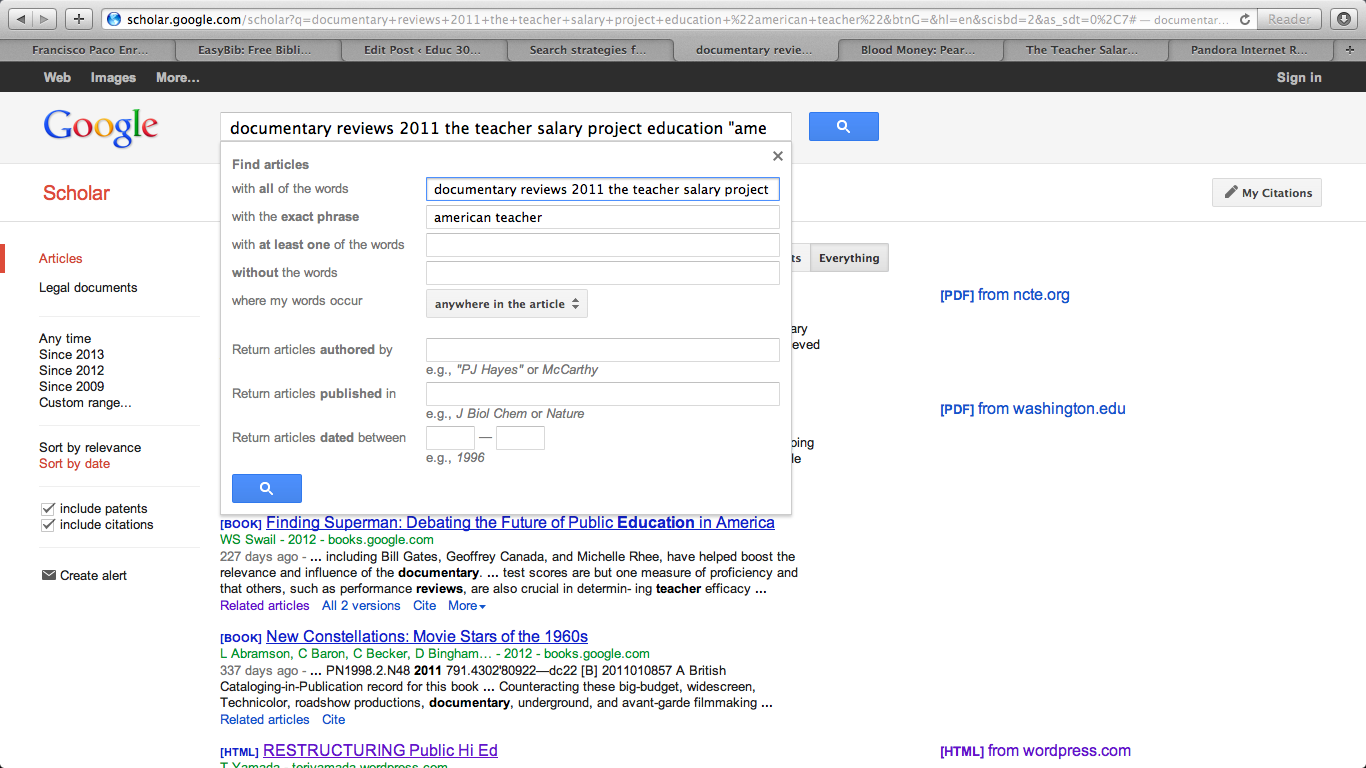
When visiting the first visiting the website, it appears as if you’re googling a normally on the primary website. Click on the small arrow next to the search button, and an advanced option to search articles appears.
Originally, it took me a while to find many reviews pertaining specifically to the actual documentary because just typing in “American Teacher” into the search bar brings up any article using both words. Specific words like American Teacher, documentary, 2011, reviews, education, and the teacher salary project narrows down the search to find articles more specific to the movie. Being as specific as possible with the search is crucial to finding a specific review for the American Teacher documentary.
Many of the articles will vary from the topics they talk about; therefore, skim each preview of the article you wish before actually including the article because although the search made the scope a lot smaller, many of the results may very well still be talking about a different topic than reviewing the film.
When I read the previews, I would make sure that the title of the movie was somewhere present along with an overview of the film to make sure the film was being reviewed.
Citations:
1. Yamada, Teri. “RESTRUCTURING Public Hi Ed.” RESTRUCTURING Public Hi Ed. www.wordpress.com, 2 Oct. 2011. Web. 21 Feb. 2013.<http://teriyamada.wordpress.com/2011/10/02/blood-money-pearsons-profit/>
In this blog post, Yamada takes an overview of American Teacher, and uses it as a positive aspect to support his claim over the growing amount of public relations campaigning.
2. Harris, K. “Amazon Official Comment.” Amazon.com: K. Harris “Film Aficionado”‘s Review of American Teacher. Amazon, 9 Feb. 2012. Web. 21 Feb. 2013. <http://www.amazon.com/review/R3RD0JMER4ASQG/ref=cm_aya_cmt?ie=UTF8&ASIN=B006>
The reviewer goes in depth and analyzes both the pitfalls and successes of the film and bases his review on both perspectives. Moreover, the reviewer goes in depth about what improvements can be made to the documentary.
3. Willmore, Alison. “American Teacher.” AV Club Live. The Onion, 9 Sept. 2011. Web. 21 Feb. 2013. <http://www.avclub.com/articles/american-teacher,62512/>.
In this review, the author refers back to key scenes in the movie and describes in depth how American teacher is a positive impact and acknowledges the counter arguements within the film and also about the film.
The review is very down to earth and makes the reader associate better with the reviewer and how his review may be misconstrued. Also, the review provides some outside knowledge and takes a definite position on the problem proposed by the documentary.
5. Walker-Bickett, Jeri. “JeriWB: What Do I Know?” JeriWB What Do I Know. WordPress, 16 May 2012. Web. 21 Feb. 2013. <http://jeriwb.com/education-criticism-reacting-to-american-teacher-2234/>.
The review really puts into perspective all of the statistics presented by the movie and gives a great overall view of the movie as well as present the hopefulness of creating change for teachers.
Prompt: How do you find reviews and essays about video documentaries? Describe your search strategy and cite the 5 most thoughtful reviews or background essays on a designated video documentary. Your search results may include scholarly and/or popular press, but do your best not to include those featured on the film’s companion site. (Hint: the goal of this question is to help your classmates identify thoughtful sources that do not necessarily agree with the policy stance taken by the film.) Add a brief explanation for why you recommended each of the five sources you selected.
For this assignment I met with a Trinity librarian, Erin Valentine, who significantly helped me in answering how to find thoughtful reviews and essays about video documentaries, in particular “The Cartel” by Bob Bowdon. We began the search on the Trinity College Library homepage, and since I was looking for reviews, Erin told me to search under “Articles”. From there, we searched by database title and chose “Education Full Text” and then hit “Go”.
On the next page, I was told to select “Choose Database” and chose a few other relevant databases such as Social Sciences full text, Humanities full text, and Readers’ Guide full text.
I then searched under “The Cartel”, but the results pertained to mainly drug and oil cartels and had nothing to do with the video documentary. I then went back to the previous page and added the writer/director’s name, Bowdon, to the search.
Since this only provided three reviews of the film, I added the database “Film and Television Literature Index” to my search. This also only offered five reviews, which Erin suggested was probably the result of how recent the film was made.
A few of the reviews found from that particular search proved thoughtful and informative, but not all five. After my next search in JSTOR was unhelpful, I then targeted Google as my next method of researching. Google News and Google Scholar both left me empty-handed, and simply searching “The Cartel Bob Bowdon” under Google mainly produced biased positive reviews from companion sites. However, this same search led me to the Wikipedia site for the film, whose “References” section surprisingly produced the two most thoughtful and insightful reviews I found.
Interestingly enough, many of the reviews I came across found that Bowdon had the right idea in mind and agreed with his general stance, but they do not write favorably about the film. Most reviews were harsh critiques and portrayed the film in a negative light. This is the advantage of using reviews from databases other than the companion site because they are not biased and give both negative and positive feedback. Below I have listed and explained the five most relevant reviews of Bob Bowdon’s “The Cartel”.
“A Digestible Lesson in Public-School Failures” by Wesley Morris
Morris takes an unbiased stance on the film, praising the message that Bowdon is trying to get across that current public school systems are corrupt and dysfunctional, but he also critiques the quality of the film itself and the righteous and condescending way Bowdon portrays himself.
“‘The Cartel’ Sees Teacher Unions’ Grip as Crippling” by Brian MacQuarrie
MacQuarrie gives less of an opinionated account of the film and more so sheds additional light on the problems and absurdities within the public school system in New Jersey. He seems to reiterate and agree with many of the film’s points, showing Bowdon and his film in a positive light.
“Children Left Behind” by Jeannette Catsoulis
From the New York Times, Catsoulis provides a rather negative portrayal of the film, pointing out that Bowdon merely focuses on the single state of New Jersey even though the film is supposed to be targeting the public school system on a national level. She calls the film “a bludgeoning rant against a single state” and finishes her review by stating that the film is “visually horrid and intellectually unsatisfying…demonstrates only that its maker has even more to learn about assembling a film than about constructing an argument”.
“The Cartel” by John Anderson
Taken from an entertainment magazine as opposed to a major newspaper, this review presents the film as ubiquitous oxymoron. Anderson argues that its central message of the dire need to change dysfunctional public school systems is undeniably correct, but Bowdon makes several crucial mistakes such as ignoring the ramifications of the No Child Left Behind act, limiting the film to New Jersey public schools when the film is supposedly of national scope, and presenting a one-sided and voiced-over interview with Joyce Powell, the president of the New Jersey Educational Association.
“Editor’s Review” by Gretchen Brion-Meisels
Brion-Meisels, an editor from the Harvard Educational Review, shines light on the tone of the movie, which she suggests points towards the idea that the culture of charter schools is more valuable than the cultures from which underprivileged and low-income students come from. She notes that the film seemed more like a negatively charged method of propaganda towards teacher unions by simply showing failing statistics and not detailing the stories behind them.
Catsoulis, Jeannette. “Children Left Behind.” The New York Times. N.p., 15 Apr. 2010. Web. 21 Feb. 2013. <http://movies.nytimes.com/2010/04/16/movies/16cartel.html?_r=2&>.
MacQuarrie, Brian. “‘The Cartel’ Sees Teacher Unions’ Grip as Crippling.” The Boston Globe. Boston.com, 25 Apr. 2010. Web. 21 Feb. 2013. <http://www.boston.com/ae/movies/articles/2010/04/25/the_cartel_focuses_on_the_stultifying_effect_teacher_unions_are_having_on_the_public_school_system/>.
Morris, Wesley. “A Digestible Lesson in Public-School Failures.” The Boston Globe 30 Apr. 2010: n. pag. Boston.com. Web. 21 Feb. 2013. <http://www.boston.com/ae/movies/articles/2010/04/30/in_the_cartel_a_condescending_lesson_in_public_school_failures/>.
A special thanks to the librarian, Erin Valentine, for helping me through my research.
HARTFORD, CT- On Saturday, February 16, representatives from the Sheff Movement: Quality Integrated Education for All Children, held a monthly meeting at Capital Prep High School in Hartford. Gathering in the library, the guest list included several citizens from surrounding Hartford towns such as Avon and West Hartford, administrators from local magnet schools, and even two students from a local magnet school along with their parents doing a history project on the Sheff v. O’Neill court case.
Ambar Paulino and Alex Conaway At the Sheff Meeting (Photographed by Jack Dougherty)
Starting off the meeting at 9am, Elizabeth Sheff, a parent who was principally involved in the 1989 case, began to speak on the agenda of planning a legislative forum in April hosted by the black and Hispanic caucus to highlight the academic achievement for those students who attend “Sheff schools”. Currently, the issue is that there aren’t enough schools in the Greater-Hartford area that please the motives of the Sheff movement; which are to be high-performing and support school integration. Staff coordinator and attorney Phil Tegler, mentioned that a bill signed last May agreed that the failing schools are to be provided with special funding and support, as well as advisory groups made up of the parents to help guide to a turnaround process. With $25 million for capital investments in high quality school models and $16 million aimed for low-performing schools, still there is little support for required diversity.
Sheff raised the question, “Why open new schools? Just build upon those who are already successful.” To answer this, statistics were brought into the picture: many of the magnet schools get nearly 2,000 applicants a year, and out of that vast number only a mere 20 students get accepted. These parents of Hartford and surrounding suburbs are interested in their kids going to a school with a diverse education, however there is not enough space, therefore opportunities are limited.
This past year the Breakthrough II School located in the Blue Hills neighborhood of Hartford was asked to be a magnet school, in which a lottery was supposed to be held for May but was switched to September. Out of 800 applicants there were only 85 spots to be filled. Principal Tammy Cassile mentioned that a lot of frustration was shown from the parents because many applications were rejected, and due to the changing of the lottery some kids had to remain at their district schools.
As the Hartford area anticipates the possibility of opening new magnets schools for the 2014-2015 school year, the winter edition of the Integrated Voice Newsletter informs the readers that just, “a simple beam of sunlight through huge classroom windows can shed light on the possibilities of the students and the town”.
Robert Cotto of the Sheff Movement, began to discuss the possibility of the implementation of a dual-language immersion program. Cotto, a representative of the Hartford Board of Education began to explain that there were many different types of Dual-language immersion programs, but that they would want to replicate the 2-way language programs which were offered in some states like Utah and North Carolina. He mentioned that the program would host native English speaking children and native Spanish speaking children in the same school, learning from a curriculum that would be taught half a week in Spanish and the other half in English. He stated, “Best research suggests that a two-way language immersion program benefit kids in all subjects, including African Americans.”
Susan Eaton, author of The Children in Room E4: American Education on Trial, also noted that this program has been sold successfully as an economic development model. She went on and suggested that the Hartford Board of Education does not need to look at other state models to start a dual-language program. The crowd at the meeting agreed, and Cotto backed up Eaton’s claim by stating that there are successful schools within the reach of our very own state.
Sheff suggested that the focus of the two-way language immersion program be on the state in comparison to just the Hartford School district.
“People need to learn a different language, it calls for success,” Sheff said. Many members agreed to the fact that learning a second or even third language would be a successful tool, especially one that can and should be used in the workforce.
Jack Dougherty, Associate Professor of Educational Studies at Trinity College in Hartford, CT proposed an event at Trinity, which would aim to bring awareness about this dual-language immersion program. He stated that by hosting this event at Trinity, the Sheff Movement would ultimately increase awareness on and off campus.
Sheff happily agreed and suggested that by inviting professors, other interested advocators and even people from the legislative branch of Education, the Sheff Movement would be bringing this idea to the surface, and ultimately starting a revolution. She concluded the meeting by mentioning that engaging the youth in such events would also be beneficial because the Sheff Movement wants to create leaders and advocates for educational equality.
On Friday, February 15, the Education Committee of the Connecticut General Assembly held its first public hearing of the new year in the Legislative Office Building, room IE. The room was packed with various members of the media and concerned citizens, and the agenda was full; Representative Andrew Fleischmann and Senator Andrea L. Stillman ruled over the hearing and were responsible for the proceedings. It began a few minutes after 11 am with the promise that it would be an important day for the future of Connecticut’s children. The first bill up for review on the agenda was H.B. No. 6357, entitled, “An Act Implementing the Budget Recommendations of the Governor Concerning Education,” which was presented on behalf of Governor Daniel P. Malloy by Ben Barnes, Secretary of the Office of Policy Management.
Members of the Education Committee listen to the governor's recommendations.
The bill includes 28 different sections, all of which are the Governor’s budget recommendations to be implemented by July 1, 2013. Myra Jones Taylor, Director of Early Childhood Planning, and Stephen Pryor, the Commissioner of the State Department of Education accompanied Secretary Barnes on the stand. Taylor declared the Governor’s proposal to be one of the boldest and most comprehensive plans attempted by any state. Each speaker was only allowed three minutes to make their case, a task that proved difficult due to the complexity of their proposals.
Barnes spoke first about Bill No. 6357 and provided the committee and audience with a brief summary of the more important components of the governor’s education funding initiative. He began by discussing the governor’s education mission that focuses on looking towards new ways of cutting costs while simultaneously raising the quality of Connecticut schools.
One of the implementations the governor is seeking to execute, which sparked a large amount of controversy amongst the committee, is the radical re-shifting of transportation funds in various school districts across the state. Section 13 of the bill states that, “The Commissioner of Education shall, within available appropriations, establish a regional transportation grant program that awards grants to local and regional boards of education that coordinate and share the provision of public school transportation services.” For complete access to the governor’s budget recommendations, visit this link: http://www.cga.ct.gov/2013/TOB/H/2013HB-06357-R00-HB.htm.
Barnes’s proposition prompted the committee to ask him several questions because of the sensitive nature of transportation amongst Connecticut public schools. Some sort of system is required, by law, to get children to and from school everyday, though it has always consumed a large amount of the education budget. Representative Fleischmann commenced the series of questions directed at Barnes, Taylor, and Pryor. His biggest concern with the changes to school transportation was based on how this government decision would affect the various towns and school districts.
He raised the question of effectiveness and efficiency, voicing the possibility that this cut in transportation might not be seen as a cost-effective way to approach issues concerning government spending and budgeting within the education sector. Barnes was quick to defend Fleischmann’s point by stating that it is more of a transitional measure meant to ensure that money allocated to classrooms and improvements in curriculum would continue to be accessible to schools.
When it comes to improving education at a state-wide level, there has been an ongoing discussion over where money should be going, and who needs it more. The governor’s proposal is meant to radically shift the dispersal of money within the education sector in the hopes that the quality of instruction within Connecticut schools improves in a significant and noticeable way.
Other committee members who appeared weary of this radical change soon echoed the concerns posed by Fleischmann. Senator Stillman directly followed her co-chairman and urged Barnes to expand on his proposition. She stated that she was most concerned that this would be viewed as a one size fits all approach to this sensitive and controversial topic. She further emphasized her point by highlighting the troubles that have recently existed in Montville, Connecticut, a small town located in New London County. It is currently losing transportation and has been struggling with how to adjust to budget cuts while still ensuring that all students are able to get to and from school.
This example was used to demonstrate the variability that inevitably exists in a state such as Connecticut, where each region encounters its own challenges within its public school system. As Stillman stated, the issue of transportation costs has always been a very big issue, and clearly needs to be addressed by the committee.
It was clear that the initiatives posed by Barnes were unprecedented due to the copious amount of questions directed specifically to him regarding transportation cuts. Senator Toni Boucher, representing Connecticut’s 26th district, asked him to clarify, once again, what exactly the governor’s budget recommendations were attempting to do. She then followed up this question by inquiring as to whether there were currently any two districts who already had a shared transportation contract in an attempt to cut back their costs.
This was one of the few moments Barnes appeared uneasy; he quickly shuffled through his notes and then responded in a quiet, muffled voice that he was not aware of any such thing. After pausing for a few seconds, he was able to recover and again emphasized the two most important components of these changes: various private school students could still have access to transportation if they needed it, and though costs would be significantly cut, all towns would still have access to aid from the state. This system, as Barnes continuously reinforced throughout the hearing, would just be a “new way of doing transportation.”
The committee’s decision remains unknown as of now, but will no doubt be revealed to the public soon. Despite the ample amount of debate and discussion the governor’s recommendations caused, it is reassuring to know that the fate of Connecticut’s children is taken seriously by state-elected officials.
Sean Corcoran, an economist at New York University, studied the teacher evaluation systems in New York City and Houston. He found that the average “margin of error” of a New York City teacher was plus or minus 28 points.
Example 1: Plagiarize the original text by copying portions of it word-for-word:
Sean Corcoran, an economist at New York University, studied the teacher evaluation systems in New York City and Houston. He found that the average “margin of error” of a New York City teacher was plus or minus 28 points.
Example 2: Plagiarize the original text by paraphrasing its structure too closely, without copying it word-for-word:
When Sean Corcoran was economist at New York University, he studied the teacher evaluation systems in New York City and Houston. While there, he discovered that the average “margin of error” of a New York City teacher was plus or minus 28 points.
Example 3: Plagiarize the original text by paraphrasing its structure too closely, and include a citation. Even though you cited it, paraphrasing too closely is still plagiarism.
As an economist at New York University, Sean Corcoran studied the teacher evaluation systems in New York City and Houston. His findings included that the average “margin of error” of a New York City teacher was plus or minus 28 points (Ravitch 270).
Example 4: Properly paraphrase from the original text by restating the author’s ideas in different words and phrases, and include a citation to the original source.
During his time as an economist at New York University, Sean Corcoran performed studies in New York and Houston that tested each city’s teacher evaluation systems. Among his findings of teachers in New York City, he concluded that the average margin of error was approximately 28 points (Ravitch 270).
Example 5: Properly paraphrase from the original text by restating the author’s ideas in different words and phrases, add a direct quote, and include a citation to the original source.
During his time as an economist at New York University, Sean Corcoran performed studies in New York and Houston that tested each cities’ teacher evaluation systems. Among his findings of teachers in New York City, he concluded that the average margin of error was “plus or minus 28 points” (Ravitch 270).
Works Cited
Diane Ravitch, The Death and Life of the Great American School System. New York: Basic Books, 2011, pp. 270
No measure is perfect, but the estimates of value-added and other “growth models,” which attempt to isolate the “true effect” of an individual teacher through his or her students’ test scores, are alarmingly error-prone in any given year. Sean Corcoran, an economist at New York University, studied the teacher evaluation systems in New York City and Houston. He found that the average “margin of error” of a New York City teacher was plus or minus 28 points. So, a teachers who has ranked at the 43rd percentile compared to his or her peers might actually be anywhere between the 15th percentile and the 71st percentile. The value-added scores also fluctuate between years. A teacher who gets a particular ranking in year one is likely to get a different ranking the next year. There will always be instability in these rankings, some of which will reflect “real” performance changes. But it is difficult to trust any performance rating if the odds of getting the same rating next year are no better than a coin toss.Original source: Diane Ravitch, The Death and Life of the Great American School System. New York: Basic Books, 2011, pp. 270-71.
Example 1: Plagiarize the original text by copying portions of it word-for-word.
Sean Corcoran, an economist from New York University, studied the teacher evaluation programs in New York City and Houston. He found that the average “margin of error” of a New York City teacher was about 28 points.
Example 2: Plagiarize the original text by paraphrasing its structure too closely, without copying it word-for-word.
It is difficult to trust any performance rating if the chances of getting a similar rating next year are no better than rolling a dice.
Example 3: Plagiarize the original text by paraphrasing its structure too closely, and include a citation. Even though you cited it, paraphrasing too closely is still plagiarism.
A teacher who gets a certain ranking at one point in their career may be more prone to recieve a different score the next year. (Ravitch, 270)
Example 4: Properly paraphrase from the original text by restating the author’s ideas in different words and phrases, and include a citation to the original source.
“It may be troublesome to fully trust any performance evaluation if recieving a similar performance evaluation the following year is merely a task of probability.” (Ravitch, 270)
Example 5: Properly paraphrase from the original text by restating the author’s ideas in different words and phrases, add a direct quote, and include a citation to the original source.
Dr. Sean Corcoran, a graduate of University of Maryland at College Park (Economics) and current researcher at NYU studied the systems of evaluating teachers in both New York State and Texas, “He found that the average “margin of error” of a New York City teacher was plus or minus 28 points…”
Diane Ravitch goes on to explain this phenomenon further:
“So, a teachers who has ranked at the 43rd percentile compared to his or her peers might actually be anywhere between the 15th percentile and the 71st percentile. The value-added scores also fluctuate between years. A teacher who gets a particular ranking in year one is likely to get a different ranking the next year…” (Ravitch, 270)
Original Text: No measure is perfect, but the estimates of value-added and other “growth models,” which attempt to isolate the “true effect” of an individual teacher through his or her students’ test scores, are alarmingly error-prone in any given year.
Original source: Ravitch, Diane. The Death and Life of the Great American School System. New York: Basic Books. Print.
————————————————————————
Example 1: Plagiarize the original text by copying portions of it word-for-word:
No measure is perfect, but the estimates of value-added and other “growth models,” which attempt to isolate the “true effect” of an individual teacher through his or her students’ test scores, are alarmingly error-prone in any given year.
————————————————————————
Example 2: Plagiarize the original text by paraphrasing its structure too closely, without copying it word-for-word:
An alarmingly error-prone measure, estimates the value-added and other “growth” models.” These measures attempt to isolate the “true effect” of an individual teacher through his or her students’ test scores.
————————————————————————
Example 3: Plagiarize the original text by paraphrasing its structure too closely, and include a citation. Even though you cited it, paraphrasing too closely is still plagiarism.
An alarmingly error-prone measure, estimates the value-added and other “growth” models.” These measures attempt to isolate the “true effect” of an individual teacher through his or her students’ test scores (Ravitch 270).
————————————————————————
Example 4: Properly paraphrase from the original text by restating the author’s ideas in different words and phrases, and include a citation to the original source.
Ravitch notes that, although some of the measures taken to identify a teacher’s success within her student’s test scores are considered to be effective, there are other measures that may have a margin of error (Ravitch 270).
————————————————————————
Example 5: Properly paraphrase from the original text by restating the author’s ideas in different words and phrases, add a direct quote, and include a citation to the original source.
Ravitch notes that, even though some of the measures taken to identify a teacher’s success within her student’s test scores are considered to be effective, there are other measures that “are alarmingly error-prone in any given year” (Ravitch 270).
————————————————————————
Works Cited
Diane Ravitch, The Death and Life of the Great American School System. New York: Basic Books, 2011, pp. 270-71.
Example 1: Plagiarize the original text by copying portions of it word-for-word.
There will always be instability in these rankings, some of which will reflect “real” performance changes. But it is difficult to trust any performance rating if the odds of getting the same rating next year are no better than a coin toss.
Example 2: Plagiarize the original text by paraphrasing its structure too closely, without copying it word-for-word.
There will never be stability in these evaluations, some of which will show genuine changes in performance. It is hard to trust any performance evaluation if the odds of getting the same rating the following year are the same as tossing a coin.
Example 3: Plagiarize the original text by paraphrasing its structure too closely, and include a citation. Even though you cited it, paraphrasing too closely is still plagiarism.
There will never be stability in these evaluations, some of which will show genuine changes in performance. It is hard to trust any performance evaluation if the odds of getting the same rating the following year are the same as tossing a coin. (Ravitch 270)
Ravitch, Diane. The Death and Life of the Great American School System: How Testing and Choice are Undermining Education, Revised and Expanded Edition. New York: Basic Books, 2010. Print.
Example 4: Properly paraphrase from the original text by restating the author’s ideas in different words and phrases, and include a citation to the original source.
The rankings will always be inconsistent and some of the data will show real differences in performance. Since the odds of getting the same rating the following year is solely up to chance, it is hard to rely on any performance evaluation. (Ravitch 270)
Ravitch, Diane. The Death and Life of the Great American School System: How Testing and Choice are Undermining Education, Revised and Expanded Edition. New York: Basic Books, 2010. Print.
Example 5: Properly paraphrase from the original text by restating the author’s ideas in different words and phrases, add a direct quote, and include a citation to the original source.
The rankings lack consistency, and the data will show variations in student performance. Furthermore, performance ratings are unreliable because “the odds of getting the same rating next year are no better than a coin toss” (Ravitch 270).
Ravitch, Diane. The Death and Life of the Great American School System: How Testing and Choice are Undermining Education, Revised and Expanded Edition. New York: Basic Books, 2010. Print.
Example 1: Plagiarize the original text by copying portions of it word-for-word.
“The value-added scores also fluctuate between years. A teacher who gets a particular ranking in year one is likely to get a different ranking the next year.” (Ravitch 271)
Example 2: Plagiarize the original text by paraphrasing its structure too closely, without copying it word-for-word.
The value-added scores tend to change between years. A teacher who gets a particular spot in year one is likely to get a different spot the next year.
Example 3: Plagiarize the original text by paraphrasing its structure too closely, and include a citation. Even though you cited it, paraphrasing too closely is still plagiarism.
“The scores tend to change between years. A teacher who gets a particular placement in year one usually gets a different placement the next year.” (Ravitch 271)
Example 4: Properly paraphrase from the original text by restating the author’s ideas in different words and phrases, and include a citation to the original source.
Sometimes the scores for teachers can go up or down in different years. In some instances teachers ranked highly in one year can be ranked very low in the next year. (Ravitch 271)
Example 5: Properly paraphrase from the original text by restating the author’s ideas in different words and phrases, add a direct quote, and include a citation to the original source.
According to Ravitch, “the value-added scores also fluctuate between years.” Sometimes the scores for teachers can go up or down in different years. In some instances teachers ranked highly in one year can be ranked very low in the next year. (Ravitch 271)
Objective: In order to avoid plagiarism, one must first learn how to plagiarize. Each of the five paragraphs: the first three show different ways of plagiarizing, while the last two demonstrate how to paraphrase properly.
Example 1: Plagiarize the original text by copying portions of it word-for-word.
Ex. 1: Diane Ravitch says that Sean Corcoran, an economist at New York University, studied the teacher evaluation systems in New York City and Houston. She says he found that the average “margin of error” of a New York City teacher was plus or minus 28 points.
Example 2: Plagiarize the original text by paraphrasing its structure too closely, without copying it word-for-word.
Ex 2: Ravitch uses results from an economist named Sean Corcoran from New York University, who studied teacher evaluation systems and found that the average “margin of error” of a New York City teacher was plus or minus 28 points, to prove that the scores were unreliable for others to judge the actual performance of the teacher.
Example 3: Plagiarize the original text by paraphrasing its structure too closely, and include a citation. Even though you cited it, paraphrasing too closely is still plagiarism.
Ex 3: Ravitch uses results from an economist named Sean Corcoran from New York University, who studied teacher evaluation systems and found that the average “margin of error” of a New York City teacher was plus or minus 28 points, to prove that the scores were unreliable for others to judge the actual performance of the teacher.
Works Cited:
Ravitch, Diane. The Death and Life of the Great American School System: How Testing and Choice are Undermining Education, Revised and Expanded Edition. New York: Basic Books, 2010.
Example 4: Properly paraphrase from the original text by restating the author’s ideas in different words and phrases, and include a citation to the original source.
Ex 4: Through her own interpretation of Sean Cocoran’s analysis of teacher evaluations, Ravitch affirms that the “margin of error” when evaluating teachers in New York City is too high to accurately evaluate the teachers, and proves to be too inconsistent when comparing the scores over the years [1].
[1]:Diane Ravitch, The Death and Life of the Great American School System: How Testing and Choice are Undermining Education, Revised and Expanded Edition (New York: Basic Books, 2010), 270-271.
Works Cited:
Ravitch, Diane. The Death and Life of the Great American School System: How Testing and Choice are Undermining Education, Revised and Expanded Edition. New York: Basic Books, 2010.
Example 5: Properly paraphrase from the original text by restating the author’s ideas in different words and phrases, add a direct quote, and include a citation to the original source.
In her novel, Diane Ravitch confirms that the system used to asses teachers is very unreliable and has too much of a gap to accurately evaluate them. Ravitch uses economist Sean Cocoran’s assertion that “the average ‘margin of error’ of a New York City teacher was plus or minus 28 points” in order to prove that the system used in very inaccurate and unreliable [2].
[2]:Diane Ravitch, The Death and Life of the Great American School System: How Testing and Choice are Undermining Education, Revised and Expanded Edition (New York: Basic Books, 2010), 270-271.
Works Cited:
Ravitch, Diane. The Death and Life of the Great American School System: How Testing and Choice are Undermining Education, Revised and Expanded Edition. New York: Basic Books, 2010.
Objective: In order to avoid plagiarism, one must first learn how to plagiarize.
In this post, I show different ways of plagiarizing, while the last two demonstrate how to paraphrase properly.
Original text:
No measure is perfect, but the estimates of value-added and other “growth models,” which attempt to isolate the “true effect” of an individual teacher through his or her students’ test scores, are alarmingly error-prone in any given year. Sean Corcoran, an economist at New York University, studied the teacher evaluation systems in New York City and Houston. He found that the average “margin of error” of a New York City teacher was plus or minus 28 points. So, a teachers who has ranked at the 43rd percentile compared to his or her peers might actually be anywhere between the 15th percentile and the 71st percentile. The value-added scores also fluctuate between years. A teacher who gets a particular ranking in year one is likely to get a different ranking the next year. There will always be instability in these rankings, some of which will reflect “real” performance changes. But it is difficult to trust any performance rating if the odds of getting the same rating next year are no better than a coin toss.
Original source: Diane Ravitch, The Death and Life of the Great American School System.New York: Basic Books, 2011, pp. 270-71.
Example 1: Plagiarize the original text by copying portions of it word-for-word.
When evaluating teachers in New York and Houston, the average “margin of error” of a New York City teacher was plus or minus 28 points. Also, these rankings are instable from year to year. It is difficult to trust performance ratings if the odds of getting the same rating next year are no better than a coin toss.
Example 2: Plagiarize the original text by paraphrasing its structure too closely, without copying it word-for-word.
An NYU economist, Corocoran, found that the average “margin of error” in ratings of New York teachers was plus or minus 28 points. This is startling, because if you think about it, a teacher in the 43rd percentile could actually range from the 15th to the 71st percentile.
Example 3: Plagiarize the original text by paraphrasing its structure too closely, and include a citation. Even though you cited it, paraphrasing too closely is still plagiarism.
Using test scores to rank teachers is invalid due to instability. Some changes may shed light on real changes, but the chance of the same rating is a 50/50 shot (Ravitch, 271).
Example 4: Properly paraphrase from the original text by restating the author’s ideas in different words and phrases, and include a citation to the original source.
There are many difficulties and holes in the attempt to rank teachers using students’ test scores. The changes of scores from year-to-year could illustrate improvement; however, this change could be easily due to chance (Ravitvh, 270-271).
Example 5: Properly paraphrase from the original text by restating the author’s ideas in different words and phrases, add a direct quote, and include a citation to the original source.
Measuring teacher performance is a difficult task to attempt. Using students’ test scores is prone to issues. Year-to-year changes could be accounted for by chance or improvement, but differentiating cause may be difficult (Ravitch, 271). NYU economist Sean Corcoran looked at teacher evaluation systems and “found that the average “margin of error” of a New York City teacher was plus or minus 28 points” (Ravitch, 270). This gives a 56-point range a teacher could fall in when looking at their percentile ranking. This wide, and therefore not informative, range and instability from year-to-year create difficulties in ranking teachers based on student-scores.
Example 1: Plagiarize the original text by copying portions of it word-for-word.
The estimates of value-added and other “growth models,” which attempt to isolate the “true effect” of an individual teacher through his or her students’ test scores, are alarmingly error-prone in any given year. The average “margin of error” of a New York City teacher was plus or minus 28 points.
Example 2: Plagiarize the original text by paraphrasing its structure too closely, without copying it word-for-word.
The ways in which teachers are evaluated in New York City and Houston have an average margin of error of plus or minus 28 points. For example, if some teachers ranked in the 43rd percentile were compared with other teachers, they may be as low as the 15th percentile or as high as the 71st.
Example 3: Plagiarize the original text by paraphrasing its structure too closely, and include a citation. Even though you cited it, paraphrasing too closely is still plagiarism.
The ways in which teachers are evaluated in New York City and Houston have an average margin of error of plus or minus 28 points. For example, if some teachers ranked in the 43rd percentile were compared with other teachers, they may be as low as the 15th percentile or as high as the 71st (Ravitch 270-71)
Example 4: Properly paraphrase from the original text by restating the author’s ideas in different words and phrases, and include a citation to the original source.
There are inherent errors found in how teacher performance is measured that are so large these measure can be seen as ineffective and unreliable. In some places, ranges of up to 28 points of difference in how these teachers are tested on their adequacy can be found. Thus, the question arises, how can these measure be trusted if there is such a high degree of variability in the results (Ravitch 270-71)?
Example 5: Properly paraphrase from the original text by restating the author’s ideas in different words and phrases, add a direct quote, and include a citation to the original source.
In looking at the ways in which teacher performance is measured, one can’t help but see that there are certain unreliable aspects to the methods. In a study performed by an economist at NYU, Sean Corcoran, “He found that the average “margin of error” of [the measure of] a New York City teacher was plus or minus 28 points”(Ravitch 270-71). In addition to the level of variability on every test, the performance of the teachers changed each year. These two factors provide the basis for why this measure of the performance of teachers in quite unreliable (Ravitch 270-71).
“The value-added scores also fluctuate between years. A teacher who gets a particular ranking in year one is likely to get a different ranking the next year.”
Original Source:
Original source: Diane Ravitch, The Death and Life of the Great American School System. New York: Basic Books, 2011, pp. 270-71.
Example 1: Plagiarize the original text by copying portions of it word-for-word.
Example 1: The value-added scores also fluctuate between years. A teacher who gets a particular ranking in year one is likely to get a different ranking the next year.
Example 2: Plagiarize the original text by paraphrasing its structure too closely, without copying it word-for-word.
Example 2: These value-added scores also fluctuate throughout the years. If an educator’s students get particular scores one year, these students are likely to get a different ranking the year after.
Example 3: Plagiarize the original text by paraphrasing its structure too closely, and include a citation. Even though you cited it, paraphrasing too closely is still plagiarism.
Example 3: These value-added scores also fluctuate throughout the years. If an educator’s students get particular scores one year, these students are likely to get a different ranking the year after. [1]
[1] Diane Ravitch, The Death and Life of the Great American School System. New York: Basic Books, 2011, pp. 270-71.
Example 4: Properly paraphrase from the original text by restating the author’s ideas in different words and phrases, and include a citation to the original source.
Example 4: Ravitch notes that, even though these scores are curved and inflated, there is still oscillation with each new class. Similarly, teacher’s success rates will not necessarily be as elevated with each class he/she instructs. [1]
[1] Diane Ravitch, The Death and Life of the Great American School System. New York: Basic Books, 2011, pp. 270-71.
Example 5: Properly paraphrase from the original text by restating the author’s ideas in different words and phrases, add a direct quote, and include a citation to the original source.
Example 5: Ravitch notes that, even though these scores are curved and inflated, there is still oscillation with each new class. Essentially, these scores will naturally “fluctuate between years” (Ravitch, 271). Similarly, teacher’s success rates will not necessarily be as elevated with each class he/she instructs.[1]
[1] Diane Ravitch, The Death and Life of the Great American School System. New York: Basic Books, 2011, pp. 270-71.
Example 1: Plagiarize the original text by copying portions of it word-for-word
Diane Ravitch argues against using student test scores to decide if an individual teacher is effective. She reports that Sean Corcoran, an economist at New York University, found that that the average “margin of error” of a New York City teacher was plus or minus 28 points.
Example 2: Plagiarize the original text by paraphrasing its structure too closely, without copying it word-for-word
The evidence of Corcoran says that there is an average “margin of error” of plus or minus 28 points, making it unpredictable to judge a teacher from year to year because between each year these value-added scores may change, causing these results to be instable. These flaws make it challenging to trust the results of the student test scores.
Example 3: Plagiarize the original text by paraphrasing its structure too closely, and include citation
Diane Ravitch uses the evidence of economist Sean Corcoran to prove that the “margin of error” between teachers to too large and that the scores fluctuate between years. As a consequence, this makes the value-added scores to be hard to trust.
Works Cited:
Ravitch, Diane. The Death and Life of the Great American School System: How Testing and Choice are Undermining Education, Revised and Expanded Edition. New York: Basic Books, 2010.
Example 4: Properly paraphrase from the original text by restating the author’s ideas in different words and phrases, and include a citation to the original source
By using the evidence presented by an economist at New York University, Sean Corcoran, Ravitch proves that the “margin of error” is too large to have a teachings ranking actually hold merit. Furthermore, this “margin of error” varies each year as well as the rankings of teachings, there by creating unreliable data.[1]
Works Cited:
Ravitch, Diane. The Death and Life of the Great American School System: How Testing and Choice are Undermining Education, Revised and Expanded Edition. New York: Basic Books, 2010.
Example 5: Properly paraphrase from the original text by restating the author’s ideas in different words and phrases, add a direct quote, and include a citation to the original source
Diane Ravitch makes a case that the value-added scores to judge teachers are unreliable. With the evidence from an economist from New York University, which states that “the average ‘margin of error’ of a New York City teacher was plus or minus 28 points”,[2] which means that the rankings of teachers is invalid.
Works Cited:
Ravitch, Diane. The Death and Life of the Great American School System: How Testing and Choice are Undermining Education, Revised and Expanded Edition. New York: Basic Books, 2010.
[1] Diane Ravitch, The Death and Life of the Great American School System: How Testing and Choice are Undermining Education, Revised and Expanded Edition (New York: Basic Books, 2010), 270-271.
[2] Diane Ravitch, The Death and Life of the Great American School System: How Testing and Choice are Undermining Education, Revised and Expanded Edition (New York: Basic Books, 2010), 270-271.
Example 1: Plagiarize the original text by copying portions of it word-for-word.
There will always be instability in these rankings, some of which will reflect “real” performance changes. But it is difficult to trust any performance rating if the odds of getting the same rating next year are no better than a coin toss.
Example 2: Plagiarize the original text by paraphrasing its structure too closely, without copying it word-for-word.
Instability will always exist in the rankings. Although real performance changes will be reflected it is problematic to have faith in a performance rating system in which a coin toss would give you the same odds of getting the same rating the following year.
Example 3: Plagiarize the original text by paraphrasing its structure too closely, and include a citation. Even though you cited it, paraphrasing too closely is still plagiarism.
Instability will always exist in the rankings. Although real performance changes are reflected it is problematic to have faith in a performance rating system in which a coin toss would give you the same odds of getting the same rating the following year. (Ravitch 271)
Example 4: Properly paraphrase from the original text by restating the author’s ideas in different words and phrases, and include a citation to the original source.
While a margin of error is to be expected in the results of any survey, in examining the teacher evaluation systems in both New York City and Houston economist Sean Corcoran found a statistic that diminishes the amount of confidence one could have in these systems. The New York City margin of error was plus or minus 28 points. (Ravitch 270)
Example 5: Properly paraphrase from the original text by restating the author’s ideas in different words and phrases, add a direct quote, and include a citation to the original source.
While a margin of error is to be expected in the results of any survey, in examining the teacher evaluation systems in both New York City and Houston economist Sean Corcoran found a statistic that diminishes the amount of confidence one could have in these systems. The New York City margin of error was plus or minus 28 points meaning that “a teacher who has ranked at the 43rd percentile compared to his or her peers might actually be anywhere between the 15th percentile and the 71st percentile.” (Ravitch 270)
Work Cited
Diane Ravitch, The Death and Life of the Great American School System. New York: Basic Books, 2011, pp. 270-71.
The goal of this activity is to give us practice avoiding plagiarism by paraphrasing and crediting sources correctly. Below are 3 examples of plagiarism that might go unnoticed and two examples of how to properly paraphrase and cite the author of the source.
Original text:
No measure is perfect, but the estimates of value-added and other “growth models,” which attempt to isolate the “true effect” of an individual teacher through his or her students’ test scores, are alarmingly error-prone in any given year. Sean Corcoran, an economist at New York University, studied the teacher evaluation systems in New York City and Houston. He found that the average “margin of error” of a New York City teacher was plus or minus 28 points. So, a teachers who has ranked at the 43rd percentile compared to his or her peers might actually be anywhere between the 15th percentile and the 71st percentile. The value-added scores also fluctuate between years. A teacher who gets a particular ranking in year one is likely to get a different ranking the next year. There will always be instability in these rankings, some of which will reflect “real” performance changes. But it is difficult to trust any performance rating if the odds of getting the same rating next year are no better than a coin toss.
Original source: Ravitch, Diane. The Death and Life of the Great American School System. New York: Basic Books. Print.
Example 1: Plagiarize the original text by copying portions of it word-for-word.
No measure is perfect, but the estimates of value-added and other “growth models” are error-prone in any given year.
Example 2: Plagiarize the original text by paraphrasing its structure too closely, without copying it word-for-word.
The value-added scores also vary every year. A teacher who gets a ranking one year is likely to get a different ranking the following year.
Example 3: Plagiarize the original text by paraphrasing its structure too closely, and include a citation. Even though you cited it, paraphrasing too closely is still plagiarism.
Sean Corcoran an economist conducted a study on the teacher evaluation systems in New York City and Houston. His results showed the average “margin of error” of a New York City teacher was plus or minus 28 points (Ravitch 270).
Example 4: Properly paraphrase from the original text by restating the author’s ideas in different words and phrases, and include a citation to the original source.
It is problematic to rely on performance ratings because they dont necessarily reflect real changes. The odds of seeing changes are similar to those received from a coin toss (Ravitch 270).
Example 5: Properly paraphrase from the original text by restating the author’s ideas in different words and phrases, add a direct quote, and include a citation to the original source.
A teacher who “has ranked at the 43rd percentile compared to his or her peers might actually be anywhere between the 15th percentile and the 71st percentile (Ravitch 270)”. The value-added scores and rankings vary. There is a possibility for a teacher who receives a high ranking one year to receive a lower ranking the next year and vice versa (Ravitch 270).
This was a great activity and it made me more aware of what is considered plagiarism even when one might not think so.
Example 1: Plagiarize the original text by copying portions of it word-for-word.
Sean Corcoran, an economist at New York University, studied the teacher evaluation systems in New York City and Houston. He found that the average “margin of error” of a New York City teacher was plus or minus 28 points.
Example 2: Plagiarize the original text by paraphrasing its structure too closely, without copying it word-for-word.
An economist at New York University, Sean Corcoran, studied the teacher evaluation systems in New York City and Houston. In his results he found that the average “margin of error” of a New York City teacher was plus or minus 28 points.
Example 3: Plagiarize the original text by paraphrasing its structure too closely, and include a citation. Even though you cited it, paraphrasing too closely is still plagiarism.
According to Sean Corcoran, an economist at New York University who studied the teacher evaluation systems in New York City and Houston, the average “margin of error” of a New York City teacher was plus or minus 28 points (Ravitch 270).
Example 4: Properly paraphrase from the original text by restating the author’s ideas in different words and phrases, and include a citation to the original source.
According to NYU economist Sean Corcoran’s findings, there is a flaw in the teacher evaluating system in New York City, therefor causing a teacher’s ranking, compared to others, to fall anywhere from plus 28 or minus 28 points (Ravitch 270).
Example 5: Properly paraphrase from the original text by restating the author’s ideas in different words and phrases, add a direct quote, and include a citation to the original source.
After studying the teacher evaluation systems in New York and Houston, NYU economist Sean Corcoran reported “that the average “margin of error” of a New York City teacher was either plus or minus 28 points” (Ravitch 270).
Example 1: Plagiarize the original text by copying portions of it word-for-word.
No measure is perfect, but the estimates of value-added and other “growth models,” which attempt to isolate the “true effect” of an individual teacher through his or her students’ test scores, are alarmingly error-prone in any given year. Sean Corcoran, an economist at New York University, studied the teacher evaluation systems in New York City and Houston. He found that the average “margin of error” of a New York City teacher was plus or minus 28 points.
Example 2: Plagiarize the original text by paraphrasing its structure too closely, without copying it word-for-word.
Economist Sean Corcoran found that the average “margin of error” of a New York City teacher was plus or minus 28 points. Therefore, a teacher who has ranked at the 43rd percentile could also fall between the 15th percentile and the 71st percentile. The value-added scores are subject to change. A teacher who gets a particular ranking in year one is not forever associated with said ranking.
Example 3: Plagiarize the original text by paraphrasing its structure too closely, and include a citation. Even though you cited it, paraphrasing too closely is still plagiarism.
Economist Sean Corcoran found that the average “margin of error” of a New York City teacher was plus or minus 28 points. Therefore, a teacher who has ranked at the 43rd percentile could also fall between the 15th percentile and the 71st percentile. The value-added scores are subject to change. A teacher who gets a particular ranking in year one is not forever associated with said ranking (Ravitch 270).
Example 4: Properly paraphrase from the original text by restating the author’s ideas in different words and phrases, and include a citation to the original source.
NYU Economist Sean Corcoran set out to prove how difficult it can be to determine a teacher’s impact solely through the teacher evaluation systems implemented in Houston and New York City. He found that there is an extreme fluctuation amongst scores over the years, and compared the odds of accurately determining a teacher’s impact via these systems to those of a coin toss (Ravitch 271).
Example 5: Properly paraphrase from the original text by restating the author’s ideas in different words and phrases, add a direct quote, and include a citation to the original source.
Due to findings of instability throughout the Houston and New York City teacher evaluation systems, NYU Economist Sean Corcoran deems both systems not entirely accurate. Corcoran reports, “The value-added scores also fluctuate between years. A teacher who gets a particular ranking in year one is likely to get a different ranking the next year” (Ravitch 271). Maybe it is time for a change in how we assess the teachings of our educators.
Works Cited
Diane Ravitch, The Death and Life of the Great American School System. New York:
Example 1: Plagiarize the original text by copying portions of it word-for-word.
The value-added scores also vary between years. A teacher who obtains a particular ranking in year one is likely to get a different ranking the following year. There will continuously be instability in these rankings, some of which will reflect “real” performance changes.
Example 2: Plagiarize the original text by paraphrasing its structure too closely, without copying it word-for-word.
No measure is faultless, but the approximations of value-added and other “growth models,” which try to separate the “true effect” of a particular teacher via his or her students’ test scores, are disturbingly prone to error in any given year. Economist at New York University, Sean Corcoran, examined the teacher assessment systems in Houston and New York City.
Example 3: Plagiarize the original text by paraphrasing its structure too closely, and include a citation. Even though you cited it, paraphrasing too closely is still plagiarism.
He discovered that the mean “margin of error” of a teacher from New York City was plus or minus 28 points. Thus, a teacher who has tiered at the 43rd percentile contrasted to his or her contemporaries may perhaps be anywhere between the 15th percentile and the 71st percentile (Ravitch 271).
Example 4: Properly paraphrase from the original text by restating the author’s ideas in different words and phrases, and include a citation to the original source.
Although there is no way to properly evaluate a teacher, the value-added and other variations of “growth models” are especially detrimental and prone to error—regardless of the year (Ravitch 271). For example, Sean Corcoran, an esteemed economist at New York University, carefully assessed the systems used to evaluate teachers in a number of public schools consisted within both New York City and Houston, Texas districts (Ravitch 271).
Example 5: Properly paraphrase from the original text by restating the author’s ideas in different words and phrases, add a direct quote, and include a citation to the original source.
Because of how the system essentially functions, there is a strong likelihood that there will be no stability in teachers’ rankings (Ravitch 271). Fundamentally this means that although a teacher may receive one particular ranking in his or her first year, the teacher is most likely not going to receive the same ranking the ensuing year (Ravitch 271). Due to this sort of instability, only some of the rankings will truly “reflect ‘real’ performance changes” (Ravitch 271). Consequently, the system is incredibly faulty and it is no longer a system evaluating teachers’ performances—rather, a system that evaluates the teachers’ luck (Ravitch 271).
Works Cited:
Diane Ravitch, The Death and Life of the Great American School System. New York: Basic Books, 2011, pp. 270-71.
Example 1: Plagiarize the original text by copying portions of it word-for-word.
A teacher who gets a particular ranking in year one is likely to get a different ranking the next year. There will always be instability in these rankings, some of which will reflect “real” performance changes.
Example 2: Plagiarize the original text by paraphrasing its structure too closely, without copying it word-for-word.
If a teacher gets a specific ranking in his or her first year it is probable that he or she will score differently the following year. These rankings will always be unstable, and only some of them will reflect serious performance changes.
Example 3: Plagiarize the original text by paraphrasing its structure too closely, and include a citation. Even though you cited it, paraphrasing too closely is still plagiarism.
If a teacher gets a specific ranking in his or her first year it is probable that he or she will score differently the following year. These rankings will always be unstable, and only some of them will reflect real performance changes (Ravitch 270).
Example 4: Properly paraphrase from the original text by restating the author’s ideas in different words and phrases, and include a citation to the original source.
Generally, the ranking a given educator achieves after their first assessment is not indicative of future rankings, as only a portion of these scores can be relied upon to demonstrate the teacher’s true progress – or lack thereof (Ravitch 270).
Example 5: Properly paraphrase from the original text by restating the author’s ideas in different words and phrases, add a direct quote, and include a citation to the original source.
Generally, the ranking a given educator achieves after their first assessment is not indicative of future rankings. These scores are widely considered to be unreliable, and only some of these rankings “will reflect ‘real’ performances changes” (Ravitch 270).
Works Cited
Ravitch, Diane. The Death and Life of the Great American School System. New York:
Basic, 2011. 270-71. Print.
Example 1: Plagiarize the original text by copying portions of it word-for-word.
There will always be instability in these rankings, some of which will reflect “real” performance changes. But it is difficult to trust any performance rating if the odds of getting the same rating next year are no better than a coin toss.
Example 2: Plagiarize the original text by paraphrasing its structure too closely, without copying it word-for-word.
Instability in these rankings will always exist, some of which reflects real changes in performance. However, it is hard to be convinced by such a rating if the chances of receiving the same rating next year are not greater than a coin toss.
Example 3: Plagiarize the original text by paraphrasing its structure too closely, and include a citation. Even though you cited it, paraphrasing too closely is still plagiarism.
Instability in these rankings will always exist, some of which reflect real changes in performance. However, it is hard to be convinced by such a rating if the chances of receiving the same rating next year are not greater than a coin toss (Ravitch 270-271).
Example 4: Properly paraphrase from the original text by restating the author’s ideas in different words and phrases, and include a citation to the original source.
In her book, Ravitch discusses the instability of teacher performance rankings and how difficult it is to determine their accuracy, given how greatly they can change from year to year. She concludes that such ratings are too unreliable to be taken seriously (270-271).
Example 5: Properly paraphrase from the original text by restating the author’s ideas in different words and phrases, add a direct quote, and include a citation to the original source.
In her book, Ravitch discusses the instability of teacher performance rankings and how difficult it is to determine their accuracy, given how greatly they can change from year to year. She concludes that such ratings are too unreliable to be taken seriously because “the odds of getting the same rating next year are no better than a coin toss” (270-271).
Original source: Diane Ravitch, The Death and Life of the Great American School System. New York: Basic Books, 2011, pp. 270-71.
Example 1: Plagiarize the original text by copying portions of it word-for-word.
Sean Corcoran, an economist at New York University who studied the teacher evaluation systems in New York and Houston found that the average “margin of error” of a New York City teacher was plus or minus 28 points.
Example 2: Plagiarize the original text by paraphrasing its structure too closely, without copying it word-for-word.
Professor Corcoran, an economist at New York University, researched the teacher evaluation systems in New York City and Houston. He concluded that the average “margin of error” of a New York City teacher was plus or minus 28points.
Example 3: Plagiarize the original text by paraphrasing its structure too closely, and include a citation. Even though you cited it, paraphrasing too closely is still plagiarism.
Professor Corcoran, an economist at New York University, researched the teacher evaluation systems in New York City and Houston. He concluded that the average “margin of error” of a New York City teacher was plus or minus 28points. (Ravitch 270-271).
Example 4: Properly paraphrase from the original text by restating the author’s ideas in different words and phrases, and include a citation to the original source.
According to economist Sean Corcoran, value-added scores are unreliable in the sense that the ranking a teacher receives varies by year (Ravitch 270-271).
Example 5: Properly paraphrase from the original text by restating the author’s ideas in different words and phrases, add a direct quote, and include a citation to the original source.
Based on Ravitch’s analysis of economist Sean Corcoran’s studies, she argues “A teacher who gets a particular ranking in year one is likely to get a different ranking the next year.” (Ravitch 270).
Works Cited
Ravitch, Diane. The Death and Life of the Great American School System: How Testing and Choice Are Undermining Education. New York: Basic Books, 2011. Print.