Student posts (all, do not display in menu)

Gustav Feingold on Intelligence and Immigrants in 1920’s Hartford

Posted on

What did Gustave Feingold write on intelligence and immigrants in 1920s Hartford?

When approaching source detective question, my first course of action was to do a quick and dirty Google search.  I typed in all the important pieces in the hopes of yielding fast yet accurate results.  The top five of the 706,000 results looked accurate.

Unfortunately, none of them would allow me to read the full pdf without payment.  It was back to the drawing board.  I decided to look over the “Search strategies for sources” under “Resources & Tools” on Ed Reform commons site.

I started with the bold subtitle, If you know very little, because I knew little to nothing about the topic.  The site instructs us to use Wikipedia.  On the Wikipedia site, I searched for Gustave Feingold and yielded no results.  A couple of times, I misspelled his name and had to go back and check my question to make sure I had it right.  It’s impossible to find the information if there are mistakes in the search inquiry, so attention to detail is a must.   According to Wikipedia, my subject did not have a page.

 Yet, another dead-end.  I went back to the search strategies page and continued to work my way down the list.  The next recommended search engine was Trincoll.WorldCat.org.  I tried my luck.  In my first search I only filled in the author section.


I assumed that the topic of immigration would be easy to find among Feingold’s publications.  It wasn’t.  I did an advance search that included the word immigration and still nothing.

A conversation with Jack got me thinking about other places that Gustave’s immigration article could be.  We brainstormed about other relevant databases and decided to try Google Scholar.  I didn’t think that it would be a successful search, because Google was the first search engine I tried.  I did my quick and dirty search of “Gustave Feingold immigrant”.  The first result was a home run. It was exactly what I needed.


Jack explained that this branch of Google was geared toward scholarly work, so my results pool was more specific to my academic needs.  I clicked on the article title, and it lead me to American Psychological Association database.  With VPN, the educational psychology article can be downloaded for free.

In the article, “Intelligence of First Generation Immigrant Groups”, Gustave Feingold disproves and discredits the results of Army testing that portray the children of immigrants as intellectually inferior.  In fact, Gustave shows that their is very little difference in the intellectual ability of American-reared in comparison to their full blooded American counterparts.

Feingold, Gustave.  “Intelligence of the First Generation of Immigrant Groups (A Study and a Critique).”  Journal of Educational Psychology Feb. 1924: Print.


Lewis Terman’s Early Intelligence Tests

Posted on

How can you find Lewis Terman’s early intelligence tests? Lewis Terman was an educational psychologist at Stanford university who developed an intelligence test (later known as the Stanford-Binet IQ test), which he described in his 1916 book. Does Trinity library own this book or is the full-text version freely available online? Describe your search strategy, as well as a few sample questions from the original test, and cite your source.

Search Process:

As suggested on the web post for the source post activity, I decided to make an appointment with one of the librarians. During my appointment with the librarian, she showed me how to use the online catalog to see if the book is located in Trinity’s library. 

Click to visit Trinity College's Library Online Catalog


I decided to search the catalog by the author’s name (last name first) to see what results would display. I saw two results on the webpage that displayed his name. I decided to click on the second result that had 7 titles on record.  As I scrolled down the page, the last result titled “Measurement of Intelligence: An Explanation of and a Complete Guide for the Use of the Stanford Revision and Extension of the Binet-Simon Intelligence Scale” that was published in 1916. This book is available for checkout in Trinity’s library, and it can be found in the main collection. 

Terman’s book is also available in full-text online for free through Google Books. To find this text, I used the advanced search feature and typed in his last name (Terman) and the publication year (1916) of the book. Terman’s book appeared as the second entry on the results page. When I clicked on the link I was directed to the page that has the full copy of the book. One nice thing about the online text is the ability for readers to use the search box feature to search within the text.

Click to view Google Book's advanced search feature


Below is an example of one of the tests in Terman’s book:

Excerpt from: "Measurement of Intelligence: An Explanation of and a Complete Guide for the Use of the Stanford Revision and Extension of the Binet-Simon Intelligence Scale" Photo Source: Google Books

Final Reflections:

I would like to give a special thanks to Katy Hart the Arts and Humanities librarian for assisting me with this search. I was not aware of Google Books prior to this activity, and I feel that it can be very useful for me ind the future. This activity reminded how useful the library actually is, and I plan to use its resources more frequently.


Sources:

Terman, Lewis Madison. 1916. The Measurement of Intelligence: An Explanation of and a Complete Guide for the Use of the Stanford Revision and Extension of the Binet-Simon Intelligence Scale. Houghton Mifflin Company.

Mental Tests: How to self-navigate the library

Posted on

Question: How can you find Robert Yerkes’ Army alpha and beta tests? For our next class we’ll analyze intelligence tests developed during World War I, which were published by Clarence Yoakum and Robert Yerkes in their book, Army Mental Tests (1920). Does Trinity Library own this book? If not, how can you request it from a nearby library, or even better, instantly view the full-text version for free? Describe your search strategy, and if possible, skim the contents and describe some that stand out.


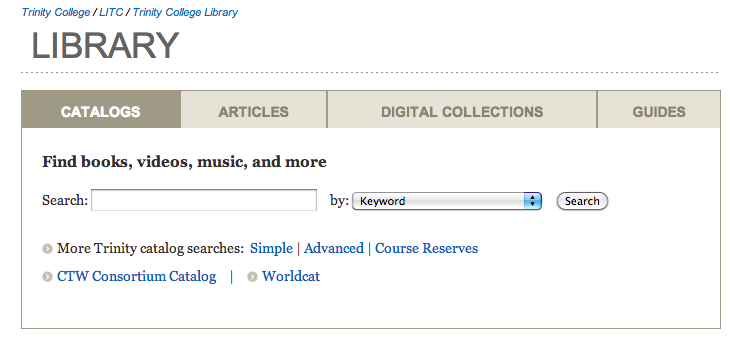
To start my search for Robert Yerkes’ Amry alpha and beta tests, I scheduled an appointment with a librarian. However, Blizzard Nemo postponed that option. Instead, I started with the library website. I began looking for Clarence Yoakum and Robert Yerkes’s book, Army Mental Tests (1920). From the library site, I clicked the link to “CTW Consortium Catalog.”

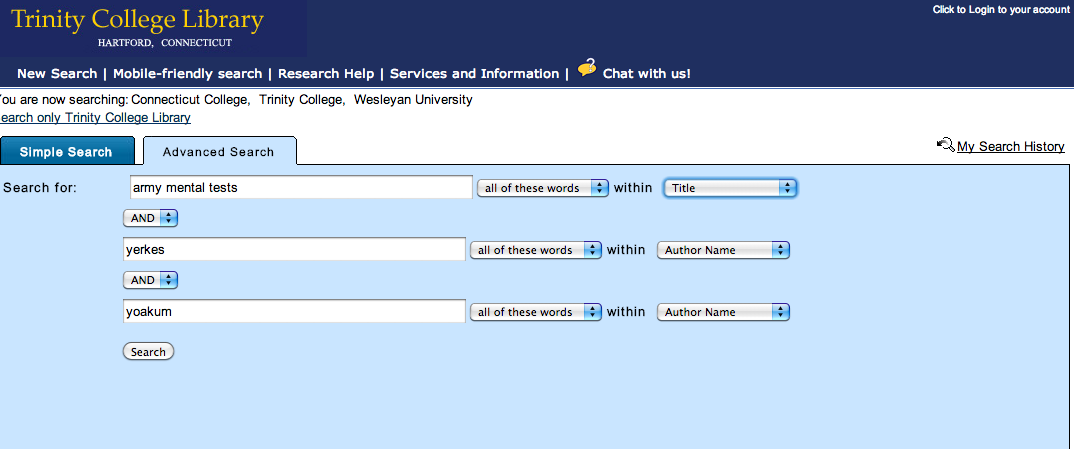
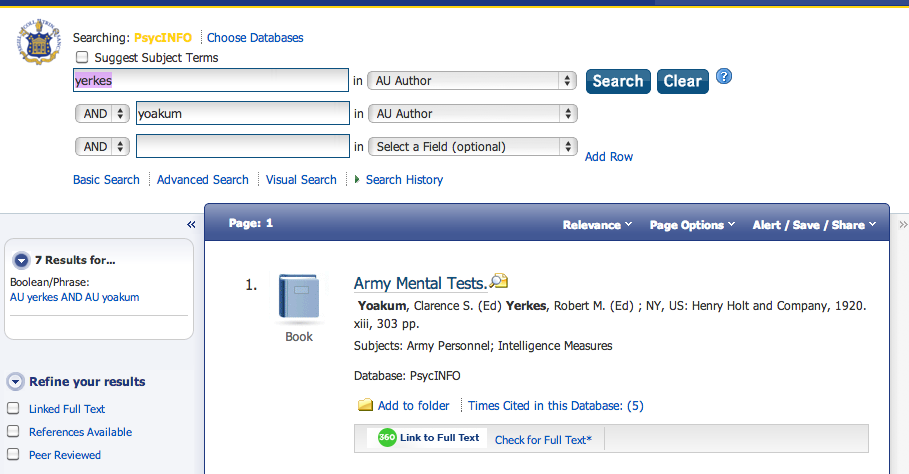
Using an Advanced Search, I looked for “army mental tests” under Title and “yerkes” and “yoakum” under Author.

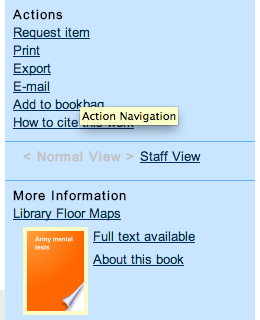
The search was successful, and a collection is available at Wesleyan University. Trinity students can request the book through the Action menu on the right side.

This is called an InterLibrary Loan and can also be done through https://illiad.trincoll.edu/illiad/illiad.dll.

Alpha and Beta intelligence tests were used to be able to test large populations with untrained examiners in 1917. These tests were used to determine candidates fit (or unfit) to serve in the army and hold officer positions. [1] Using the library database (PsycINFO), I was able to find abstracts (summaries) for the contents of Army Mental Tests. Searching “yerkes” and “yoakum” under Author, I found the book as well as information on each chapter, though not the full text itself. 

The book includes the making of the tests, the methodology and results, a guide for examining people using the test, army tests, practical applications, and blank forms. Binet, a French psychologist, created intelligence tests for school children that were used in some schools. Revisions were made, and both group and individual tests were developed for use in the army after America joined WWI. The test pages, instructions for administering, and blank forms are all included in the book. This information was gleamed from the abstracts found on PsycINFO.


[1] “Revising the Test” (on Army Alpha and Beta intelligence tests), from “Race and Membership in American History: The Eugenics Movement, Chapter 5,” Facing History and Ourselves, January 3, 2012, http://www.facinghistory.org/revising-test.


Oh Say, Can You See? (Yes, but thanks to Canada.)

Posted on

Who published the National School Service and why? For our next class we’ll read a short article by educational psychologist Robert Yerkes, “The Mental Rating of School Children,” National School Service 1, no. 12 (February 15, 1919): 6–7, http://archive.org/details/nationalschoolse01unituoft. Who created this publication and what was its purpose in 1919? What major themes stand out in the February issues? And who made it available for us to view on the Internet today?

       The National School Service was a monthly paper (magazine) produced and distributed by the Division of Educational Extension, in the Department of the Interior of the United States government. This publication was addressed namely to the teachers and educators who had the most impact on the minds of children, but was also available to the public, such as parents of children in the educational system.

         Though these monthly issues would seemingly focus on the latest academic developments and teachers who inspire change in the lives of students, the National School Service actually serves a very different purpose. These monthly papers serve as a form of propaganda, promoting nationalistic views of America and informing teachers of the most important aspects of the military…namely, the victories and sacrifices of American soldiers the government wants fed to the minds of youth. Conveniently enough, a very patriotic poem “My Country,” is plastered directly underneath Robert M. Yerkes’ article. That is to say, Major Robert M. Yerkes. Yerkes is not just a psychologist or a scholar, but also a member of the United States Armed Forces.

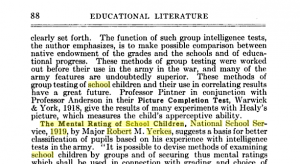
(Image from http://archive.org/details/nationalschoolse01unituoft)
Robert Yerke’s article within the February 1919 issue of The National School Service suggests a new way to evaluate the mental capabilities of students, thereby classifying them into three groups. By using “the application of mental measurement in the army,” Yerke suggests tracking students in 3 groups: A, B, and C; A completing 5th grade material in 3 years, B in 4, and C in 6. These groups would then separate students into “diverse courses,” funneling A students into a professional track, B into an Industrial track, and C into a manual labor track. Yerke argues that this would be beneficial to students’ intelligence (each student would be able to work at their own level without being pushed or held back), and would provide equal opportunities for children of families in all classes.

(Image from http://archive.org/details/nationalschoolse01unituoft)
This issue was published in February of 1919. Though World War I had just come to a close, the Red Scare was just beginning to take root in society. Furthermore, soldiers were returning from war and had extreme difficulty finding jobs. Interestingly enough, a front-page article of this issue is entitled, “Our Soldiers Become Serious Students,” and another article, “Special Message to Teachers” emphasizes how this month it is imperative that teachers stress the extreme importance of staying in school to their students. This push to both keep kids in school and send retuning soldiers back to school shows how desperate the government was to produce a highly intelligent youth after such a devastating war. Furthermore, it illustrates the lack of job opportunities that currently exist, or jobs that the government feels “may lead him nowhere.” These are most likely the manual labor jobs that Yerke’s “group C” kids would be tailored for.

(Images from http://archive.org/details/nationalschoolse01unituoft)
These National School Service issues were made available online by the Internet Archive, an incredible resource housing millions of primary sources online, and giving multiple means of locating past information on the internet. However, these issues were posted on this database by The Ontario Institute for Studies in Education in Toronto, Canada. I found this curious, seeing how The National School Service was an American produced paper. The information that I needed to answer my questions were located within the text of the February 1919 issue and I was able to reach conclusions through my own historical knowledge of WWI and the Red Scare. However, I wanted to further investigate why these magazines were made available by a Canadian library, and where, if anywhere, could I find the magazine in the archives of the United States government.

(Image from http://archive.org/details/nationalschoolse01unituoft)
I was surprised and alarmed upon realizing that the government has done a very keen job at making The National School Service papers disappear from American history. Not only was I not able to find the works through any of Trinity’s library resources, but I was also unable to find references to the issues on academic search engines such as JSTOR. 

Though the National School Service is not directly available through Trinity resources, Trinity does offer, through WorldCat, multiple resources to locate an issue.

(Image from http://trincoll.worldcat.org/title/national-school-service/oclc/1759403)

Blame it on my generation…but I was extremely narrow-minded in my thought process of: If I can’t find something online with ease, it must either not exist, or those controlling the internet must be hiding it! However, copies of the National School Service are conveniently located in many libraries (yes, with actual books….yikes!)  around the country.


It was only through a search for Yerkes (not the magazine itself) on JSTOR that I was able to find, “The Handbook of private schools” written by Porter Sargent. This book mentions Yerke’s study on the mental measurement of students as found in the National School Service, though this was the only place in which I could find any proof that such an issue even existed. 

Though the above statement is no longer accurate, I think that the passage within Porter Sargent’s “The Handbook of private schools” does a nice job of summing up Yerke’s article.

.

(Image from http://archive.org/details/nationalschoolse01unituoft)

Upon searching the National Archives at www.archives.gov/education, no record of “The National School Service” was found. Clearly, America is ashamed of the propaganda this paper promoted.

It is true that through a search of the national archives online I was not able to locate any issue of the National School Service. However, that is why the Ontario Institute for Studies in Education is so important. This library has utilized their time, resources, and funds to prioritize the online availability of the National School Service, and as scholars, we must be grateful for such accessibility to a document that reveals so much about our country’s past education system.


How to investigate the history of intelligence testing, and not be fooled by key words

Posted on

Prompt: How do you find scholarly books on the history of intelligence testing? Imagine that you decide to write a research essay on the history of intelligence testing, particularly how it evolved in U.S. education during the twentieth century. Describe your search strategy for finding books on this topic at Trinity Library, and cite five of the most relevant titles. (Hint: the goal of this question is to distinguish between keyword and subject-term searches.)

This past week I was able to meet with Trinity librarian Erin Valentino. I have learned in my time here that it would be considered foolish not to meet with a librarian before beginning research in the library. Her assistance in navigating the vast collection of media within the library is something that was essential to me completing my source detective question.

To begin, she asked me what kind of media I was looking for. I replied “books” as the question states. She told me had I answered articles, we would look under scholarly sites such as JSTOR or simply the Trinity College Article Database. Because I did answer books however, she directed me to WorldCat, which searches amongst all types of media. She told me we will be utilizing the “advanced search” feature.

I began by entering “iq test history” in the keyword field.

I recieved 1,637 search results. I was told that because I had searched by keyword, any publication containing the texts: “iq”, “test”, and “history” will be generated. I searched through the first 15 until I was able to select a book that I thought would be essential in a report. It was titled “IQ: a smart history of a failed idea”.

On the bottom of the page was the call number, which is how one would find it on Level 3. But to the right is a field titled “More like this”. This is used to suggest books of similar topics to the inquirer. It also lists the subjects these books are categorized under within the system. One subject I found on the right side of the page jumped out at me: “Intelligence Tests–history.”

Subjects> Intelligence Tests -- history.

I brought my cursor over the text and clicked, refined the search for only books, and was brought to a more concise, only 214 items long. This is when I felt I had arrived at where I was supposed to be looking for information, for all the books shared the subject of “intelligence tests– history” rather than simply containing a word or three. Keywords can help you start, but once you have figured out which direction you want your research to head, subject searching is much more helpful.

*I was able to further specify the subject into “intelligence tests–history–20th Century United States”, in an attempt to address the initial question better, but I found that some books were left out of the search that would have been useful, such as The Big Test by Nicholas Lemann.

At the end of my research session, I organized my results in order of relevance and found that the 5 most relevant books on the subject of the history intelligence tests were:

The mismeasure of man
by Stephen Jay Gould
The intelligence men, makers of the IQ controversy
by Raymond E Fancher
The big test : the secret history of the American meritocracy
by Nicholas Lemann
IQ : a smart history of a failed idea
by Stephen Murdoch
Measuring minds : Henry Herbert Goddard and the origins of American intelligence testing
by Leila Zenderland
The 5 most relevant books on the subject of the history of intelligence testing.

A special thanks to Erin Valentino for her assistance during my research.

How did book reviewers assess Ravitch’s reversal?

Posted on

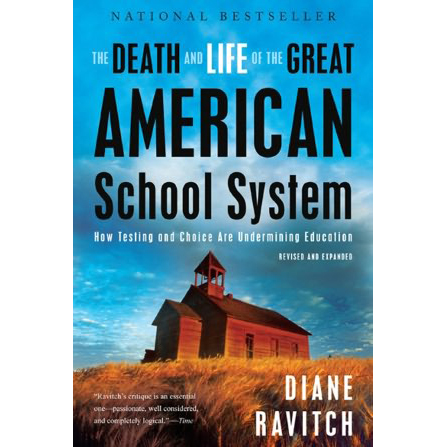
Question: How did book reviewers assess Ravitch’s reversal? Next week’s book, The Death and Life of the Great American School System, became a best-seller in part because of the dramatic shift in thinking by its author, historian and policy advocate Diane Ravitch. How do you locate in-depth reviews of this book in both scholarly and popular media? Describe your search strategy, and quote some representative reviews, including both favorable and critical comments.


 In The Death and Life of the Great American School System, Diane Ravitch, also known as one of America’s education experts, desperately claims that America’s educational system must be immediately reformed in order to protect and improve the quality of education. This book caused a major uproar within the Educational reform community, because of Ravitch’s change of heart. As a former assistant secretary of education, Ravitch worked closely with the Bush administration in order to implement the No Child Left Behind Act nationwide. Critics have flooded the Internet with extensive book reviews on The Death and Life of the Great American School System, favoring and objecting her views. It was fairly difficult to determine whether reviews on Ravitch’s works were considered scholarly reviews, or ones posted in popular media. Scholarly reviews are those written by scholars, whether they are published on blogs such as Word Press or whether they are published onto scholarly journals/databases.


Option One: Looking inside the book

This source detective work assignment asked me to locate in-depth reviews on Diane Ravitch’s The Death and Life of the Great American School System. The first thing I did was to look inside the actual book itself to locate some of the blurbs/excerpts regarding her book, since many authors tend to give a few lines. In this case, the book’s very first page read: Praise for The Death and Life of the Great American School System. I immediately realized that although I would be able to find entire book reviews through the lines provided, the chances of me reading a critical book review were slim to none, so my next action was to actually Google some of the lines provided by the author. This gave me a better insight to some of the book reviews, and whether the author had taken specific lines from a critical book review. Some of the praises that were selected to appear in her book that were published onto popular media websites such as NYTimes.com, were actually written by scholars- in this case Alan Wolfe, a political scientist, and sociologist/Professor at Boston College.

Other favorable book reviews on her book, such as that written for the Denver Post were written by guest writers, which are not considered scholars. The most important thing to keep in mind while searching for scholarly book reviews is to acknowledge the fact that there is a distinction between scholarly and popular media. The easiest way to determine what is scholarly and what is not, requires you to Google the author and make the connection based on the information given regarding who wrote the article.


Option Two: Google is Indeed Your Friend!

My search to locate critical book reviews, led me once again to Google- only this time to locate the actual author’ website, where the author provides hyperlinks to her book reviews found throughout the Internet.

  1. Using your laptop or a desktop at the Trinity College Raether Library, use Google and search “Diane Ravitch Reviews.
  2. The very first link provided by Google should lead you directly to Diane Ravitch’s website- specifically the section where the reviews are found.
  3. You will note that there are two sections to the webpage- Book Reviews, and Commentary About the Book or Author, we must keep in mind that we are looking for book reviews and not commentaries regarding the book itself.
  4. Only some of the links provided under Book Reviews lead to in-depth reviews, always remember to Google the author if the link provided leads to a Word Press Blog, or an article published on a website. Also remember that although Amazon may list some lengthy and critical reviews- those may not necessary count as scholarly or even popular media because of the nature in which the comment is being made.


Option Three: Using Resources Provided by Trinity College (My Personal Favorite)

Ask a Research Librarian

Make great use of the Trinity College Librarians, they truly do know how to give you the answer to all questions that are research related.

 I was fortunate enough to be able to walk into the library and receive immediate help upon asking for it at the front desk. Usually the best way to go about meeting with a research librarian is to make an appointment through the Library Scheduler website.

I was able to meet with Outreach Library Kelly Dagan and explained to her that I needed assistance in locating scholarly databases such as WorldCat.org where I could find Scholarly reviews on The Death and Life of the Great American School System. Kelly asked me what the book was about and explained to me that it was fairly easy to find databases that were geared toward my specific area of study.


  1. I was told to go to the Trinity College Library Website, and under Articles, to search up the Educational Studies database. This lead me to a webpage that lists databases specifically geared towards literature on Educational Studies.

    Screen Shot of the Trinity College Library Website
  2. Kelly pointed out to me that JStor, and the Education Full Text databases were the best ones suited for my search.

For the two databases, I realized that I would be able to refine my search to Reviews, specifically to Scholarly (Peer Reviewed) entries on both of the websites.

Both the JStor search, and the Education Full Text databases produced dozens of findings (scholarly reviews) on The Death and Life of the Great American School System. (Click on the links above to see for yourself!)


Findings
I found it easier to locate book reviews that favored Ravitch’s radical work, than to locate those critiquing it. Some of the more favorable comments included:

“The first thing to say about Diane Ravitch’s new book, The Death and Life of the Great American School System (Basic Books, 2010), is that it is the bravest book on education in years, perhaps ever. Why brave? Because it’s a book about being wrong, a book that rejects reforms Ravitch once espoused, and that, like most mea culpas, will probably lose her many old friends without gaining her nearly as many new ones.” – Richard Barbieri, Independent School

“Ravitch writes early in The Death and Life of the Great American School System, “When we are too certain of our opinions, we run the risk of ignoring any evidence that conflicts with our views.” Her ability to change her mind is what makes this book so valuable. In it, Ravitch explains clearly why she first believed in NCLB, why she changed her mind, and where she believes current school reform efforts are wrong. This is an important book. Ravitch has done us a great service. Policy makers ignore her at everyone’s peril.” – Dudley Barlow, Education Digest


Below are some of the comments I found critiquing Diane Ravitch’s works:

“While I applaud Ravitch- after all it takes a good deal of courage to do what she is doing- I am also tempted to ask a somewhat impolite question. Given the immense evidence against the positions she had originally so strenuously supported, what took her so long?” – Michael W. Apple, Educational Policy

 “While Ravitch covers the landscape of issues thoroughly, she offers few solutions to the problems she has posed, some are not only worth considering, but have been shouted from the rooftops in the field of education, other hearken back to Ravitch’s conservative roots with frightening results.” –Scott Cody, InterActions: UCLA Journal of Education and Information Studies


Works Cited

1. Apple, Michael W. “Challenging One’s Own Orthodoxy: Diane Ravitch and the Fate of American Schools.” Educational Policy 24.4 (2010): 687-98. JSTOR. Web. 31 Jan. 2013.

2. Barlow, Dudley. “The Death and Life of the Great American School System.” Education Digest 76.2 (2010): 69-72. Education Full Text. Web. 31 Jan. 2013.

3. Barbieri, Richard. “The Death And Life of The Great American School System.” Independent School 71.1 (2011): 118-20. Education Full Text. Web. 31 Jan. 2013.

4. Cody, Scott M. “Review: The Death and Life of the Great American School System: How Testing and Choice Are Undermining Education by Diane Ravitch.” InterActions: UCLA Journal of Education and Information Studies 6 (2011): 1-4. EScholarship. Web. 1 Feb. 2013.


No Sect Can Rule This School: A Journey through Harper’s Weekly (May 8, 1875)

Posted on

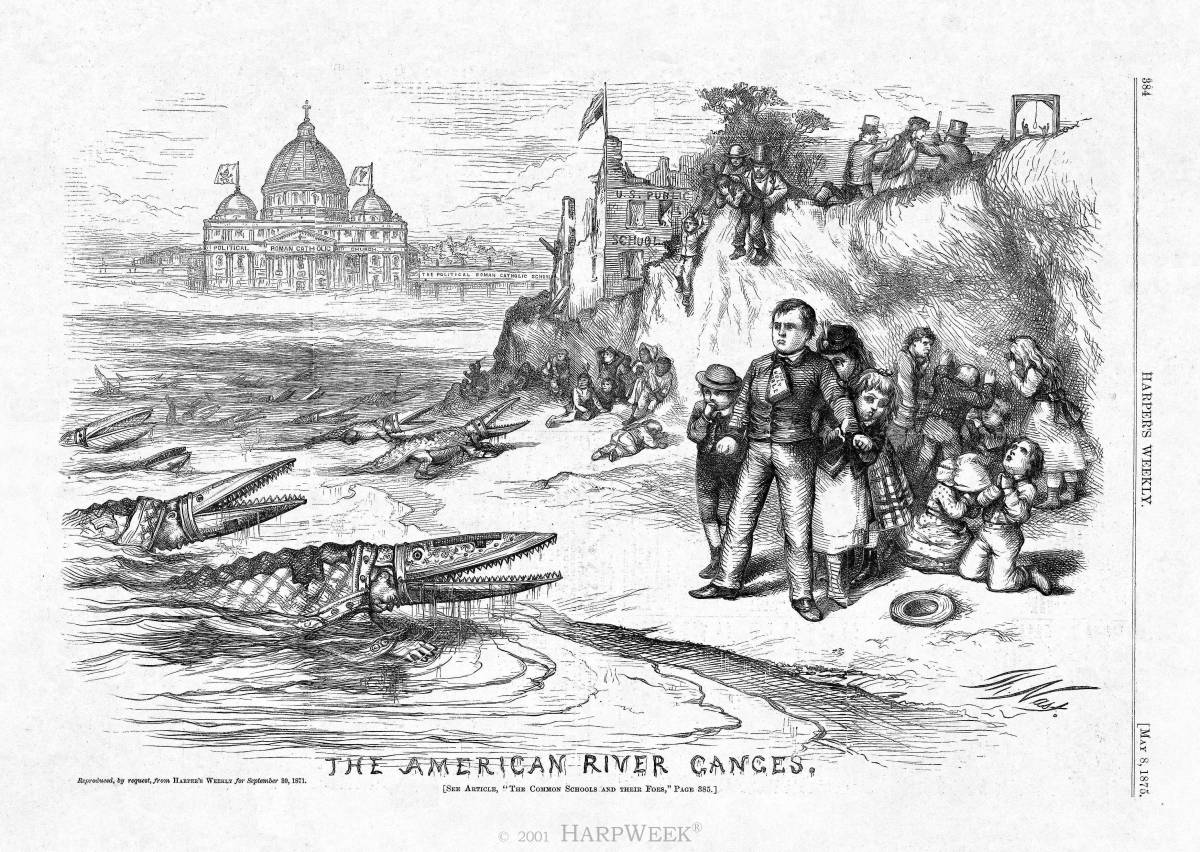
What was the companion article to Thomas Nast’s political cartoon? In our next class we will examine a political cartoon by Thomas Nast, titled “The American River Ganges: The Priests and the Children,” which appeared in Harper’s Weekly, May 8, 1875, page 384. The cartoon is freely available online. In fine print at the bottom, it refers to a companion article, “The Common Schools and their Foes,” on page 385 of same issue. Describe your search strategy to locate the article and summarize its content. (Hint: Sometimes the past is only available in print.)

This week, I had the opportunity to do some real detective work to find my source. The first stop of my search was the Watkinson Library at Trinity College (Hartford, CT) and it happened to be my only stop. I was greeted at the door by an extremely well-dressed elderly gentleman, Mr. Peter Knapp, Special Collections Librarian and College Archivist who was eager to hear about my problem and see how he could be of assistance. When I showed him Thomas Nast’s political cartoon, “The American River Ganges,” I could tell by the smile on his face that he was quite sure what I needed. He asked, “Harper’s Weekly?” and with an astonished look on my face, I simply responded, “Yes, please.” I took the courtesy of leaving the main floor for a few minutes while he searched for the Harper’s Weekly 1875 Edition (It is standard procedure that guests of the Watkinson cannot be left unattended on the main floor.)

When Mr. Knapp returned, he brought with him an extremely dense book titled “Harper’s Weekly – 1875” and suggested that I could find what I was looking for on page 385 (in reference to American River Ganges). When I opened to page 385 I found the companion article titled “The Public Schools and its Foes.” Directly above the article was another political cartoon by Nast. This cartoon titled, “No Church need apply” depicts a Catholic bishop handing out Vatican decrees to young school-aged boys. The boys stood in the doorway of a school, and the sign beside the doorway read, “No Sect can rule this school,” the main theme of the companion article.

The companion article written by Eugene Lawrence highlighted the greatest enemy of the common schools as being the Roman Catholic Church and its leader Pope Pius IX as well as other religious/political institutions that did not promote American common schools. The article favored the condition of the common schools and emphasized what we consider today to be the separation of church and state:

“Their people have become conscious that the common school is the source of ease, comfort, wealth; that it doubles the value of their lands, build towns, factories, railroads; and hence all over the south there is a plain advance toward a new condition of society.” (p.386)

Furthermore, Lawrence cited the common schools as places for “repression of violence” and “cultivation of knowledge” and expresses the notion that the enemies of the common school, which included, “a foreign pope, democratic politicians and a foreign sect” as being responsible for “the decreed destruction of the common school…” (p.386)

Lawrence speaks to his readers as an advocate of reason and truth, he says that the “newspaper is the natural fruit of the common school” (p.386) which would allow readers to give credence to his published article on the evils of the Roman Catholic Church and other Religious institutions and their corruption of American schools:

“At Des Moines, when an episcopal clergyman assailed the common schools from his pulpit, members of the congregation rose and left the church, in protest of religious bigotry…” (p.386)

He goes on to say that schools under the jurisdiction of Pope Pius IX were “never needed” and questions why they were built in the first place – while alluding to the fact that they were built to contest the traditional common school system.

Lawrence mentions that the public (common) schools offer “ample room for all the children of the city” (p.386) in reference to the many parochial schools in New York City. He goes on to say that Papal priests were in association with Boss Tweed and Peter Sweeney and had a direct involvement as conspirators in the political ring. This piece of the article was towards the very end – almost as if to tell his readers: if you still aren’t convinced…here’s more proof.

Lawrence ends his piece with two very important quotes, which sum up his article on the separation of church from American schools, but even more importantly, the vilification of all who opposed the common schools. The first quote stood out to me because of the notion that those who did not support common schools must not support their country as loyal Americans:

“No patriotic American of any creed of race will suffer his own honest and necessary principle of un-sectarian education to be tainted by any dangerous compromise…” (p.386)

Finally, Lawrence urges his readers to understand that: “the only sure defense we have against it, is to vote it down…” (p.386) in reference to the church’s presence in American schools and the political authority that  common citizens yield through their right to vote.

Acknowledgements

A very special thank you to Mr. Peter Knapp and the Watkinson Library staff for allowing me to use their vast archives.


Women and Public Speaking in 19th Century

Posted on

Were 19th-century women permitted to be public speakers? 

To answer the presented question I used my prior knowledge and skills from being a history major to approach the question. I used the Trinity College Library online resources and databases to search for sources that would be able to answer the question. I personally prefer JSTOR, so I searched through JSTOR.

A struggle and very important aspect of searching in JSTOR is the keywords that you use to search. In my first search I used the keywords “19th century”, “women”, and “public speaking”. I further narrowed my results by only searching for results in English that are articles, books, or reviews, and narrowed the discipline to American Studies, Education, Feminist and Women’s Studies, and History. My results were very scattered, in order to narrow it down and to get better results I modified my search and added the keyword “American” in addition to my previous keywords. My search results yielded this. After that, I read the titles of the works and picked out a few that I thought would help answer my question. The following titles are the articles that I thought would help me to answer the question: “Schooling Women in Citizenship”, “woman’s High Calling: The Teaching Profession in America, 1830-1860”,  “On the American Dream: Equality, Ambiguity, and the Persistence of Rage”, and “Allowed Irregularities: Women Preaches in the Early 19th-Century Maritimes”.

In the article “Schooling Women in Citizenship” by Susan Douglas Franzosa, I found a quote that read “In the schools, girls and boys learned to revere and support the laws that provided for women’s disenfranchisement and prohibition from speaking in public, owning property, holding political office, and voting”.[1]  On the other hand, in the article “Allowed Irregularities: Women Preachers in the Early 19th-Century Maritimes” by D.G. Bell it reads “This study uncovers no tradition of female preaching in Maritime Protestantism, but the findings suggest tat female preaching was not uncommon”.[2] A female preacher suggests that women were allowed to be public speakers and in front of audiences of both men and women. However, it has a religious dimension attached to it. It does not answer the question of whether a woman would be able to give a public speech on something other than religion. In addition, in the article “woman’s high calling: the teaching profession in America, 1830-1860” it says, “When the movement to improve the public schools took hold in the 1820s and ‘30s, leading reformers could point to women teachers and pupils in the female seminaries as qualified instructors for common schools”.[3]

In order to further my search, I went out on a limb and googled the presented question. Most of the times nothing but Wikipedia or other unreliable sources come up.  However, this time it presented me with an interesting source “Social Conditions Inspired Women to Speak Up – In Speaking Up Women Changed History”, which said “Women could not speak in public without fear of being hit with rotten vegetables or worse”.[4] Eventually, “A few of the young women at Oberlin, led by abolitionist and feminist Lucy Stone, organized the first debating society ever formed among college girls. At first they held their meetings secretly in the woods, with sentinels on the watch to give warming of intruders and later at the home of an old black woman at the edge of the wood”. [5] Furthermore, Phillips the author of this article comments, “Stone, who graduated from Oberlin in 1847, refused to write a commencement speech since she would not be allowed to read it. Ten years later, in 1857, Oberlin College finally allowed a woman to read her part at the public ceremony”.[6] Phillips argues that after the middle of the century women were beginning to be allowed to speak in public.

With this knowledge I went back to JSTOR and used “lucy stone”, “19th century”, “America”, and “public speaking”. I did not find many different sources. In order to find more sources I decided to use a different database, Google Scholar. I just typed in “lucy stone 19th century public speaking” and discovered a book titled Lucy Stone: Pioneer of Woman’s Rights”. I then searched within the book for “public speaking”. With these results I was able to confirm the discoveries of the article by Lois Phillips, that Lucy Stone was able to public speak as a woman and was headlining this campaign. However, it was not until after half way through the 19th century that this was possible.


[1] Susan Douglas Franzosa, “Schooling Women in Citizenship”, Theory into Practice , Vol. 27, No. 4, Civic Learning (Autumn, 1988), 278.

[2] D.G. Bell “Allowed Irregularities: Women Preachers in the Early 19th-century Maritimes”, Acadiensis , Vol. 30, No. 2 (SPRING/PRINTEMPS 2001), 4.

[3] Keith e. Melder, “woman’s high calling: the teaching profession in America, 1830-1860”, American Studies , Vol. 13, No. 2 (fall 1972), 20.

[4] Lois Phillips, ‘Social Conditions Inspired Women to Speak Up – In Speaking Up Women Changed History”, 4.

[5] Phillips, 7.

[6] Phillips, 7.


Learning Goals: Ed300

Posted on

As a visiting student, I expect that this class will provide a unique perspective on present-day education reform by encouraging exploration through a historical lens. Much of my past experience and current realm of study engages learning and reform through  lenses of modern research and cognitive development. I am excited to look for historical patterns in order to newly inform my perspective in the current education reforms.

What do I wish to take from EDUC 300?

Posted on

I recently became acquainted with the Educational Studies program at Trinity, and immediately fell in love with the courses that were offered. As a student who has been through many different types of educational institutions, including public and now private, I have noticed that there is a major problem that exists in the way schools teach our children. As an Educational Studies major, I hope to learn what causes these imperfections in the system, and particularly what have policy-makers in the past done to relieve many of the problems. As mentioned, this class will not only teach me the aims that educational reformers had in the past, but it will also teach me what we can do in the future. I also hope to polish my writing skills in order to properly execute my ideas about Education reform.

Reform Through the Red Tape

Posted on

I spent the last two and a half years working at a community college. More often then not in attempting to implement a new program, activity or initiative I was met with a daunting series of bureaucratic red tape. It was all incredibly frustrating to me and I constantly was asking myself, “Why is change so hard?” along with “Where does this resistance stem from?” Attending Trinity and in particular taking this course is my attempt to begin to answer those questions. I want to learn about the process of change in our educational system, how and why some reforms succeed, what are the catalysts for educational reform and how all the moving pieces come together to break the barrier of inertia, as I have experienced it, in education.  Additionally, I have limited experience with many of the technologies being used in this course and look forward to gaining exposure to these.

Blazing My Own Trail

Posted on

Ed 300 will satisfy a requirement for the Educational Studies Major. I am excited about this class because I will have the opportunity to learn more about what Ed reform is and about strategies that have previously worked as well as getting the opportunity to analyze those that did not work (and somehow apply it to my Ed Studies Concentration: Race, Social Class and Social Relations in Urban Education.) My ultimate goal in life is to be a leader in a school district (hopefully Hartford) and I appreciate the opportunity to explore in depth the idea of Ed Reform in the hope that I can acquire the necessary tools to become an Ed “Reformer” one day, too.

“We Don’t Need No Education”

Posted on

Freshman year, I was enrolled in a first year seminar named after the lyrics within the famous song serious, “Just Another Brick in The Wall,” by Pink Floyd. This course focused on student movements, narrowing in on students’ intense desire to modify the system so that it better reflected and represented their needs.  In this class, I hope to discover more in depth how the education system has changed over time, and the social pressures that assisted in bringing about such change. Furthermore, I hope to better understand which societal groups (whether they be religious, political, racial, etc) have the most prominent impact in bringing about academic reform/change, and why.

Lessons in Educ 300: Education Reform, Past & Present

Posted on

As the spring semester begins, I am happy to have new learning opportunities. When I took Educ 200: Analyzing Schools last spring, I did not know that I would fall in love with the content of the course and discover my passion for education. Through this class, I hope to gain more knowledge on the education reform movements that have happened in the past and are currently happening to discover how I would like to make my mark in changing the education system. I am aware that in order to look forward to the future, I must look at the past. I look forward to the readings, videos, and class discussions to come.

What I Wish to Learn

Posted on

Within this course, I first hope to learn about the history and current state of Education policies and reforms. I would like to see how policies have changed schools that I work and volunteer at as well as at the schools I attended. I look forward to watching documentaries about the current state of the education system and read about the history. My learning goal is to become better equipped to become involved in the education system.

Beyond the basic knowledge, I hope to gain skills to be a better writer and researcher. Whether looking at archives and books or searching sources online, I need help improving my skills of digging deeper. With my writing, I hope to be able to create stronger theses and clearer transitions.

All the wonderful things I wish to learn…

Posted on

I hope to learn more about the public side of schooling. From to going to school board meetings and hearings in Philadelphia, I found I was interested in how the school boards interact with the surrounding community. Reforming schools is a processe that requiers a large amount of community approval and involvement to be effective, so I hope to learn more about how that takes place.

What I’d Like to Learn

Posted on

Thoughout the course of the semester I would like to learn how to write as well as analyze web journals. In my previous class students never had the opportunity to do such a thing, so having this opportunity is helpful for me simply because it is a new skill as well as a challenging task that can improve my writing.

My ED300 Goals

Posted on

In Education 300 I hope to gain greater skill in research, writing, and reading. Through these I wish to obtain an understanding of education movements past and present. I especially look forward to utilizing the Watkinson Library.

What I Wish to Learn in EDUC 300

Posted on

As a history major, I am very interested in the history of the education system of America. Therefore, this class seems to fit perfectly in what I am interested. I hope to learn how the education system got to where it is now.  The main reason I want to learn this is because I want to be able to analyze potential ways to continue to reform and improve the education system. I hope to learn about the history and be able to apply it to the present and future.

In addition, I hope to learn journalistic writing and overall improve my writing skills. I am very excited about having to attend and critique a public event on educational policy. I think that it will be very interesting to view the current issues and problems that the education world is dealing with. Furthermore, I am excited to be able to relate it to the history of education reform.

My hopes for Ed 300

Posted on

In Ed 300, I hope to learn how past education policy and culture has informed our modern educational structure.  I would also like to utilize this learning to put current ed policies and practices in context.  I also hope to learn valuable research methods (particularly how to include technology resources) to assist in my coursework as a potential Ed Studies major.

My Learning Goals

Posted on

Throughout this class, I hope to grasp an understanding of both education and it’s history in order to interpret the different types of reform now. I would really like to grasp the roots of education and be able to express my own opinions and understand the opinions of others as well about education reform. Being able to understand the past of education reform also is something I want to grasp in order to possibly understand the new reform throughout education at the moment and possible reform that can be created to prevent past wrongs or continue reform that has been continuously working.

My learning goals

Posted on

In Ed 300, I’d like to learn more about the history of education reform and how it has shaped our country’s current education policies.  There is so much controversy and debate over what should be done about school systems, and I believe that it will be beneficial to learn about past reform movements and comparing them to what is going on now.

My Learning Goals

Posted on

This semester I hope to learn more about the history of education reform as well as discuss current issues within the education system in our country.  I would also like to improve my researching skills by learning how to use and source texts in our library more effectively for future research papers.  I have never formally written anything on the web, so I look forward to learning how to properly do this.

My Learning Goals

Posted on

I wish to learn about the policies that have come to shape today’s schooling system. I wonder which previously enacted polices essentially compromised certain individuals’ and/or group’s educations and which proved themselves to be considerably successful. Are there any plausible solutions to today’s arguably unequal educational system?

Learning Goals

Posted on

In taking this course, I hope to further my knowledge about the educational system of our country, and how they have changed along with the times. So far, I think I picked to the right course to learn about that kind of stuff.

Specifically, I am interested in System Building vs. Decentralization. I helped out in HPS last year and definitely recognized that things were different than I thought they’d be. I am curious to hear the opinions of scholars who have spent their lives trying to determine the best way to educate the American youth, and hopefully form a belief of my own.

Academic Dishonesty and the Internet in Higher Education

Posted on

To most educators, the essential element to the success of their mission is academic integrity. It can be said that higher education as well as society will benefit from standards of integrity that pave the way for vibrant academic life, promote scientific progress, and prepare students for responsible citizenship. Despite efforts to uphold such principles, academic dishonesty is a growing concern for most educational institutions. Academic dishonesty has been a problem in schools as long as schools have existed, but over the past decade researchers and teachers have reported a dramatic climb in the occurrence of academic dishonesty especially among students in higher education, seemingly sparked by the rise of the Internet. Although increased technological developments of the last twenty or so years have been critical in creating new aids in research and avenues for faculty to publish their works, the Internet has made it easier for students to plagiarize, fabricate, and tamper with information. Another important factor that can be considered is student confusion over the nature of originality and textual appropriation when it comes to using online resources. Because many students do not know exactly what constitutes cheating and plagiarism through the use of the Internet, it is becoming increasingly more common and acceptable among students to use sources found on the Internet in some way that is not in accordance with higher education institutions. With this, can it be proven that the growth of academic dishonesty been facilitated by the Internet and have the methods in which academic dishonesty is employed changed since is widespread prevalence?

What is Academic Dishonesty?

Academic Dishonesty, “includes ‘cheating,’ ‘fraud,’ and ‘plagiarism,’ the theft of ideas and other forms of intellectual property-whether they are published or not. (). This practice is commonly believe by many to endanger the quality of education and depreciate the authentic achievements of others. There are many different forms of academic dishonesty including plagiarism, cheating, fabrication and falsification, multiple submissions, misuse of academic materials, and complicity in academic dishonesty. Plagiarism is the use of another person’s distinct ideas or words without acknowledgment. On the other hand, cheating involves the possession, communication, or use of any type of information not authorized by the instructor. Fabrication and falsification means to invent or counterfeit information by creating your own results or deliberately altering information in any academic exercise. Another form of academic dishonesty that is often overlooked is that of multiple submissions, meaning submitting academic work for which academic credit has already been earned. Misuse of academic materials includes stealing, destroying, or unauthorized possession/alteration/sale/purchase of any academic materials. Lastly, complicity in academic dishonesty, sometimes overlooked, entails knowingly contributing to another’s acts of academic dishonesty ().

Growth of Academic Dishonesty

The Internet has revolutionized the computer and world of communications like nothing ever before. The invention of the telegraph, telephone, radio and computer, set the stage for the unprecedented integration of capabilities that later arose with the invention of the Internet. It is generally agreed upon that the Internet reached public consciousness in the United States in the mid to late 1990s and with this later came the growth of academic dishonesty. Here are some studies and cases about academic dishonesty that lead to insight about its relation to the Internet:

In a study, “The Impact of Unethical Reasoning On Different Types of Academic Dishonesty: An Exploratory Study,” the authors argue that there is an increase in academic dishonesty in the education system, which is concerning because it is suggested that those who cheat in college are more likely to cheat on the job. The idea that it is likely that students who cheat in academics are more likely to cheat in the business world coupled with the thought that academic dishonesty is on the rise, is problematic for it would seem to create an increasingly corrupt society. This is one of the reasons professors and academic institutions are concerned about this growing problem (Iyer 2008).

“A Campus Fad That’s Being Copied: Internet Plagarism,” is an article about how a study conducted in 2004 on 23 college campuses has found that Internet plagiarism is rising among students. Out of the undergraduate students surveyed said that in the last year they had engaged in some sort of Internet plagiarism without citation. In a similar survey three years earlier than this study, only 10 percent of students had acknowledged such cheating. This study in 2004, by Donald L. McCabe from Rutgers University, surveyed over 18,000 students, 2,6000 faculty members and 650 teaching assistants at large public universities and small private colleges nationwide, not including Ivy Leagues. Professor McCabe says, “There are a lot of students who are growing up with the Internet who are convinced that anything you find on the Internet is public knowledge and doesn’t need to be cited.” This studied revealed that about half the students who participated in the study considered Internet cheating to be trivial plagiarism while only twenty-two percent of undergraduates acknowledged that they have cheated in a “serious” way in the past year. According to the majority opinion of students, the more serious way of cheating is copying from another student on a test, using unauthorized notes or helping someone else to cheat on a test. Most students believe that cheating and plagiarism through the use of the Internet is less serious and therefore students are more likely to partake in this sort of plagiarism. The article also adds that administrators at Princeton have said that many times students as well as parents do not understand why it is wrong to using sections of text for academic word without using citation. The author ends by saying that colleges need to make it clear to their students what defines cheating and that is important to uphold principles of academic integrity in order to stop the growth of academic dishonesty within educational institutions (Rimer 2003).

In the article “Student Online Plagiarism: How Do We Respond?” the author talks about how it has been perceived that Internet plagiarism by college students is on the rise and that professors and administrators are alarmed. It reviews quantitative studies of student plagiarism over the past forty years, as well as how institutions have responded weakly. Lastly it offers strategies for addressing and preventing such plagiarism. The author reveals that quantitative studies based on student self-reports have reported high levels of academic dishonesty over several decades, but vary from 9 to 95 percent of students admitting to some form of academic dishonesty. It is found that Internet plagiarism is highly influenced by peer behavior on students’ decisions to plagiarize and that it is on the rise among high school students. Because of this, it is now even more critical how colleges respond to such dishonesty. In the past, cheating and plagiarism was more time consuming, as it required students to obtain books, read, and copy. Now students can find online resources in a matter of seconds, with just the click of a mouse, which has led to the growth of academic dishonesty (Scanlon 2003).

In the literature review of the study, “It’s Wrong, But Everybody Does it: Academic Dishonesty among High School and College Students,” it is suggested that cheating has increased over the course of the past several decades. “In 1941, Drake found that 23% of college students reported cheating. Goldsen (1960) reported rates of 38% in 1952 and 49% in 1960. By the 1980s, Jendrek (1989) estimated the typical rate between 40 and 60%. By 1992, she found that 74% of college students engaged in cheating (Jendrek, 1992). Even more recently, researchers have reported rates as high as 90% (Graham, Monday, O’Brien, and Steffen, 1994). These rates pertain to college students” This study gives evidence that academic dishonesty has increased since the Internet has become mainstream and continues to become more widely used.

Here are studies and reports of academic dishonesty from 1915-2010:

http://www.cheatingculture.com/academic-dishonesty/2010/10/7/academic-dishonesty-studies-and-reports-1915-2010.html

Methods of Academic Dishonesty through use of the Internet

Although it is commonly accepted that the Internet in general is an easily accessed source in which students take unfair advantage in academia, there are many different ways students obtain information on the web. In an analytical study on where students find unoriginal content on the Internet, “Plagiarism and the Web: Myths and Realities,” close to 40 million college student papers were examined to obtain a glimpse into the resources students use over the Internet. These papers were submitted to Turnitin, which is the leading plagiarism prevention and wiring application for instructors. The results reveal that there were about five different resource categories that students used when it came to plagiarism, although it was reported that some were used more often than others. These five categories are as follows: Social networking and content sharing, homework and academic, news and portals, paper mill and cheat sites, encyclopedias (White Paper).

Social networking and content sharing are sites that rely on user-generate content rather than published professional content. These social networking sites include sites such as Facebook, MySpace, and question and answers on Yahoo Answers and Answers.com. The homework and academic category encompasses websites that are established to help students prepare for tests or give aid in some educational or academic aspect. Most of these sites have .org or .gov domain registrations, but also includes sites such as www.bookrags .com and www.sparknotes.com. News and portals include sites that have a traditional published model, such as the New York Times, and the Huffington Post. Sites that profit from students selling and exchanging original student papers are called paper mills or cheat sites. Lastly, encyclopedia web sites are classified into their own category because of its vast and growing popularity, including Brittanica.com and Encyclopedia.com and Wikipedia (White Paper).

The results of the study show that plagiarism is going social. One-third of all content matched in the study is from social networks or other question-and-answer sites where users contribute and share information over the web. One-quarter of all matched material is from educational web sites, which is more than double the number coming from paper mills or cheat sites. This means that educational sites are a more popular way students tend to plagiarize, although paper mills and cheat sites are the third most popular category for matched content. With 7 percent of matches, Wikipedia remains the most popular single source for student-matched content. This study also argues that educators who employ the proper tools and technologies can minimize plagiarism. The authors present this argument by giving statistics that institutions with widespread adoption of Turnitin experience a reduction in unoriginal content of 30 to 35 percent in the first year. By the fourth year, many see levels of unoriginality fall up to 70 percent. (White Paper).

Discussion:

With the increasing prevalence of the Internet and advancing technology, students have become more creative and discrete in how they go about cheating. The old standards of cheating, prior to the invention of the Internet, often involved looking over a classmates shoulder during a test, copying homework from another student, or bullying someone into writing a paper. The Internet itself has become a breeding ground for plagiarism as students often just copy and paste information and declare it as their own words and ideas. Although there are many studies and reports that have given evidence that academic dishonesty is on the rise, it cannot be fully proven. It is true, however, that the Internet has allowed for different methods of cheating that were impossible before its widespread popularity, but many people are unaware of what constitutes such cheating. It is unclear whether students have significantly dropped their old methods of cheating and replaced them with techniques involving the Internet, although it is pretty well known that both methods are still in considerable practice. With the rise of the Internet, it has also become easier for professors and educational institutions to detect academic dishonesty, such as plagiarism, from Internet sources through the use of devices that are able to detect unoriginality. It is only until recent years that universities and other academic institutions have been keeping records of academic dishonesty cases. When starting my research project I originally wanted to find out if academic dishonesty has increased at Trinity College since the 1980s, but I found that I was unable to do so. I spoke to Peter Knapp to see if there were any files on such cases in the Watkinson Library, but he told me that there was no pertinent material in the Archives. He told me that the best place for me to go would be the Dean of Students’ Office for this information, but when I told Dean Reuman about my research she told me that there is only data from the last 7 years. Because of this I found it to be impossible to complete my research on this specific matter. It may be that there is a rise in concern over academic dishonesty in recent years and more honor councils are being established to punish cheating and promote academic integrity.

Here are studies and reports of academic dishonesty from 1915-2010:

http://www.cheatingculture.com/academic-dishonesty/2010/10/7/academic-dishonesty-studies-and-reports-1915-2010.html

Works Cited

Rimer, Sara. 2003. “A Campus Fad That’s Being Copied: Internet Plagiarism.” New York Times, 3 Sept. nytimes.com/2003/09/03/education/03CHEA.html

Scanlon, PM (2003) “Student Online Plagiarism: How Do We Respond?” College Teaching, 51: 161-5. Schon, D. (1983) The Reflective Practitioner. New York: Basic Books.

Iyer R, Eastman JK (2008). The impact of unethical reasoning onacademic dishonesty: Exploring the moderating effect of social desirability. Mark. Educ. Rev., 18(2): 21-33.

Jensen, L. A., Arnett, J. J., Feldman, S. S., & Cauffman, E. (2002). It’s wrong, but everybody does it: Academic dishonesty among high school and college students. Contemporary Educational Psychology, 27, 209 –28. 229 –241.

“White Paper – Plagiarism and the Web: Myths and Realities.” Web. 01 May 2012. <http://pages.turnitin.com/PlagiarismandtheWebSEC.html>.

Diekhoff, George M., Emily E. LaBeff, Robert E. Clark, Larry E. Williams, Billy Francis, and Valerie J. Haines. “College Cheating: Ten Years Later.” Research in Higher Education 37.4 (1996): 487-502. Print.

Maramark, S., & Maline, M. B. (1993). Issues in education: Academic dishonesty amongcollege students. Washington,DC: U.S. Department of Education, Office of Educational Research and Improvement.

“An Ethical Dilemma: Talking About Plagiarism and Academic Integrity in the Digital Age More.” An Ethical Dilemma: Talking About Plagiarism and Academic Integrity in the Digital Age (Ebony Elizabeth Thomas). Web. 04 Apr. 2012. <http://wayne.academia.edu/EbonyElizabethThomas/Papers/832016/An_Ethical_Dilemma_Talking_About_Plagiarism_and_Academic_Integrity_in_the_Digital_Age>.


Differing Approaches: Native American Education at Carlisle and Hampton

Posted on

The reformation of education for Native Americans was based on ideals of individualism, industry, and the acceptance of Christian doctrine and morality (Wallace Adams 15). The set of European values that were prevalent in American culture saw to it that the Native Americans could never live in harmony due to Euro-centric hegemonic views. In the 19th century it became clear that the Native Americans would either face extermination or “civilization”. In the last two decades of the nineteenth century, Americans built an all-encompassing system of Indian academies. These academies were largely funded by Congress and increasingly controlled from Washington. These schools were primarily residential, boarding institutes. Their goal was to instruct Indian children in white ways or to get rid of native tribal cultures (Fear Segal). This movement to transform native children into American citizens appeared to represent a clear affirmation of faith in the equality and educability of the Indian. Two schools which pioneered the cause of Indian education were Hampton Normal and Agricultural Institute, in Virginia, and Carlisle Indian Industrial School, in Pennsylvania. By carefully comparing the policies and philosophies of these two schools we can explain how the Native Americans experienced the “Americanization” process from the 1870s to 1910.

Today, Native Americans are one of the most underrepresented groups in the hierarchy of American culture. In the past they have been viewed as savages and lower level members of society. Attempts to educate the Indians were based on the ideals of assimilation or nothing at all. Policymakers never took into account that Native Americans had their own set of skills and intellect that they could bring to the table. In general, the system of mass education, not only for Native Americans but for other immigrants has been based around deculturation and not integration. This process is successful in creating a mostly unified nation but it fails to account for aspects of ethnic identity that cannot be drawn out and erased. Hampton School and Carlisle School were both somewhat successful in the process of educating the Native Americans during the 19th century.   The attitudes and practices that these two schools shared have a lot common, but the schools have also exhibited significant disagreements which were vitally important at the time and which continue to animate the issue of cultural difference and assimilation today (Fear Segal 325). The ideals found at Hampton were based on a biological theory of social development while the ones found at Carlisle were based around an egalitarian view of society. These differing viewpoints crucially affected the way the students were taught and the way they experienced the American education process. Although the two schools taught the same things Carlisle may have been a better experience because they got the students at a younger age and the school’s underlying theory was based around a belief in universal human capacities.

The 19th century saw the rise of the common school movement, which changed American education forever. The common school movement led to the collective socialization of the American population. Samuel Chapman Armstrong and Richard Henry Pratt, the founders of the two Indian schools we will examine would both become pioneers in the common school movement for their efforts in education of the Indians. Samuel Chapman Armstrong was the founder of Hampton Institute. He was the son of a Hawaiian missionary and was awarded American citizenship after leading an all colored troop in the Civil War. His participation in the platoon of colored men aroused his interest for the welfare of blacks. After his time in the war he felt like colored people had enough mind power and determination and that they were capable of doing well in school and furthering their lives. This interest inspired him so much that he started up Hampton Institute in 1868 to educate freed blacks in the south. In 1878, a party of seventeen Indians was brought from St. Augustine, Florida where they had been prisoners of war. This became the nucleus for the Indian Department at Hampton (Armstrong, M F). The man who brought the Indian prisoners to Hampton was Captain Richard Henry Pratt who would soon become the founder of the Carlisle Institute. During Pratt’s time with the Indian prisoners of war Segal explains, “he used these warriors to develop a simple set of rules for educating Indians and then elaborated a code which he adhered to tenaciously for the rest of his life. (Fear Segal 326)” Segal further explains, “Every step Pratt took to ‘civilize’ the prisoners was guided by his belief that they were essentially no different from whites. (Fear Segal 326)”. Pratt’s belief in equality would provide a more enjoyable experience for Indians in education in the 19th century.

Pratt and Armstrong shared an interest in Native American education. Both agreed that the best answer to the age-old “Indian problem” lay in education (Fear Segal 327). After a lot of collaborative work Pratt began to defer because he didn’t share some of the same ideals as Armstrong. A year after the first Native American program started at Hampton he moved on and started the Carlisle Indian School. Pratt picked the right time to leave because politicians in Washington were looking for something to do with the Indians. By 1885, the United States made a clear effort to try and educate the Native Americans. Hampton Institute reported “120 Indians are provided for by the United States Government” (Armstrong, M F). Carlisle also received grants so that they could start their school in some abandoned military barracks in Pennsylvania.

The two institutions developed a pattern of schooling rooted in a general view of what was needed to convert wild Indians into American citizens (Fear Segal 326). At both Hampton and Carlisle, it was essential to teach the Indians how to work. The division of the day was split into two parts, one part was for study and the other part was for practical work. During these two time periods the children learned their lessons, were taught a trade and concurrently provided most of the goods and services necessary to run the schools. This process kept the costs down and made it easier for the schools to thrive financially. At both schools the students wore uniforms and were taught discipline. It was imperative that the students were taught agricultural work. Hampton particularly taught industry and the necessity of becoming good workers in the capitalist system for both blacks and Native Americans. Hampton was a normal school and it’s goal was to create teachers that would go on to educate minority students about the American values of both hard-work and perseverance that they internalized at Hampton. This process would effectively pass down white American values from generation to generation for both blacks and Indians. It is important to remember that the goal of these schools was to eradicate Indianness so it was vital to teach the students colonial trade. The course load focused on “the fundamentals of political economy and civil government” ( Armstrong, M F). Not only did the schools teach students the American way but they also stripped the students of their culture. The students had their hair cut, were put into American clothes and had their names changed to become assimilated.

Pratt believed that the process of eradicating Indianness could happen in a few years while Armstrong thought that it would take a few generations before change occurred. Particularly at Hampton Armstrong recalls, “For a majority of cases the three years’ Normal course is preceded by a year in the Night School, during which time the students work eight or ten hours daily and study two hours in the evening an arrangement which…weeds out effectually the incapable or unwilling.” Brief glances at Armstrong’s writings on his colored students show a general uncertainty about his colored students. When he says things like “Will Indians study? Can they learn” or “Will Indians work? Can they be broken in to civilized pursuits” it shows that he has a certain negative perception towards these students (Armstrong, M F). In comparison Pratt had a firm belief that the Indians could learn. He compared the situation of the Indians to that of the immigrants in that “they both needed to be absorbed into American society to achieve full participation” (Fear Segal). This positive viewpoint allows for a more liberal education where the Indian would not have to fear being disenfranchised.

Segal cites that Pratt was a Universalist and Armstrong was an evolutionist. For Armstrong, “education was necessary, but it was not sufficient alone (Fear Segal)”.  Segal states that in Armstrong’s opinion “Indians would have to be guided step by step up the evolutionary ladder, from hunter to herder to farmer.” Armstrong didn’t believe that the Native Americans could make any progress on their own or without guidance. It is reasonable to infer that their experience at Hampton wasn’t a polite one. Armstrong’s colleague Helen Ludlow talks about how she visited the Hampton Indians when they went back to Dakota. Her article asks about whether or not it was useful sending students to Hampton and how a good percentage of the students went back to the traditional dress of the Indians after receiving education at Hampton. Her testimony shows that the process was somewhat unsuccessful (Armstrong, M F). Many of the downfalls of Indian education at Hampton might be due to the fact that it was a black school for freedmen. Carlisle didn’t have to deal with this problem because their school was based solely on the education of Indians. Armstrong was uncertain about mixing the two races at Hampton because he believed that their strengths and weaknesses were very different.

In comparison, Carlisle’s procedures were much less focused on race. “At Carlisle he insisted on a set of principles rooted in a fundamentally different attitude to the Indian (Fear Segal 329).” Carlisle’s different structure allowed for a better Indian experience. In this testimonial to the Institutional experience some Indian children expressed excitement in “dressing up like whites” (Wallace Adams 108). “How proud we were with clothes that had pockets and boots that squeaked! We walked the floor nearly all that night. Many of the boys even went to bed with their clothes all on.” (Wallace Adams 108). This testimonial shows a certain positive attitude towards the Indian experience at Carlisle that is partially due to the theory of Universalism that Pratt instilled in the school.

Carlisle was such an open and accompanying campus that it even put together a football team. Pratt wanted to bring Indians into direct competition with Americans and show they could win (Fear Segal). One of their goals was to become one of the best football teams in the country. They aqcuired a good coach and after a while the Carlisle team was known as one of the better teams in the country. Just the fact that Pratt wanted to do this shows a differing approach to the way Carlisle and Hampton went about the Indian experience. Pratt was “utterly opposed to what he called ‘race school'”(Fear Segal). He wanted his students to count as more than just Indians but as equals. In comparison at Hampton, Indian graduates weren’t encouraged to settle amongst white people. At Hampton the most important task was to train “Indian leadership.” This perspective is very significant and it insists upon self-sufficiency amongst the Indians. Armstrong of the Hampton school pushed for segregated environments which in his words would, “afford the best conditions to prepare the red race for citizenship.” (Fear Segal). Hampton Normal may have produced some of the same results as Carlisle Industrial but its methods didn’t provide as gratifying an experience for Indian students.

Hampton Normal and Agricultural Institute, in Virginia, and Carlisle Indian Industrial School, in Pennsylvania were the foremost schools in the education of the Native Americans during the 19th century. The founders of the two schools believed in the education of the savages but went about it in very different ways. The approach that Armstrong from the Hampton Institute took was evolutionist and less encompassing. The approach that Pratt at the Carlisle Institute took was based around Universalism and it allowed for a better experience for the Indians.

Sources:

Armstrong, M. F. Hampton Institute. 1868 to 1885. Its Work for Two Races. Hampton, Va: Normal School Press Print, 1885.

Adams, David Wallace. Education for Extinction: American Indians and the Boarding-school Experience, 1875-1928. Lawrence: University Press of Kansas, 1995.

Fear-Segal, Jacqueline. Nineteenth-Century Indian Education: Universalism Versus Evolutionism. United Kingdom: Cambridge University Press, 1999.

Lindsey, Donal F. Indians at Hampton Institute, 1877-1923. University of Illinois Press, 1995.

Required Community Service in High Schools and Civic Engagement

Posted on

Required Community Service in US High Schools

In the United States civic engagement has been a crucial component of society, whether it is through political activism or lending a helping hand to our fellow neighbors. In recent years, youth participation in volunteerism has fluctuated, resulting in a growing number of high schools requiring them to complete a certain number of hours of service in order to graduate. This increase is most notably seen in the late 80s and early 90s when “…[v]olunteer rates among youth ages 16-19 soared from 13.4 to 24.5 percent between 1989-2007”(Clemmitt, 79). There has been a range of reactions regarding the movement of mandatory participation in community service, from lawsuits to enthusiasm, which beckons the question, how has this requirement changed since the 90s and how has it affected their long-term outcomes as citizens? Since the 90s there has been an even greater push for service as a result of federal incentives, thus engaging more students into the community, creating civic minded individuals (which can be dependent on the structure of the mandatory program).

When researching high school graduation requirements of community service, there are several terms that ought to be clarified, as they may be confusing. Civic engagement is an overarching term and is defined as enhancing civic society through the combined use of “knowledge, skills, values and motivation” to achieve social change (NYTimes). This occurs through several means including: volunteerism, community service, and service-learning. Volunteerism is the genuine devotion of time to a cause without receiving compensation, whereas community service is similar on some level, but differs in the sense that some “volunteers” participate because they are required to through an institution, like a school. Service-Learning as defined by the former US Commissioner of Education, Harold Howe II is, “… an educational activity, program, or curriculum that seeks to promote student learning through experiences associated with volunteerism or community service…Service learning emerges from helping others and reflecting how you and they benefited from doing so” (Howe II, iv) These terms are often used interchangeably when discussing youth involvement in their communities. For the purposes of this research, the use of the terms service-learning and community service will be used interchangeably in a general sense of their definitions. The focus of this research will be required community service in US high schools since the 90s.

When engaging in the discourse of service-learning a key figure is philosopher John Dewey. Although he did not directly coin service-learning, he suggested that a significant instrument to education reform is experiencing the benefits of hands-on education that would contribute to social development (Conrad and Heiden, 1991). His words would bear more significance years later when the percentage of youth participation in volunteerism drops to 13.5 in 1989 (Clemmitt, 79). This drastically low percent heightened the urgency for youth civic engagement to increase. Thus individual schools began incorporating service-learning as a part of school curricula. The need for youth to be more civically engaged was acknowledged and solidified in 1990 when the federal government began promoting community service for all in the country while providing incentives for schools.

In the early 90s there were two significant pieces of federal legislature. The first was in 1990 when President Bush signed the National and Community Service Act which addressed the multiple facets of community service (Clemmitt, 79). This act provided $64 million in grants for community service programs like Serve America (now named Learn and Serve America) which works directly with students from the primary level through the tertiary level (ofm.wa.gov). The second piece was the National and Community Trust act of 1993 signed by President Clinton (Wutzdorff and Giles, 108). The law established the Corporation for National Service which promotes service through different organizations like Learn and Serve America (Wutzdorff and Giles, 108). These two efforts kick-started a movement toward greater youth participation in civic life. They allowed schools to pursue steps to receive federal funds for service-learning curricula. Recently, in 2009 President Obama has also encouraged volunteerism through federal legislature. In April of 2009 the Edward M. Kennedy Serve America Act was passed, granting even more opportunities for service, considering the $1.49 billion budget (nationalservice.gov). These efforts further legitimized school-based volunteerism which has been steadily increasing.

Although these federal movements are impressive, it does not directly define its significance. What does youth disengagement mean? It is dangerous for youth to go through many years of schooling and not be able to realize the grander scheme of things. Life is more than grade in a class and certainly more than a test score; if students are not interested in anything outside of the realm of academics, we have will have potentially lost citizens that could contribute greatly to society. Sometimes students may not be connected to education whatsoever and may turn to other non-productive routes to fill up time. In order to avoid both of these scenarios, and any other of the like, providing a safe and engaging outlet like community service would not only benefit the youth, but the larger society as well. Some schools have decided to approach this issue of disengagement in a number of ways, which are not always welcomed.

The combination of the need for youth to be civically engaged as well as the opportunities provided by the federal government motivated high schools to incorporate community service/service-learning as a part of the curriculum, sometimes as a high school requirement. As of August 2011, only the state of Maryland and the District of Colombia has adopted community service as a graduation requirement. While this is relatively low, high school districts across 35 states incorporate some level of service learning(whether required community service or granting credit toward graduation) which fares pretty high compared to districts in seven states in 2001 (Education Commission of the States; servicelearning.org). As a result of an increasing number of schools that have a community service/service-learning component, in the years 2008-2010 33.7 percent of civic engagement in the US was school-based. Although many may see the social gains society and participants receive by being mandated to volunteer, there has been opposition to the high school graduation requirement.

Over the years, there has been an adverse reaction toward the graduation requirement of volunteering in the students’ communities. One such case is that of Steirer v. Bethlehem Area School District in 1993.

The Third U.S. Circuit Court of Appeals rejected the argument that a district’s 60- hour service requirement amounted to “involuntary servitude” banned under the 1 3th Amendment outlawing slavery. The amendment bans “forced labor through physical coercion,” not service that is “primarily designed for the students’ own benefit and education” by teaching them about the value of community work”(Clemmitt, 84).

This example, is obviously one of the most extreme reactions, but on some level understandable that one should pursue community service if they please. The Bethlehem case only further exemplifies the challenges schools face when trying to teach their students the value of community investment. One can assume what their immediate perspectives were upon fulfilling their requirement, which is a reflection of many youth: resentment and disdain. Researchers have attributed these attitudes to several factors like disorganization of service projects and imposing on the busy lives of the students. While mandating community service has been challenging in some respects, researchers have shown that it also inspires many students to do so as well.

In a 2005 study researchers studied graduating high school seniors as the required service policy shifted. One group of students were in the graduating cohort that did not require community service (’00) while the 2 following cohorts (’01, ’02) were required to participate in community service. They looked even further into these groups and tracking the change in attitude toward civic engagement from those who were more or less inclined to volunteer. Prior to thecommencement of the study, the researchers Metz and Yuniss surveyed the students about their civic views and activity to establish a baseline. Over the years, they recorded the change in student answers to track any growth. The following table is an example of their findings.

Mean Scores of Civic Engagement–Metz and Youniss

Overall, the less- inclined group of students who were required to participate in community service demonstrated significant growth in their civic engagement. When asked about their likeliness of future voting, the less-inclined group which were required to volunteer showed a .32 standard deviation increase, unlike the less-inclined cohort that were not required. As you can see, they decreased .14 standard deviations. A clearer demonstration of this data is displayed in the graph below:

Graphical display of decision to vote based on the groups of less and more inclined students who were and were not required to volunteer–Metz and Youniss

According to this research project, less-inclined students who are mandated to participate in community service, are generally benefited by furthering their desires to be civically engaged. Interestingly enough, one of the researchers Youniss participated in another relevant research project related to youth participation in community service and its effects in civic engagement. He and the small team of researchers discovered in 2007 that youth are more likely to vote (and participate in civic life through other manners)  as a result to their exposure to community service in high school (Hart, Donnelly, Youniss, Atkins, 2007).

Although this research demonstrated some gains between these set of students there are other variables that need to be examined when determining why community service affects civic engagement. One must consider the factors that lead to successful implementation of community service requirements in high school. Jeffery Bennett of the University of Arizona conducted a study on urban high schools that had the graduation requirement suggested that the strength in the program determines whether or not it effectively promotes civic engagement. In his research he discovers that student opinion on community service and civic engagement was based upon the structure of the program. Mentors, better community relationships and a variety of service opportunities would have greatly influenced the views of the students. What is interesting is that Bennett explains that although that additional support would have been helpful, it would have also been limiting. For this study community service and service-learning are not interchangeable. I declare this because Bennett decides upon completing his research that requiring community service is limiting in the sense that it does not allow time for the students to process, to reflect upon their experiences. This only leaves them with an impression to volunteer some more versus looking at the larger picture and taking social action.

In sum, it is crucial to have youth participate in service learning/community service (mandatory or voluntary)/volunteerism that would expose them to becoming civically engaged. When youth are not involved, whether socially or politically, it puts our society at risk. We need a holistic view of education and citizenship in order to continue functioning as a society. It is therefor vital that we encourage our youth to become involved through federal incentives or even at the idea of personal growth. There is much to be learned outside of the classroom and much to gain as seen in the case studies outlined. There will be a continuous debate on whether or not community service should be required, but I think that we have to find ways to engage students to think beyond the walls of the classroom. Perhaps it will be through class trips, service-learning based curricula, or statewide required participation, whatever the means, we need to continue the efforts in order to maintain (as much as we can) a functioning society.

Bibliography:

Clemmitt, Marcia “Youth Volunteerism.” CQ Researcher by CQ Press, n.d.http://library.cqpress.com/cqresearcher/cqresrre2012012700.

Dávila, Alberto, and Marie T. Mora. “Civic Engagement and High School Academic Progress: An Analysis Using NELS Data, [Part I of An Assessment of Civic Engagement and Academic Progress.” InUniversity of Maryland, 2007.

“ECS Education Policy Issue Site: Service-Learning.” Education Commission of the States–Helping State Leaders Shape Education Policy. Web. <http://www.ecs.org/html/IssueSection.asp?issueid=109>.

Hart, Daniel, Thomas M Donnelly, James Youniss, and Robert Atkins. “High School Community Service as a Predictor of Adult Voting and Volunteering.” American Educational Research Journal 44, no. 1 (March 1, 2007): 197–219.

“Impacts and Outcomes of Service-Learning in K-12 Settings: Selected Resources.” National Service-Learning Clearinghouse. <http://www.servicelearning.org/impacts-and-outcomes-service-learning-k-12-settings-selected-resources>

Metz, Edward C., and James Youniss. “Longitudinal Gains in Civic Development Through School-Based Required Service.” Political Psychology 26, no. 3 (June 1, 2005): 413–437.

“NationalService.gov Our History and Legislation.” Corporation for National and Community Service. Web. <http://www.nationalservice.gov/about/role_impact/history.asp>.

Stanton, Timothy, Dwight Giles, and Nadinne I. Cruz.Service-learning: A Movement’s Pioneers Reflect on Its Origins, Practice, and Future. San Francisco, Calif: Jossey-Bass Publishers, 1999. Print.

Schine, Joan G. Service Learning. Chicago: NSSE, 1997. Print.