Upcoming Classics Courses for Next Semester and Summer
Leave a reply
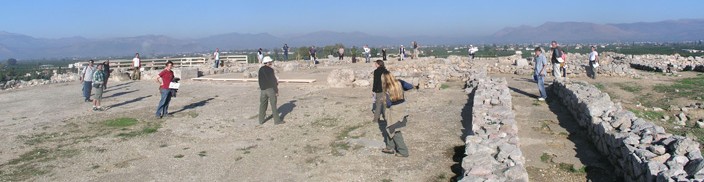
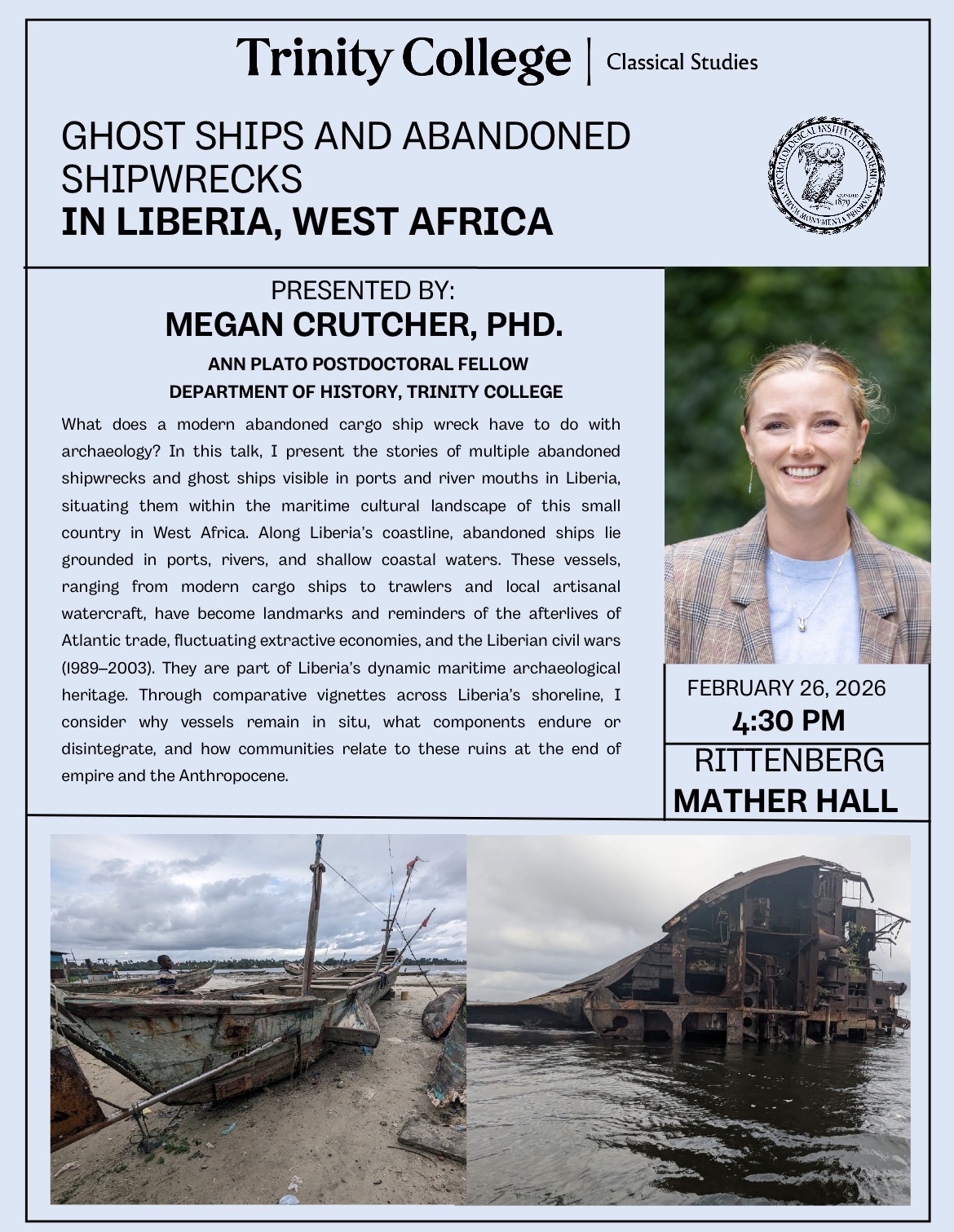
Liberia is primarily known as the first African nation to free itself from colonization, but in Dr. Crutcher’s presentation on February 26th, she discussed in depth how modern cargo ship wrecks and ghost ships can provide useful information about the area’s archaeological history. In her talk, Dr. Crutcher said, “Liberia is inherently a maritime country with a maritime history,” an aspect of archaeology that is often underrepresented and underresearched in of more land-based sites. She continued in depth about the different kinds of shipwrecks and what information each can give, and even gave specific examples of ships that have crashed or gone missing in the area. Dr. Crutcher ended with how these findings and the relatedresearch affected the growth of Liberia as a country and how it continues to affect Liberia today. More on her research can be found here. We at the Trinity Classics department are very grateful for her insights and for giving such an in-depth and informative presentation.
Screenshot
Professor Brown, a visiting assistant professor in the Classical Studies department, gave a talk at the Society for Classical Studies’ 157th annual meeting in San Francisco, CA, in January. Professor Brown spoke about books ten and twelve of Martial’s Epigrams during a panel on urban ecology in the Roman Empire. Martial was an ancient Roman poet, born in what is now Spain, who worked between 86 and 103 CE. He published books ten and twelve under the emperor Trajan. Her main discussion point was on how Martial viewed his own ability to work as a poet and create art in the city of Rome compared to in his home in the more rural areas of Spain. Martial is somewhat conflicted in these two books over whether the restrictive patronage system and the constant noise of urbanity can make up for the lack of people and things to write about in the countryside. Epigrams are traditionally about people, usually making jokes or comments about the lives and habits of others, so a knowledge of the social scene and a large audience is usually required. While Martial describes Spain using a lot of imagery surrounding the mythical golden age of the titans, when sheep changed the colors of their wool freely and plants grew without needing to be cultivated, he does not find this metaphorical poetic cultivation to be available in a place that has no one to write about in his primary style, the epigram. During her time at Trinity, in addition to teaching many interesting classes covering a wide array of Classical subjects, Professor Brown is also working on a book covering Martial’s descriptions of monuments.