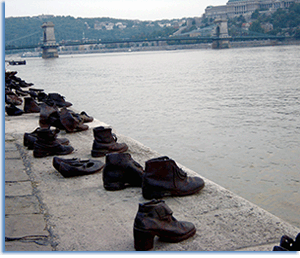
James Grossman, executive director of the American Historical Association, recently wrote a piece musing on what he called “the vexed relationship between history and memory.” In a visit to Hungary he realized that all the museums and monuments he visited focused on victims rather than perpetrators and began thinking about “the implications of a politics of nationhood that relies on victimization as its central theme.” As he notes, it allows Hungarians to avoid any responsibility for what was done, from participation in the killing of Jews during WWII to collaboration with the Soviets I oppressing their countrymen during the Cold War. He then considers how Americans depict our own history – are we focusing on victimization too, thus avoiding responsibility for evil actions of our past – Prof. Cheryl Greenberg (History Dept.)
“Tragedy, Memory, History” By James Grossman: On the east bank of the Danube, a few hundred yards south of the grand halls of the Hungarian Parliament, lies a memorial that should attract the attention of any historian interested in memory, tragedy, and sheer inhumanity. Sixty pairs of shoes, cast in iron, affixed to the concrete pathway. Walking along, slowly, I counted only 115 shoes, not all in pairs. Perhaps I miscounted, though in general, the information I subsequently pieced together on the web was anything but definitive.But that ambiguity befits this monument. An evocative work of art that ought to attract more attention from tourists, the shoes are part of a contested history. They commemorate the thousands of Hungarian Jews murdered by other Hungarians in 1944–45—many of them shot at the riverbank, thus saving the trouble of burial as the bodies fell into the river. The shoes? Removed because they were valuable—more valuable than the lives of the victims. That’s the crucial word: victims. The individuals who shot these innocent men and women on the river’s edge are invisible. Both “history” and “memory” engage more comfortably with victims than with perpetrators. It’s easy to identify victims, to sympathize, and to condemn their victimization. Here, Budapest, a “lovely city with a grim history” (as one of my more knowledgeable colleagues puts it), offers a provocative laboratory. The city’s strategic location and the political geography of European conflicts, has, for a millennium or more, repeatedly placed its people and its landscape amidst the horrors and cruelties of war and occupation. It is not a history I know well. I could enter into it only as a curious tourist.”
(source: James Grossman, “Tragedy, Memory, History.” Perspectives in History (October 2012))
Read entire essay HERE.