Archive for the ‘Audubon’ Category

“This little bird so much resembles the young of that called, I know not why, the Blue-eyed Yellow Warbler, that I was at first inclined to think it the same; but, recollecting that the latter acquires the full colouring of its plumage, in both sexes, before the return of spring, and finding some material differences in their habits, I have not hesitated in presenting it to you, kind reader, not only as a new species, but as one extremely rare in the United States.

I shot two of these birds in May 1821, near the town of Jackson, in the state of Louisiana.  They were sitting amongst the stalks of the plant, on which they are represented . . . I shot both the parents, and took the young under my care, but they would not receive any food, and died towards the end of the second day after their removal.  I have never seen another of these birds since.

. . . The plant is known by the name of the Wild Spanish Coffee.  It grows very abundantly in almost every field in the Uplands of Lower Louisiana.  The smell of its flowers, as well as of its leaves, is extremely disagreeable, if not nauseous.”

–J. J. Audubon, Ornithological Biography, I (1831), 180 [excerpted].

21
May

Commencement crowd!

   Posted by: rring

Thanks mostly to the enthusiastic comments made by President Jones during Commencement weekend, we had over 100 visitors to the Watkinson on Saturday to see the recently acquired “Second Folio” of Shakespeare.  We don’t often see people literally lining up to see our books, but it is entirely gratifying.

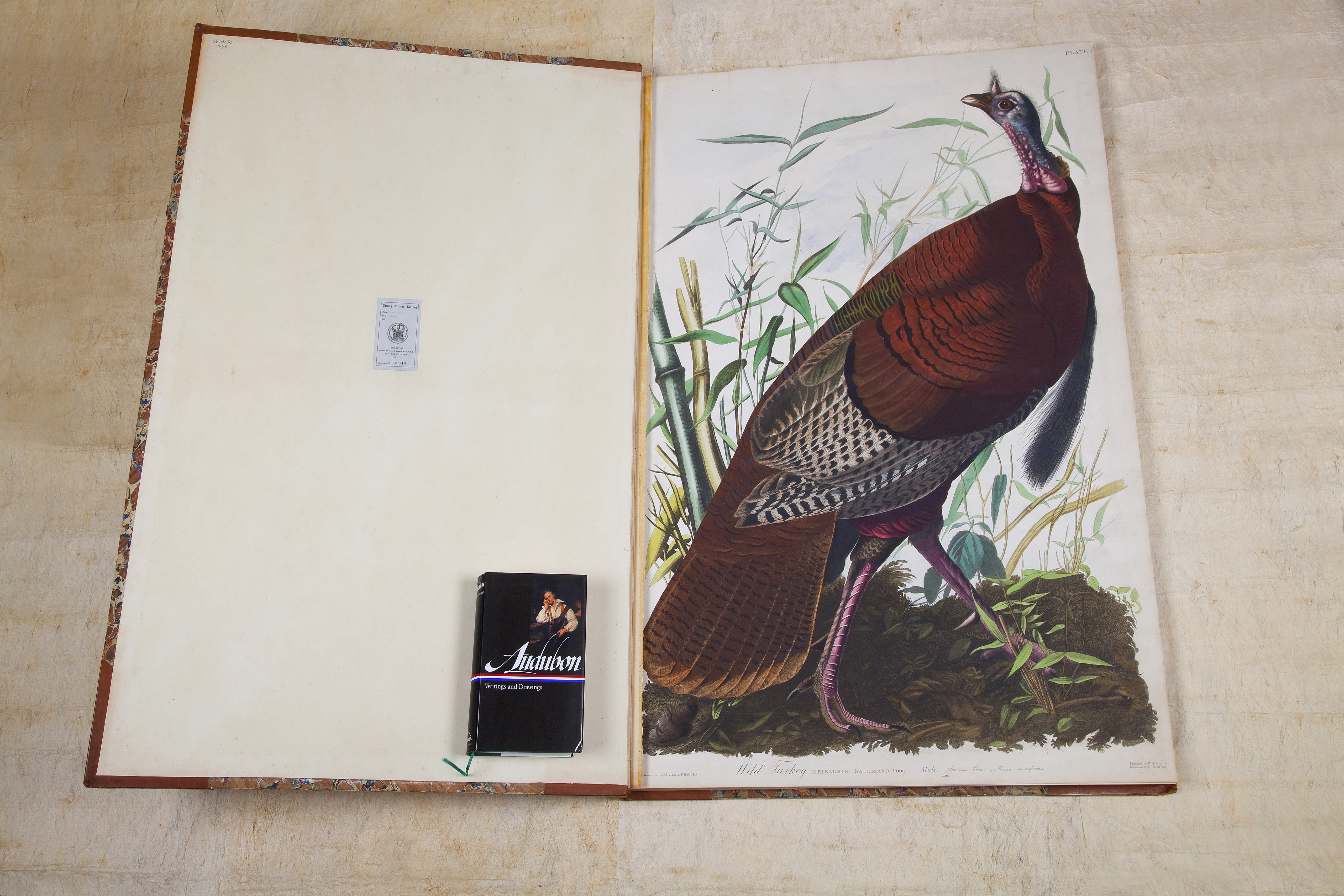
Folks also were impressed by our marvelous copy of John James Audubon’s Birds of America, which is on permanent display (we turn the page to show a new bird every week).

Other items which I brought out for the day included two engravings on copper sheets which were used to illustrate Prideaux John Selby’s Illustrations of British Ornithology (published 1834-39), which were placed alongside the book itself.  Selby was a contemporary of Audubon, and the two ornithologists compared notes and shared insights when the latter was at work in England.

Parents and students appreciated the current exhibition, Drawing Birds, which features sketches done by students last semester for Devin Dougherty’s Studio Arts class (Drawing I), especially as they noticed the work of friends and classmates.

“The nest of this active little bird is formed of singular materials, being composed externally of dried mosses and the green blossoms of Hickories and Chestnut-trees, while the interior is prettily lined with fine fibrous roots, the whole apparently rather small for the size of the occupants . . .

It is an inhabitant of the interior of the forests, and is seldom found on the borders of roads or in the fields. In spring they m0ve in pairs . . . [and] are ever amongst the decayed branches of trees or other plants, such as are accidentally broken off by the wind, and are there seen searching for insects or caterpillars.

. . . This species reaches the Central Atlantic Districts in the middle of May, and breeds there, as well as farther northward.  I have found them more numerous in the Jerseys than in any other portion of the Union.  In Kentucky and Ohio I have seen only a few of them; nor have I ever found their nests in either of these states.

The plant on which you see a pair of Worm-eating Warblers is well known throughout the United States by the name of Poke-berry.  It grows in every situation, from the tops of the most arid mountain-ridges to the lowest and richest valleys; and it is almost impossible to follow a fence for a hundred yards without seeing some of it.  Its berries are food for numerous species of our birds, and produce a beautiful dark crimson juice, which is used instead of red ink by some of the country people, although it does not retain its original colour for many days.  This plant grows to a height of four or six feet, and is eaten when it first shoots from the ground as a substitute for asparagus, quantities of it being not infrequently exposed in the markets.  The juice of the berries is taken in cases of ague and continued fever, but requires to be used with judgment, as too large a dose proves deleterious.”

–J. J. Audubon, Ornithological Biography, I (1831), 177-178 [excerpted].

. . . A few breed in Kentucky and the State of Ohio, but the Middle Districts are their principal places of resort during summer, although they extend their migrations to a high latitude.

. . . So fond of each other’s company are they, that a party of them passing on the wing will alter its course at the calling of a single one perched on a tree.  This call is uttered with much emphasis . . . no sooner has the flock, previously on wing, alighted, than the whole party plume themselves, and then perform a little sweet concert.  So much does the song of our Goldfinch resemble that of the European species, that whilst in France and England, I have frequently thought, that they were the notes of our own bird which I heard.

. . . In ascending along the shores of the Mohawk river, in the month of August, I have met more of these pretty birds in the course of a day’s walk than anywhere else . . . for a considerable space along the Gennessee river, the shores of Lake Erie, Lake Ontario, and even Lake Superior, I have always seen many of them in the latter part of summer.

–J. J. Audubon, Ornithological Biography, I (1831), 172-174 [excerpted].

” . . . The woody sides of the sea are the places to which this species usually resorts.  It passes from the south early in March, and continues its route through Florida, Georgia, and all the other States verging on the Atlantic, beginning to rest and to breed in North Carolina, and extending its travels to the province of Maine.

. . . the most remarkable distinction between this species and the Yellow-billed Cuckoo is, that the former, instead of feeding principally on insects and fruits, procures fresh-water shellfish and aquatic larvae for its sustenance.

. . . It being so scarce a species in Louisiana, I have honoured it by placing a pair on a branch of Magnolia in bloom, although the birds represented were not shot on one of these trees, but in a swamp near some, where the birds were in pursuit of such flies as you see figured, probably to amuse themselves.”

–J. J. Audubon, Ornithological Biography, I (1831), 170-171 [excerpted].

“The figure of this noble bird is well known throughout the civilized world, emblazoned as it is on our national standard, which waves in the breeze of every clime, bearing to distant lands the remembrance of a great people living in a state of peaceful freedom.  May that peaceful freedom last forever!

[there follows a vivid and dramatic account of an eagle hunting a swan, an many observations of their habits]

. . . Before steam-navigation commenced on our western rivers, these Eagles were extremely abundant there, particularly in the lower parts of the Ohio, the Mississippi, and the adjoining streams.  I have seen hundreds going down from the mouth of the Ohio to New Orleans, when it was not at all difficult to shoot them.  Now, however, their number is considerably diminished . . .

In concluding this account of the White-headed Eagle, suffer me, kind reader, to say how much I grieve that it should have been selected as the Emblem of my Country.  The opinion of our great Franklin on this subject, as it perfectly coincides with my own, I shall here present to you. ‘For my part,’ says he, in one of his letters, ‘I wish the Bald Eagle had not been chosen as the representative of our country.  He is a bird of bad moral character; he does not get his living honestly; you may have seen him perched on some dead tree, where, too lazy to fish for himself, he watches the labour of the Fishing-Hawk [i.e., the Osprey]; and when that diligent bird has at length taken a fish, and is bearing it to his nest for the support of his mate and young ones, the Bald Eagle pursues him, and takes it from him.  With all this injustice, he is never in good case, but, like those among men who live by sharping and robbing, he is generally poor, and often very lousy.  Besides, he is a rank coward: the little King Bird, not bigger than a Sparrow, attacks him boldly, and drives him out of the district.  He is, therefore, by no means a proper emblem for the brave and honest Cincinnati of America, who have driven all the King Birds from our country; though exactly fit for that order of knights which the French call Chevaliers d’Industrie.'”

–J. J. Audubon, Ornithological Biography, I (1831), 160-168 [excerpted].

26
Apr

Happy Birthday, Audubon!!!

   Posted by: rring

One of our new “regulars” from the area who comes in every week to see the new bird reminded us that on this day 227 years ago (April 26, 1785) John James Audubon was born.

Here is “Plate #1” which was on display all summer and which started our page-turning exhibiton. If you look closely, you can see the Library of America edition of Audubon’s works, a normal-size book, for scale.

“I regret that I am unable to give any account of the habits of a species which I have honoured with the name of a naturalist whose merits are so well known to the learned world.  The individual represented in the plate I shot upwards of twenty years ago, and have never met with another of its kind.  It was in the month of May, on a small island of the Perkioming [i.e. Perkiomen] Creek, forming part of my farm of Mill Grove, in the State of Pennsylvania.  The bird was fluttering amongst grasses, uttering an often repeated cheep.

The plant on which it is represented is that on which it was perched when I shot it, and is usually called Spider-wort.  It grows in damp and shady places, as well as sometimes in barren lands, near the banks of brooks.

–J. J. Audubon, Ornithological Biography, I (1831), 153 [excerpted].

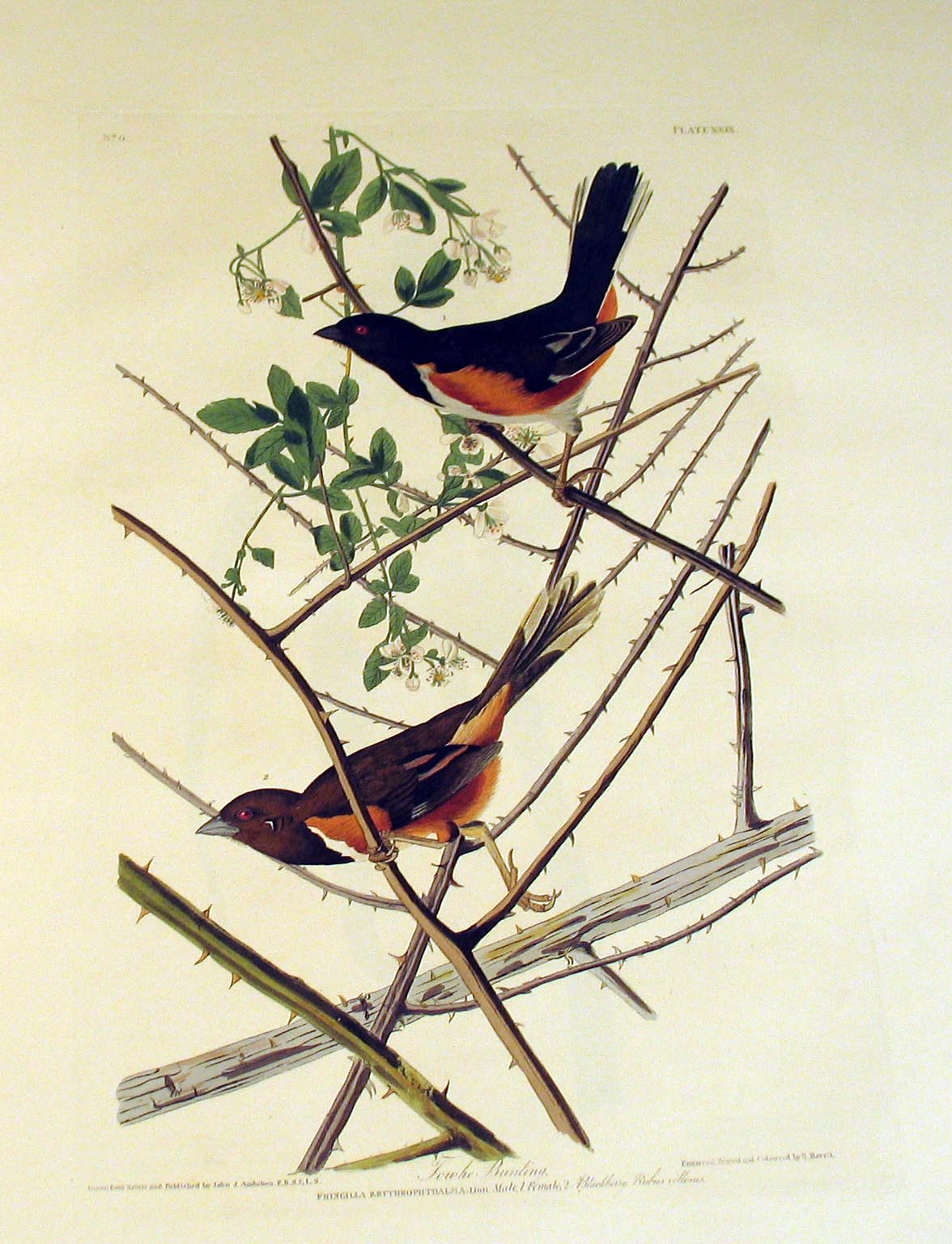
“The flight of the Towhe Bunting is short, low, and performed from one bush or spot to another, in a hurried manner, with repeated strong jerks of the tail, and such quick motions of the wings, that one may hear their sound, although the bird should happen to be out of sight . . . it is a diligent bird, spending its days in searching for food and gravel, amongst the dried leaves and in the earth, scratching with great assiduity, and every now and then uttering the notes tow-hee, from which it has obtained its name . . .

The favorite haunts of the Towhe Buntings are dry, barren tracts, but not, as others have said, low and swampy grounds, at least during the season of incubation. In the Barrens of Kentucky they are found in the greatest abundance . . .

They generally rest on the ground at night, when many are caught by weasles and other small quadrupeds. None of them breed in Louisiana, not indeed in the state of Mississippi, until they reach the open woods of the Choctaw Indian Nation.”

–J. J. Audubon, Ornithological Biography, I (1831), 150-151 [excerpted].

“This, reader, is one of the scarce birds that visit the United States from the south, and I have much pleasure in being able to give you an account of it, as hitherto little or nothing has been known of its history.

It is an inhabitant of Louisiana during the spring and summer months, when it resorts to the thick cane-breaks of the alluvial lands near the Mississippi, and the borders of the numberless swamps that lie in a direction parallel to that river . . . In the month of May 1809, I killed a male and a female of this species, near the mouth of the Ohio, while on a shooting expedition after young swans.  The following spring, I killed a female near Henderson in Kentucky. In 1821, I again procured a pair, with their nest and eggs, near the mouth of the Bayou La Fourche, on the Mississippi, and since that period have killed eight or ten pairs . . .

The manners of this bird are not those of the Titmouse, Fly-catcher, or Warbler, but partake of those of all three.  It has the want of shyness exhibited in the Red-eyed and Yellow-throated Fly-catchers.  It hangs to bunches of small berries, feeding upon them as a Titmouse does on buds of trees; and again searches among the leaves and along the twigs of low bushes, like most of the Warblers.  On the other hand, it differs from all these in their principal habits.  Thus, it never snaps at insects on the wing, although it pursues them; it never attacks small birds and kills them by breaking in their skulls, as the Titmouse does; nor does it hold its prey under its foot in the way of the Yellow-throated Fly-catcher or Vireo, a habit which allies the latter to the Shrikes . . . I have never heard it utter a note beyond that of a querulous low murmuring sound, when chasing another bird from the vicinity of its nest.”

–J. J. Audubon, Ornithological Biography, I (1831), 147-148 [excerpted].